

to paint this picture of the Playhouse on plywood for our second wedding anniversary.
SEASON THREE, 1974
Season of Shows The Company
Harvey Bill & Shari Murphy (Harper) Coote
What the Butler Saw John & Judy Porter Hennen
Bell, Book, and Candle Al & Tommie Martin
Angel Street Norma Stone
See How They Run Rich Ferguson
A Thousand Clowns Tom (T.C.) Cervone
A Girl Could Get Lucky Mary K. Hervey DeGarmo
Born Yesterday Jo Lynne Nugent
Marqueta Stephens

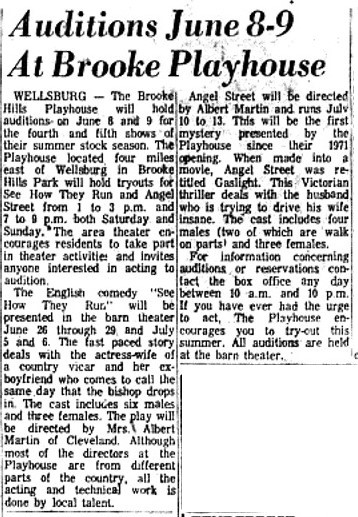
Steubenville Herald Star on June 2, 1974, just before the season opened.
AN 8-SHOW SEASON! WHAT WERE WE THINKING?
I have no recollection of how or why we decided to do EIGHT shows in the third season. It was very ambitious, and I think it almost killed us! The only thing that made it a little easier was that we did no musicals. The very first show we ever did (back in 1972) was the musical You’re a Good Man, Charlie Brown. In the middle of the second season, we produced The Fantasticks.
Musicals are a lot harder to produce than comedies or dramas because, well, music! You now have to add a musical director, musician(s), and often a choreographer, and most musicals have larger casts. The royalties for musicals are also a lot higher than for comedies or dramas, and money was always tight in those first years. Additionally, the royalties and rental fees for musicals have to be paid IN FULL BEFORE the scripts and musical scores are sent to the theatre. The scripts for plays are significantly cheaper and can be bought in advance, and play royalties are due just shortly before the play opens. Of course, we eventually learned that musicals usually made more money at the box office and brought in larger audiences. In 1974, however, we hadn’t learned that!
STANLEY’S MAD DASH
Stanley Harrison, our acting and directing professor at West Lib, was the consummate professional. He would be in two shows this season, and he always had to go to the bathroom before going on stage. Having no backstage toilet in those first seasons (just a sink in the men’s dressing room that the men had to share with the women in the casts), Stanley would watch through the knothole in the big, toolroom door that led to the lobby. When all of the audience members were heading upstairs, he would dash across the lobby to the public restrooms, dash back to the dressing rooms, and then up the very steep back stairs to the stage for his entrance.
Finally, in 1975, I think, we built a bathroom for the casts by carving out a corner of the kitchen/tool room. A large sign over the door proclaimed, “The Stanley Harrison Memorial Toilet!”
For some reason, cast and staff members started writing memories on the walls of the toilet stall. It was nice having a few laughs and memories while one was in there. Over the years, when staff or cast members returned to the area and stopped by to have a visit, they often visited the stall to see something they’d written or some of the new additions.
Sometime after I left the Playhouse in 1995, staffer Mary Freshwater (1982, 1983, 1984) sadly reported that on a recent trip to the barn, she had visited the hallowed stall, and the old graffiti had been painted over. Her heart was broken!
THEATRE IN THE WILD, PART 2

was never used. We don’t seem to have any other photos from Harvey. Sigh…
We opened the 1974 season with Harvey, that old chestnut about a milquetoast of a guy named Elwood P. Dowd who lives with his sisters and has a 6’ tall, invisible rabbit, a pooka, named Harvey for his best friend. Stanley Harrison was playing Elwood and was alone onstage at the end of Act I. Elwood had a few lines indicating that he needed to find Harvey and was about to exit before lights out when a cat leaped onstage, walked over to a chair downstage right on the set, jumped up into the chair, and made himself comfortable.
Stanley was not about to be upstaged by a cat, so he crossed over to the chair, picked up the cat, carried the cat to center stage, looked directly at the audience, and said, “Maybe he…” Here he turned the cat over, looked at his underside, and continued, “…maybe SHE knows where Harvey is!” EXIT. Huge laugh.
During intermission and after the show, people wanted to know how we got that cat to do that every night! If they only knew. It was just a wandering stray! The cat continued to hang around, but he/she (?) never appeared onstage again. At the end of the season, Tommie Martin named the caramel-striped cat “Barney,” which was so appropriate. A director, she often conducted rehearsals in the lobby with Barney on her lap. At the end of the season, Tommie and Al took Barney home to Cleveland with them where Barney lived 14 more years!
WHO KNEW A RUBBER GLOVE COULD BE SOOOO FUNNY?
We also did a crazy show called What the Butler Saw during the 1974 season. There was no butler or even a hint of a butler in the show which took place in a doctor’s examining room/office, a part of a private mental clinic.
Downstage left was the doctor’s desk and up center was an alcove that housed the examining table with the alcove opening covered by curtains that closed in the middle and were on a sliding track. Stanley played a doctor with a wandering eye, and Linda Huggins played an innocent woman applying for a secretarial position. Judy Hennen played Stanley’s wife.
The show opened with Linda being interviewed for a job. After some romantic double entendres, Linda was reluctantly sent upstage to the alcove to undress for an “examination.” Stanley, meanwhile, crossed downstage to his desk with a big, lascivious grin on his face and proceeded to put on green surgical gloves, unzip his fly, and lower his pants when Judy, his suspicious wife, entered up right. Stanley whipped around, saw Judy, and said something very loudly, like “Hello, darling,” to warn Linda (who popped her head out of the curtains). Turning to face downstage, Stanley pulled up his pants and zipped his fly.
Unfortunately, the tip of his left index finger glove got caught in his fly! He pulled his hand away and the finger just stretched out like this long, green, stretchy thing attached to at his fly. Big laughs. Even bigger laughs when he moved his arm in and out, to and from his fly a couple of times.
Linda and Judy were on the verge of breaking up in laughter with the audience, and who could blame them? Stanley was moving here and there trying to get the zipper to go down and release the glove finger, and frantically looking for a solution. Somehow, he spotted a pair of scissors on the desk (that were there for set dressing and not a part of the plot). He pulled his hand out from the zipper and snipped off the finger of the glove. Now, he had a green rubber finger-thing hanging from his fly, and everyone in the audience, backstage, and on stage cracked up. Composure eventually prevailed. Stanley got the finger-thing out of his fly, and the show went on. He was very careful with those gloves and his zipper from that night on!
How I wish there were photos of Stanley and the cat and Stanley with the rubber finger hanging from his fly!
THE ORIGINAL GASLIGHTING
Part 1: Saved by God and John
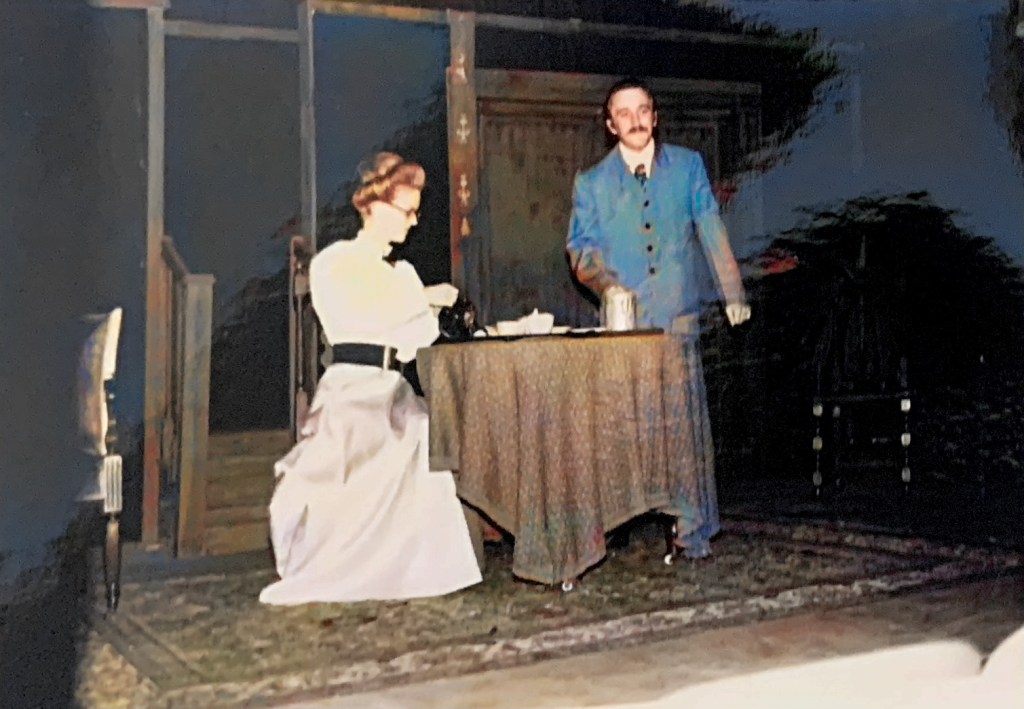
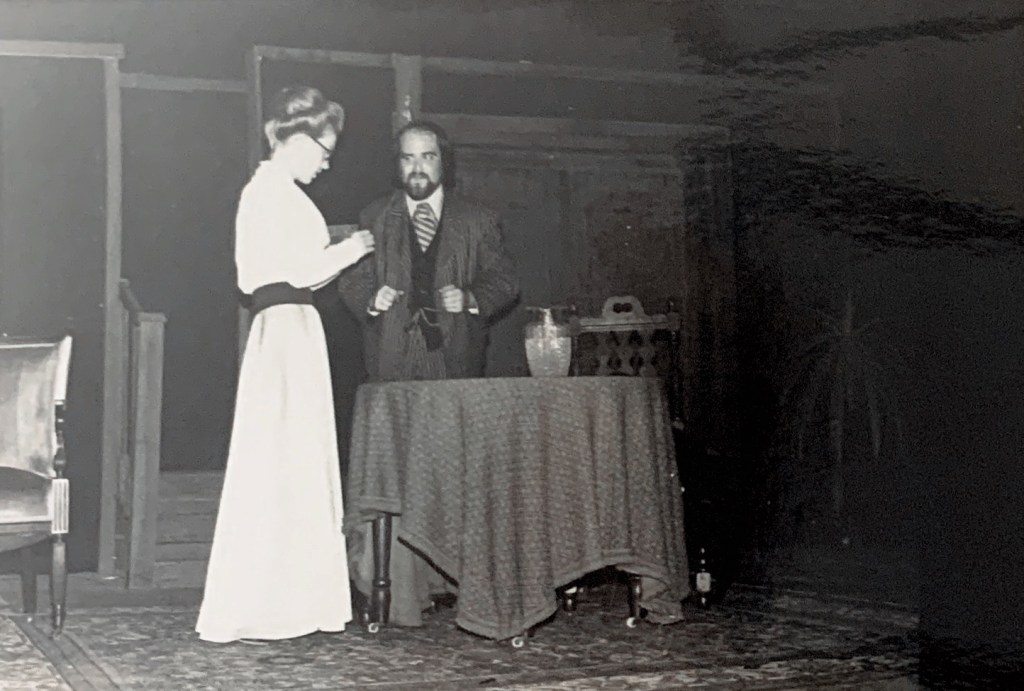
We also did Angel Street in the third season. Written in 1938 and made into the movie Gaslight in 1944, Angel Street was a huge hit for us. The show took place in a Victorian drawing room with a fireplace down right, staircase up right, arched entrance with pulled back, floor-length curtains up left, desk down left, antique settee, side table, and armchair right center, on an oriental rug.
There was a gaslight chandelier and gaslight sconces flanking the fireplace. More gaslights were on the landing, in the hall outside the arch, and on the wall behind the piano. It was a lovely set—dark, brooding, and so perfect. Every day with a performance, one of the staff would polish (not just dust) the furniture and vacuum the rug! The furniture, chandelier, sconces, rug, and andirons came from my Aunt Alice and Uncle Bob’s garage. Our crew had moved the furniture from their basement to the garage out of harm’s way during the 1972 flood. Now some of the lovely pieces we had saved were gracing our stage.
At the Sunday afternoon rehearsal of Angel Street before its Wednesday opening, the guy playing the evil husband just upped and quit. The guy was still holding onto his script for dear life days after the rest of the cast was off book. I think it had become apparent to him that he couldn’t memorize lines and wasn’t meant to act. That left us with a big problem, even though we had kind of seen this coming. It was decided on the spot that John Hennen would take over the role, a role he really should have had from the get go.
The rest of the cast was very supportive of John, and they did everything they could to help him out. John would study and study his lines, and Judy ran lines with him hour after hour. Wednesday, opening night, arrived. John was noted for his horrible stage fright up to the moment he walked onstage when it seemed to miraculously disappear. John started drinking Maalox straight from the bottle. He ran lines all day and went through his blocking on stage as the crew put the finishing touches on the set.
The weather had been gray and grim all day, and at 6:00 p.m., a massive thunderstorm blew in. It wasn’t long before the electricity went off. We called the Drover’s Inn and learned that the power was out all up and down Washington Pike. At 7:00 p.m., as usual, the cast began getting into makeup and costumes by candles and flashlights.
By 7:30 p.m., audience members were milling about our open-air lobby with no lights on. Norma was sitting in a dark box office with a flashlight. We were at a loss as to what to do. The audience was patient as they waited for us to make a decision. Meanwhile, John was in the dressing room praying for the electricity to stay off!
Finally, at 8:20 p.m., much to our chagrin (and John’s relief), we canceled the evening’s show. The audience left; John breathed normally again; and a quick run-through was held for John’s benefit.
The next morning, we learned that canceling had been the right decision as the power hadn’t come back on until 12:30 a.m. Thursday morning. The show opened Thursday evening with John still drinking Maalox, but in lesser quantities, and the show, with its now-wonderful, actually perfect, cast was a resounding success.
Part 2: Nothing Like Audience Involvement
My favorite thing during each performance of Angel Street was this: Detective Rough, played by stalwart Rich Ferguson, would come to see the wife, Bella, played by Linda Huggins, each evening. Bella had hired Rough to help her determine whether or not she was going mad. (Bella’s devious husband (thankfully played by John Hennen) was in fact trying to drive his wife insane, and he was abetted by the pert housemaid, played by Judy Porter (Hennen). )
Bella had noticed that the gaslights in her home would dim shortly after her husband left each evening “for his club,” and they would flare back up right before he returned. Rough waited outside until after the gaslights dimmed, then he would enter to confer with Bella. On Rough’s third appearance, the gaslights came back up earlier than usual, meaning the husband would appear at any minute. Rough quickly exited, leaving his bowler hat behind in plain sight on the desk. Every single evening, on Rough’s quick exit, the audience would gasp, and you could hear them whispering, “His hat! He left his hat.” Once a woman just yelled out in anguish, “You forgot your hat!” It was great theatre. The audience was so involved.
Anyway, Rough would dash back on stage, grab his hat, and dash back out just in the nick of time. There would be a big collective sigh of relief from the audience, and someone might say, “Thank goodness!” or “That was close” out loud. To this day, I love that show!
THE SHOW WILL GO ON!
Near the end of the 1974 season, we produced a little 2-character comedy called A Girl Could Get Lucky. Marlene Marston Bringarder and Tom Ott were cast. One morning during the run of the show, Tom cut his parents’ grass and had a massive allergic reaction, swelling up like a bouncy house. By showtime, he was a little better, but his face, eyes, and lips were still bright red and big-time puffy.
Marlene said she’ll never forget answering the door to her onstage apartment with Tom standing there doing his best to not look miserable. Once onstage Tom summoned his reserve, and the two of them completed the show. By the next day’s performance, Tom was back to his normal size and feeling much better. Let no one say Tom isn’t a trouper!

in A Girl Could Get Lucky
THEATRE IN THE WILD, PART 3
The final show of the 1974 season was Born Yesterday and featured Judy Hennen as Billie Dawn, the lovable, showgirl airhead, played in the 1950 movie by Judy Holliday, and Jack Hunter as Harry Brock, the classless, millionaire, junk man, played by Broderick Crawford in the film. The action of the play takes place in the sitting room and bedroom of the swankiest penthouse suite of the most expensive hotel in Washington, D.C.
(PERSONAL NOTE: Doesn’t this speak volumes about the power or perhaps the wonderful mystery of theatre? The audience was sitting in a pre-Civil War apple barn outside of Wellsburg, West Virginia, but they were perfectly willing to believe they were observing the action in a fancy suite in Washington, D.C., even though the “walls” of the suite were made of black burlap framed by flimsy, painted 1”x3” pine boards. Just magical! –Shari)
During one scene, Jack and Judy were both on stage when this darling, little kitten wandered onto the set! The kitten had shown up at the barn about a week before, and Marquita, one of our crew members had adopted it. Somehow, the kitten had gotten up those steep back stairs from the dressing rooms and found a way to make an entrance!
I think the audience saw it first, but Jack picked right up on it. He rose and started blustering things like, “What the heck? What kind of a dump is this hotel anyway?” He crossed to the kitten and grabbed it with Judy saying things like, “Aw, Harry. Look how cute he is. Now don’t hurt him, Harry. Can I keep him?” Jack spit out, “No, you can’t keep him! What a dump!” Judy, “Now be careful with him, Harry.” Jack walked the kitten off stage and handed him to someone in the wings as the adlibbing continued. When Jack returned, he and Judy picked up where they’d left off and carried on. Once again people in the lobby at intermission were asking how we got that kitten to enter on cue each evening!
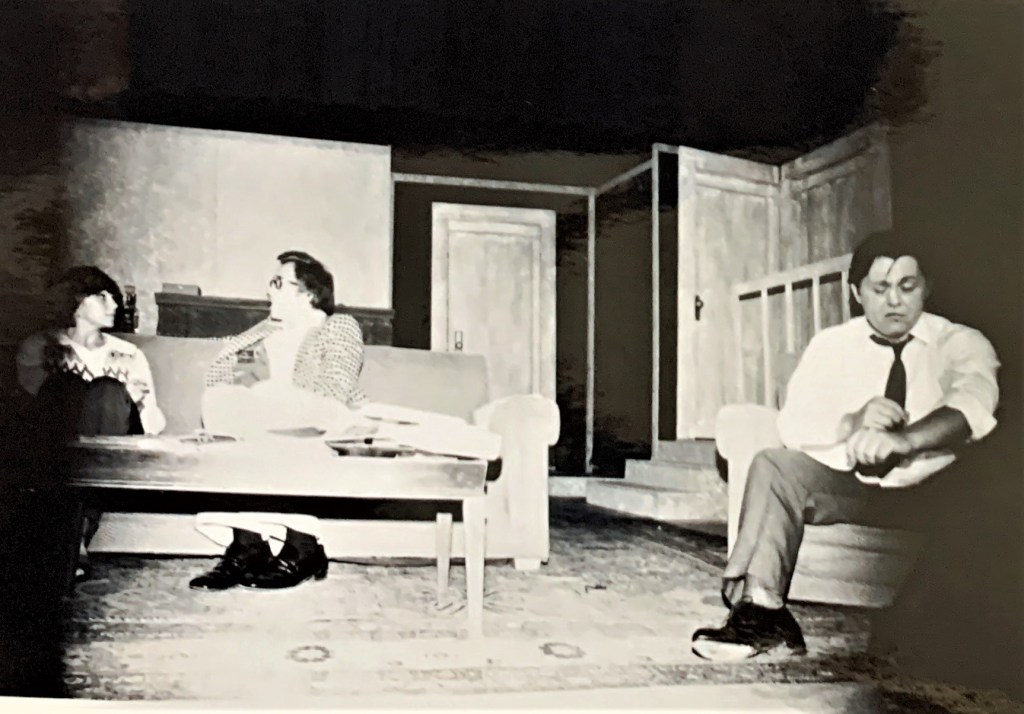
Note the framed, black burlap “walls” of the set.

Note that young Russ Hervey ran lights for the show,
and in between light cues, he played two parts!

 Life Without Lesson Plans
Awesome. Thank you,
LikeLike
Always good to hear from you, Bill. Will pass along your good wishes! –Shari
LikeLike