
by Shari Murphy Coote and Friends

Cover Sketch by Marlene Marston Bringardner. NOTE: The mime show, Tom Ott’s Circles of Silence, was added to the season after the program covers were printed. CHECK OUT THOSE ADMISSION PRICES!
Season Six, 1977
THE SHOWS
Fiddler on the Roof
Rated X-tra Special
Finishing Touches
Circles of Silence
Natalie Needs a Nightie
Veronica’s Room
Move Over, Mrs. Markham
My Fat Friend
I Do, I Do
THE STAFF
Mike Switalski
Bill & Shari Murphy Harper
John and Judy Porter Hennen
Al Martin
Norma Stone
Rich Ferguson
Mary Kay Hervey
Sharon Rush
Barb Pryor
Judy Freshwater
Jill Wiggins
AN OFFER WE COULDN’T REFUSE
Over the winter, Bill hired our paid staff members, Mike Switalski as designer and technical director, Sharon Rush, who did everything from gathering props to helping with scenery to running lights, Judy Freshwater to solicit program ads and do publicity, Jill Wiggins as a jack-of-all-trades, and Barb Pryor to run the box office. Previously, we had four to six “paid,” full-time staffers, so having only three completely dedicated to production was a little scary–Mike, Sharon, and Jill. In addition, our partner John Hennen and his now wife, Judy Porter Hennen, had moved to Charleston, W. Va. to take full-time jobs. (See Parts 3 and 4 of this Memoir.) Those two left a big hole in the manpower department! Both were wonderful actors and directors, but they also worked on everything from scenery to costumes, and they would be sorely missed.
Also, Al Martin’s wife Tommie had died over the winter, which meant we were lacking another director! Then we caught a break. John and Judy would be able to spend several weeks with us. John would direct one show, and Judy would perform in another.
Once again, we scheduled eight shows, but then one of our stalwart company members came to us with an offer we couldn’t refuse. Tom Ott had studied mime, and he offered to put on his mime show, Circles of Silence, on August 1, 2, and 3, the Monday, Tuesday, and Wednesday between the two weekends when Move Over, Mrs. Markham was running. So now, we were doing NINE productions in our 13-week season.

I guess we thought (incorrectly, as it turned out) that if we did more shows, we would appeal to more people and bring in more revenue. We were wrong! It was a good season, but we worked ourselves to death. I’m pretty sure that even with some big hits, we didn’t gross any more than fewer plays would have. And fewer productions would equal lower production costs. Honestly, we were still young and crazy!
After the 1977 killer season, we dropped down to doing six shows (some still ran for two weeks and some ran for one) for several years. Eventually, we came up with the excellent idea of doing five shows for two weeks each. That was a winner! We even had a “formula” for selecting the plays. We’d open with a big-cast musical, followed by small-cast comedy, followed by a mystery or large-cast comedy (often an old “chestnut” like George Washington Slept Here, The Solid Gold Cadillac, etc.), followed by a small-cast musical, and ending with a farce. That formula served us well for the rest of my time at the Playhouse.
BLIND-SIDED
We got a little gut punch right before we were about to announce our season lineup of plays at the beginning of 1977. Our teacher, mentor, and friend Stanley Harrison announced that he would be producing shows in the amphitheater in Oglebay Park about 18 miles from the Playhouse and just outside the much-bigger-than-Wellsburg, Wheeling, West Virginia. Stanley had been in a number of our shows in our first five seasons, and he was a Playhouse favorite on stage. It was a major surprise to learn that he was opening his own venue, Theater in the Park (TIP).
I know that Bill and I were a little shocked by the announcement, and I know a lot of other Playhouse personnel were shocked as well. Stanley certainly hadn’t told Al Martin, who had been a good friend of Stanley’s since Stanley’s undergrad days. When I told him, via a phone call, he said, “What the hell is he doing?”
Stanley had lined up the Wheeling Symphony and the resources of West Liberty State College (now University) Drama Department to provide production assistance. Believe me, we were fearful for the future of the Playhouse, and we were hurt that Stanley hadn’t told us of his intentions, which made the news even worse.

We did have a few things in our favor. We had a roof, and our shows would go on rain or shine. This was a little comforting. The amphitheater stage and audience were open to the elements. We had regular, fold-up theater seats with nice padding on the bottoms and backs, and we had armrests. The seats at Oglebay were wooden benches, like bleachers with two wooden slats for backs. Ouch! Of course, many people knew to bring a seat cushion. The amphitheater stage was concrete. This made stabilizing scenery very difficult, whereas we were able to stabilize our scenery by nailing it to our stage floor or the barn side walls. [Some of the sets at Oglebay did blow over during performances.]
Finally, the TIP crew would build the scenery in the theater shop at West Liberty, transport it to Oglebay, erect the set on the Oglebay stage, and cover it with plastic anytime rain was predicted. If the amphitheater was rented out for some other function, the TIP crew would have to take the set down, carry it around to the yard behind the brick wall that delineated the limits of upstage, and cover it with plastic sheets in case of rain. The entire process was going to entail lots of hard work for the crew. Our scenery stayed in one place, on the Playhouse stage, for the duration of the play’s run.
But what could we do? Not a thing. We announced our season, sent out newsletters, hired staff, and carried on as usual.
MIKE SWITALSKI REMEMBERS
Michael Switalski was a godsend for us. With a small paid staff, we were fortunate that Mike was not only a talented designer, excellent technical director, and a very good carpenter, but he could also act.
Mike came from a military family, but he claims Baltimore as home. After graduating from Frostburg State College in Pennsylvania, he received his M.A. from West Virginia University graduating in 1977, but not before interviewing with Bill Harper for the job of Designer/Technical Director for the Playhouse.

Mike said, “The day of my interview I met with Bill, he held up a blade with a handle at either end and asked if I knew what it was. I, in my most newly minted M.A. manner, simply stated, ‘Of course, that is a spokeshave.’ Bill said, ‘You’re hired.’ Just like that one of my fondest memories in theatre began. I was TD for the 1977 season which debuted with Fiddler on the Roof. I remember mounting 8 shows in 10 weeks.”
[NOTE: The shows ran for 10 weeks, but 3 weeks were built into the beginning of the employment term to get the Playhouse up and running—clean the barn from whatever surprises had accumulated over the winter, hold auditions, start rehearsals, build scenery, gather props, hang lights, etc.]
Mike really had to have it together for his summer at the Playhouse. Although we were short-staffed, Mike never complained. He just calmly explained what he wanted done and how he wanted it done (sometimes he had to do this more than once), and we all got down to work. Mike really knew what he was doing, and the sets went up and came down handily.
“The planning for the season and building it taught me my craft. Never had so few built so much for beer and cigarettes,” said Mike. I even was cast in that classic British bedroom farce Natalie Needs a Nightie. I created the memorable character of John Watson, the janitor who carried a toolbox with his initials J.W. painted on the side. I carried that toolbox for years.
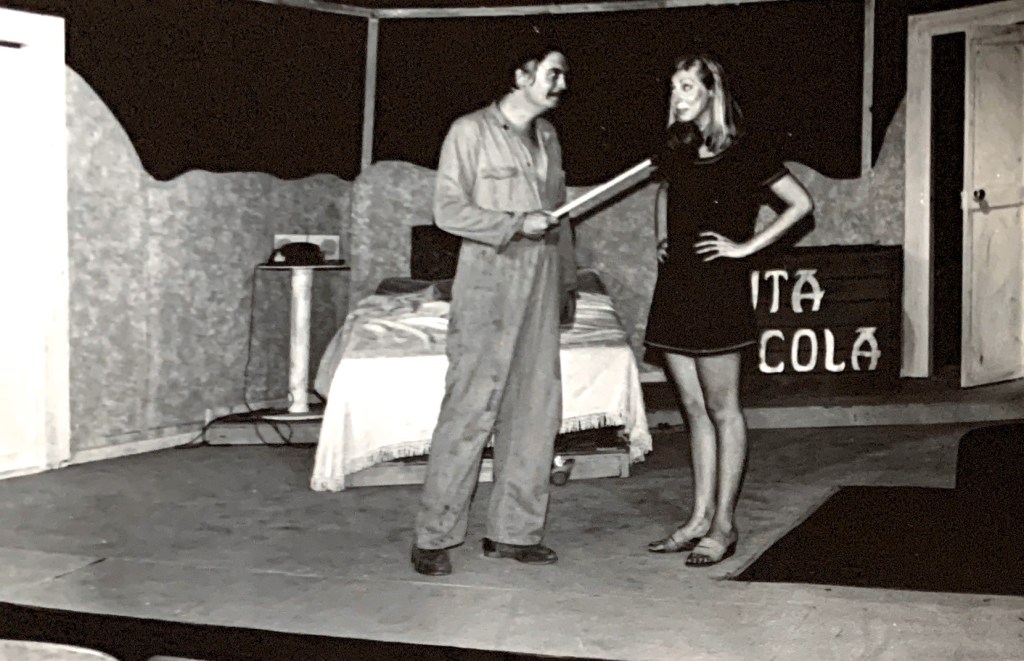
My dog Agatha was with me that summer. She would run around in the field beside the apple barn with only her tail as a flag giving away her location. When the season was over, I packed Agatha, my jeans, my books, and my tools in my ‘72 red, VW Bug and moved to Charleston. That’s another story of sex, drugs, and rock ‘n roll.”
In Charleston, Mike worked at the Cultural Center, and on the side, he designed, built, and acted in shows with the Kanawha Players, eventually becoming the President of their board.

After 20 years, Mike went to work for a Charleston lighting company doing industrial, commercial, and residential designs for eight years. That was followed by work at an architectural firm and Ticket Master. (“I kept myself in the entertainment business,” said Mike. “Incidentally, I was watching the screens in the office when the planes hit the Twin Towers on 9/11. Suddenly, all the screens went blank as the communication grid went down.”)
Mike returned to the Cultural Center as Tech Director and married Mary. They eventually moved to the D.C. area where Mike worked at the Woodrow Wilson International Center for Scholars as their A/V guy. Since retiring, Mike and Mary have lived in Canton, Ohio where Mike has performed with two community theatres.
“I have wonderful memories of my time at Brooke Hills,” said Mike. “It’s where I learned my craft. I braced the sets by nailing 1”x3”s from the back of the scenery to the barn walls. They were the strongest sets ever! One thing I will always remember is that I was hired for “$50-a-week-room-n-board-n-all-the-beer-you-can-drink.”

BANG! THE SEASON BEGINS
The 1977 season opened with Fiddler on the Roof. We could not have chosen a better season opener if we had tried for a decade. It was a huge hit, and just as importantly, the Playhouse gained a great multi-talented couple who became onstage favorites and dedicated offstage volunteers for over 20 years–Rick and Teresa Taylor. [NOTE: Much more about the Taylors in Part 15-B, the next post.]

I recently received this program insert from Chris Cipriani, who played Nachum, the beggar. Take note of these names. They made Playhouse history. After five seasons, we finally had a SELLOUT, STANDING ROOM ONLY! It was exciting beyond belief, jump-up-and-down exciting, whoop-and-holler exciting! A person enjoying the show in every one of the 220 seats and a few people sitting/leaning on the horizontal crossbeams along the barn’s side walls. The box office’s nightly reports are long gone, but Fiddler sold out many of its eight performances.

Now, this was the way to get things rolling! After the dud opening of the prior season, this was walking-on-cloud-nine intoxicating, and the best thing was that other shows in the season had sellouts as well. Lesson learned. Getting off to a good start set the tenor for the season. From 1977 on, we opened the season with a big musical—The Sound of Music, Oliver, The Music Man, My Fair Lady, etc.
[NOTE: It wasn’t long before we removed the front row of seats which was too close to the front of the stage. People with longer legs in that row would put their feet up on the stage, often distracting the actors. Later we added another two feet of space, a little “apron” in theater speak, to the front of the stage, and we again removed seats. When I left the Playhouse in 1995, there were 205 seats for the audience.]

“EVERYBODY FREEZE!”
Playhouse newcomer Rick Taylor played Tevye, and Playhouse veteran, Nancy Paull, played his wife Golde in Fiddler. Rick, a native of Washington, Pennsylvania, was a music major and recent graduate of West Liberty State College, who had been hired as the choral music teacher and assistant band director at Brooke High School in the fall of 1976. Norma Stone and I got to know Rick when we all three worked on the Brooke High musical that spring, 1977. Norma and I convinced Rick to try out at the Playhouse in the summer, as he had been in a couple of shows at West Liberty, and he was cast.
One night during Fiddler, it finally happened. It had been raining off and on all day. The barn had a good roof but not a perfect roof. (I think we had two leaks that required buckets, and neither leak was over the stage.) Sometimes, a few people with reservations wouldn’t show up on rainy nights but not on this night, not for Fiddler. Again, the house was packed. I don’t think this particular evening was a complete sellout, but it was only a few seats short of being one. At some point, it started raining again, and this time it was pouring with thunder and lightning. The cast was practically yelling to be heard above the rain on the corrugated steel roofing.
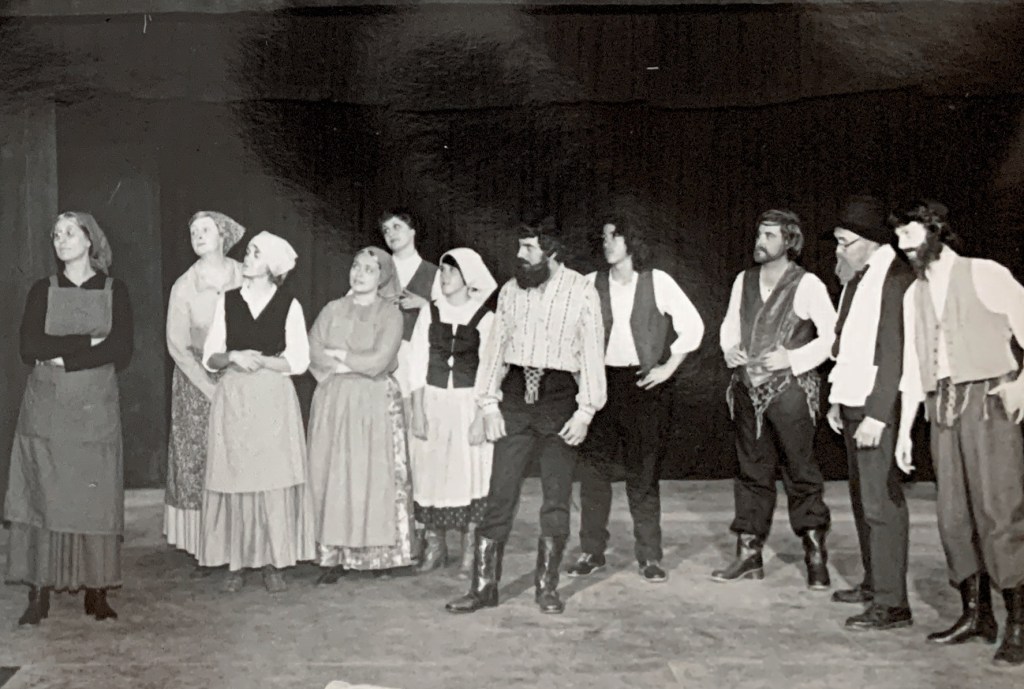
The Playhouse had been standing since before the Civil War, and I always figured that it was one of the safest places to be during a storm. But then it happened! The entire cast was on stage for a big number. There was a loud clap of thunder, and the power went out. Good grief, it was as black as pitch.
There was a huge collective gasp from the audience. Cell phones wouldn’t become ubiquitous for another 20+ years, so no one reached for the flashlight in their pocket. I was sitting in the last row of the house. I jumped up and yelled, “Everybody freeze! Just stay where you are, and we’ll see what happens.”
The audience breathed a sigh of relief. They started to relax and chat, and “wonder of wonders, miracle of miracles” within about 2 LONG minutes, the power came back on! The cast was exactly where they had been when the power went out. Using my director’s voice, I said, “Let’s start that number over again.”

The audience laughed. The cast moved back into place for the top of the song, and on they went. The rain soon quit, and the show was as wonderful as always!
The next day we got a phone call from John Paull, the President and CEO of Eagle Manufacturing in Wellsburg (now a division of Justrite Safety Group). John was also the husband of Nancy Paull who was playing Golde in Fiddler.
John hadn’t been at the previous night’s performance, but he learned from Nancy that the power had gone out during the show and how dark the barn was. He asked if we had any emergency lighting. Our only answer was that we had a couple of flashlights!
We had never given emergency lights a thought. John said that he had done some research and would like to purchase four emergency lighting units for us. A week or so later John stopped by the Playhouse on his way home from work and dropped off four lovely, two-lamp emergency lights.

We had to run some cables with outlet boxes to plug in the units, but they sat nicely on the little “shelves” formed by the horizontal beams alongside the barn walls and over the two back exits. Whenever the electricity went off (and it was rarely), the charged lighting units came on automatically, lighting the entire inside of the upstairs theater.
Those emergency lights were like gold on the few occasions when the power went out during a production. Each winter, we would take them down and store them off-site. I don’t know what they cost, but we didn’t want to buy replacements for them and their large rechargeable batteries!
ORIGINALS
We got a little frisky this season and produced two original shows, two shows with no royalty costs. Rated X-tra Special was a revue designed for a cast of 19 pre-teens and teenagers. Norma Stone took on the task of creating, directing, and choreographing the show, and Rick Taylor provided the musical direction. Rick, Norma, and I suggested skits for the kids to improvise between numbers. It was a delightful show, featuring a lot of talent from all over the Ohio Valley.
There were skits, solos, duets, quartets, and numbers featuring the entire cast. It really was a delightful show. I wish we had had a video camera in those days, because there was no script for posterity, so to speak. We discussed putting together a similar show in later years, but the task seemed too daunting. If we had a videotape, we could have easily repeated our earlier success. Kids have families, and families have friends. The audiences were large, but I don’t think it ever sold out. I could be wrong on that. After all, it was a big cast!


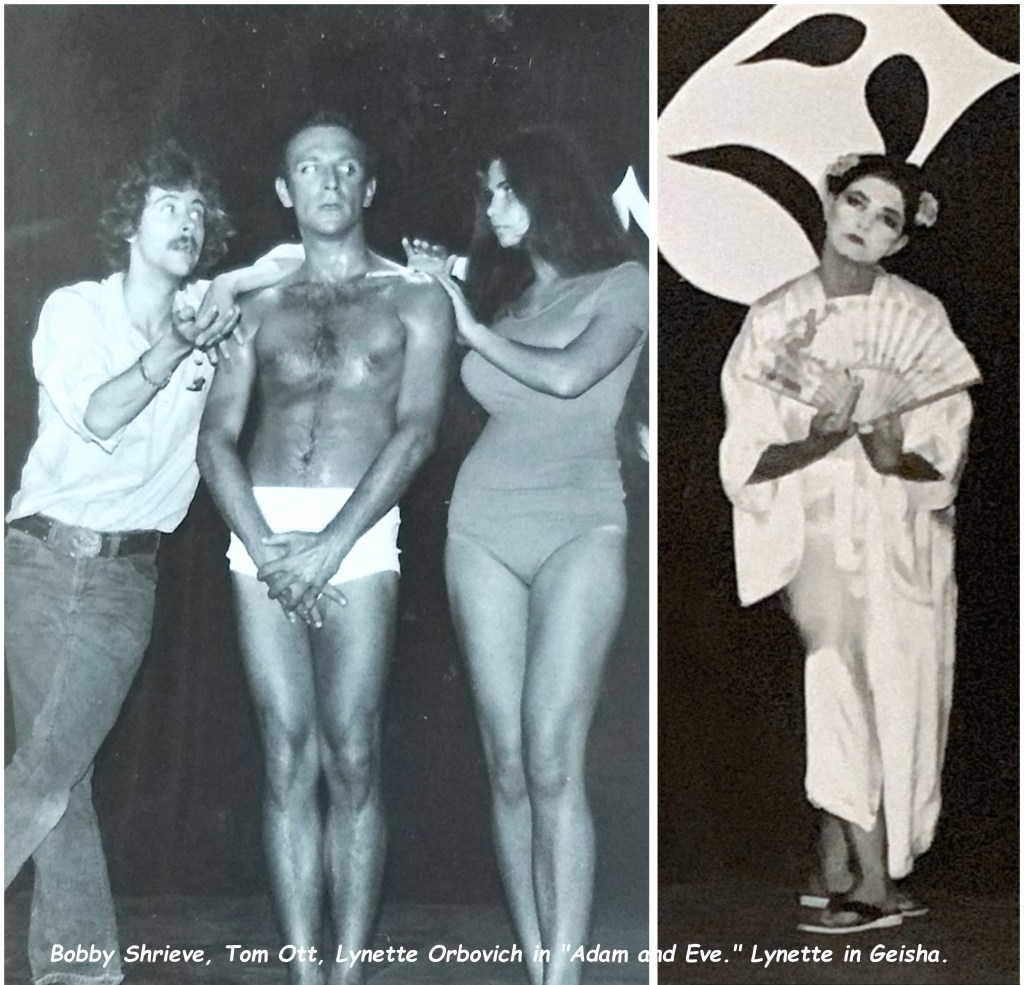
I’ve already mentioned Circles of Silence, the mime show conceived and headlined by Playhouse regular Tom Ott from Follansbee, W.Va. Tom recruited Lynette Orbovich of Weirton, W.Va., and Bobby Shreve, a former Playhouse designer and actor from Farmington, W.Va. to make up the cast. The show featured Tom’s mime prowess (and his great body! LOL!) and sketches hitting on such diverse topics as Adam and Eve in the Garden of Eden, The Glass Menagerie, and mime interpretations of poems.


THEATRE IN THE WILD, PART 4
This was the summer that we first produced the wonderful, British, farce Move Over, Mrs. Markham. Rich Ferguson played a rake in a proper suit and bowler hat, the picture of British propriety. The play required a split set, a raised bedroom on stage right, the living room of the luxury apartment which was undergoing renovations on stage right.

Rich’s character has borrowed the flat to use as a trysting place for an affair he is conducting. In this scene, he enters the empty flat and starts to tidy up and ready the flat for the arrival of his lover. Unfortunately, as Rich was scurrying around chilling champagne, arranging flowers, and testing the bed, a large black Labrador retriever wandered on stage through the apartment door which Rich had intentionally left ajar. Rich was not an “animal person.” In the back of the audience, I moved to the edge of my seat in horror when the dog from nowhere entered, trapping Rich (who was fluffing pillows in the bedroom) onstage alone with a rather large dog. The audience was enthralled at this plot twist.
Rich exited the bedroom crossing into the living area and stopped short when he saw the dog! The dog stopped, too. I can’t even imagine what Rich was thinking, but with the most staid and proper stance, he lifted his upstage arm in indignation, flexed his elbow, and snapped out his arm pointing decisively toward the door. That damn dog looked quizzically at Rich, standing there stolidly pointing, took a last look around, turned, and headed back toward and out the door! Richard most properly straightened his waistcoat and carried on in stoic British fashion with his assignation preparations. I think the audience was collectively thinking, “What did we just see?” I knew what I had seen, and I was in awe! Richard’s performance was inspiring, and thank goodness that dog was well-trained! I don’t think we ever discovered where the dog came from!
I LOVED IT!
Never for one minute did I ever consider directing shows. I had taken directing classes at West Liberty because I had to for my major, not because I wanted to. What I liked was designing and building sets and gathering and constructing props.
I started directing shows in 1976. Thank goodness I had saved my directing textbooks and all of my course notes! I read the book, probably for the first time, and got down to work. The first show I directed was a fluffy, little comedy (that’s probably been produced by every little theatre in the country) called Right Bed, Wrong Husband. My cast was very talented, cooperative, and helpful, and the audience got some good laughs. AND maybe more importantly, I discovered that I loved directing. At the end of the season, I also directed a fun, little musical, Dames at Sea, another all-star cast who had to spend a few weeks before rehearsals began taking tap dancing lessons!
Over the next 18 seasons, I directed 2-3 shows at the Playhouse each summer. Eventually, I was hired to direct shows at West Liberty State College (1 children’s show) and Wheeling Jesuit College (5 shows). Those all came with nice paychecks, as opposed to my Playhouse gigs which came with great friendships!
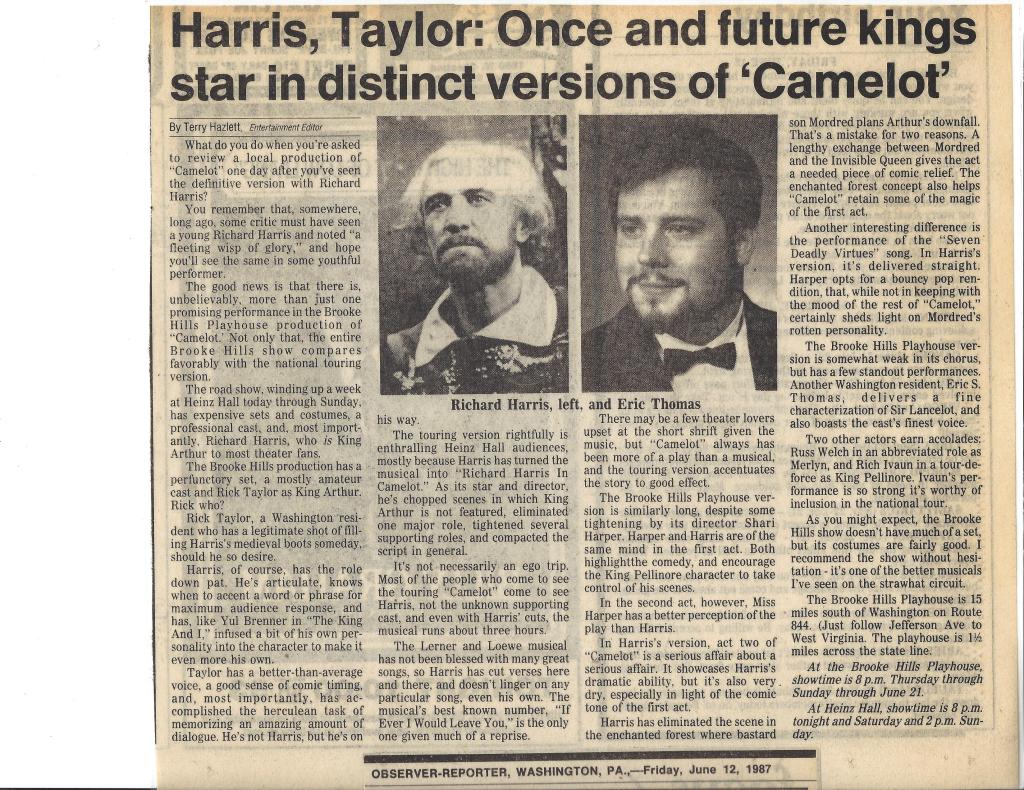
Emily Vulgamore Hores, a Playhouse regular, recently asked me to name the favorite musical I directed. In truth, I liked them all. I didn’t want to do Annie, let alone direct it. I thought it was too big for our stage. I ended up designing and directing it and ended up loving the show and set! I didn’t want to do They’re Playing Our Song. I can’t remember why, but I think it had to do with some of the technical tricks that the show required. I ended up designing and directing that show, too, and solving the technical problems, such as having a car onstage. I ended up enjoying that show, too. I wanted to do Camelot, but it scared me–so well-known, difficult music, lots of scenery, big-ish cast. I not only loved the show, but it’s the only show for which I kept a copy of a review.
Almost all of our shows were reviewed by area newspapers and radio stations. The Camelot review was different from those others in one special way. While we were doing this glorious show featuring lots of pageantry, royal costumes, and throne rooms in a barn in a little W. Va. park, Richard Harris (yes, that Richard Harris, winner of all kinds of acting awards, singer, Dumbledore, and so much more) was playing Arthur in one of the big, beautiful theatres in Pittsburgh! It was scary and humbling. Here’s the review from the Washington, Pennsylvania Observer-Reporter, June 12, 1987:
At the end of the summer season, our Camelot got another nod from the Washington paper. Check out #2:

I may not have a favorite musical, but I do have a favorite play. I directed The Best Christmas Pageant Ever at the Brooke County Museum around Christmas time three or four times. After leaving the Playhouse, I directed the show at my church in San Jose, California in 1996 and again at our church in Little Rock in 2002. In truth, I would direct this precious, little show every year from now on if someone would ask me.

CAROLE MIKITA REMEMBERS
I was able to locate Carole Mikita in 2021 through a Google search. I dropped her a line and heard back from her very quickly.

My Dear Shari,
How great to hear from you! Scott Martin had given me a “heads up” about this anniversary [50th season in 2021] for the Playhouse— remarkable!
I would love to see you, but our daughter, son-in-law, and 3 grandchildren who live in New York City will visit us this summer in Salt Lake City during that time.
I am happy to write about my memories. Thank you for asking!
And you made both me and my husband (Neil York) laugh about the sweat. It’s not true, but let’s keep that to ourselves. I have always told him, “I don’t sweat, I glisten!!”*
My career in TV news has been wonderful, and I’m still doing special projects. Neil, my husband, taught Early American History at Brigham Young University for 42 years and is now retired. Our younger daughter and her husband live in Park City, Utah, and my brother, Steve, just retired from the Attorney General’s office is in Salt Lake.
I was and am grateful to you for making me a part of a talented group of people, even for a short time!
Best wishes,
Carole
P.S. Please know that I now understand that you were a visionary in our arts community and a woman of infinite good cheer! That is impressive!
*[NOTE FROM SHARI: The “sweat story:” Finishing Touches ran July 7-10, 1977, and it was a horribly hot and humid weekend. One evening during intermission, I stopped by the dressing rooms to see how everyone was holding up. Bev DeBord, Carole Mikita, and Linda Huggins Smith were in the ladies’ dressing room stripped to their undies and fanning themselves trying to cool off before returning to the stage under the hot lights. Bev turned to Carole and announced, “I hate you.” Carole, Linda, and I were shocked beyond belief! Then Bev said, “You don’t sweat! You look as cool and collected as always while the rest of us are puddles slogging around the stage.” We all laughed and laughed and the three of them had to calm down because there was another act to go.]
CAROLE FOLLOWS UP
In 1977, I had just returned to Steubenville, Ohio to work for WSTV-TV, which is now WTOV). I graduated from The Ohio State University (Yes, you must say all four words!) with a degree in theatre; however, I was not fooling myself about my talent.
My parents had enjoyed productions at the Playhouse, had met Shari, and were impressed. They suggested I audition. I can still remember the first time I saw it, the barn. There is truly something magical about the place.
I auditioned for Fiddler on the Roof; however, no one has ever been
impressed with my singing, so…
That summer, I had the lead in Natalie Needs a Nightie, and I was also cast in Finishing Touches. What a wonderful group of people I spent my favorite hours with! Shari and Scott Martin and Bev DeBord, you are all so very talented and you invited me to join you!
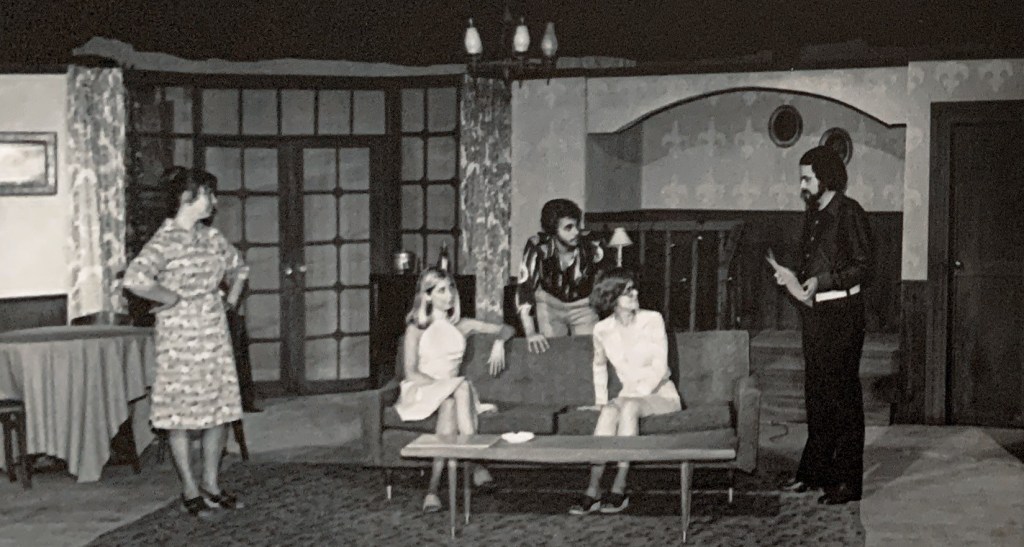
I do recall a heavy rain one evening and our acting then turned to “oration” to compete with the sounds from the tin roof. I asked someone in the audience afterward, “Could you hear us?’” The reply, “Some of it!”
In 1978, I had the lead in The Star-Spangled Girl, a three-character comedy by Neil Simon. I still laugh because I believe it was in this production that I was to exit through an upstage door, but the doorknob came off in my hand. For some unknown reason, I stuck it in my pocket!
When Scott and David Woodrow found me still on stage, their facial expressions reflected complete surprise. I did something ridiculous like shrug my shoulders, and they did some fast improvising. I never produced the doorknob, and I cannot remember how I left the stage! I apologize once again!
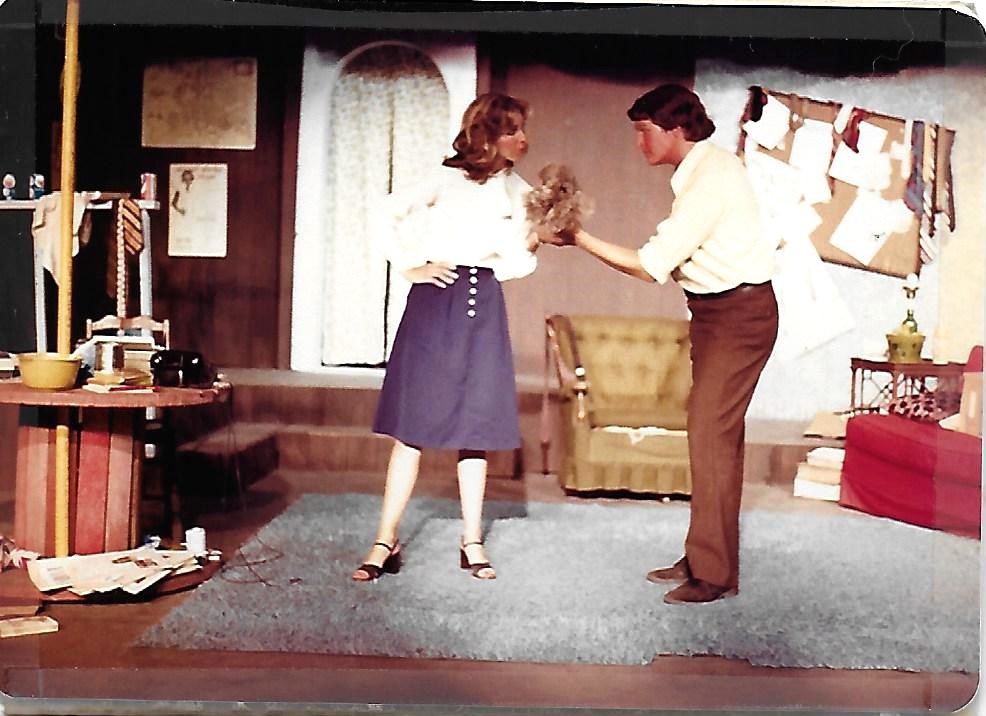
You all were a gift in my life. In June 1979, I left the Ohio Valley for a job at KSL-TV in Salt Lake City, where I worked for 40+ years. During my career as a television news reporter, I have been both the arts and the religion specialist. What I learned from you and others at the Playhouse helped me tell the stories of our tremendous arts community here in Utah.
Thank you! I send my best wishes for a wonderful 50th season reunion!
****************
In a March 2024 note, Carole wrote, “More recently, I did an hour-long special with all nine siblings of the Osmond family, including their 2 older brothers, Virl and Tom, who are deaf, and their spouses. It aired last October. It is very faith-centered, but they were all gracious and very open about struggles—health and financial.
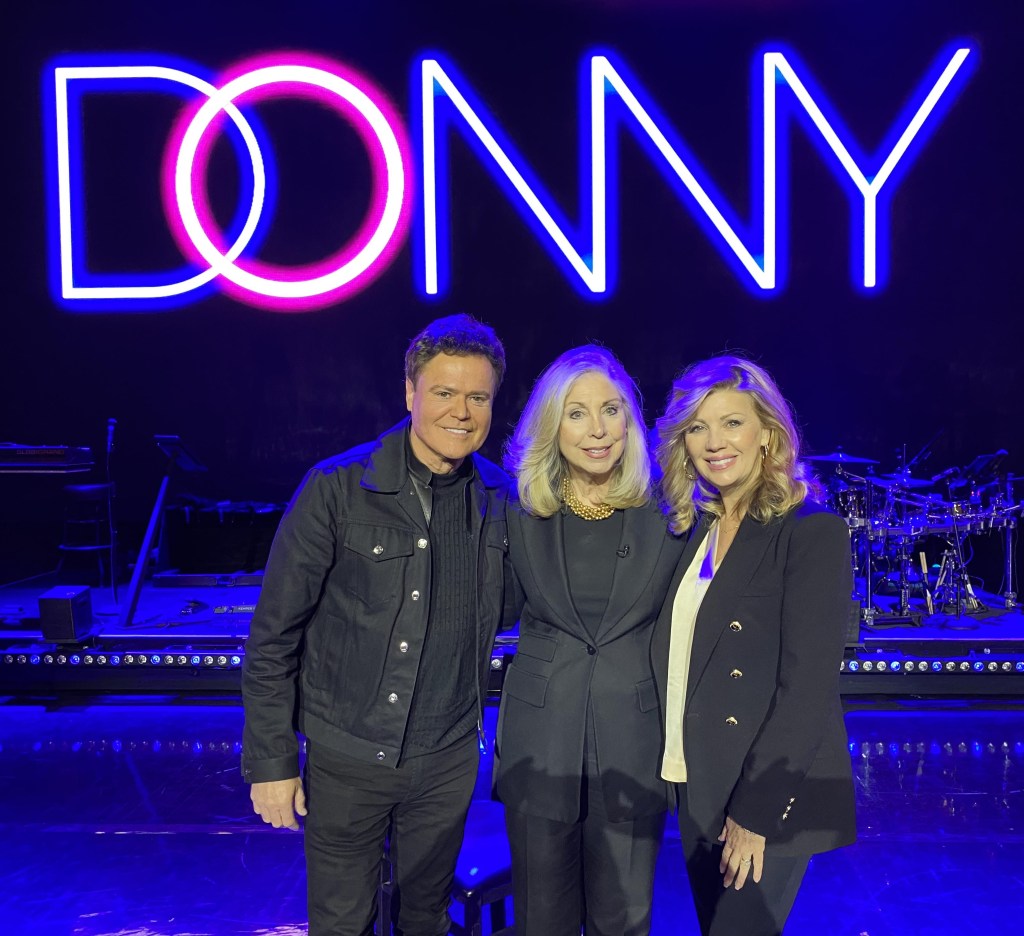

[NOTE: From Wikipedia: Carole won a regional Emmy for “Gideon’s Story” and has a Lifetime Achievement Emmy. She has also received many awards from the Society for Professional Journalists and the Utah Broadcasters Association for both news stories and documentaries. She was honored in 1994 by the Utah State Office of Rehabilitation and in 1996 by the Assistance League of Utah as a “Woman of Distinction.”
In 2018, Carole received an honorary doctorate from Southern Utah University for her contributions to journalism and the arts. In 2000, the Utah-California Women’s Association honored Carole with its Legacy Award. She has hosted the Primary Children’s Medical Center Telethon for more than 20 years. Carole received a Telly Award in 2018 for “Someone at the Other End,” a special program about Afghan refugees who have come to Utah.]
MORE TO COME!
The summer of 1977 was chock full of good things at the Playhouse—our first sell-out, many new people auditioning and getting cast in shows, the production of original shows, and another great designer and tech director who was as great onstage as offstage. My thanks to the many people from that year who have volunteered their memories, so many that I had to create a second part for 1977. Read those great stories in The Brooke Hills Playhouse: A Collective Memoir, Part 15-B.
AN INVITATION
What about you? If you were in Playhouse shows or if you were on the Playhouse staff or if you volunteered at the Brooke Hills Playhouse from 1972-1995, I would love for you to share your memories with me.
You can write those memories up, or you can contact me, we’ll chat, and I’ll write them up. I’ll send you what I write for editing and approval before posting. You were a part of the Playhouse. Now be a part of the Playhouse history!
Do you have any photos, program booklets, or program inserts you could share with me? I’d love to see them! E-mail me at smcoote@gmail.com, and we’ll set up a time to talk.

 Life Without Lesson Plans