
by Shari Murphy Coote and Friends
SEASON NINE, 1980
THE SHOWS
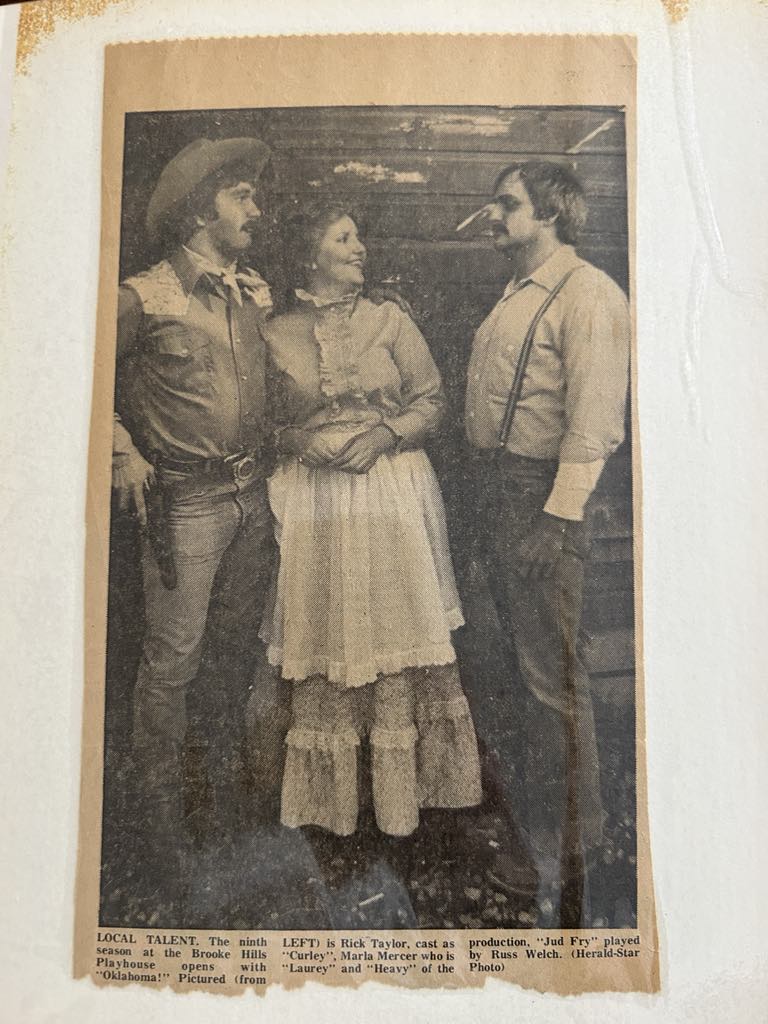
Oklahoma!
The Music Festival July 5, 6
That’s No Excuse (orig. Dear Agatha,
by Dick Boyd of Wheeling)
God’s Favorite
Wait Until Dark
A Funny Thing Happened
on the Way to the Forum
Going Ape
THE STAFF
Erich Zuern
Bill & Shari Murphy Harper
Al Martin/Betty Martin
Cathy Gaines
Bill Hossack
John Touloumes
Kendra Stingo
Cathy O’Dell
Don Reed
Anne Roberts
Jeff Lilly
John and Judy Hennen*
Tommy Pasinetti*
Bobby Shreve*
*Former company members who
returned to do one show
SOME GREAT NEWS
Our dear friend Al Martin, who lost his wife Tommie (Joanne Thomas), during the winter of 1976, returned for season nine with a bonus. Al and Tommie had known Betty Marks Brown for decades. They had acted together at several little theatres in the Cleveland area, and the three were good friends. In the winter of 1979-1980, Betty and Al married, and this summer and many more Betty joined Al for his annual stint at the Brooke Hills Playhouse. In 1985, Al and Betty would play the leads in On Golden Pond.
A SMALL KERFUFFLE
Once again, we announced the season in the Christmas newsletter, never imagining there would be a problem. Scott Martin, who had written, directed, and accompanied his shows in 1978 and 1979 (Sgt. Fenshaw of the Mounties and The Return of Sgt. Fenshaw) was planning to return for a third season. We had enjoyed enormous success with his two previous shows, so without hesitation, we scheduled another called Tin Pan Abbie. Abbie had debuted in the Cleveland area, but Scott can’t remember giving us a script to peruse or a video of the show to watch, and I can’t remember doing either of those things. I imagine Al had seen it, and I’m sure we just took his word that it would be a good show for us to produce.
Scott does know that John Kenley hired him in the spring of 1980 to tour with Brigadoon. This earned Scott his Actors’ Equity card. (Kenley was a famous producer known especially for his Kenley Players in Cleveland and touring summer theatre shows. Kenley first used TV and movie stars in his little theatre shows in the East and Midwest, bringing big talent to mid-size cities.) Following the Brigadoon tour, Scott went to Los Angeles in August 1980, where he worked in various shows and venues.
Without a doubt, without Scott, we switched our lineup of plays, substituting A Funny Thing Happened on the Way to the Forum for Tin Pan Abbie. According to a recent note from Scott, “Just as well. Funny Thing… is a much better show.” Since I can’t remember a thing about Abbie, I wouldn’t know. I do know that I directed both Oklahoma! and Funny Thing … that summer. I loved them both, but I had more crazy fun directing Funny Thing… than any other show I ever directed, and that was a whole lot of shows!
OTHER NOTES ON THE SEASON
Because the Fourth of July fell on a Friday, we had a small scheduling problem. The Fourth celebration lasts about 10 days in Wellsburg, and it is the biggest thing that happens all year. We would normally open a show on Thursday, but opening a show then going dark on Friday didn’t seem fair to the show, so we scheduled something we called The Music Festival. This gave the staff members and some of our actors from the area an opportunity to show off their individual talents. We ran the show two nights on Saturday and Sunday, July 5 and 6.
If I remember correctly, the festival wasn’t very well attended, but it was certainly enjoyed by all the performers and the paying patrons who did come. John Barto, who performed a song or two with his guitar, still fondly remembers accompanying Bill Hossack who sang a poignant and loving rendition of “The Rainbow Connection” in a tribute to Kermit the Frog.
Local playwright, Dick Boyd of Wheeling, had submitted one of his scripts to us in the winter hoping that we would produce it. It was a comedy titled Dear Agatha about a woman who writes an advice column for the lovelorn. Of course, she has her own hangups. I only know what it was about because there was a description in the season line-up on the back cover of the 1980 program booklet.
There was one problem. Bill Harper hated that title, but he wanted to do the show for several reasons. Dick was a local guy (and would hopefully bring in some folks from Wheeling who had never been to our theatre). Dick wasn’t charging us any royalty. And most importantly, we secured a grant from the W. Va. Arts and Humanities Council to cover the production costs—a very big incentive! Anyway, we said we’d do the show if Dick changed the title which he did. The new title was That’s No Excuse. [NOTE: I’m not sure that title was any better than the original!] The program also notes that Dick had had other plays produced at Towngate Theater in Wheeling and Little Lake Theater in Washington, Pennsylvania.
Our production had a solid cast: Russ Welch, Linda Huggins, Anne Roberts, Debbie Patterson, Amy Charlton, Paul Harris, Al Martin (in a bit part as he also directed the show), and Erich Zuern. It ran for one week (four performances) and had respectable audience numbers.
The fourth production, God’s Favorite, is Neil Simon’s re-telling of the biblical story of Job, the man afflicted by Satan who never renounces his faith in God. Some plot for a comedy, huh? Well, it is hysterical. Al Martin also directed this show, and years later, I directed it at Wheeling Jesuit College, now Wheeling University.
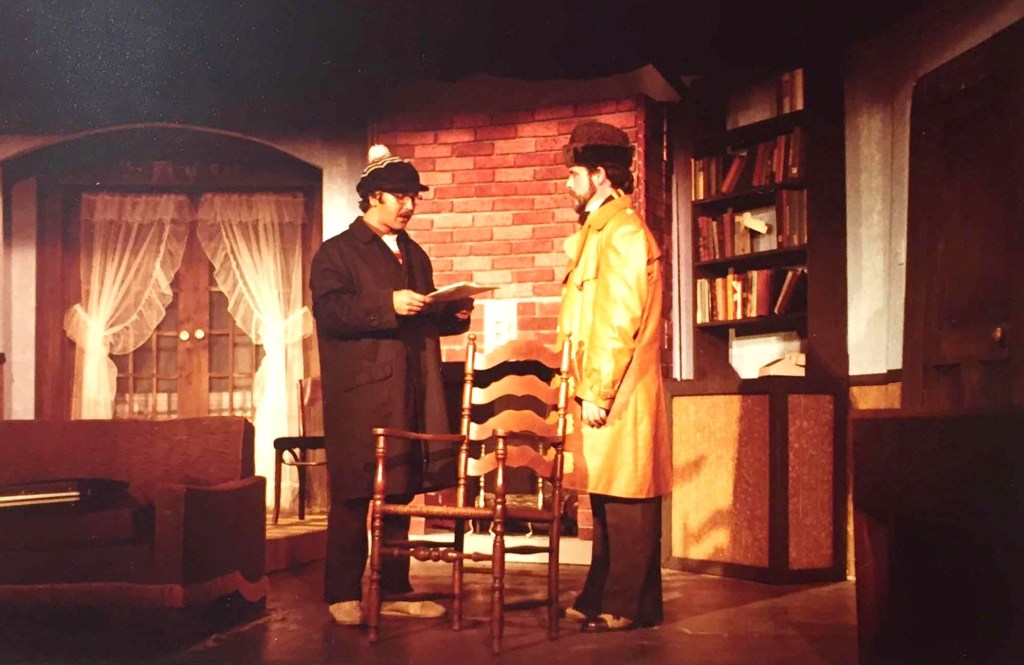
Of some significance is that Rick Taylor was in this show playing the very nerdy Sidney Lipton, God’s messenger, complete with a big Superman S in a diamond on his sweatshirt. This was Rick’s first non-musical, and up until the curtain call on opening night, you would have thought we’d asked him to step out of an airplane without a parachute! He never doubted his musical talent or his ability to sell a song on stage, but having to depend solely on his acting ability was a whole other matter. Fortunately, the cast (Richard Ferguson, Chris Cipriani, Monica Rasz, Nancy Sweat, John Touloumes, Susan Price, and Bill Hossack) and Al were all very supportive, and Rick went on to act in many comedies over the years.
Wait Until Dark and A Funny Thing Happened on the Way to the Forum were discussed in earlier memoir sections, and both did well. Both were critical and box office successes.
The final show of the season, Going Ape was a wild, crazy, high-energy, 5-actor farce with lots of characters entering and exiting, some physical comedy, and an exaggerated, but very entertaining, situation. The two main characters, Rupert and Miss Deaton, are always Rupert and Miss Deaton, but the other 16 characters AND the gorilla (!) are played by two other males and one female. Believe me, the costumes were flying on and off backstage. The show also started the tradition of the Playhouse ending its season with a farce. From 1980 until I remarried and left the Playhouse behind in 1995, every season ended with a madcap, laugh-producing farce.
THEY’RE BACK!
The teens from the Heatham House Youth Theatre in Twickenham, London, England and their parents were back with another British Music Hall-type show this season. The show called Singalongacentury featured lively music from the 19th century and corny but very entertaining skits. The production featured great costumes and set pieces, clever choreography, and creative directing. The kids from ages 12 to 18 were very talented, and we had people return on the second night to take in the show again.
The show ran for two nights on Tuesday and Wednesday, August 5 and 6, between the weekends that A Funny Thing Happened on the Way to the Forum was running. They were able to cover the Forum scenery with some draping and set up their own scenery in front of ours.
The parents of the cast were more than just chaperones. They helped with the costumes and set changes. They ran the lighting and sound cues. And the entire company, young and old, loved performing in an actual theatre with a defined stage featuring wings and backstage space (somewhat limited as many of you know), raked theater seats, dressing rooms, and stage lighting.
The entire group, 40+ people, stayed in the homes of local people wherever they went, and Nancy Patterson, who still lives on Marianna Street in Wellsburg, coordinated their stay in Wellsburg. Most of the Heatham House folks enjoyed watching our casts rehearse in the early evening before their show and our crew building and painting scenery during the day. We all enjoyed our evening meals together provided by the local hosts.
As I wrote in a prior post, David King, the director of Heatham House, and his wife Rosemary accompanied the group on both trips. We still exchange Christmas greetings across the ocean each year, as I write this in 2025.
OFF AND RUNNING WITH A BANG!
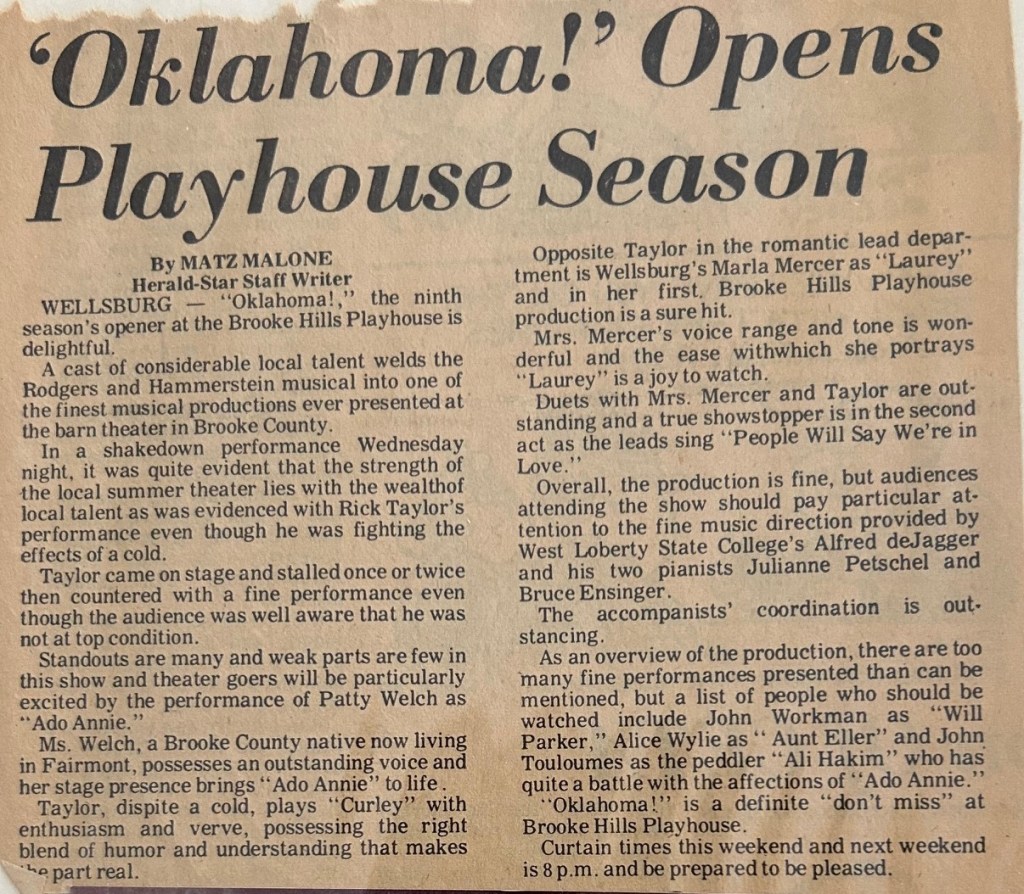
Oklahoma! got the season started on the right foot! Once again, I wish I had kept our box office reports, but like Fiddler, The Sound of Music, and Oliver!, the opening shows in the three prior summers, Oklahoma! also enjoyed many sell-outs during the 8-performance run. I may have said this before, but when the season starts off strong with big audiences, the rest of the season seems to ride that big wave and bring people back for more as the season progresses.
In preparation for directing the show, I read how many ground-breaking events were introduced in Oklahoma! If you remember, the stage lights slowly, like a sunrise, come up on an empty stage, and then the cowboy Curley, played on our stage by Rick Taylor, starts singing “Oh, What a Beautiful Mornin’” way off-stage, eventually entering. It was so impactful, and the empty stage and building to that entrance with that glorious song was innovative.
Unfortunately, Rick caught a bad cold on Monday, and his voice struggled during that first week of performances. I know he was sick at heart as his fabulous voice occasionally let him down each night, but his stage presence carried the day, and the audiences were with him 100%. He was back in top form for the second week of the run, and I looked forward to that wonderful opening number each evening.
Just a quick nod to another musical theatre first that was introduced in Oklahoma!, the dream ballet. Laurie, the female lead, is induced by a shady traveling salesman to take the opiate laudanum. She falls asleep and dreams about her date with Judd for the upcoming social. The “dream” is danced in low light or behind a gauzy scrim. Of course, she wants to go to the social with Curley, and her dream in the dance eventually turns into an ugly nightmare ballet. The dream scene technique has been re-worked hundreds of times since.
I have been asked many times, “How did you do 5, 6, 7, 8, or even 9 shows in a 13-week stretch?” It wasn’t easy! In 1980, we did six scripted shows, the Music Festival, and presented Singalongacentury, the British music hall review, on two of the dark days in the middle of the Funny Thing Happened… weekends.
First, we were lucky. The staff members were always such good kids. They worked hard, and they worked well together. I was always amazed by how well the staff kids meshed. They came from a variety of colleges and backgrounds, but they always worked well together, were anxious to learn new things, would pitch in to help each other, and knew how to have a lot of fun. In my 24 summers at the Playhouse, I only had to fire one staff member. I think that says a lot when you realize that putting on a lot of shows in a short amount of time is a pressure-filled situation.
Second, the designers/tech directors overseeing the various crews—scenery, props, costumes, lighting, sound—were talented and organized. Even those who were learning on the job had innate leadership skills. Third, after lunch and dinner, there was always time for croquet (in the early days) and volleyball once Al Martin decided we needed more physical fun. (Besides, he was in a volleyball league back in Cleveland, and he wanted to keep in shape for those games back home!)
Fourth, the community adults, teens, and children who acted in the shows, volunteered backstage, responded to pleas for donations (pianos, refrigerators, sewing machines, sinks, sofas, beds, you name it), ushered, and did all manner of odd jobs around the barn were great to the staff members in so many ways—helping with their laundry, inviting them into their homes for an evening, showing interest in their lives, families, dreams.
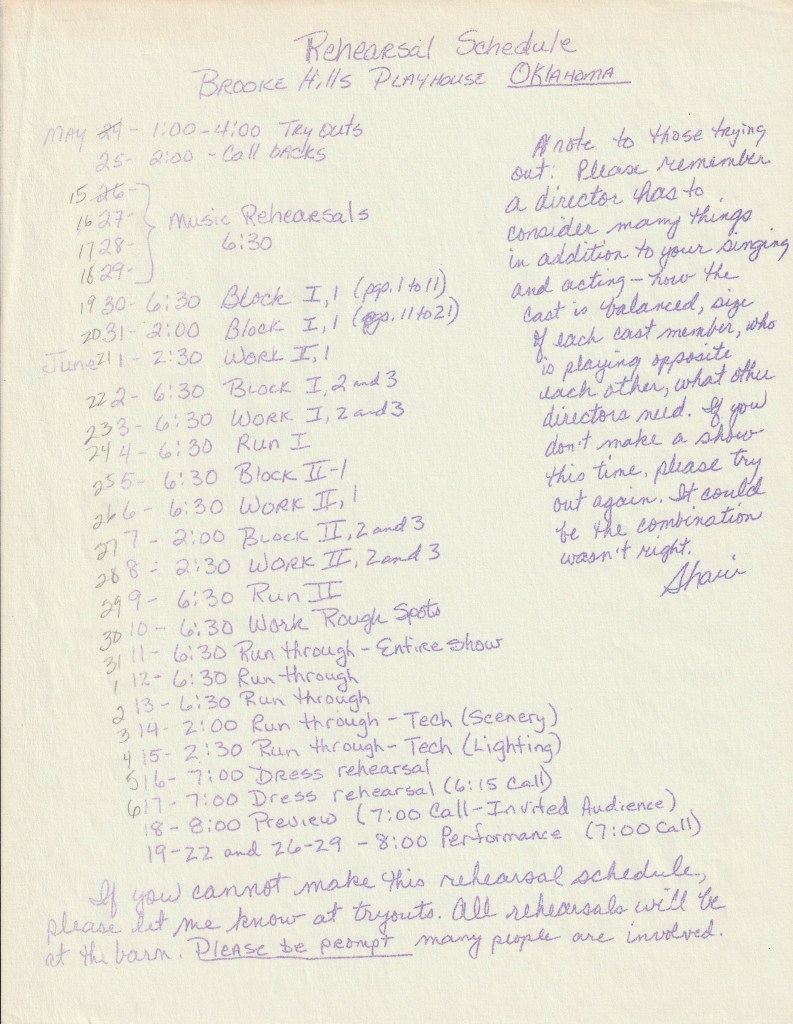
Finally, our directors understood that rehearsals were limited, and they had to be organized. Costume notes, prop lists, lighting and sound cues had to be worked out well before rehearsals even started. Rehearsals had to be structured to make every minute count. Since we had no front curtain, directors had to choreograph their scene changes in advance. The comedies normally rehearsed for 14-17 days. The musicals had 4 days of music rehearsals, then 20-21 rehearsals to bring it all together. That is a very short rehearsal period, and yet—magic happened!
CATHY GAINES MELVIN REMEMBERS
I was brought up near Washington, D.C. and started college at Morris Harvey College (University of Charleston) in Charleston, W. Va. in 1977. Shortly afterward, my father died, so my mom and sisters joined me in Charleston, where my mom had been brought up. So, Charleston was my “home,” although I wasn’t really from there. I had always loved Charleston, though, especially the times when we would visit my grandmother and cousins in the ‘60s and ‘70s.
I met Judy Hennen at Morris Harvey, where she taught theatre. I was active in the theatre program there until she left in 1980. She told me about Brooke Hills Playhouse. In January of 1981, I started studying theatre at West Virginia University, but I realized after a few semesters I really wanted a 9-to-5 work life, and I changed to computer science. I spent my whole career doing a wide variety of computer jobs at Wake Forest University School of Medicine/North Carolina Baptist Hospital in Winston-Salem until I retired in 2014. Towards the end of my career, it really wasn’t very “9-to-5”!
I have always been so grateful to have learned and worked in theatre. It really has enriched my entire life, although I never worked in theatre again after I switched majors at WVU.

My first season at the Playhouse was in 1980. At first, there were four interns that year: myself, Erich Zuern (designer/technical director), Bill Hossack, and John Touloumes (all from Elizabethtown College, I believe). We stayed in the dorms at Bethany College. Every morning, we would pile into Erich’s VW Beetle to go to the Playhouse for breakfast at the picnic table. We would all cry “shotgun!” to sit up front. Later, we were joined by Cathy O’Dell, Kendra Stingo, and Don Reed of Fairmont State. (They all seemed to know Bobby Shreve, a former Playhouse designer/tech director.) My favorite show that first summer was Oklahoma!. I was the stage manager, and I was also in the chorus, so I got to attend the chorus music rehearsals, which I loved.
I hardly knew which end of a screwdriver was which, but by the end of the summer I was screwing the old, recycled screws into the hinges on the flats with everyone else. Al Martin used to say, “You always screw in the dark,” referring to the dim lighting where the hinges were screwed at the back of the flats to join them together on strike nights. Al was infinitely patient with my lack of expertise, and he was so encouraging, as was everyone else. All was not bad screwing in those hinges. There were beautiful scene paintings on the backs of some of those flats done by Al’s late wife, Tommie.
One of my most vivid memories was a night when we had all worked late. It was probably the night before an opening. There had been a terrific thunderstorm that evening, and when the thunder, rain, and wind stopped, the lightning remained, going from cloud to cloud to cloud. I remember we all stood in the arches of the lobby and watched it, fascinated.
At least once a week, after the day’s work was done, Erich would drive us to Wellsburg in his VW Beetle to have a beer at Betts’s. I always tell people that the way the community supported the arts was to buy us pitchers! The tables were classic square dinette tables with chrome legs and immaculate white cotton tablecloths. We would push several together and all sit together. The favorite snack was a Lance “Rye-Chee” with a dill pickle slice. I believe that Shari introduced me to this treat! On the juke box, I think Betts’s favorite was “Funky Town” https://www.youtube.com/watch?v=RVwiixXViT0. My favorite was Willie Nelson singing “Georgia on My Mind.” I didn’t even know that Ray Charles wrote it! I can’t remember ever going into Wellsburg before it was dark.
[NOTE: You may remember that it was Cathy, who, after all these years, still has her Betts’s membership card. You can see it in Part 17 of this memoir.]
I seem to remember spending a bit of time trying to entertain some of the kids of the parents working on shows. My favorite was Myles Roberts. I remember one evening we were out behind the barn, and there were thousands of fireflies all over the field behind the barn. I have to say that the weather on that hilltop was the best summer weather anywhere I have ever lived, before or since. Near Washington, D.C., where I was raised, and Charleston, W.Va., where I had been going to school, summer weather was something to be tolerated, not really enjoyed. At Brooke Hills Playhouse, it seemed the sun was usually shining, the breeze was blowing, and we got the day off if the temperature ever exceeded 90.
A quick thought: Shari, I really enjoyed your description of Rich Ferguson. I really liked him, and it was almost like seeing him again to read about him.
After starting to study theatre design at WVU in January 1981, I returned to Brooke Hills Playhouse. I was told by my teachers to draw as much as possible, but a quick check of my sketchbook shows I did not take that advice to heart. Possibly a forewarning of my later move to computer science.
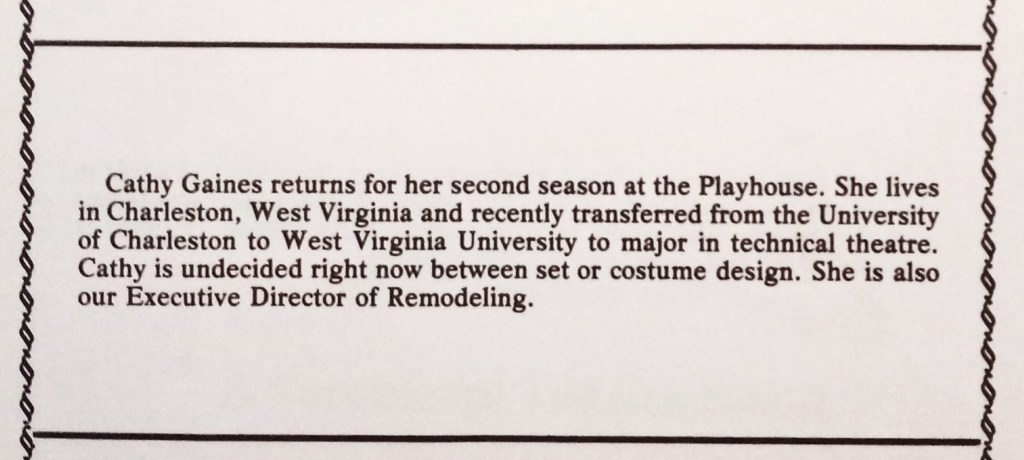
After staying at Bill and Shari’s a while, our crew in 1981 moved into the big, old, yellow farmhouse next to the Playhouse. The costume storage was moved into there as well. I remember at Bill and Shari’s that there was a book on screenwriting. The author wanted to make sure that his readers did not commit the grievous sin of using cliches, so he wrote a list of phrases to avoid at all costs. Our favorite was, “There, I said it, and I’m glad!” For weeks, we would say that to each other. I think Bill Hossack got more mileage out of that than the rest of us, but I think we were all guilty.

[NOTE from Shari: We, the Playhouse founders, made a lot of mistakes regarding history. I guess when you start something when you’re young, you don’t even think about how long that “thing” will last. I know that back in 1972, our first year, we never imagined that in 2025, the Playhouse would be presenting its 54th season! All this is to say that we put on shows and hardly thought about taking photos or keeping program inserts with the casts and crews listed for posterity. Too, we didn’t take group photos of the staffs over the years, and we should have. I asked Cathy if she had a photo of herself during her Playhouse years. This is the only photo Cathy could find, her college ID! Gotta love it!]
I was able to work with Judy Hennen again on Godspell, the first musical of that season. That season might have been the last time I laid eyes on her. Judy and I had gotten to be good friends in Charleston, and although we are Facebook friends, I still miss her. I saw John Hennen a few times after that since he always seemed to be wandering around W. Va. and would show up wherever there was a show. (I know that sadly John passed away in 2020.)
Later in that 1981 season, when we did Arsenic and Old Lace, I think I had the peak laugh event of my life. Bill Hossack was the victim of the live-audience snafu that caused this amusement. He was playing the Teddy Roosevelt character, actually the crazy nephew of the two crazy old sisters who poison lonely, old men. Teddy thinks he is burying yellow fever victims while he’s digging the Panama Canal in the basement. Bill/Teddy picked up a “body” that was a department store mannequin with a stocking cap hiding its bald head. The stocking cap slid right off that slick head, and the mannequin was revealed to all. It seems that it was not easy to get the cap to stay, but eventually the “body” was stowed away. It makes me smile to think of it even now. Bill Hossack was one of the nicest people I have worked with, and he surely did not deserve that challenge, but it was pretty funny.
I was in the chorus of Babes in Arms, the second musical of the season. During rehearsals, between chorus numbers, I would chat with Ken Kasprzak. At some point that season, a bunch of us, including Ken, I think, went to Pittsburgh to see Rocky Horror Picture Show. I don’t think I had ever been to Pittsburgh before, and I really loved it, although I didn’t see much more than the inside of a movie theatre. I’ve always enjoyed my few trips to Pittsburgh; it is one of my favorite cities.
As I look at the Babes in Arms program, I see that C.R. Wilson did the choreography. I remember that we used to go to his studio for dance classes, in Steubenville, I think. I’ve never been good at dancing, but I’ve always enjoyed dance classes. C.R. was cleaning out a friend’s attic and gave me a little porcelain doll that he had been given. It was a boy-doll with knee-britches, and he told me that it reminded him of himself, and I should keep it and remember him. I think I still have it with my other dolls. We also did laundry in Steubenville, so it was sort of a big day to go to town for us. I really liked Steubenville; I had never been in a small town like that before. It was so charming, with all the low-rise buildings on the main street, it looked like a set for The Music Man. Following Babes, I had a small part, Miss Tipdale, in Not Now, Darling, a very funny British farce that took place in a furrier’s salon.
At the end of the season, I was back to Morgantown. Bill Harper drove me all the way, instead of my having to take a bus. Bill was kind to me in many ways, especially when I told him that I was interested in lighting design. He always said, “Be nice to people on your way up. You will meet the same people on your way down.” Well, I never went up, and I never went down, but I have tried to be nice. You never know how that might have paid off.
After a year more of studying theatre, I had met my husband-to-be, and I was ready to follow his suggestion that I study computer science and adopt a 9-to-5 workday. In the summer of 1982, I started computer science, and I never worked in theatre again. But I do enjoy great performances, and I hold so many fond memories, especially of the people I met at Brooke Hills Playhouse.
I moved to Winston-Salem from Morgantown with my first husband after we got married in 1983. I married my second husband, Ken, in 2011. In 2014, I retired after 28 years of working at Wake Forest Baptist Health.
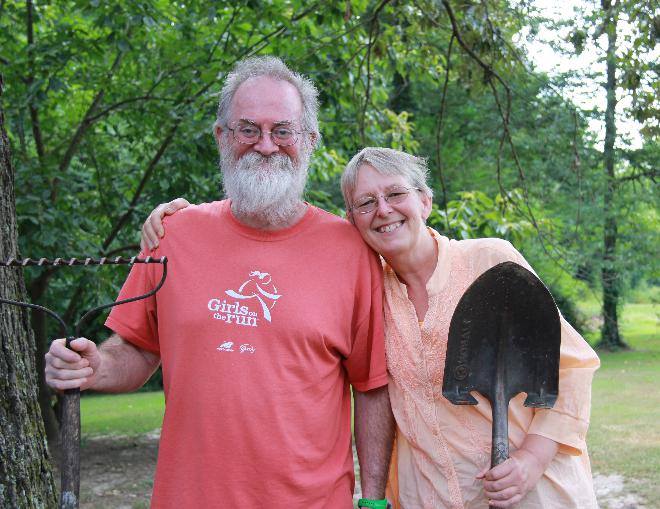
Although I did not finish my computer science degree at WVU, I credit the 4 semesters of computer science study at WVU with giving me the tools and confidence to take on many different types of computer work at Wake Forest Baptist Health, from developing games for psychological assessment and writing 3D visualization software to managing a small Unix network. Honestly, computer science at WVU was so hard and competitive that I thought I could take on anything after that.
My brief education in theatre design at WVU has truly been a “moveable feast,” helping me to enjoy all sorts of visual arts with a depth that was never possible before my studies there.
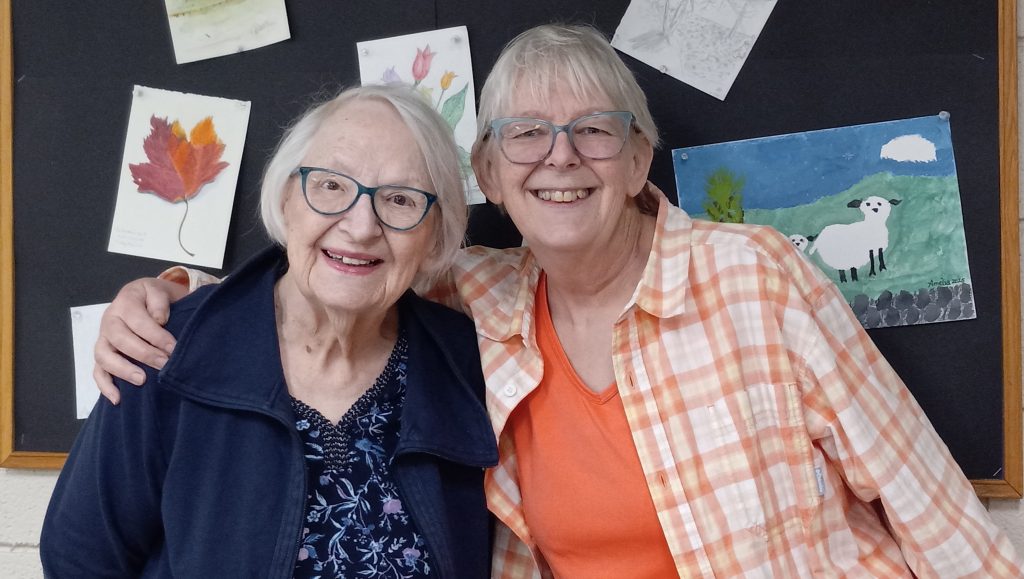
My husband Ken died in 2022, and my mom, Marybelle, moved in with me. We’re roomies now! I got into amateur radio with my late husband (my callsign is KM4OCS), and I enjoy a 2-meter “ragchew” (conversational) “net” called the Vagabond Ragchew Net. It’s sort of like a radio call-in show. When I’m not talking on the radio, I stay busy with my wild half-acre garden in an older suburban neighborhood in Winston-Salem, North Carolina.
[NOTE FROM SHARI: After this part of the memoir was published, Cathy O’Dell, another staffer, found this photo.]

BILL HOSSACK REMEMBERS
During my freshman year at Elizabethtown College in Pennsylvania, I was introduced to the Theater Department. I cannot recall if I enrolled in a class in the department, but I do remember meeting and talking with the Chair of the program and seeing a production of Bell, Book and Candle featuring a senior major named Erich Zuern. And I believe the Chair talked to me about the Brooke Hills Playhouse, or it may have been Erich. Regardless, I found myself at the Playhouse in Wellsburg, W.Va. in the summer of 1980.

The actors/interns were housed at Bethany College that season, and I remember the drive back and forth from the campus to the Playhouse over a hilly, narrow road reminding me of Southeastern Pennsylvania where I am from. I don’t recall just how many of us there were that season. There was Erich Zuern, myself, John Touloumes, and Cathy Gaines. There may have been others that summer that I don’t recall.
I arrived with little to no experience in the technical side of theater, and learning how to build flats and gain some very rudimentary knowledge of lights and sound was something I enjoyed and looked forward to taking back to Temple University, where I was transferring to in the fall of 1980. The community around the Brooke Hills Playhouse was something I didn’t anticipate and thoroughly enjoyed.
Back home, I hadn’t yet ventured into the world of community theater. My stage experience consisted of school plays and the annual Passion Play at the Methodist church my family attended. As a nineteen-year-old from rural Southeastern Pennsylvania, my social circle, outside of school, consisted of a few friends, my siblings, and the cats, dogs, and horses my mother collected and cared for throughout her life. So, meeting and getting to know the folks who volunteered their time and talents to the Playhouse enriched the experience for me.
The memorabilia from the two seasons I spent at the Playhouse are all gone, but I recall productions of Babes in Arms and Oklahoma in 1980. I remember that I “assisted” on the light board for Oklahoma!, and during one performance, I leaned on the board and caused a blackout during the dream sequence. I recall that Richard Ferguson was the stage manager for the show, and he came flying down the stairs in a panic because the stage was in complete darkness. Erich kept a much closer eye on me from then on. There was a production of A Funny Thing Happened on the Way to the Forum that season that allowed me to explore my feminine side. Judy Hennen told me that she was in the audience for one of the performances and kept me in mind for Godspell that was being considered for the 1981 season.
The two seasons I played at Brooke Hills are mingled in my memory, so I am not very clear on all of what played when. I remember the 1981 season as the tenth anniversary of the Playhouse, and my driving you a little batty, Shari, as I tried to write a song to celebrate the event on the piano, which I didn’t know how to play. Sorry about that!

We all lived in a house on the grounds of the park that season. Both Erich and I returned for the summer, and we were joined by Cathy O’Dell, Kendra Stingo, and Ken Kasprzak. The three were WVU students. Cathy Gaines also returned in 1981. And Joe Tribbe joined us at some point. He and Cathy O. were the leads in Barefoot in the Park.
That season had its ups and downs. I believe it was in the 1981 season that I met Al and his partner Betty. I have very fond memories of them both from that season. Al was the sort of fellow a young person might model themselves on and do okay in life. Betty exhibited such grace and kindness, not to mention her intellect and the gentle wisdom she shared with me in numerous letters. She also introduced me to the delights of New Yorker cartoons! The two of them were part of the “Ups.”
Let’s see, I believe the 1981 season included Godspell, Barefoot in the Park, Wait Until Dark, and Not Now, Darling. I’m probably leaving something out. Godspell came up in conversation at work recently between a couple of my co-workers, and I told them that I performed the musical years ago. My boss Kourtney, no stranger to the musical theater stage herself, exclaimed, “You played Jesus?!” “Yes,” I answered. To which she replied, “I would have loved to have seen that.” Maybe I’ll surprise her with a little rendition of “Save the People” some afternoon.
Among the “Ups” that season was the arrival of John and Judy Hennen. I remember sitting in the dressing room talking to John as he applied his makeup to become Victor Velasco in Barefoot, smoking his filterless Pall Malls, standing the cigarette on its end, applying a wrinkle line or two around the eyes, and then picking up the cig for another drag before working on the other eye. Frankly, I would have paid the price of a ticket just to sit and watch John apply his makeup. What he did on stage was, to my youthful and worshipful eyes, brilliant! When John learned that I was from the Philadelphia area, he created a streetwise tough guy backstory for me and started calling me “Spike.” Now, add beauty to brilliance, and you have Judy! The two of them gave a masterclass in the art and craft of acting. They provided mentorship with generosity and kindness.
That season unfolded with an undercurrent of unrest and concern. The fridge often housed more beer than food. I seem to recall some issues with the stipends. And I developed an eating disorder that resulted in my dropping from 140 pounds at arrival to just under 120 pounds when I departed at the end of the season. I recall standing in the ballet studio in Steubenville in dance tights, alarmed at my appearance. But the show must go on! And it did. And there was heartbreak to witness among our community volunteers. I recall a fellow named Russ Welch and his wife Paula, who were involved with the Playhouse, he on the stage, and she in an auxiliary support role. Paula was very sweet, and she would do our laundry for us. I remember getting my clothes returned to me ironed and folded! Russ left his wife in the midst of the season. I remember his wife being devastated, tearfully asking what she had done wrong, blaming herself. Heartbreaking. [NOTE from Shari: Thankfully, their separation didn’t last long, maybe a month at most, and their marriage survived and thrived until they died, Paula in 2018 and Russ in 2023.]

The 1981 season came to a close with a couple of us planning to move to New York City in the fall. I headed to Charleston to stay with John and Judy for a week during which Judy coached me through an audition piece for Stanley Harrison’s studio NETWORK in New York.
Cathy O’Dell and Joe Tribbe got an apartment somewhere on the Upper West Side near Fordham University. I joined them late that fall, I think. Joe was working with a children’s theater, and Cathy was working as a cocktail waitress at the Hilton in Midtown and going on auditions.
I was trying to live on what savings I had accrued and not having much luck finding a job. I did meet Stanley, but he didn’t ask me to audition. He did offer an important insight that I have shared countless times with young artists I met over the years that I worked in Arts Programming at Connecticut College. Stanley observed, “The mistake young artists make is trying to work their art around a job versus working a job around their art.” In the end, I don’t think I remained in the city for more than three months. I kept in touch with Cathy for a little while and then left all of it behind me. Well, I did have some photographs from A Funny Thing Happened on the Way to the Forum that we giggled over now and again.
PART 2
When I returned home following my brief and unspectacular flirtation with NYC, I got a job in the warehouse of the now-defunct Norcross Greeting Cards Company and enrolled at West Chester University as a part-time student in Literature. And I poked around in the local theater scene. I was not a disciplined student, and I paid little attention to the track one should follow if one hopes to earn a degree. My parents paid off my outstanding student loans from my semesters at Elizabethtown and Temple, and I dabbled in academia for a couple of years on my dime.
A friend of my father’s arranged an interview for me with the artistic director of the People’s Light & Theater Company, a regional theater outside of Philadelphia. The interview was cordial, but at one point, Danny pulled out four deep, filing cabinet drawers and told me that what I was looking at were the resumes of actors seeking a face-to-face meeting. He pointed to my scant resume and training and offered me a position in the box office. I took the job and stayed for two years while continuing to take classes at West Chester University. I also got work with a children’s theater company that operated out of the Fulton Opera House in Lancaster, Pennsylvania. The actors I worked with were wonderfully talented and serious about their craft. They also encouraged me to follow my passion for the craft.
But in late 1984, I found myself captive to what Allen Ginsberg called “the fear trap.” I grew anxious about the direction my life seemed to be taking and projected a grim future if I did not change course. So early in the new year, I found the address of the local recruiting office and began the process of enlisting in the U. S. Navy. On March 18, 1985, I flew off to boot camp in Orlando, Florida. I spent four years on active duty in the Naval Submarine Service and an additional two years in the inactive reserves. In the final year of my active duty service, I met Elisa and realized that the journey I had been on was kismet! We married in 1989.
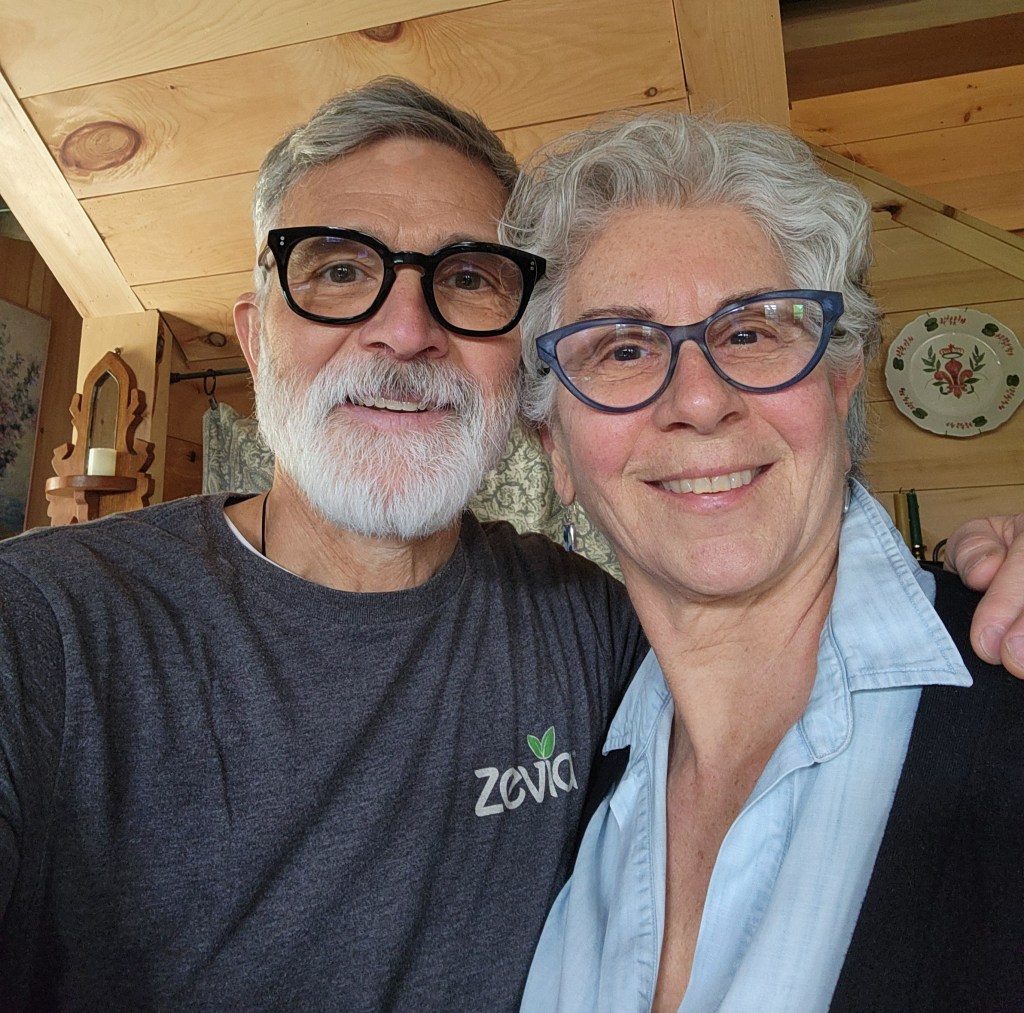
I worked in the retail book business for about ten years, then took a job with the Connecticut Social Services agency for two years, followed by two years of development work at the Eugene O’Neill Theater Center in Waterford, Connecticut, and finished up at Connecticut College in the Arts Programming office where I worked for seventeen years.
I retired from the college in the spring of 2020, and now work at our local, natural foods coop in New London five days a week. In all those years in between, I continued to act in community theater, some industrial films, and some professional gigs. I got to know some playwrights who would often contact me when they had a new work they wanted to hear and/or put up on its feet. That was some of the most gratifying work I have ever done as an actor. 😊
THE NINTH SEASON COMES TO AN END
Bill and I had gone out to the barn after school on May 22, 1980. We checked out the public restrooms off the lobby, unlocked the box office, and opened the big door to the tool room/kitchen and dressing rooms. Bill turned on the water. We had no leaks, and we hadn’t been broken into. Everything was fine. We went up the stairs from the dressing rooms to the stage and looked out over the house. The seats were still covered in plastic. No pigeons had found a way in and taken up a messy residency again (WHEW!), and the piano keys still moved but would need tuning. Other than the usual amount of dust from sitting unattended for nine months, Brooke Hills Playhouse was in great shape—for a 100+ year-old barn.
Thirteen weeks and eight shows later, on the evening of Sunday, August 25, the final production of the season filled the barn with laughter one last time in 1980. The ninth season was over. After the show, the staff and some volunteers from various casts and crews struck the set, took down the lights and the big, black curtains, coiled the lighting cables, cleaned the dressing rooms, packed up the tools, and our two big saws, and made several trips to Bill and my home in Follansbee where everything would be stored in our basement for the winter. We covered the seats with plastic and finished around 2:00 a.m. when we sat down on the stage for one last beer together before going our separate ways in the morning. 1980 was a very good year.

 Life Without Lesson Plans