
by Shari Murphy Coote and Friends
SEASON TEN, 1981
THE SHOWS
Godspell
Music Festival*
Art Auction*
Barefoot in the Park
Arsenic and Old Lace
Everybody Loves Opal
Babes in Arms
Not Now, Darling
*Work-arounds for the 4th of July
THE STAFF
Bill and Shari Harper
Al and Betty Martin
John and Judy Porter*
Erich Zuern
Cathy Gaines
Bill Hossack
Cathy O’Dell
Kendra Stingo
Joe Tribbe
Jean Carlson
Dick Overmyer
*Back for part of the season
SHARI’S LOST SUMMER
1981 was somewhat of a lost summer for me. Bill and I were expecting our first child in October after the close of the season. I was also finishing my master’s degree and driving back and forth to Morgantown each weekday.
Paula Welch took over the cooking duties from me for the 1980 season, and that had been a big relief. I cooked for the crew for the first eight seasons from 1972 to 1979, and it was my least favorite thing to do, probably because I was terrible at it. Bill Hossack said he lost 20 pounds during one of his Playhouse seasons, but I wasn’t the cook!
[NOTE: I hasten to add that when I married Richard in 1995 and left the area, teaching, and the Playhouse behind, I discovered that I really loved to cook! I finally had time to learn how to get everything to come out at the same time, and because I wasn’t doing ten things at once—directing shows, teaching, being a single mother, running the box office, writing press releases and newsletters, planning group trips for 105 people to New York City, etc.—I had time to read recipes, plan menus, shop with a grocery list, and watch what I was doing. I love cooking now, and I really do pity those kids who endured what I called cooking for those 8 summers! When Paula took over as the company cook in 1980, I was thrilled beyond belief.]
Thankfully, we had a full staff this season. The college-age staff was living in the old yellow farmhouse near the barn where we also stored costumes. The adults were staying at my Aunt Alice and Uncle Bob Hamilton’s big house in Wellsburg, while the Hamiltons stayed at their summer cottage near Independence, Pennsylvania.
Al Martin returned for his 10th season. Al’s wife Tommie had died in 1977 over the New Year’s weekend, but by May, Al was ready to return to Brooke Hills, by himself. He came alone for four summers, but in early 1981, Al had remarried. Betty Marks had been active in the Cleveland theatre scene for years and had done shows and been friends with both Tommie and Al. Betty and Al married early in 1981, and Betty naturally came with him to Brooke Hills. Betty spent most of her days sitting and reading in the theatre seats that were in the lobby outside the box office which at that time was in the corner by the ladies’ restroom. Al often conferred with her when he had a sticky directing situation, and they’d work it out together. Betty was always willing to run lines with our actors and help them with their parts.
Two of Al Martin’s friends joined us this summer, Jean Carlson from Cleveland and Dick Overmyer from Meadville, Pennsylvania. Jean had been in numerous shows in and around Cleveland with Al and Tommie Martin, as well as with Al’s second wife Betty Martin. When Jean came to the Playhouse, she was active at the East Cleveland Community Theatre where Al was directing and designing in the winter season.
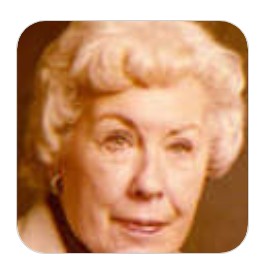
Jean started acting as a young girl, and her natural beauty, talent, and convivial personality landed her numerous ingenue roles. She gradually accepted more mature parts and continued acting late in life. She was a spry 67 during the summer of 1981 when she played one of the murdering sisters in Arsenic and Old Lace to great acclaim at Brooke Hills. She returned in 1984 to play opposite Al Martin in neat little comedy The Second Time Around. Jean died in 2008 at the age of 94.
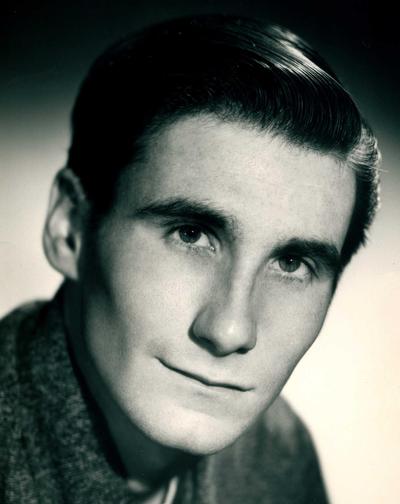
Dick Overmyer had graduated from Allegheny College in Meadville, Pennsylvania with a degree in Theatre. After a stint in the army, he attended San Diego State and received his Master’s Degree in Fine Arts. And then it was back to Allegheny College as a theater professor.
In the 1950s and ‘60s, Allegheny College had a theatre troupe known as the Penn Players. Al and Tommie Martin had both been a part of the group, and in the 1970s and ‘80s, Al was invited back to the college annually by the drama department to speak at a colloquy. The colloquy is where Al and Dick became friends. At the 1981 colloquy, Dick told Al that he had never worked at a summer stock theatre. Al talked up the experience, and he invited Dick to come to Brooke Hills for as long as he wished during the 1981 season.
Dick, like Jean, was a great asset. He arrived in time to help us get the barn open and to conduct auditions as he directed Barefoot in the Park. He was a talented director, but he was also a wonderful carpenter and actor, so he got the full, summer-stock experience—building scenery, acting, and directing. In addition, he was a super-nice guy. His wife came to visit on one or two weekends, and he departed once the final show opened. He was sent off with an open invitation to return anytime, although he never did.
When Dick retired from Allegheny College, he became the Director of the Academy Theater in Meadville. Dick died in Sarasota, Florida in 2019, at the age of 85.
Neither Jean nor Dick would accept any remuneration (as modest as it would have been). They both were so gracious and expressed their thanks to the staff for their Playhouse experience. Then they each left a nice cash donation when they departed!
The November trip to New York City was more popular than ever, and people started signing up early. The cost was $175 for the trip this year (up from the $100 in prior years), and we had to expand to two buses—90 instead of 45 people! The price still covered round-trip transportation, two nights in a mid-town hotel, and tickets to four (yes, 4!) Broadway shows—center orchestra seats! Can you get even one, last-row-in-the-balcony seat for $175 now?
Other than that, the 1981 season was a blur. I painted three walls and papered one wall of the nursery for the baby’s arrival then furnished the room with the baby crib my siblings and I had used (Our parents had it stored away). Bill’s mother provided a rocking chair and a chest of drawers which cleaned up nicely.
Bill wasn’t happy about the baby and refused to stop smoking and drinking. He was not contributing to household accounts either. I had left him four times in the past nine years, but when I filed for a divorce on July 5 (after a row on the Fourth), it was with the knowledge that I could only support one other person, and that person would be the new baby. My lawyer asked, “What do you want from the divorce?” I said, “The house (I’m paying the mortgage), my car (I’m making the payments), the baby, and the Playhouse.” Bill didn’t contest the divorce. I was granted the four requests and $100 a month child support. I stayed away from the barn during the workday for most of the summer. I did love watching each show numerous times without the worry of writing press releases, taking press photos, typing up program inserts, or directing a show.
ANOTHER OPENING, ANOTHER SHOW
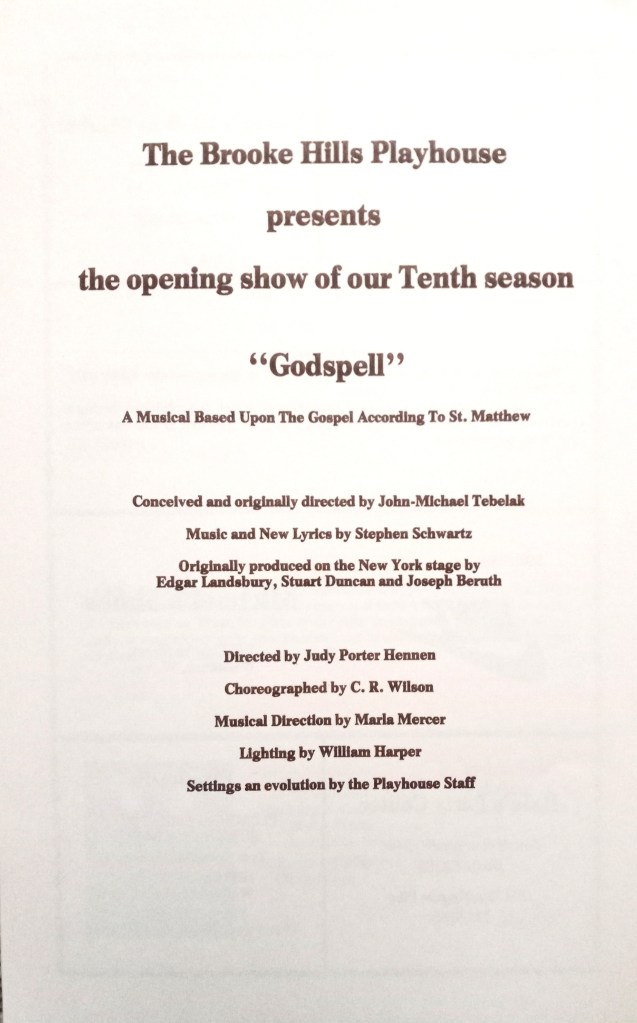
GODSPELL
The 1981 season opened with Godspell. John and Judy Hennen had returned to the Playhouse for part of the season, and Judy directed this show. I was mesmerized by the production and so proud of it, and I didn’t have a thing to do with it! The cast was so genuine and musically talented. The musical numbers were nothing less than virtuoso. Judy’s direction using benches, cable spools, boards, and stools to construct and deconstruct playground equipment was creative and lively. It was a colorful, lively, engaging production.
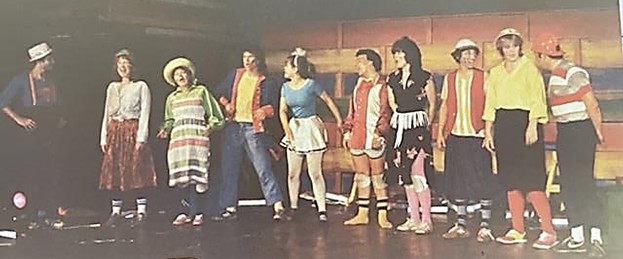
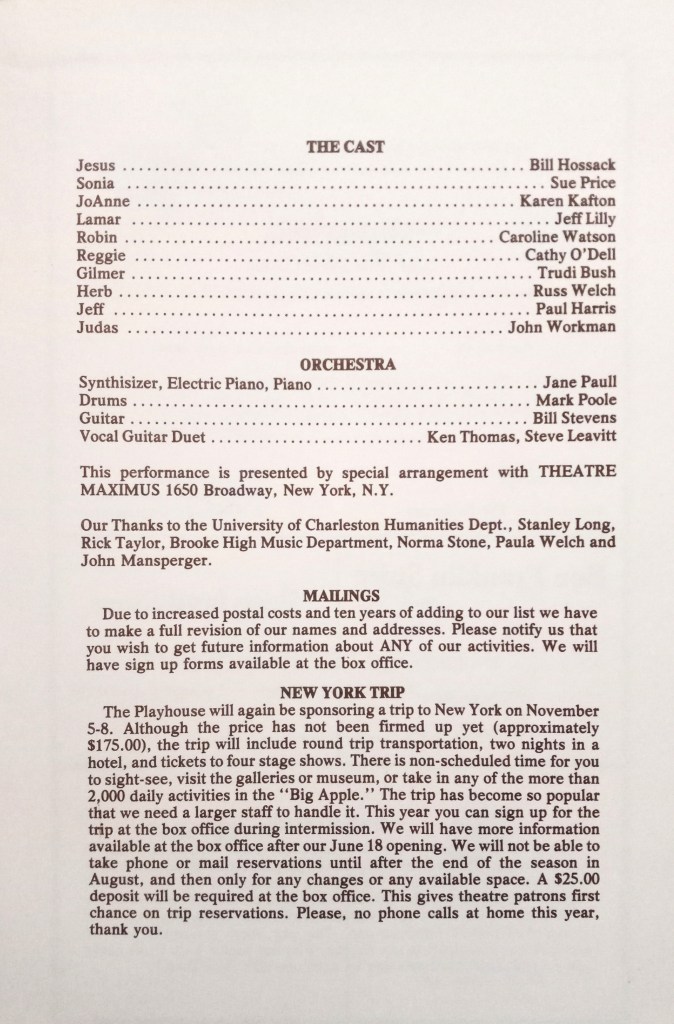
Bill Hossack, whose memories are recorded in the previous entry, Part 19, played Jesus in the loving retelling of the Gospel of Matthew. He wrote, “I have no mental pictures of Godspell, but what I know is that the show and the role were particularly significant and meaningful to me. As a young person, raised in the Methodist Church, and introduced to the gospel stories by the Reverend Donald Bower, (a gifted teacher, and a sensitive and humane interpreter of the gospels, who urged his parishioners, young and old and everyone in between, to live the Beatitudes), I know that I felt a responsibility to the character and the story we were telling, to make it alive, to really live in the moment. And I am grateful for having been given the opportunity to perform in the musical.” I love what he wrote.
My mother and grandmother, both wonderful Christians, came on opening night, and I couldn’t wait to talk to them about it. Oh, boy, was that a mistake! I stopped at Mom’s a day or so later, and she gave me an earful. The show was “sacrilegious;” it was “mocking;” “if you weren’t my daughter, Mother (meaning her mother, my grandmother) and I would have walked out.” I was stunned and felt just awful. I sucked it up, but I wanted to cry. I knew the show was one of the best we’d ever put on our stage. There were no weak links. I apologized and left.
A few days later, my mom called to ask when I’d be stopping by. I had been avoiding her, and she knew it. Reluctantly, I said I’d be by later that day. When I arrived at Mom and Dad’s, she was waiting for me with all smiles. “I was a little hard on you about the show, Shari,” she said, “but I’ve had some time to think about it, and Mother and I have talked about the show, and we’ve come to the conclusion that Godspell did a great job of interpreting the Gospel of Matthew for a younger audience. It might even bring some people to Christ. I really did love the music. I may have to come see it again.”
I don’t think she saw it a second time, but I was so relieved that she had changed her mind about that wonderful show.
BAREFOOT IN THE PARK
Dick Overmyer directed the second show, Barefoot in the Park, the show we had produced as the second show of our very first season back in 1972, ten seasons earlier. Dick was accustomed to the 6-8 week rehearsal schedules which academic theatre afforded, and I think he was amazed at the progress the cast showed at every rehearsal during their 2-week schedule.
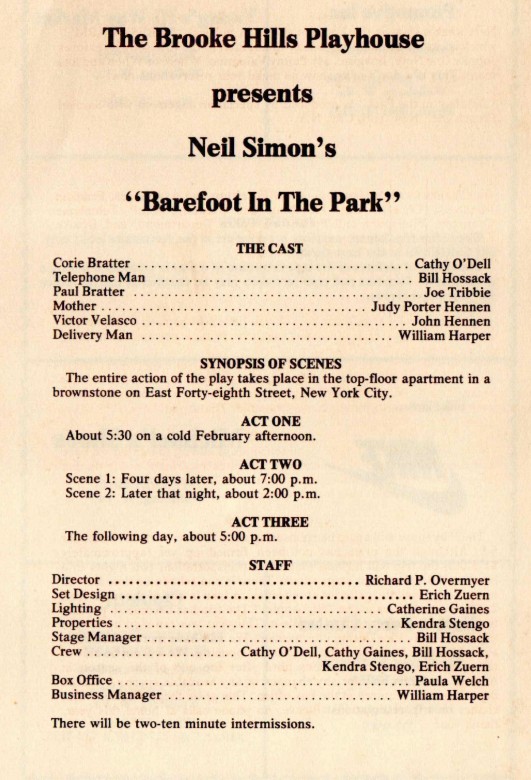
The William Harper listed in the cast as playing the Delivery Man was actually William Harper, Sr. You may remember the story of Mr. Harper told in Part 16, 1978, of this memoir. He simply couldn’t remember his lines as the Indian chief, so he wrote them on a series of Masonite cut-out tomahawks! Mr. Harper was a little guy, about 5’4’, nice looking, with wavy white hair. This part in Barefoot was perfect for him. All he had to do was pretend he had just walked up six flights of steps, gasp for breath several times, hand the leading lady, Cathy O’Dell, three packages, say something gurgling like “Argh, argh,” and exit. He always got a couple of laughs, and I know he enjoyed doing the show.
The William Harper listed in the staff portion of the program was William Harper, Jr., the brains behind the Playhouse remodeling, who taught so many of us what it meant to be “doing summer stock theater.” He was also my husband for nine years.
When the anonymous review came out in the Steubenville Herald Star, we were thrilled. The reviewer had wonderful things to say about the Hennens. The reviewer raved about Judy, who had played the young wife 10 seasons earlier, and was now playing the mother. John, who had played the telephone repairman, now played opposite Judy as the eccentric, upstairs neighbor, and he, too, was applauded. The leads, played by Cathy O’Dell and Joe Tribbe, were not forgotten either. Honestly, the review just gushed!
Here are some excerpts from the review with the headline:
Brooke Players Sparkle Again
Judy Hennen’s portrayal of the mother can only be described as magnificent. This talented actress possesses the vitality to carry any script, but when armed with a strong, very funny Neil Simon script, the material and talent are welded into a memorable evening of entertainment at the barn.
John Hennen, playing opposite his wife, presents a fine-tuned and talented interpretation of the occupant upstairs.
Judy and John complemented each other’s performances and should not be missed.
Even though the Hennens shine in the play, this does not mean that Cathy’Odell and Joe Tribbe, playing the newlyweds, are flat in their performances. Cathy and Joe work well together on stage and present the audience with three acts of fun.
As was said last week [in a Godspell review], Cathy is a very, very talented young actress, and more should be seen from her in the future. As the lead in Barefoot in the Park, she is wonderful.
Cathy presents an ease on stage that is a joy to watch. Her anticipation when working with Joe, Judy, or John is so natural that one forgets that it is a stage production, but rather, begins to believe they are actually in the living room of a New York apartment.
Joe Tribbe complements Cathy and also is a strong link in this fine cast.
Under the direction of Richard P. (Dick) Overmyer, the cast takes the script and makes it live with fun and enthusiasm.
ARSENIC AND OLD LACE
The review of Arsenic and Old Lace by our friend Matz Malone says volumes about the season’s third show, another revival which had also been produced in 1972. This is the only thing that remains in our files from this wonderfully entertaining old comedy.
The long review with this picture is the only thing that remains in our files from this wonderfully entertaining old comedy.


Excerpts from the Review of Arsenic and Old Lace in the Steubenville Herald Star by Matz Malone
The production of Arsenic and Old Lace is fun, fast-paced and well-done—as is the rule, rather than the exception at the Brooke Hills Playhouse.
Anyone thinking the Upper Ohio Valley is a wasteland for talent will be greatly surprised after attending a Brooke Hills Playhouse production—especially this offering.
Highlights of the play have to be the ease and comfort of the interpretations of Miss Abby, played by Jean Carlson, and Miss Martha by Mary Neal. The delivery and believable performances by these two talented ladies make the show shine.
Ms. Carlson’s timing and delivery are not overdone and give the audience the impression that the part was written only for her. The other half of the sister team, Ms. Neal, is utterly lovable. Both ladies show considerable understanding of the parts they portray and work well together. More should be seen from both of these talented ladies.
The review went on with phrases like “Russ Welch sparkles” as the “Teddy Roosevelt” brother, and he “expands his list of accomplishments each year.”
Richard Ferguson “gives another fine performance and is as comfortable in a bit part as he is in a leading role.”
Ken Kasprzak “in his first appearance on the barn theater stage, receives very high marks for his efforts. Ken is the heavy in the play and genuinely comes across as “THE” heavy. Much more should be seen from this talented young man.”
Ken’s sidekick, played by Bill Hossack, is comfortable and very easy going in his delivery and approach to the part. Coupled with an ease that shows astute stage presence, Bill’s part requires a German dialect, which is not overdone.
Rounding out the cast are Monica Rasz, Richard Call, John Workman, Charles Calabrese, Richard Ivaun, and Richard Overmyer.
HALFWAY THROUGH THE SEASON
Once that third show opens, the season is like a full barrel rolling at top speed downhill! The final three shows are cast and are in rehearsal. Scenery elements are being painted out in the yard while other pieces are being built in the lobby. Rehearsals are run every evening. Depending on the work schedules of the cast members, on a weekend, all three shows might rehearse at different times during the day.
Often, there would be a family reunion or a company picnic in the nearby Kiwanis shelter, so we couldn’t use it for rehearsals. When the picnickers came over to the barn to use the restroom, they often stayed around for a while to watch a rehearsal in the backyard, on the stage, or in the lobby.
Sometimes, a picnicker would ask, “What are you doing here?” and someone would explain. Once in a great while, a picnicker would return the following day or week and buy a ticket to see an evening show.
EVERYBODY LOVES OPAL
The fourth show received another glowing review from Matz. The big headline said, Everyone Should Love Everyone Loves Opal. (The name of the play was incorrect, but it was close enough! “Everyone” instead of “Everybody.”) In the review, Matz related a couple of cute stories.
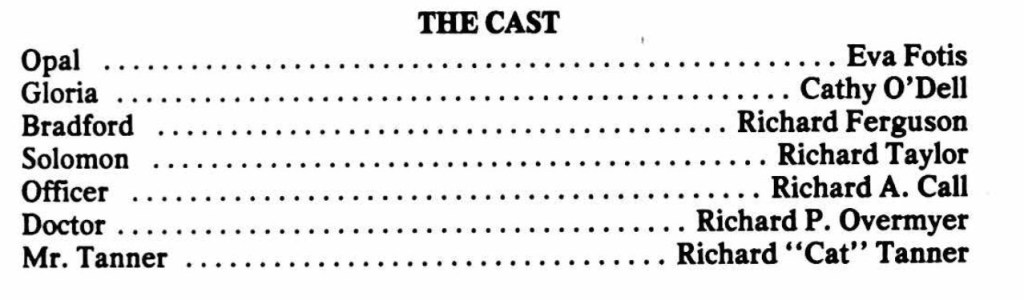
First, he told about the 6-person cast that had four guys named “Richard” in it, certainly unusual!
Second, Matz told the cat’s story. Before we even had to go borrow a cat from someone, an orange-striped tabby walked through the barn during auditions and made himself comfortable! He seemed happy to stay, probably because someone immediately ran out and bought canned cat food. The cat’s character name in the play was Mr. Tanner. It seemed fitting to list him in the program as another “Richard.”
The show was a sweet play. Eva Fotis, who played the kind, always-forgiving, and ever-optimistic character of Opal, was perfect for the role. Opal is so nice she even wins over the “bad” guys played by O’Dell, Ferguson, and Call (who all relished their parts). Since the show went well, we scheduled the sequel, Opal Is a Diamond, for the 1982 season, and Eva reprised her role.

I tried to locate Eva recently only to discover that she had died in 2017. Sadly, her obituary was very short.
Eva Fotis, 66, of Weirton, passed away Wednesday, November 1, 2017 at the Weirton Medical Center. Born February 27, 1951, in Weirton, she was the daughter of the late Gus and Hazel (Sabo) Fotis. Eva was a 1970 Weir High graduate. She went on to receive her bachelor’s degree from West Liberty University and her master’s in fine arts from Ohio University. Friends will be received on Tuesday from 10:00 a.m. until the time of funeral services at 11:00 at the All Saints Greek Orthodox Church, Weirton. Fr. Frank Milanese will officiate.
BABES IN ARMS
If you remember those old black and white movies with Micky Rooney and Judy Garland where someone says, “Let’s put on a show,” you are familiar with the plot of the Rogers and Hart musical Babes in Arms, the fourth show of 1981.
Even if the title of the show isn’t familiar, the score is loaded with songs that were sung by crooners for decades— “I Wish I Were in Love Again,” “Where or When,” “My Funny Valentine,” “The Lady Is a Tramp,” and “Johnny One-Note.” It still seems crazy to me that very few people know the title of this show, which had five, bona fide hit songs (songs that were recorded by all the big-name singers of the ‘40s and ‘50s). Broadway musicals with one or two hit songs outside of the show are big deals. FIVE—unheard of, yet Babes in Arms had five!
My dear friend for decades, former roommate, co-worker in two disparate school districts, partner in crime and play productions, and one of the original Barn Stormers in 1972, Norma Stone, directed Babes in Arms, a snappy and popular production. Norma was the drama teacher at Brooke High School, and she, Rick Taylor, and I had been doing musicals and Madrigal Dinners together for quite a few years by this time. For this show, however, Rick and I were both commuting to Morgantown for grad classes at W.V.U., so Norma teamed up with Cindy Belardine as her musical director and Erich Zuern as her designer. They proved to be another blockbuster trio.
Babes required tap dancing by the entire cast, I think. The cast would traipse over to a dance studio in Steubenville for lessons from C. R. Wilson, who also choreographed the show. With few exceptions, the cast was very young, and Norma, so used to working with high school students, was the perfect director.
Gosh, I wish we had a photo of the cast doing their thing in their tap shoes!
NOT NOW, DARLING
A wonderfully funny British farce, Not Now, Darling, by Ray Cooney and John Chapman (which had opened our 1975 season) had audiences rolling in the aisles again, as it rounded out the 1981 season. The duo also wrote two other farces that we produced over the years, Move Over, Mrs. Markham (1988) and There Goes the Bride (1984).
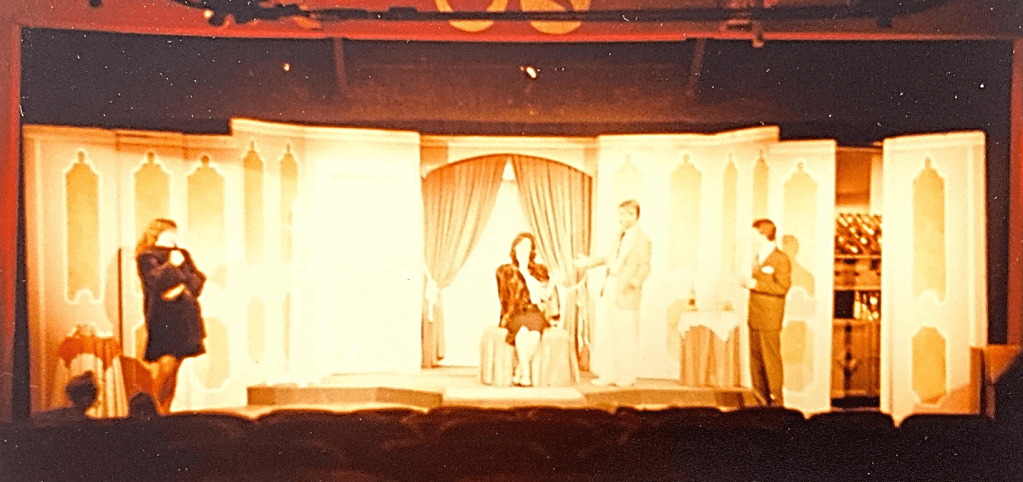
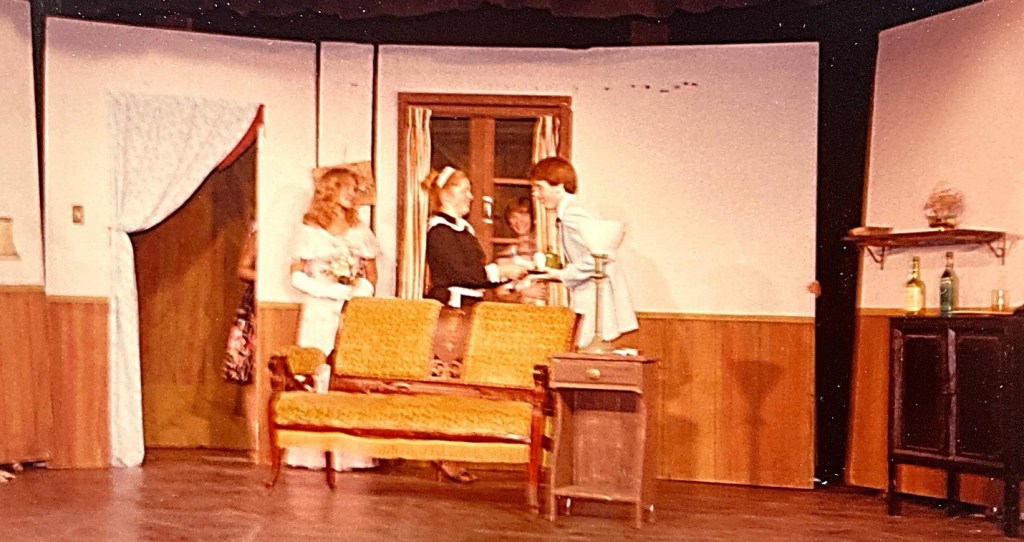
The show was directed by Playhouse regular Richard Ferguson, his first directing stint, but not his last, and the beautiful set, an exclusive London furrier’s salon, was designed and executed by Erich Zuern. That set with its raised platform, classic crown molding, decorative panels, drinks cabinet, and upstage arched entrance was a knockout. We’d come a long way from the board and burlap days!
RICK CALL REMEMBERS
Rick Call grew up in the East End of Steubenville, Ohio and went to Wintersville High School. “I played clarinet in the high school band,” said Rick, “but I also took up guitar, and over the years, I’ve played in a lot of unpopular bands—no Top 40s! Everybody wanted to be The Beatles, but those jobs were taken. I mean, I spent hundreds of hours on stage playing music, but I was always interested in drama. I always thought I could act.”
And Rick’s right. Many of us look at a painting like Picasso’s Guernica, and we think, “Yike! I could never put that kind of agony on canvas.” Or we see Michaelangelo’s David and marvel at the detail in marble, no less. We hear Beethoven’s Fifth Symphony and are bowled over by its power, knowing we couldn’t come close to duplicating something so glorious. But seeing a play, we just might think, “Heck, I talk all day, and a lot of time I’m acting in real life. I could do that. I could act.”

Fortunately, for the Brooke Hills Playhouse and for little theatres around the country, there really are a lot of people who can act, who can put themselves into another character’s “skin,” and make that character loved or despised by friends, family members, and perfect strangers! If, and this is a big if, if they can memorize lines and not bump into the furniture!
After high school graduation, Rick went to Kent State University and earned his B.S. in Chemistry. Then it was off to Los Angeles from 1971 to 1974, where he used his degree in the cosmetics industry. After three years in the big city, he returned to Steubenville and took over the family business.
“My grandfather had started the Call Insurance Agency in Steubenville in 1921,” said Rick. “He would walk the alleys in town and talk to the guys fixing their cars. Then he’d sell them insurance. At some point, my dad took over the business, and in 1974 I joined it as well.”
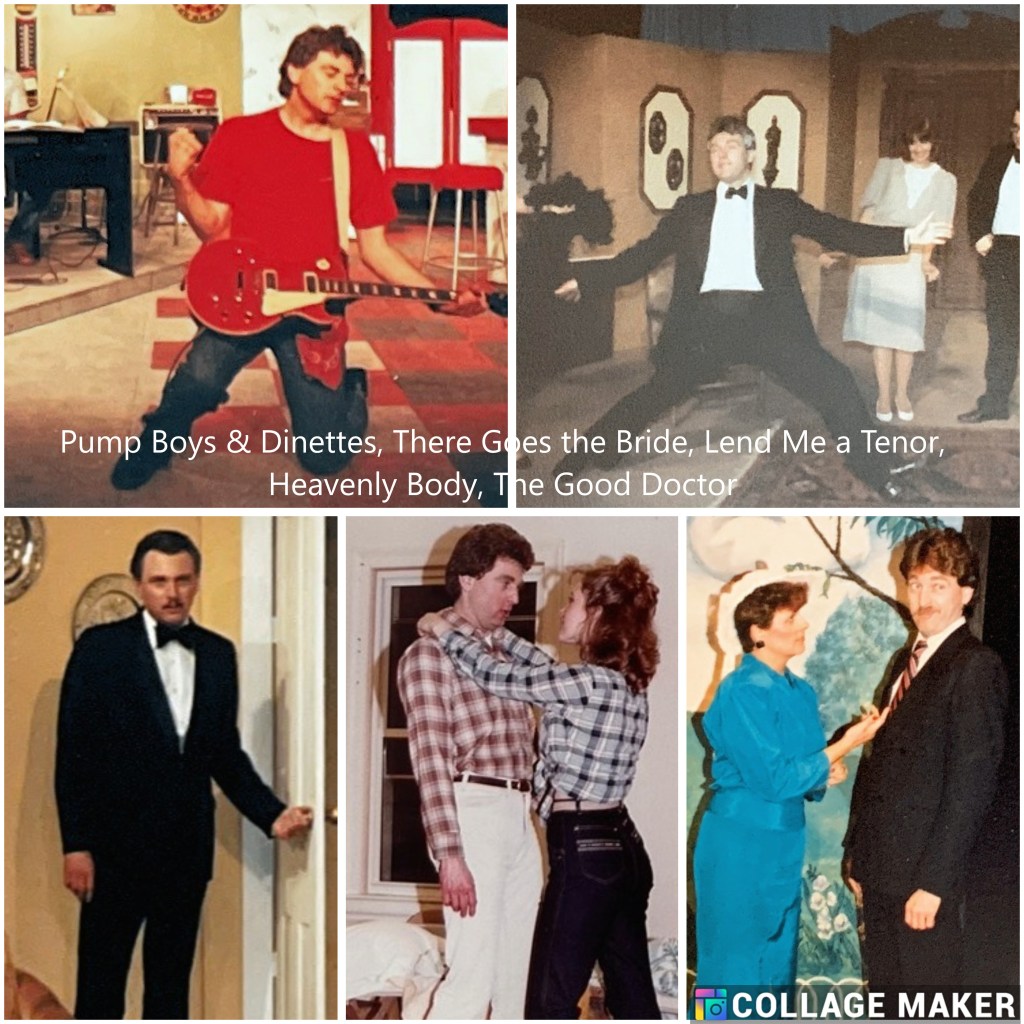
And in 1975, Rick auditioned for his first play, Finishing Touches, with the Steubenville Players and got a part. “I had been on stage, playing in a lot of bands for hundreds of hours,” said Rick, “and I didn’t have stage fright. I did two more plays with the Steubenville Players in 1980 and one in March of 1981. That spring I saw the announcement for auditions at Brooke Hills Playhouse. The acting bug had bitten me, and I was in love with the theatre. Brooke Hills had a solid reputation. I was cast in Arsenic and Old Lace. All in all, I spent 39 years acting on numerous stages around the Ohio Valley, including 24 summers at Brooke Hills.”
Unlike so many “theatre people,” Rick, who confesses to be anal retentive, kept a wonderful accounting of his stage career. He calls it THE LIST. It lists the name of the show, the date it opened, the role he played, the theatre where the show was performed, and how many performances each show ran.
[NOTE FROM SHARI: How I wish I had been so foresightful! I look at the list of shows we produced over the 24 summers I was at Brooke Hills, and in many instances, I can’t tell you which shows I directed or designed or ran props for or worked the box office, wrote press releases, or did whatever!]
THE RICK CALL LIST shows that from May 1975 to December 2014, Rick acted in 122 plays (43 at Brooke Hills) for 898 performances at 17 different theatres. That is an impressive list for a professional actor, let alone one who was holding down a full-time job! “Call Insurance was my sponsor,” said Rick, “It sponsored my music and theatre habits.”
With that many shows under his belt, Rick has lots of memories. “I distinctly remember a little spiel that you gave, Shari, something like, ‘I know you are not getting paid to do this, but you hustle to get to rehearsal every day. You learn your lines. You work hard with your fellow actors and crew members to get the show on. You’re not a professional. You’re an amateur. Take pride in that. That word ‘amateur’ is from the Latin word ‘amare,’ which means ‘to love.’ You’re not doing this for money. You’re doing this show because you love what you’re doing, and that love will be apparent on this stage every night. So, thanks for being here and sharing your love of theater with the Playhouse and our audiences.’
[NOTE FROM SHARI: Over the years, I gave some iteration or other of that speech many, many times! LOL!]
“I never took a vacation,” said Rick. “In 1983, I did the spring show that the Playhouse produced in April at the Brooke County Museum, and then I was in EVERY show of the SIX-show season at the barn! That’s seven shows, one right after another! I went to Wellsburg or Brooke Hills every day. That was my vacation.
“That same year, a lot of us were in the crazy musical called Something’s Afoot, and we were also in the following show, the farce See How They Run. We’d be performing Something’s Afoot upstairs on stage, and whenever we were offstage for a few pages, we’d run downstairs and over to the Kiwanis picnic shelter where See How They Run was rehearsing.
“Whenever someone arrived for rehearsal, someone would ask, ‘Are you dead yet?’ because nearly everyone dies in Something’s Afoot, and once you were dead, you could stay for the remainder of the rehearsal. Well, you could stay until it was time for the Something’s Afoot curtain call. If you weren’t ‘dead’ yet, you’d have to run back over to the barn and up those steep back stairs for your next entrance. Those were some wild rehearsals!”
At the Playhouse, we never had the luxury of understudies. People went on with raspy voices, broken toes, bellies full of Maalox in an effort to overcome stage fright, arms in casts, and I don’t know what all! In 1986, we were doing a little comedy called Breakfast with Les and Bess. A Brooke County teacher named Jim McElroy had caught the acting bug like Rick had, and he had a very small part in Les and Bess. Unfortunately, after Jim arrived at the theatre around 6:30 p.m., he started vomiting—violently, and he couldn’t stop. Food poisoning? Maybe.
Even though Jim only had two lines, there was no way he could go on. Worried, we had called Mary Jane, his wife, as Jim couldn’t take more than a few steps away from the backstage toilet before having to turn around and go vomit again!
“I remember one Friday evening, I was sitting at home watching Jeopardy when the phone rang,” said Rick. “It was a few minutes after 7:00 p.m., and the caller was Shari, who told me that Jim McElroy was barfing his brains out and couldn’t do the show at 8:00! She asked if I could come down and do the role, only two lines. Of course, I hopped in my car, repeating the two lines for the 25-minute drive. I was on stage about an hour later.”
Filling in is never very comfortable for the fill-in actor or the rest of the cast, but every so often, little theatres have the situation where a fill-in is needed. And when it does happen, everyone from the director to the leads to the ushers is super grateful for the person who says, “Sure, I’ll do it,” and saves the day’s performance. Fortunately, for the Playhouse, it only happened about a half dozen times in my 24 seasons.
Rick has another story where he agreed to fill in. “In a production of Never Too Late, somewhere beside the Playhouse,” said Rick, “one of the minor characters had a commitment on the two Friday evenings, and I was asked to fill in. I had about 6 lines and plenty of time to learn them, but those lines and my cues were all I learned. During both performances, for the short time I was on stage, some other actor ‘went up,’ lost his/her place or forgot something. It wasn’t up to me to fix it. I’m not sure I could. I just sat there! I never did get all my lines in.
“Cathie Barger Spencer and I were in several plays together at Brooke Hills. In 1988, we were in a mystery called Dead Wrong. Al Martin directed. At some point in the action, Cathie pulls out a gun, aims at me, and fires. One night, the gun didn’t go off, but I fell down anyway! It happened to be the night that Matz Malone, a writer for the Steubenville Herald Star, my hometown newspaper, was there to review the show.

“In the next day’s paper, there was the headline, ‘It Happens!’ Matz had written a great review, even detailing the silent gunshot and my dropping to the ground. He turned that big mess-up into a really great story. From then on, Al made sure to be backstage whenever we got to that part of the play. He’d be ready with two slap boards that simulate a gunshot sound, just in case. Of course, the gun fired right on cue every other night!”
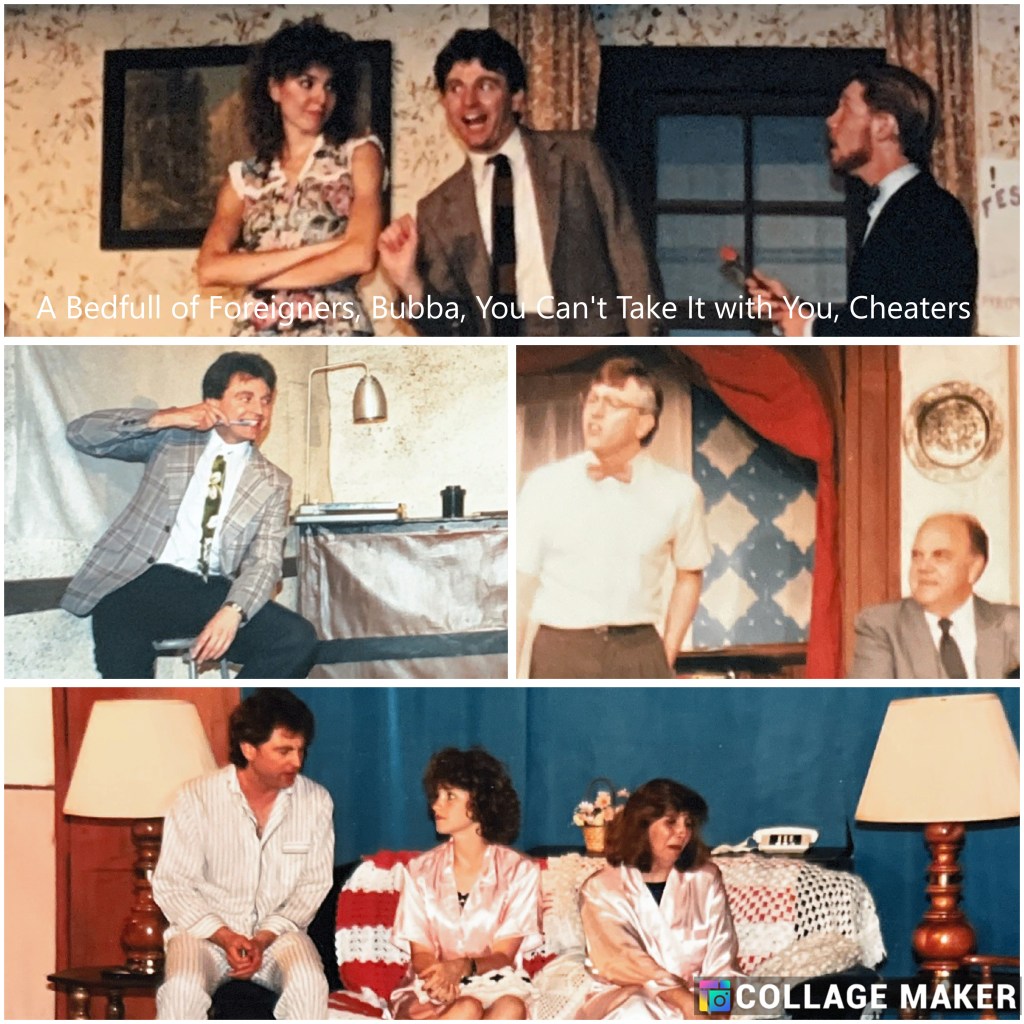
Also in 1988, this talented guy, Gregg Kreutz, who was an artist and an author in New York City, was visiting his in-laws on Rt. 88, not far from the Playhouse. The final show of the season was the farce Move Over, Mrs. Markham. Rick and Cathie were in that show together, also. Gregg saw the show, and that winter he wrote a farce called Bottoms Up! The Playhouse presented the show’s original production, and Gregg directed it.
“When the play was published by Samuel French (New York and London!),” said Rick, “it was a thrill to see the Brooke Hills Playhouse cast listed in the published script. That following summer, Gregg told Cathie and me that he had written our two roles with us in mind. I’d be lying if I didn’t say I was flattered.” In 1994, Rick also appeared in the second show Gregg wrote, Academia Nuts. And again, the Brooke Hills Playhouse cast was credited.

Rick has some great memories of shows at other theatres as well. In 1982, he was in Grease produced by the Steubenville Players. “I played Teen Angel,” said Rick, and John Maltese, writing for the Herald Star, gave me my greatest review ever: “Rick Call as Teen Angel stole the show.” Mic drop!
Rick has acted in three productions of A Christmas Carol—at the Capitol Music Hall and Towngate Theatre in Wheeling, and at West Liberty State College. The West Liberty production was A Christmas Carol, Scrooge and Marley in December 2011. Rick played Marley, and John Hennen, one of the Playhouse founders back in 1972, played Scrooge.
“The production had matinees and evening performances, something I hadn’t done very often,” said Rick. “Another interesting thing is that the director, Michael Aulick, gave me a CD to help me work on my English accent. I could probably have used that CD to greater advantage 20 years earlier!
Playing Marley with John Hennen was my favorite role ever, and I started thinking, ‘I love this role so much that I’ll never have another role like it. I’m done.’
“I’d been acting for 39 years. I had sold my business and retired in 2003,
and I was playing in a couple of bands. It just seemed the right thing to do.” Rick actually did five more shows, and after acting in the Towngate production of A Christmas Carol in December 2014, he walked away from acting.
“I had such a great time being in shows,” said Rick. “When I was just starting out, I was lucky to be on stage with some great actors at Brooke Hills—Cathy O’Dell, Bill Hossack, and so many more, and the Playhouse was so well run. I felt I was in good hands. I think there’s real beauty when acting in or volunteering at a community theatre. Everybody gets a chance to experience the thrill of participating in live theatre. It’s a kick, and I loved every audition, rehearsal, performance, and cast party!
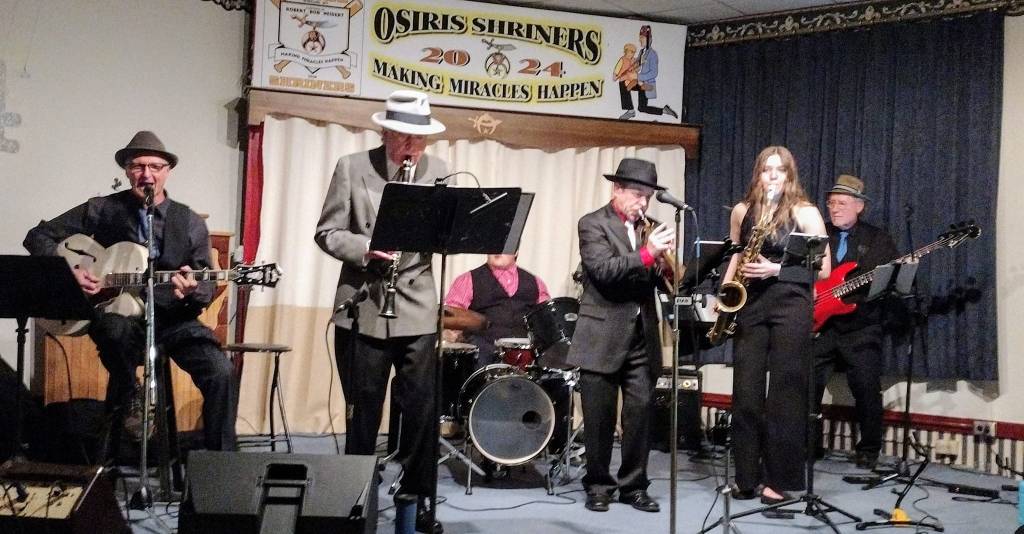
“I’m playing saxophone and clarinet in a 6–7-piece swing band now. It’s called Matt Hill and Friends. We play a lot of New Orleans-type gigs and swing dances. I’m the only person in the band without a degree in music, and frankly, it’s a little intimidating, but I’m having the time of my life. The band fulfills my need to create. Just as I occasionally miss acting, I know I’ll really miss playing in a band eventually.”


KAREN HALL HARRIGAN REMEMBERS
Karen Hall’s family was from Connecticut, but when Karen was in the 5th grade, the family moved to Bethany where Karen went to middle school before going on to Brooke High.
“When we were kids,” said Karen, “my parents would take my sisters and me to see shows. We always liked going to plays, and my sisters and I loved to ‘put on a show.’ I think that’s how I got hooked on theater.
“In middle school, we kids begged our teachers to do a play. The principal got some students from Bethany College to help us put on a play. I think it was You’re a Good Man, Charlie Brown. Whatever it was, I loved it. I also got lucky, because I really wanted to build things (scenery, maybe?), and when I was in middle school, the county changed its policy, and girls got to take shop.”
In 1980, Karen began her long association with Brooke Hills Playhouse when she was cast in Oklahoma! and started hanging out at the barn. She distinctly remembers seeing A Funny Thing Happened on the Way to the Forum that summer, and the following spring (1981), she graduated from Brooke High after being in Guys and Dolls.
Following her freshman year as a drama major at West Liberty State College, she was hired as a staff member at the Playhouse for the 1982 and 1983 seasons.
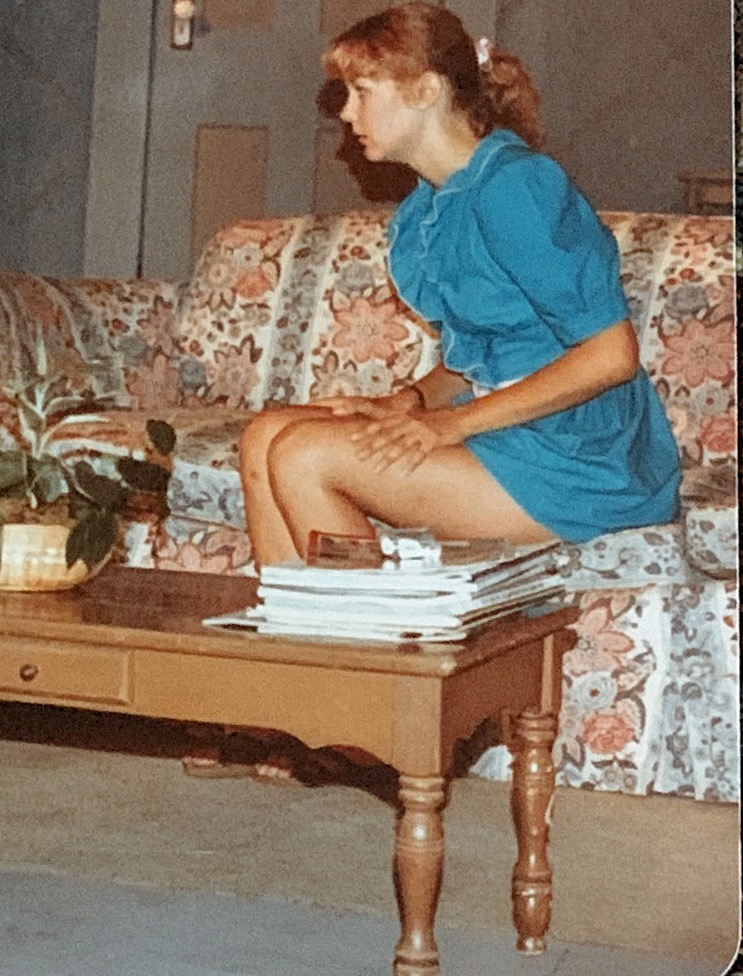
“At West Lib, I went for an elementary teaching degree but ended up spending all my time in the theater,” said Karen, “so I switched to a technical theater degree. I had to take courses in acting and directing, but I took every course I could in stagecraft and design. I found my niche in theatre early on, and I loved everything connected with what goes on behind the scenes of a show—scenery design and construction mostly, but also costumes, props, lighting, sound, whatever made a stage show work.
Also, I was so lucky to have Meta Lasch Deenis as my technical theater professor, mentor, and now life-long friend. Her influence on my entire life has been wonderful beyond measure, and we are still very close.” Karen graduated from West Liberty in 1985.
“After graduating,” said Karen, “I went back to West Liberty to get my teaching degree in art, hoping to be an art teacher. I graduated again in 1987, but with the recession, districts were cutting music, art, and drama positions, and there were no jobs.”
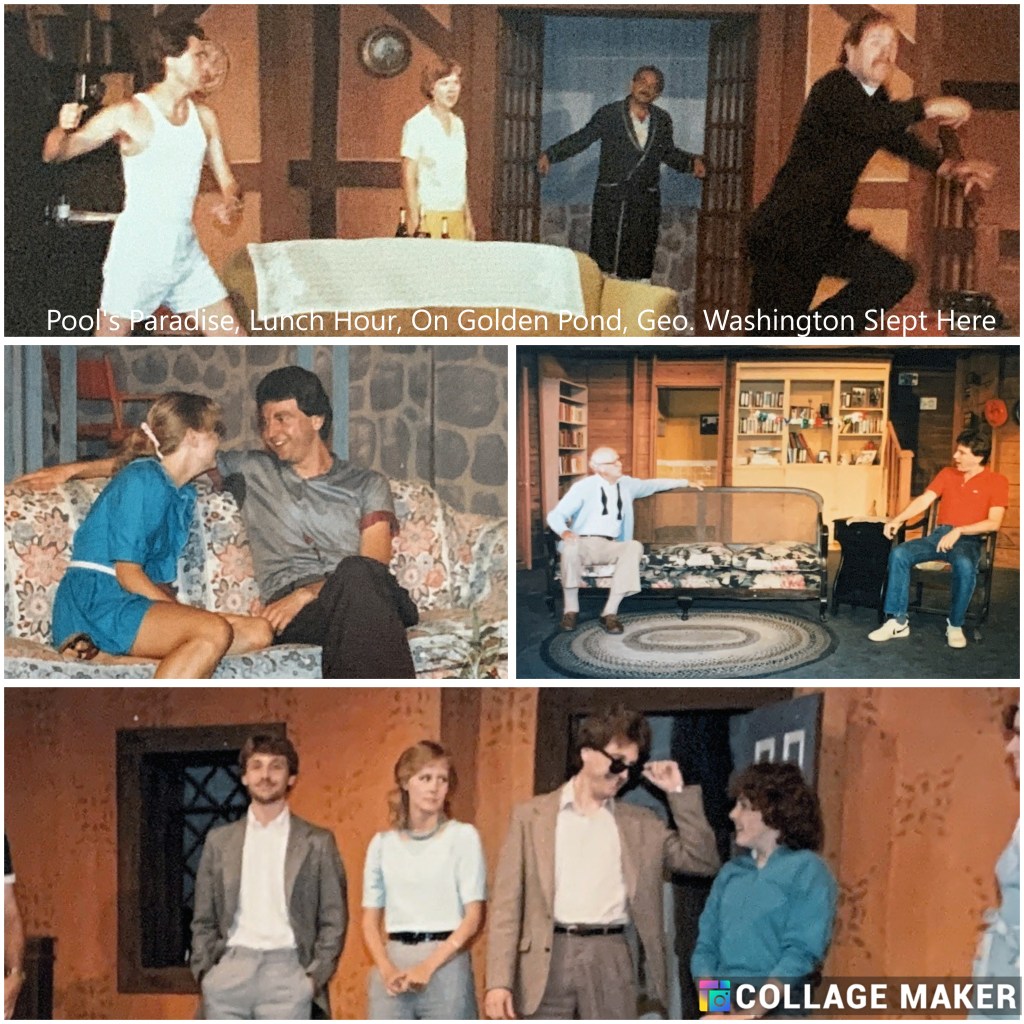
Karen wasn’t on the Playhouse staff during the 1984 season. She had been hired as the technical director at Towngate Theater in Wheeling that year and the next. “Actually, I worked at both Towngate and also at Brooke Hills in 1985 summer, and I was in the comedy, George Washington Slept Here, at the Playhouse as well.
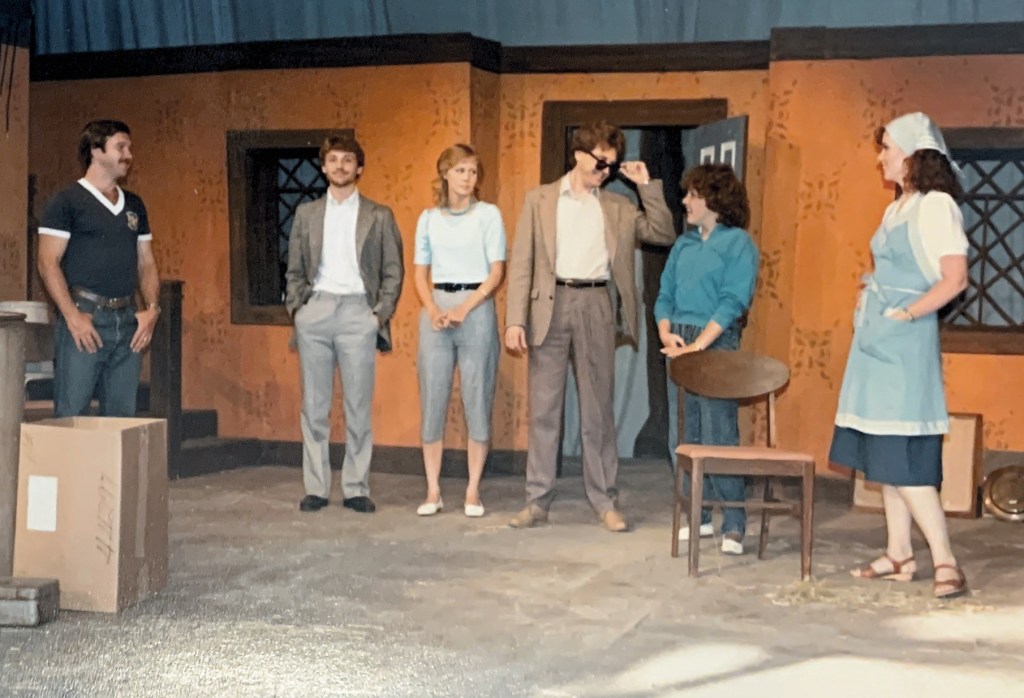
After several years on the Playhouse staff and with design and tech experience under her belt while at West Liberty, Karen returned to the Playhouse as our Designer/Technical Director for the 1985, 1986, and 1987 seasons. She not only designed shows, but she oversaw their construction and painting and all the other aspects of the productions. She supervised the staffs of 5 to 9 members plus volunteers, directed two shows—The Butler Did It, the final show of 1985, and The Foreigner in 1987, and acted in several shows! I think she was probably our youngest director, but she was well-trained and knew what she was doing.
Karen was our first “home grown” designer/tech director. Before Karen, our designer/tech directors had been from out of state.
Karen said, “During rehearsals of The Foreigner, it seemed like no one was taking me seriously, probably because I was young. Also, many of the cast members were friends, and we often joked around. But this was serious. We had a show to get on. Finally, during one rehearsal, I stood up from my seat in the house and said or commanded, ‘Go home.’
“I think they all turned and said, ‘What?’
“I said, ‘You don’t know your lines. You’re goofing off during rehearsal. Go home.’ Then I left.”
“The next day’s rehearsal and every rehearsal after that was great, disciplined, full of good energy, and it was obvious that people had been studying their lines! And the show was very funny and entertaining.”

I’m always relieved when former staff members or actors tell me they have wonderful memories from their time at the Playhouse. Karen said, “I loved Al Martin. He taught me so much. For one thing he taught me a lot of scene-painting techniques, like how to make painted bricks, clapboards, or a stone wall look 3-dimensional. Al and I would work hard getting flats or window units or fireplaces built, but we always had fun. And once in a while, he’d kind of flirt with me and say, ‘Ah, Karen, if I were younger…’
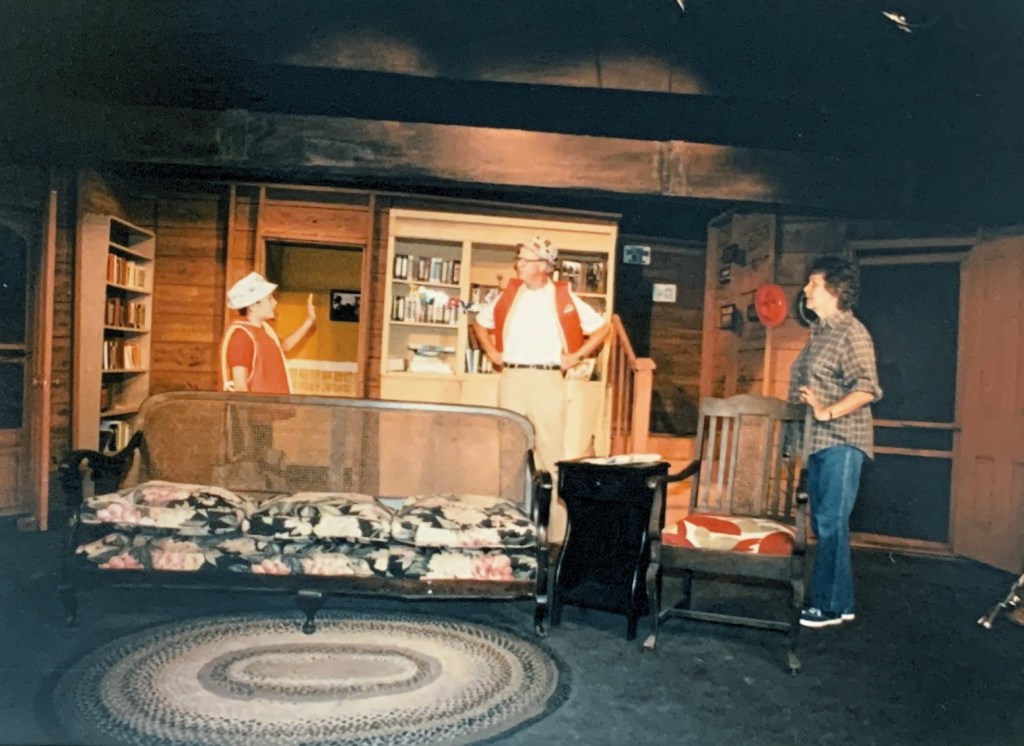
“Al directed Fools in 1985, and I was in it,” Karen continued. “The show, written by Neil Simon, is based on the stories of Chekov. I loved that show. It was so much fun to do. The cast was fun, and Al was in his element directing a sweet, touching show, so much like him. It’s still my favorite.
“Every summer, Al would take me to dinner at the Drover’s Inn, just the two of us. It was always a memorable evening.
“Of course, I remember the volleyball games after breakfast, lunch, and dinner, and Shari, I remember watching your Andrew grow up. My first summer on the staff, he wasn’t even one year old, but he’d be in his playpen in the lobby for a while each day while we were building and painting scenery all around him. Later, when he was a toddler, I remember watching him play with our tools. He was a natural!”
[NOTE from Shari: Andrew loved the Playhouse and especially the tools. He was pounding nails at three and a half with a hammer nearly as big as he was. Toy tools held no appeal for him. He begged to be allowed to stay late for strike nights, and I finally let him stay for a while as we were taking down the old set when he was five. His job was carrying things down to the lobby. He probably made 50 trips up and down the ramp every strike that year. He also begged me for a Mikita battery-powered drill driver for a couple of years. Santa finally brought him one after he turned six. I think Karen would have loved growing up around tools as much as Andrew did, as she was so adept with them.]

Playhouse stage in his carpenter’s apron, 1985
In 1989, Karen moved back to Connecticut and earned her Master’s Degree in Special Education in 2010 at St. Joseph College. Years later in 2021, she earned another degree, this one in school administration at Connecticut Central State University, “but,” she said, “I have no intention of using it!”
She married (she is now Karen Hall Harrigan), had two sons, and divorced. Today, Karen lives in Newington, Connecticut, just outside of Hartford. Her sons Shaw and Zachary are grown and nearby, and Karen teaches math at the Greater Hartford Academy for the Arts.
MEMORIES CONTINUE IN PART 20-B, 1981

 Life Without Lesson Plans