
By Shari Murphy Coote and Friends

THE ELEVENTH SEASON, 1982
The Season That Nearly Didn’t Happen
| THE SHOWS |
| The Music Man Opal Is a Diamond Blythe Spirit H.M.S. Pinafore Not in the Book U.T.B.U. |
| THE STAFF |
| Shari Harper Al and Betty Martin Karen Hall Harrigan Mary Freshwater Geib Jim Wilson John Wilson Jim Matterer Caroline Watson Kelsey Hedrick Debbie Patterson R. W. (dismissed) |
SHARI WONDERS, “WHAT DO WE DO NOW?”
(CONTINUED FROM PART 20-B)
[NOTE: Here’s a synopsis of the end of Part 20-B to catch you up: When the 1981 season ended, Bill and my divorce was about to be final. He packed up the theatre equipment that belonged to him and moved on. So we had no heavy black curtains for masking the back of the stage, a couple of lights and a little cable, no light control board, and few tools.
We never had much money at the end of any season, but the last several summers we ended the season with enough money to reopen in the spring, at least $2,000. Now the bank balance was less than $1000, not enough to put season or audition announcement ads in the papers or on TV or radio. Not enough to pay royalties or order scripts. Not enough to meet the first few weeks’ payroll for our college staff members. It was not a pretty picture.
On the positive side, we didn’t owe any money, and we didn’t have to transform a barn into a theatre this time around. We had some tools and a lot of stage hardware. We had a stock of scenery, costumes, props, makeup, and some lighting equipment, and most importantly, there were a lot of local people who cared deeply for the Playhouse. We all wanted to carry on, but September was when we recouped from the just-finished season, when we rehashed what we had loved about the shows, when we told “Remember When…” stories of the goings on backstage and onstage. Usually, the next season was out of sight and out of mind.]
My son Andrew was born on October 6 (the same day our divorce was finalized), and the Playhouse problems moved to the back burner. Thankfully, our loyal cadre of actors and volunteers started to call. Eventually, we started thinking about what we could do to produce another season of plays and musicals at the Brooke Hills Playhouse.
In early November, a few of the Playhouse regulars got together, possibly at our favorite bar, Betts’s. At that informational meeting, I related our situation, which was bleak. Regardless, everyone was enthusiastic about keeping the Playhouse alive. Someone suggested that we put on a show, a la Judy Garland and Mickey Rooney, but where? The barn was out—too many shrunken boards letting the wind in, a plus in the summer, not so much in the fall or winter.
For the next week or so, I put Andrew in his car seat, and we drove around town looking for a place for the group to do something to raise some money. Churches were definite possibilities, as most churches already have a raised platform (a stage if you will) and good sightlines.
Then one day, BINGO! I drove by Miller’s Tavern, a historic building at the corner of 6th and Main Streets in Wellsburg overlooking the Ohio River. As a kid, I had been in that building several times. One of my best friends, Carol Stewart (now Carol Stewart Booth), had taken tap dancing lessons in that building, in a big room on the second floor, and I had gone with her to watch several times.
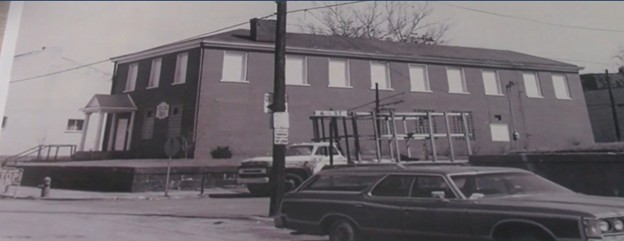
On this day, the building looked deserted except that there was a sign by the door proclaiming that the building housed the Brooke County Museum. The big upstairs windows were all covered with sheets of plywood, but I called the number on the sign when I got home.
A few days later, someone on the Museum Board let me into the building. The first floor housed the museum. When I asked about the upstairs, my guide, local historian Nancy Caldwell, I think, said it was empty and a big mess.
We went upstairs and turned on the lights. She was right! The floors were in terrible shape. The once-white walls were dingy, I think with layers of cigarette smoke. The fluorescent lighting had lots of burned-out bulbs, and the place was dark because the big windows were covered with plywood. A nice surprise was the second, wider set of stairs near the back of the building, and a kitchen which had counter space, cabinets, a double sink, and hook-ups for a refrigerator and a gas stove. But more than anything, it was cold! Freezing, to be exact! That level was no longer heated!
GETTING RE-ORGANIZED
Our ad hoc group met again, this time at the Museum. When Bill Harper, John Hennen, and I started the Playhouse in 1972, we incorporated as a for-profit corporation. It was obvious that the Playhouse was never going to make much of a profit, so the group discussed forming a not-for-profit corporation to be named the Brooke County Arts Council. The Arts Council would serve as an umbrella of sorts to oversee the productions in the summer at the Brooke Hills Playhouse and whatever the group would schedule in the fall, winter, and spring. We needed officers for the new corporation, and the one position which worried me the most was Treasurer. Hooray for Linda Huggins, actress and accountant, who stepped up and volunteered to take on that job. I can’t tell you what a big relief that was! Just thinking about payroll and taxes at the Playhouse, something Bill always handled, made me break out in a cold sweat! I would be the board president.
I’m pretty sure I went to attorney Bill Watson, a member of my church, a member of the Brooke Hills Park board, my divorce lawyer, and a dear friend! He drew up our articles of incorporation and filed them with the West Virginia Secretary of State’s office free of charge. We received our charter dated December 23, 1981.
At our January meeting, we “inspected” the room, and it seemed like everyone saw the possibilities. We would refurbish the second floor of the museum. The group just came alive with ideas. We discussed fundraising and decided to put on a small-cast comedy in the museum’s upstairs room. We’d have to re-do the floors (sand and seal). We’d have to replace the fluorescent light bulbs and paint the walls. AND we’d do the show “in the round.” We could bring platforms from the Playhouse to “build” a stage in the middle of the room. We’d have to get permission from the Brooke County Commission and the Museum Board, but, honestly, we just knew our group could do this. It was all very exciting, but I didn’t know how we were going to pay for everything.
Back in 1972, I went to the county commissioners’ meeting and asked for permission to transform the barn in Brooke Hills Park into a summer theatre. Now, with a bunch of our group behind me, I asked permission to transform the second floor of the museum into a small theatre-in-the-round, and I told them how we would do that. They asked a few questions, made a motion, stipulated that we get the approval of the museum board, and permission was granted. One of the commissioners, Henry Wilson (a Wellsburg businessman whose family owned and operated Wilson’s News for decades), excused himself from the meeting and showed us out, then he pulled me aside.
“Shari,” he said, “Dolly (his wife) and I would like to pay for the material that it will take to re-do the floor and walls—sander rental, sealer, and paint, but it has to be anonymous. Just bring me the receipts.” I was joyfully flabbergasted. He was as good as his word.
Before our next meeting, a couple of us went through the play service catalogues and ordered some scripts for shows with small casts to read as possible shows to produce. Some of the guys came up with our plan of attack—replace the fluorescent bulbs, paint the walls and ceiling, sand the floors, then seal them. For now, there was nothing we could do about the windows (the plywood would have to stay) or the heating (pray for mild weather).
Then someone came up with the brilliant idea of doing the show as a dinner-theatre! I am not kidding; we were on fire! Someone suggested that we consider Betty Cunningham, from Beech Bottom, I think, maybe Windsor Heights, to cater the dinner.
Someone contacted Betty who wanted to see the space and the kitchen. A couple of us met with her at the museum, and she agreed to be our caterer. She was great! And she used the Brooke County Cooperative Homemakers to help her cook. Members of our new arts council would act as servers. Each night would feature a different menu! The cost for the dinner and show? $12.00! The show would run for four performances over two weekends, Friday and Saturday, April 16 & 17, and April 23 & 24.
We borrowed tables and chairs from my church, the Wellsburg United Methodist, at 11th and Charles. This sounds so easy, but the tables and chairs had to be collapsed, taken out and loaded on someone’s truck, driven down the street to the museum, unloaded, and taken up the front steps of the museum, up the steps to the second floor, and set up. After the Saturday night performance, the process had to be reversed so the church could use the tables and chairs for their lunch/social hour after the Sunday service. The tiring process was repeated over the second weekend.
Since the show would be staged in the round, something our group had never done before, lighting the show proved to be a problem. First, we had very few lighting instruments, and we had no idea how to light a show in the round and not blind our audience!
YOU DO WHAT YOU HAVE TO DO
(OR WHAT YOU’RE CRAZY ENOUGH TO DO)
During our first ten Playhouse seasons, the Playhouse had acquired some lighting equipment, but the big black curtains, the bulk of the lighting instruments, and “Old Sparky,” the rheostats that were used to bring up and dim the lights, belonged to Bill personally. When he left, the curtains, lights, a lot of cables, and the big, old rheostats went with him. What to do?
I was teaching at Follansbee and Wellsburg Middle Schools. Wellsburg Middle had 12 Fresnels (a type of stage light with a short throw) hanging 40’ above the gym/auditorium stage floor. Not one of the instruments worked. I approached my principal, Kurt Tarr, and asked if he had any intention of replacing the lamps in those instruments. He did not. I then asked if he would consider loaning or donating those instruments to the Playhouse. He said he would give them to us, but of course, we’d have to get them down!
My Uncle Bob Hamilton just happened to have a 48’ ladder. One Saturday morning in the spring of 1982, Rick Taylor and Russ Welch picked up the ladder from the Hamiltons’ house and walked it the block and a half down Main Street to the middle school where I met them. Once the ladder was extended, Russ and Rick somehow stood it upright, then they secured it with brute strength alone, holding it perfectly perpendicular while I climbed straight up with a wrench in my pocket to unmount the Fresnels and bring them back down to the floor. I questioned my sanity with each trip up that ladder. Twelve trips up and down that tall, straight ladder, trusting the guys would hold it tight enough to ensure that my infant son didn’t become an orphan!
In truth, those Fresnels weren’t doing a thing for the middle school stage, even when they had working lamps in them. They were too far away from the stage for their throw. They were, however, perfect for the Playhouse and the Museum with their intimate settings, and they saved our bacon.
But how would we control them? My notes say that I applied for and received a $2500 emergency grant (maybe from the W. Va. Arts and Humanities Council?) for a compact 2-scene preset, lighting control board. We were still using this little gem at the barn and the museum when I left the Playhouse in 1995. It was a lot safer than the old rheostats and could be operated by the stage manager, off-stage left, instead of downstairs at the barn. (Eventually, the board was moved to an elevated platform at the back of the house for the “Master Electrician,” a fancy name for “Light Board Operator,” to run the cues from a place where he or she could see the stage.

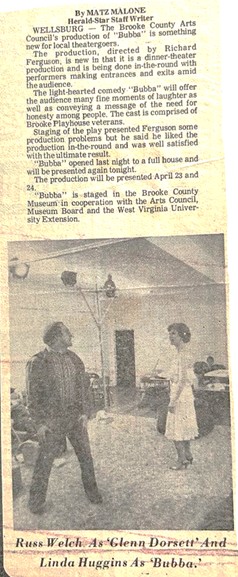
Anyway, a cute little 4-character comedy titled Bubba was selected for production. We asked high school student Mary Freshwater to handle publicity, and audition announcements (I think this was the first time we used our new title, Brooke County Arts Council) were sent out in February as the remodeling progressed. Richard Ferguson from St. Clairsville, Ohio, one of our most prolific actors and occasional directors, was chosen to direct the show.
GETTING THE WORD OUT
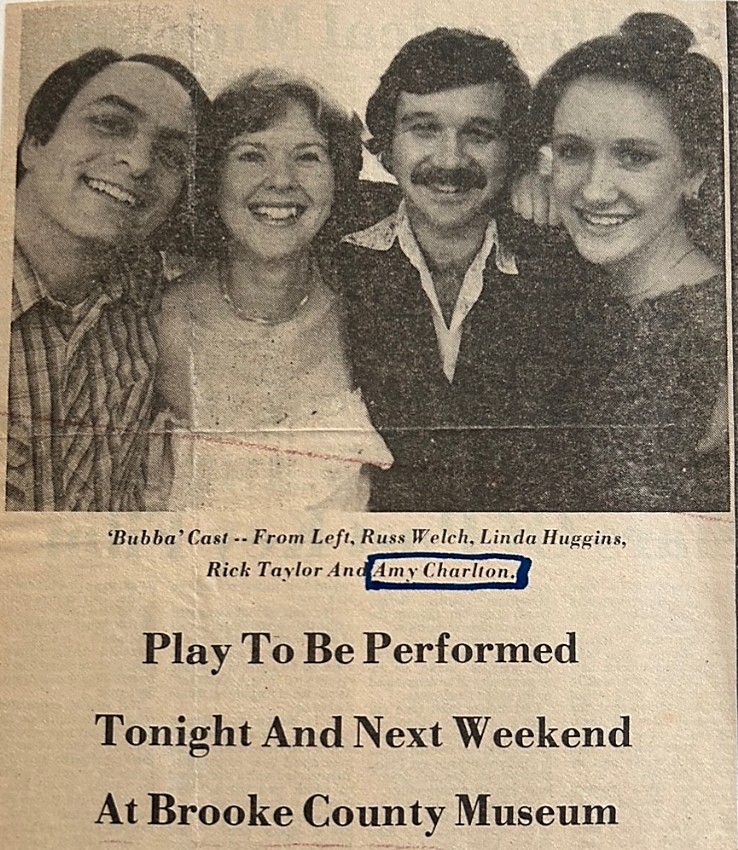
Once the show was cast, we took publicity photos, and Mary wrote press releases announcing the cast, dates, times, place, etc. for the papers from Moundsville to East Liverpool on both sides of the river and east to Washington, Pennsylvania.
Four very popular local actors were cast in the show: Linda Huggins, Amy Charlton, Rick Taylor, and Russ Welch. Our crew began constructing the stage, finding furniture and props, creating the program, and deep cleaning the museum kitchen.
In those days, we had a 600-name mailing list and a bulk mailing permit. Each name and address on the list was on a 3” x 5” index card. When the newsletters came back from the printer, I would divide up the newsletters and the index cards, and everyone would hand-address 50 or so newsletters, return them to me, and I’d mail them. Mailing newsletters was going to be a big expense, but we felt it was necessary as the people on the mailing list were, for the most part, proven customers. We didn’t have enough money to have newsletters printed. Somehow, we got them Xeroxed. I don’t know where the money for the paper and postage came from.
Someone (and I wish I could remember who) came up with the solution for lighting our stage in the round. Pieces of galvanized slotted angle iron from our stock at the Playhouse were attached vertically to each corner of the stage, and those pieces were braced and connected to each other up near the room’s ceiling with long horizontal angle iron pieces. Lights were hung focused down on the stage from the horizontal cross pieces, and cables were run across the floor, up the corner pipes to the lights.
A BIG BUNCH OF GRATITUDE
Even though we weren’t tackling anything as large as remodeling the barn, the process was still very time-consuming, and 1982 differed from 1972 in a very big way for me–ANDREW.
My parents, Mark and Jeannette Murphy, who had both helped with the opening of the Playhouse in 1972 (donating time, labor, and food), stepped up again. They were just great, babysitting while the Arts Council cleaned out the second floor of the Brooke County Museum and transformed it into a very usable space. During the summers of 1982 through 1992 (when Andrew started staying with me at the barn until the show was underway), my parents would come to the barn night after night to pick up Andrew and take him to our home in Follansbee, so he could sleep in his own bed. Without my parents’ help, I never would have been able to continue working at the Playhouse and the Museum—summer and winter, work on numerous shows at the schools where I taught, and direct shows at Wheeling Jesuit College and West Liberty State College.
READY TO ROLL
We had done everything we could to make the Museum’s second floor presentable. There still weren’t any windows or heat, but we could darken the house without a problem, and we would rely on body heat! So many people had worked on the project, and I think we named them all in the Bubba program. This big, beautiful, empty room had so much potential, and we would use it to great advantage for nearly two decades.

ON WITH THE SHOW
Bubba was a huge success. We never dreamed that one little comedy could save the Playhouse, but it did! We netted $3200(!), and we knew we’d have enough money to open the Playhouse for the 1982 season. While all the activity was happening, we were also reading scripts and hoping for a Playhouse season. We also realized that the Museum was a potential gold mine, so once the Playhouse season opened, we started looking for another show to do at the Museum in the fall.
Money in the bank! What a relief! We always opened the barn for spring cleaning and auditions on the last Saturday in May. When Bubba closed on April 24, 1982, we were exactly five weeks away from the Playhouse auditions, but we now had the money to pay the royalties for the first couple of shows, advertising for auditions and the season, and a season announcement newsletter printing and mailing. We had cut it close, but our loyal customers soon started purchasing season coupons, which helped us meet the early payrolls and production expenses.
FINALLY, WE GET THE PLAYHOUSE SEASON STARTED
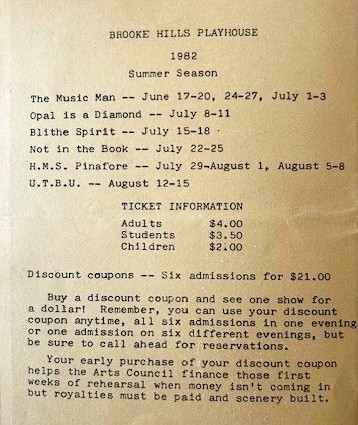
We settled on six shows for the 1982 season. Two shows made deciding the season a little easier. In 1981, we produced Everybody Loves Opal. It was a cute show, and the audiences liked it. It had a sequel, Opal Is a Diamond, so it was slated. We had done a crazy farce called U.T.B.U. (Unhealthy to Be Unpleasant) back in 1973. The audiences and cast loved the show about a vain, over-the-hill actor and a zany organization dedicated to erasing mean people from the world. Around the barn, people were still throwing out the occasional wacky line from the play. We decided to revive it.
We had learned that opening with a big-cast musical started the season off with a bang, and we settled on The Music Man, which delivered big time. We chose the Gilbert and Sullivan operetta, H.M.S. Pinafore, for the second musical. We learned a valuable lesson—don’t do two big musicals in the same season. It’s back-breaking! Music Man had a cast of 30, and Pinafore had a cast of 28. There were no royalties and only one set for Pinafore, which made it appealing, but there were a lot of costumes (although very few costume changes), and any large cast has its challenges when there is as little backstage space as we have at the Playhouse.
Blythe Spirit, a well-known sophisticated comedy by Noel Coward, and Not in the Book, a clever little comedy thriller, rounded out the 6-show season. Again, the season covered nine weeks, but we were still producing 4 one-week shows in this season. At one point, three one-weekers went up and down in a row. Can you say “backbreaking”?
JITTERS
Personally, I was apprehensive about this season. I was always confident of the many roles I had assumed at the Playhouse in the past (directing, set design and construction, props, box office, cook (not so confident!), publicity, occasionally acting, lighting, and even costuming), but I had never been responsible for “the whole ball of wax,” and I never had had to contend with an infant son. The situation was looming and intimidating. Thank goodness Al Martin would be returning for his eleventh season, and the board members of the new Arts Council were all solid Playhouse volunteers, many of whom had years of Playhouse experience under their belts.
The staff also helped to calm my jitters. It was a great, talented bunch of hard-working, dedicated young people, happy to be building, painting, acting, running crew, willingly doing whatever it took to get the shows on. Our paid staff was anchored by Karen Hall Harrigan. Karen had been with us for two seasons, and she joined the staff as the senior member this year. Mary Freshwater Geib was a very mature high school kid who had done a great job as the stage manager for the 1981 Brooke High spring musical. Jim Matterer had been in shows, and now he was tapped to be our cook, and Debbie Patterson, another one of our former high school students, would handle the publicity. My sister had “recruited” Kelsey Hedrick, a kid from East Liverpool with acting chops and tech ability, for the crew. The twins of Henry and Dolly Wilson (the couple who had paid for the museum remodeling materials), Jim and John, were welcomed aboard with the praise of their teacher at Madonna High School, Anne Roberts, one of our veterans.
We hired one other guy, R.W., to work tech and direct. He brought his wife along with him, which meant another mouth to feed, but he didn’t work out, and he is the one person in my 24 years at the Playhouse that I had to let go.
On Thursday, June 17, 1982, the season opened with a 76-trombone fanfare, metaphorically speaking, with The Music Man.
MICHAEL MUSANTE REMEMBERS
Mike Musante was 9 years old in May 1982. “My mother saw the announcement for auditions at Brooke Hills Playhouse,” said Mike, “and she said, ‘Hey, would you like to try this?’ I’m sure she did this because I was a non-stop talker even back then! It sounded like fun, and I was cast in the season’s opening show, The Music Man, as one of the town’s kids who would join Professor Harold Hill’s band.
“First, we had music rehearsals to learn the songs. I met a lot of people, and all the kids were fun. When the stage rehearsals started, the adults helped us kids with our entrances and exits. Shari, the director, gave me a line or two. I’ve always had a very loud voice.”
Shari takes over the story, “As rehearsals progressed, a problem developed. The kid I had cast to play Winthrop, the librarian’s young brother who can’t say the letter ‘s,’ couldn’t or wouldn’t learn his lines. His mother was in the show, and she had been in many others at the Playhouse and had directed a show or two, but she couldn’t get her son to do what needed to be done—learn his lines and the lyrics to his song, ‘Gary, Indiana.’ I was getting a little panicky, so I went to the mother. She was very understanding (quite a relief!) when I told her I was moving her son to the chorus.
“By this time, I had noticed this little dark-haired kid with big dark eyes in the chorus who was prompting the Winthrop actor. I also saw him mouthing the lines of every other character when he was on stage. I think he knew every line in the show! It was Michael Musante, and I talked to him for a few minutes. He was sharp as an ice pick, and I told him I was promoting him to play Winthrop.
“Mike said when his mom, Honey Musante, picked him up after rehearsal, he got into the car and said, ‘Mom, I’m playing Winthrop.’
“Honey said, ‘Why would you say that?’
“The next day, Honey asked me, ‘Do you think he can do this?’ I wasn’t 100 percent positive. Honestly, you’re always taking a chance with someone new, but I was pretty sure he could.
“Whew! That was one of the best moves I ever made. Mike was a natural. He didn’t have the greatest singing voice (the other kid had perfect pitch), but he could absolutely carry a tune, project his voice, and sell a song. More importantly, he WAS Winthrop. Once we broke him of the habit of mouthing everyone’s lines, he was just great! LOL!”
The year after The Music Man, it was back to the chorus for Mike in Annie Get Your Gun, and then in 1984, we didn’t produce any shows that called for a young person, so Mike had the summer off, but he did two shows in 1985. He was back to being a member of the chorus in Fiddler on the Roof, but later that summer, he played the young boy in On Golden Pond with Al and Betty Martin playing the elderly couple. Mike was a natural for that part. He was always good with older people in real life, asking them questions about their lives and anxious to hear their stories.
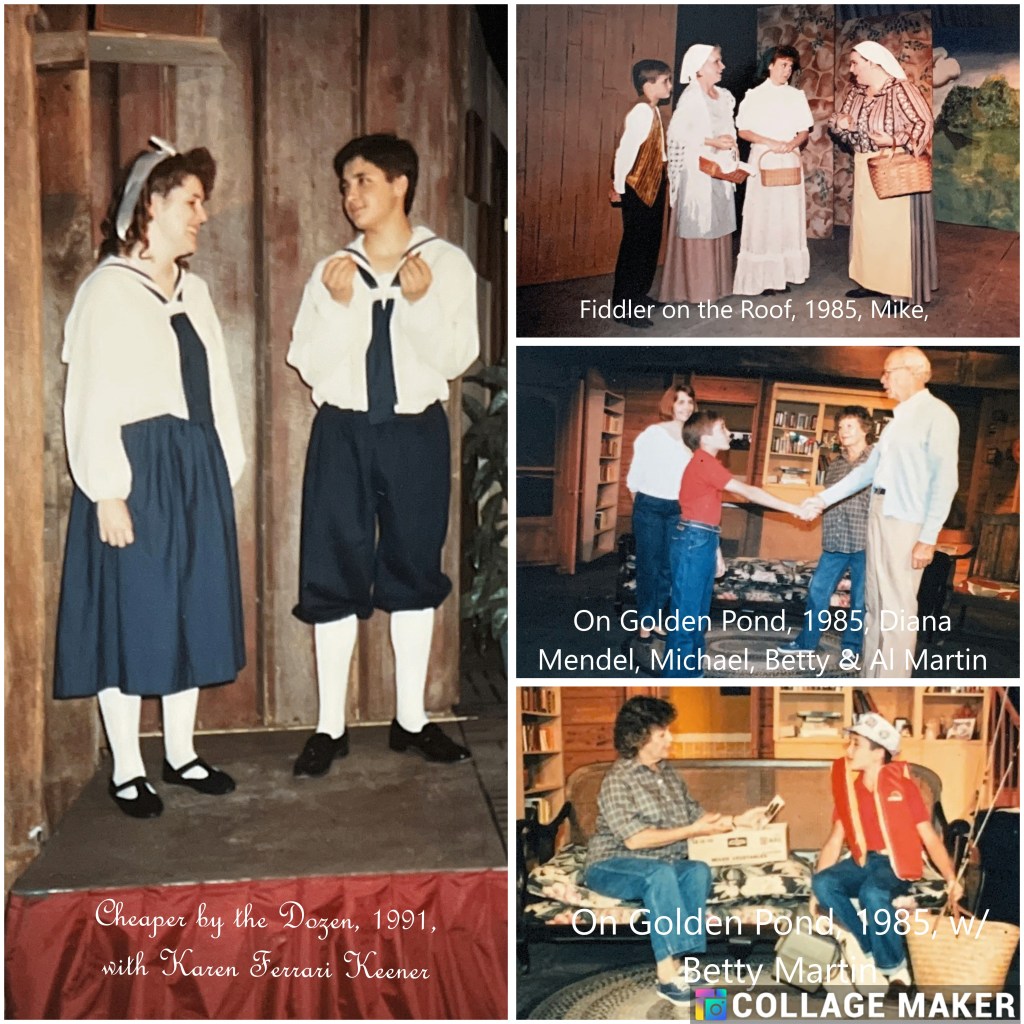
From 1987 to 1991, Mike did a show or two each summer. “I remember some things very vividly,” said Mike. “In that crazy farce, What the Butler Saw, in 1990, right after my high school graduation, Heather Deerfield was playing this doctor’s patient, and she had the line, ‘My uterine contractions have been bogus for some time.’ One night, there was a gasp from the audience, which contained a group of church women. They were polite enough not to get up and storm out after the line, but they did leave at intermission.
“The next day, you made a sign, Shari, and posted it in the lobby and by the box office. It read, ‘This show contains some adult-oriented language.’”
[NOTE by Shari: It’s kind of odd that people walked out of this production in 1990, as we had done the same show back in 1974 without repercussions. Most people probably didn’t care, and some people were probably glad they saw the sign in the lobby! The show really wasn’t “dirty.” It just had a few “ornery” but funny lines. For me, the funniest line in the show is, “You were born with your legs apart. They’ll send you to the grave in a Y-shaped coffin.”
I feel certain that we offered to refund the ladies’ money and just as certain that they declined the refund. I only hope that some of them returned for other shows.
We’ll never know.]
“Summers at the Playhouse were magical for me,” said Mike. “Greg LeMond had won the Tour de France in 1986, and that winter I kept thinking, ‘I could ride my bike out to the Playhouse next summer, like Greg LeMond.’
“Summer came, and Mom and I were driving out to the Playhouse. I was thinking about biking, but in that car, I thought, ‘These hills are pretty big!’ Mom kept driving me, unless I got a ride with Shari, until I was able to drive myself. Those were some of the best times of my early life.”
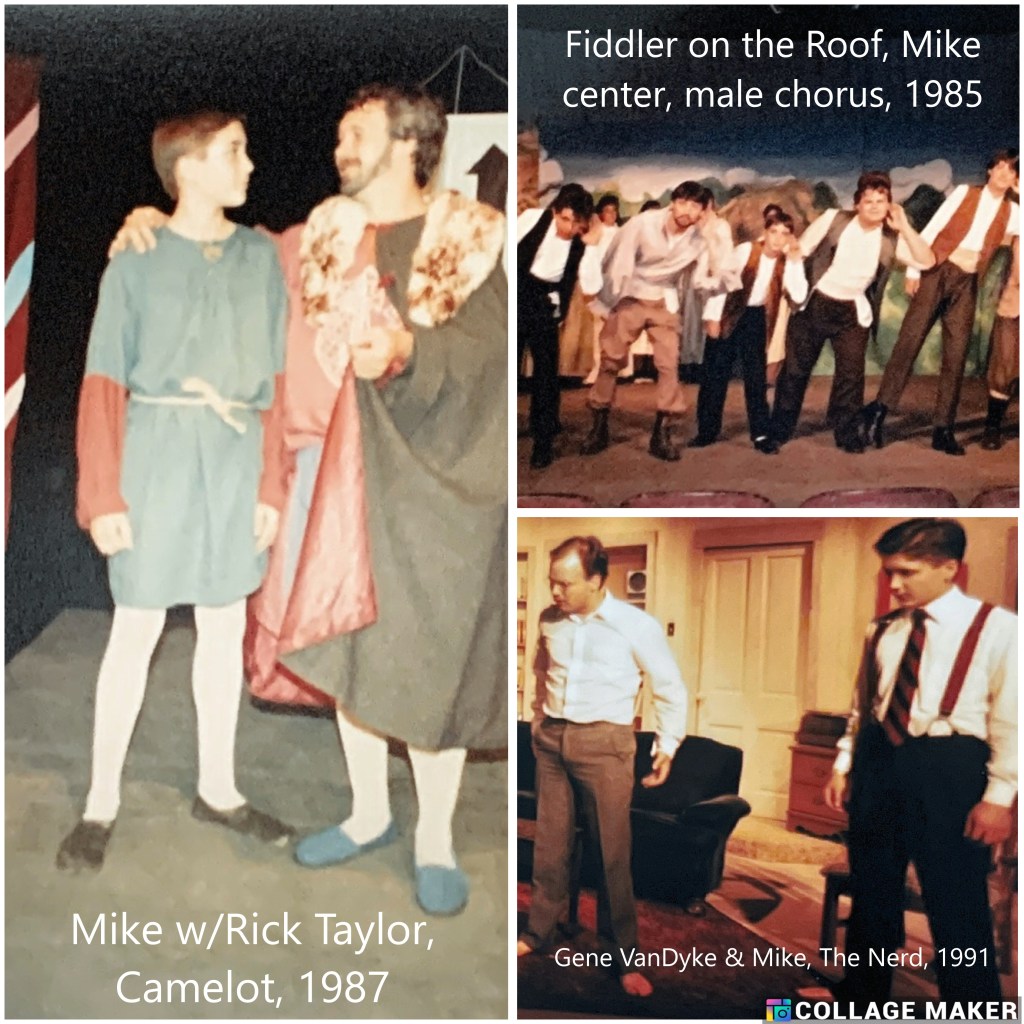
I recently spoke to Mike’s mother, 92-year-old Honey Musante. Honey was always supportive of Michael’s activities, whether he was onstage or working as Brooke High football Coach Bud Billiard’s “Aide-de-camp.”
She made great costumes for Mike in quite a few shows, and she created a stunning jester’s costume with a fabulous headpiece for Mike when he was the Madrigal Dinner jester at Brooke High during his senior year. She graciously donated that costume to the music department for future jesters to wear. Of course, she also drove Michael to and from rehearsals for years.
“That was a good time for us,” said Honey. “It was just the two of us in the car, and we talked about so many things. Nothing all that important, but things that mattered to us. “Mike wasn’t really into sports. He liked working with Coach Billiard, but he loved being on stage, and I think he was good at it. Being involved with the plays and Madrigal dinners at Brooke High and the plays and musicals at the Playhouse were some of the best experiences for Michael. The college kids and the adults at the Playhouse were so good to him. And I knew he was safe at Brooke Hills. I never had to worry about him.
“One time, Michael and I saw our priest at the Playhouse. After the show, Fr. Ostrowski said, ‘I heard you, Michael, but I didn’t see you. You must have had good makeup.’ We laughed at that one!”

Mike also did three spring musicals at Brooke High School (Grease, South Pacific, and Brigadoon, where he had leads or large parts). At Brooke, he was also working with Playhouse people. Norma Stone was directing the musicals. Rick Taylor was Mike’s Concert Choir and Madrigal Choir director and his music director for the stage musicals. I was doing the scenery for the musicals, writing and directing the Madrigal dinners (also with massive contributions by Norma and Rick), and writing and directing the occasional 1920s Review, A Night at The Club Soda, so Mike and other students were immersed in theatre winter and summer.
Mike graduated from Brooke High in 1990. He wanted to attend the Naval Academy, and he visited D.C., where he met Congressman Alan Mollohan. At the end of the visit, Congressman Mollohan told Mike, “The appointment to the Academy is yours if you want it.”
“At some point, I got a card from my cousin Chris DeSantis,” said Mike, “who wrote, ‘Your college years are so important.’ Then a card arrived from George Washington University, and it said, ‘Be in the heart of it. The halls of power are steps away.’
“There were pictures of many of the D.C. monuments, and it started me thinking in a new direction. I had always been patriotic, and I loved politics. So, I decided to go to G.W. on faith!” said Mike. “I never visited the campus beforehand. I just arrived!”
At G.W., Mike was in many student productions, and in Cloud 9 on the G.W. main stage. One evening, Mike and I were talking, and I mentioned that I was going to read Cloud 9. He said it was “a bit risqué,” which is apparently a massive understatement, because next he said, “Don’t read this play!” He was convincing. I didn’t.
“By the way,” said Mike, “my friend Andy Kaminski got the Naval Academy appointment and went on to be a decorated Navy S.E.A.L. before his tragic death at a young age from cancer.”
Mike returned to his home in Follansbee following his freshman year in college and was in his last show at the Playhouse, Cheaper by the Dozen, in 1991, ten seasons after his Brooke Hills debut. He really had grown up at the Playhouse.
Majoring in political science and drama, Mike stayed in D.C. following his sophomore year and from then on. Mike graduated from G.W. in 1994 and applied to grad school at West Virginia University.
“I had always planned to return to West Virginia and run for office,” said Mike. “I used to tease my mother, a stickler for good etiquette, and say, ‘It won’t matter if I win or lose an election, my mother will make me write a thank-you note to everyone who voted for me!’
“W.V.U. told me I’d been wait-listed because my application was missing a form, so I went to work for George Washington University and was able to attend the classes for my Master’s Degree free of charge. I think it was meant to be, as I also met Ramola Gupta during that time and fell in love.
“Ramola and I were married in 2000. We had two ceremonies, the first in traditional Hindu style. Talk about high drama! I rode into the ceremony on a horse wearing a turban, and Ramola and I were both arrayed in beautiful, gold-trimmed, traditional Indian attire.”


both in Belmont, Massachusetts, Ramola’s hometown.
Left: The Pundit (Hindu priest) and Ramola’s mother. Right: Michael’s parents.
“Then we had a second ceremony, a Catholic Mass. My family and many of our Follansbee friends and neighbors chartered two buses to come to the Catholic wedding!”
Today, Ramola and Mike have two children. Simryn is a rising senior at Villanova, majoring in Economics, and Kian is a high school senior who excels at ice hockey.

Michael has worked as an educational consultant for over 20 years, pushing to improve educational options for low- and middle-income children, especially in urban settings. Ramola works for Sherwin-Williams. They live on Capitol Hill in Washington, D.C.

CARL MARSH REMEMBERS
“Oh, man! You really want me to remember all that?” wrote Carl when I sent him a list of questions about his time at the Playhouse. Ironically, it turned out that Carl had a lot of memories once he started thinking!
Carl was born in Toms River, New Jersey, one of five children. The family moved to Brooke County, West Virginia, “sometime in the mid-70s. It’s funny,” said Carl, “I don’t think I was interested in doing shows at that time. Somewhere along the way, Mike Rager and I became best friends. Mike had played the lead in Oliver! at Brooke Hills when he was really young. The summer before our freshman year, he talked me into trying out at the Playhouse.”
CARL’S CRAZY CHRONOLOGY AT THE PLAYHOUSE
“That summer, 1982, when we were 14, Mike and I did The Music Man at the Playhouse,” said Carl, “and I was cast along with Ron Gamble, Jeff Lily, and Jim Matterer as the guys who form the barbershop quartet in the show. I was the bass. None of us had ever sung barbershop before, and Rick Taylor worked us hard.”
[NOTE FROM SHARI: This was asking a lot of these four kids. The music was a real challenge, but I vividly remember being blown away the first time they sang in a rehearsal. They were just great, and the whole cast thought so!]
“I was hooked,” said Carl. “Being cast in that quartet really changed my life, but more about that later. After the show, most of the cast would go down to the lobby to chat with members of the audience. One night, an old fellow came up to me and said, ‘Hey, I’m from the Barbershop Chorus in Pittsburgh. I’d like you to come sing with us.’
“I looked at him and said, ‘I’m 14. You’ll have to talk to my mother,’ and I pointed her out.”
“You’re 14?’ he said, “and I could tell he was both amazed and disappointed.”
“He asked my mom what she thought, and she said, ‘I’m not driving 1½ hours once a week for him to sing,’ and that was it.”
“Later in the same summer, I played one of the sailors in H.M.S. Pinafore. After my freshman year at Brooke High, when I sang in Rick Taylor’s chorus, Brother Joe joined me at Playhouse tryouts, and we were both cast in Annie Get Your Gun.

“In the fall of 1983, we moved to Iowa, where I did a couple of shows during my sophomore year, and after the school year, we moved back to West Virginia. “My dad worked for Mammoth Plastics, and we did move a lot.” [NOTE FROM SHARI: The Mammoth plant in Wellsburg had been the home of the former Hudson Paper Co. on Charles Street, between 17th and 18th Streets. The office building sat empty for years, then some kids set it ablaze. The burned-out building was eventually torn down. I’m not sure what happened to the adjoining factory. Mammoth made all sorts and sizes of plastic buckets and smaller plastic containers with lids.]
“We got back to Wellsburg in time for the 1984 summer auditions at the Playhouse,” said Carl. “First, I was cast in Once Upon a Mattress as one of the rejected suitors, and I fell in love with Beth Ann McElwain, who had the most beautiful, dark brown eyes and played the princess in the show. She was a knockout!

“At the second set of auditions that summer, I was cast as the lead in the musical Snoopy!!! AND I fell in love again! Donna Jo Reitter played Lucy. Her dad had built a gorgeous, little white MG roadster for her from a Volkswagen kit. I think I fell in love with Donna Jo, who was a couple of years older than I was and who was very nice to me, but I might have fallen in love with the car! What a summer that was! I definitely did some growing up that summer.
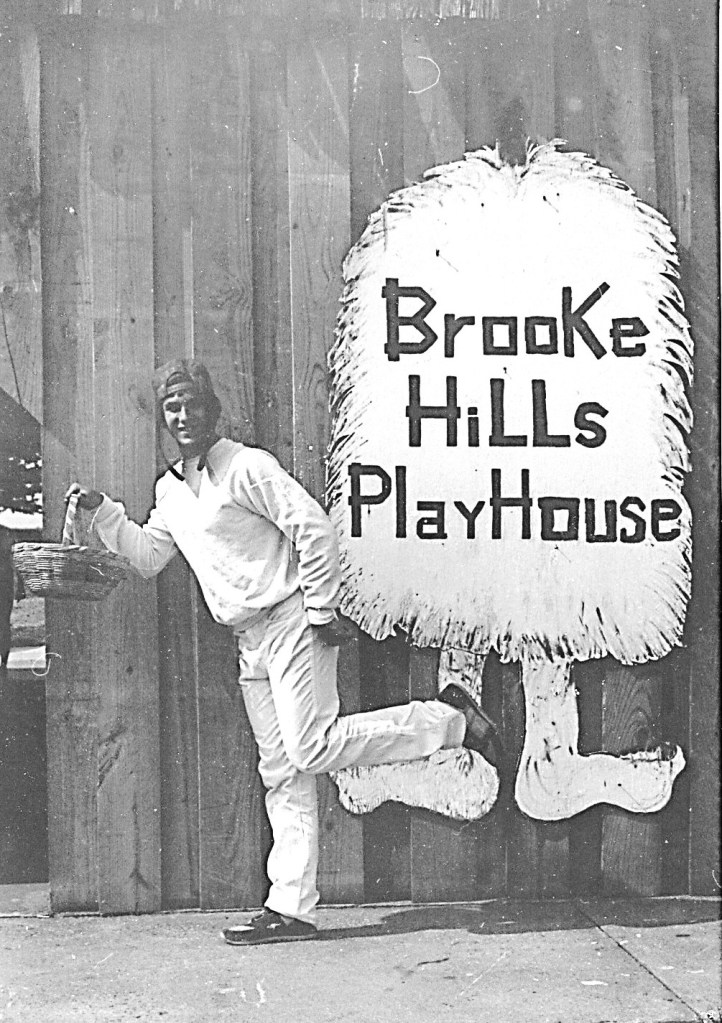
“That fall, I started my junior year at Brooke High, but right after my first report card, the Marsh family moved to Florida. During my senior year, still in Florida, I did some shows (I played Curley in Oklahoma!), was inducted into Thespian Troupe #3502, went to the state drama competition, and actually won some awards.”
Carl graduated from high school in Florida in 1986 after attending three high schools, and then it was back to Wellsburg.
In 1987, Carl became a member of the Playhouse staff, and he appeared in Camelot. The following summer, he was on the staff again, and he played one of his favorite parts, the sleazy con-man Rooster Hannigan (so much fun to play a dastardly villain!) in Annie.
Carl has some great memories from his five summers at the Playhouse. “The people I met and worked with at the Playhouse were a really good bunch of people. I came from a large family. No one at the barn ever picked on me for wearing hand-me-downs. Everyone was just accepted for who they were, for their talents, and their contributions to putting on a good show.
“I also remember we had lots of parties, lots of getting high (sorry, Shari), which I dutifully confessed to my Marine recruiter. In 1987, Dean West and I were on the staff. One day, the two of us were building something, and somehow, I tore off my thumbnail. It wouldn’t stop bleeding, so off we went to the emergency room. Have you ever tried to hammer a nail or drive in a screw without using a thumb? I think I got the afternoon off, but not that evening. I was playing one of the dates of the women leads in The Female Odd Couple. I went on with my thumb and half my hand wrapped in a big, old bandage!
“That summer, my dad donated a lot of equipment from his company, and Dean and I did a lot of electrical work. I vividly remember the two of us spending whole afternoons up in the barn rafters, hanging like monkeys and tossing tools back and forth to each other. Dean also worked on the sound system.
“I also remember that Rick Taylor had lent us his little red Mazda truck to move something. For some reason, I was driving. After arriving at wherever we were going, I put the truck in reverse and ran into something, destroying the tailgate. Thankfully, the repair cost wasn’t deducted from my small paycheck!”
And then Carl made a life-changing decision. While living back in South Florida in 1990, Carl enlisted in the U.S. Marines. “When I was sent to Okinawa, Japan, in 1991, it was my first time overseas,” said Carl. “Honestly, as a kid, I never thought I’d ever leave the U.S. In 1992, I was assigned to the U.S. Embassy in Tokyo, and then the embassy in Dhaka, Bangladesh, where I met Sabina in 1993 while her mom was working at the French Embassy.
“The Marines had a movie night showing A Few Good Men, and Sabina just happened to be there. We had paused the movie to open the bar. She requested a Tequila Sunrise, and boy-oh-boy, that was it for me. I was smitten with this woman.

“We married in October 1994. Our daughter Elizebeth Nicole was born in 1995 at the U.S. Navy Hospital in Okinawa, and our son Alexandre Michael was born in 1999 at the U.S. Navy Hospital in Yokosuka, Japan. And, yes, Alex is named after my best friend, Mike Rager. By the way, Sabina was born in Stockholm, Sweden and has a degree in International Law. Today, her mother lives in Paris, and her Nigerian father, who lived in Kenya, unfortunately passed in 2009.
“My parents have both passed on, as has my sister Nancy. My other siblings, Gee, Donna, and Joseph, are still with us. My daughter recently married and now lives in Idaho, and Alex is active-duty U.S. Air Force stationed in Tokyo, Japan! The same as my first overseas posting!”
POST RETIREMENT
For a kid who never thought about leaving the United States, Carl has become a world traveler and a member of a global family, having served in Japan, Bangladesh, Korea, the Philippines, Australia, India, Kuala Lumpur, Iraq, and Afghanistan overseas with postings in North Carolina, Baltimore (where he stayed with Mike Rager), and California. For 23 years, Carl served honorably and faithfully as a U.S. Marine. He retired in 2013 with the vaulted rank of Master Sergeant.
Since Carl’s retirement from the Marines, he’s held a number of jobs, mostly in support of the Department of Energy in Nuclear Waste Operations and the refurbishing and upgrading of the nation’s nuclear deterrent in several locations. In 2018, the family moved to Richland, Washington, where Carl continues to work with the Los Alamos Nuclear Lab at their Richland office.

For most of Carl’s adult years, barbershop singing, which began for him at the Playhouse, played a big part in his life. “My first barbershop chorus (right out of high school in 1986) was called the Plantation Chordsmen out of Plantation, Florida,” said Carl. “That was a really good bunch of dudes that taught me the ins and outs of barbershop, and they set me down the right path. This is also where I had my own first quartet, New Blend. We were four young dudes just trying to ring chords. Before long, I went to my first competition, where I learned a lot, getting some really good intel from well-established quartets. This is where I switched from Bass to Baritone, learning that the “Bari” is the glue (garbage note) that fills out the sound and rings the chord!
“I found that I just needed to sing, so when I was stationed on Okinawa, I went to the base chapel and started singing there. I met a group of really good people (we’re still in touch!!), and I spent my year there harmonizing Sunday mornings and Wednesday evenings. I performed in the Christmas show for the base chapel.
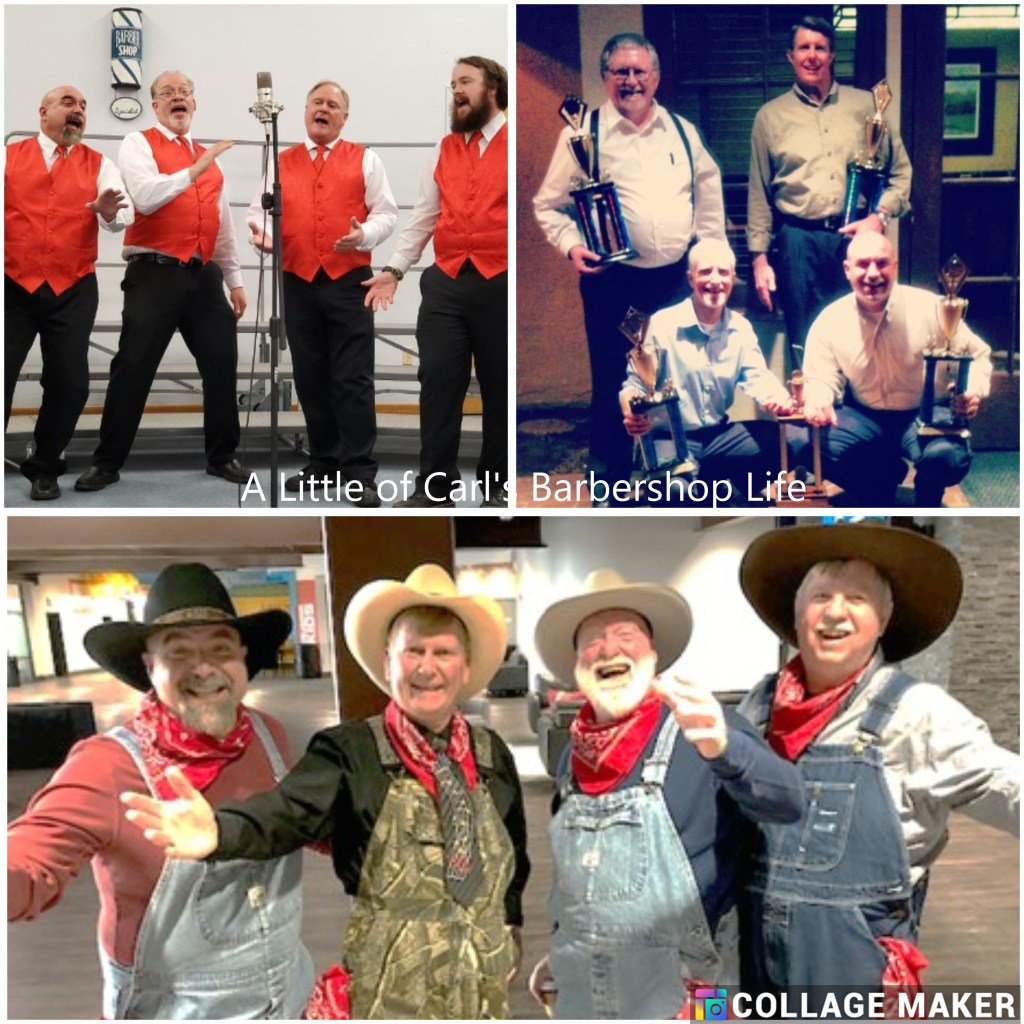
“In 1993, I was walking my post in the American Embassy, Dhaka, just singing ‘My Wild Irish Rose’ when a State Department employee poked his head out and asked what I was singing. That started the Embassy Notes Quartet. We were three State Department dudes and a Marine, ringing chords for Heads of State and Ambassadors of almost every country located in Dhaka. The American Ambassador had us sing a few songs for all his functions, which was pretty cool! At Christmas time, I was asked to sing in the “Hallelujah Chorus” concert being put together by the American School of Dhaka. That was cool, too!!
“Sadly, from 1994 through 2002, my groups were too far away to travel to for rehearsals. I joined a chorus in Baltimore for a while, but I didn’t belong to a quartet. I just wanted to keep the interest in singing alive, as I felt it had started to diminish a bit.
“When I was in Okinawa from 2005 to 2011, I couldn’t get a group going, so I joined the base chapel choir again, singing on Sundays and Wednesdays to keep the pipes active. During this time, my falsetto started to return, and I couldn’t wait to get stateside to find a quartet again.
“Finally, in 2011, I joined the Temecula Harmonizers in Temecula, California. I’ve been so fortunate. This was another really good bunch of dudes. In my two years with the group, I won the Novice competition (twice!!), competed at the district level, but never made it to International. I was also introduced to the Extreme Harmony Brigades (more on this later). Interesting note: I had a quartet from San Diego sing the National Anthem for my retirement ceremony! Most of the Marines/civilians I worked with didn’t believe I sang Barbershop until I showed up during the Christmas party with a quartet and started singing!
“When I retired from the Corps in 2013, we moved to Kennewick, Washington, and I started a quartet which competed many times at the Regional/District levels, scoring fairly high, but not high enough to get to International.
I attended my first Extreme Harmony Brigade in Reno, Nevada in 2018. The Brigade of 80-120 dudes roll up, take over a venue, sing in quartets all weekend, compete for bragging rights, then go home and plan the next Brigade. There are brigades all over the world, and I am an official member of four: Lone Star Harmony Brigade in Richardson, Texas, Great Lakes Harmony Brigade, Okemos, Michigan, High Sierra Harmony Brigade in Reno, Nevada, and Indiana Harmony Brigade in Indianapolis, Indiana.
“Brigade members receive music, 11-12 songs with learning tracks, six months before the rally. All Brigades have the same minimum eight pieces of music, with each one adding 3-4 additional pieces. We learn our music inside out, roll up, and start singing in random quartets. The computer spits out four names, one for each part (Bass, Lead, Baritone, Tenor). The group is assigned a song, goes onstage, and competes in front of judges for score. Eight quartets and two random wildcard quartets move to Round 2 and so on. Also, there’s a show for the public on Saturday evening with all members singing the Brigade songs and a few step-out quartets. It is a freaking amazing weekend of quartet singing!! I probably average four hours of sleep Friday night and 1-2 hours Saturday night. On Sunday morning, I jump on a plane back to Washington.
“Through the Brigades, I’ve been singing with some really good singers! I’ve now been asked to sing Baritone in a quartet with a Tenor from Portland, Oregon, a Bass from Indianapolis, and a GOLD MEDAL WINNER Lead from Indianapolis. We’re learning four pieces of music to compete in October 2025 in preparation for the international competition in 2026 in St. Louis. Because of this, I’ve been taking voice lessons, just to improve my breath support, breathing, and everything else I need to sing well with these guys.”
When Carl said that singing in the barbershop quartet in The Music Man at the Brooke Hills Playhouse changed his life, he absolutely meant it. Today, Carl says, “Because of my time at the Brooke Hills Playhouse (and affiliation with the Barbershop Harmony Society), I’ve had the opportunity to talk to high school kids, and I tell them how much music has meant to me. I encourage them to get involved with music. I believe this when I tell them, ‘If you’re in music, you’ll know you’re in a place where you belong and where the bullies are outside. Music doesn’t die. Years from now, the bullies will be left far behind, but you’ll be in a group, a music group, that will always support you and be there for you.’
“Barbershop is the only hobby I have,” said Carl, “and it is a huge part of my life.”

Christmas, 2023, Richland, Washington
MARY FRESHWATER GEIB REMEMBERS
Mary Freshwater was one of the few kids we hired to be on the staff BEFORE she graduated from high school. She lived in Wellsburg and didn’t require housing, so she was hired following her junior year at Brooke High for the summer of 1982. We would never provide housing for anyone under 18.
“I was in Norma Stone’s homeroom at Brooke, and she was also my English 9 teacher. I took Drama classes (taught by Norma) as electives later in high school, and I was secretary and later the president of the Drama Club. She nudged me to get involved with Guys and Dolls in 1981, so I was on the stage crew and ran the follow spotlight. That hooked me, and I was interested in being involved with theater from that point forward.
“In the spring of 1982, I helped with the renovation of the upstairs of the Brooke County Museum for the first Dinner-Theater there. I was asked to write the press release for Bubba, which was a new experience for me, but, since my sister Judy had done publicity for the Playhouse in the 1970s, I figured that I would be able to do it. I knew I had English teachers all around me, so I wasn’t going to be flying solo! I distinctly remember adding the word auspices to my vocabulary while writing that first press release. I’m not sure whether you, Shari, or Norma suggested it, but it has stuck in my mind forever as a great moment in vocabulary expansion! “I wrote, ‘The Brooke Hills Playhouse and the Brooke County Historical Society, under the auspices of the Brooke County Arts Council, will present the delightful comedy, Bubba…’”
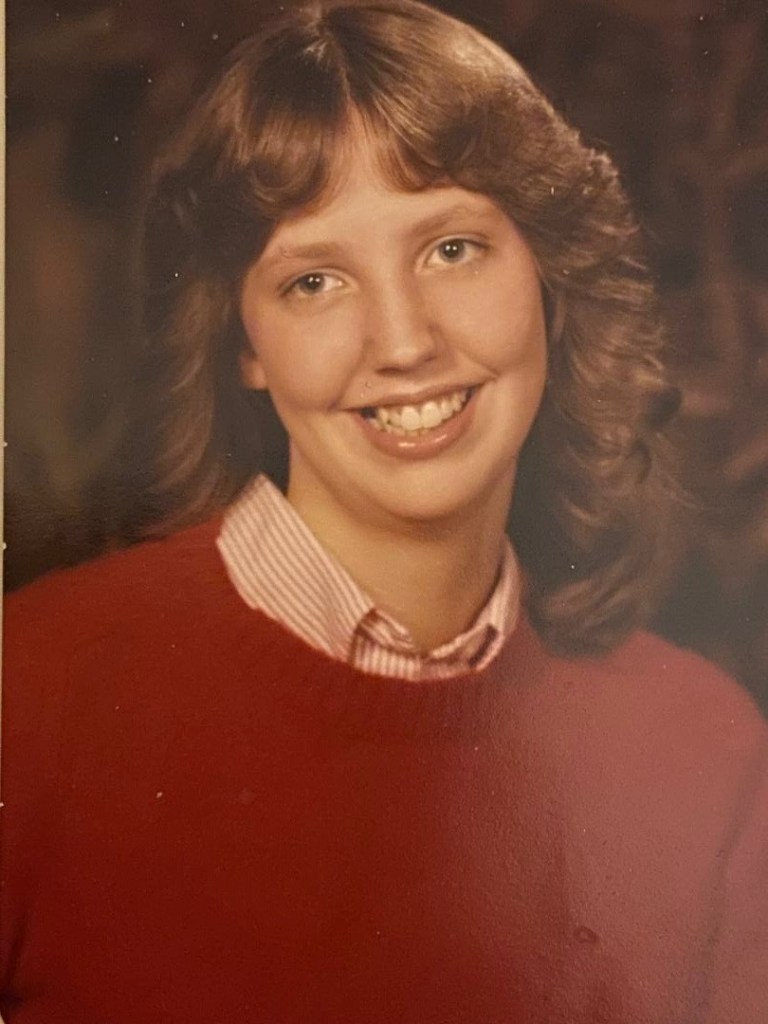
Smart and dependable to the max, Mary is a natural-born stage manager. While doing publicity for the show, we asked Mary to stage manage Bubba as well, her first time in that role. She took to that job like that proverbial duck took to water, and she went on to stage manage numerous other productions at Brooke High and the Playhouse.
“My mother, Kathleen O’Connor Freshwater,” said Mary, ”was probably the biggest influence for interest in theater,” said Mary. “She was active in plays while at Wellsburg High School, and we often heard her tell about playing Mama in I Remember Mama in high school. She also frequently played soundtrack albums from Broadway shows at home, and she took us to see plays. I was in the audience at the Playhouse for the very first production, You’re a Good Man, Charlie Brown, in 1972! I was 7 years old!
“My sister Judy did publicity at the Playhouse in 1977 and 1978. She had done PR for the high school musical South Pacific in her senior year of high school (1977), and she was also the stage manager. (It must be in the genes!) She was a Journalism/ Communications major in college and was trying to get as much writing experience as possible. The Playhouse job combined her love of theater with the writing experience. She was officially on staff full-time in 1977. During the summer of 1978, she worked at Sears during the day, and she did publicity for the Playhouse, also.”
After her work on Guys and Dolls at the high school, the Museum renovation, and Bubba, I think Mary was invited to join the Playhouse staff in the summer of 1982 for a whopping $30 a week. We may even have begged her, as we realized how much grit and dedication she would contribute to the summer. She never disappointed. For one thing, Mary was a dedicated techie, seemingly uninterested in auditioning (more on that in a moment). Except for our Designers/Tech Directors, 90 percent of our staffers wanted to act, but they were more than willing (and required!) to do everything from painting scenery to cleaning toilets as well. Following her high school graduation in 1983, Mary was re-hired for the summers of 1983 and 1984. She was a real find!

As for auditioning, Mary wrote, “Despite a popular belief to the contrary, I lacked the confidence to audition! I would have dearly loved to be in choir in high school, but I didn’t have the guts to audition. I would have loved to have been in plays, but, again, I did not have the confidence to get up and sing or cold read for the auditions. It’s ridiculous in many ways, looking back on it. I had been very involved with Girl Scouts from the time I was old enough to join in second grade and all through high school. I was the song leader at day camp and on camping trips, and I did public speaking frequently through scouts, but I couldn’t muster up the courage to audition!”
In all, Mary was involved with 16 Museum/Playhouse shows and even appeared on stage occasionally. She may have been drafted, which eliminated her need to audition! She kept meticulous records. I wish I had!
| 1982 | Bubba (Museum) | Stage Manager, Publicity |
| 1982 | The Music Man | Stage Manager, Crew |
| 1982 | Opal is a Daimond | Properties, Crew |
| 1982 | Blithe Spirit | Stage Manager, Crew |
| 1982 | Not in the Book | Properties, Crew |
| 1982 | H.M.S. Pinafore | Stage Manager, Crew |
| 1982 | U.T.B.U. | Properties, Crew |
| 1982 | Vanities (Museum) | Stage Manager, Crew |
| 1983 | Annie Get Your Gun | Props, Crew, Mrs. Ernest Henderson, Mrs. Yellow Foot |
| 1983 | The Rainmaker | Costumes, Crew |
| 1983 | Lunch Hour | Stage Manager, Crew |
| 1983 | The Solid Gold Cadillac | Miss Logan, Crew |
| 1983 | Something’s Afoot | Stage Manager, Crew |
| 1983 | See How They Run | Stage Manager, Crew |
| 1984 | Once Upon a Mattress | Stage Manager, Crew |
| 1984 | George Washington Slept Here | Crew |
“My favorite show of the 1982 season,” said Mary, “was U.T.B.U. (Unhealthy To Be Unpleasant) by James Kirkwood.” [NOTE from Shari: Kirkwood won the Tony Award, the Drama Desk Award for Outstanding Book of a Musical, and the Pulitzer Prize for Drama for the Broadway hit A Chorus Line. U.T.B.U. is as far from A Chorus Line as one can get! LOL!] “We all have picked up lines from shows or songs from shows and dropped them into everyday conversations,” said Mary. “At the Playhouse, so many of those lines were written on the backstage bathroom wall! One of the lines I constantly drop is from U.T.B.U. One character (a vain, mean, has-been actor) grabs a battle axe off the wall and the head falls off while he’s trying to kill another character who is blind. When the axe head falls to the ground and makes a huge crash, the killer-to-be says, ‘Oops! I dropped my watch!’ I have been saying that line since 1982 anytime I drop anything that makes a crash. None of my family has seen the play, but they are determined to see it eventually. I have told them how hilarious the show is, and they really need to know why I say this line all the time!
“At another place in the show, the nasty actor threatens his sweet, little mother by saying, ‘If you don’t shut up, I’ll turn you upside down so fast, you’ll wonder where the floor went.’ Huge laugh.
“Chris Cipriani played the blind man in our 1982 production, and his account of the things that happened during the production of this play in Part 5 of the memoir brought back wonderful memories of a fantastic show!
“You really have to see the play. We saw nothing but humor and laughed all the way through it. Today, I suppose the comedy would ruffle tons of feathers, and audiences would be horrified, as the premise is based on blowing up nasty people. Sadly, U.T.B.U. is probably never going to be produced anywhere ever again.
“While my favorite show was U.T.B.U., my favorite piece of stage business occurred each night during Blythe Spirit. Kelsey Hendrick set up a lot of the tricks that the ghost (played by Amy Charlton) would do on stage. I was stage manager, so I got to make some of those things happen from backstage.
“For instance, there was a box on the mantle, and there was a deck of cards in the box. A fishing line was attached to the lid of the box and fed through a pinhole in the flat. That line would open the box. In the box, there was a mousetrap with a few playing cards lightly resting on the loaded mechanism. A second fishing line controlled the mousetrap. I got to pull the fishing lines opening the box and then tripping the mousetrap to make the cards go flying out of the box. It always got a great audience reaction! Maybe I’m easily amused, but I thought the effect was brilliant, and I was so happy to get to make it happen every night!
“Jim Matterer was the chef in the summer of 1982. I recall that one of the first weeks of the season, Jim purchased and prepared Cornish hens for the crew for dinner. I had never even SEEN Cornish hens (I was from a big family; I was lucky if I managed to get a drumstick from a chicken at dinner if my brothers were all at the table!) I do remember you having a serious conversation about the food budget when you saw the Cornish hens! It was delicious, but, to this day, I’ve never had Cornish hen again, and anytime I’ve heard them mentioned, I think about Jim practicing his culinary arts skills with us.
“I was also the stage manager for H.M.S. Pinafore. It had a large cast, and I was taking roll during one Saturday afternoon rehearsal while everyone was on stage warming up. I decided to stand on the arms of one of the seats in the house, so that I could see the kids in the back on stage. I don’t know what happened, but I started to lose my balance. Instead of stepping straight down onto the floor, I stepped forward to the arm of the seat in front of me to catch my balance. I did not succeed.
“I fell and landed with one leg in the upper row and one in the lower row, straddling the back of a theatre seat. It was stupid, and I jumped up like everything was fine. I finished what I was supposed to be doing and got ready for the show. I was NOT fine. I got an ice pack and then headed backstage.
“Ken Kasprzak was on the light board downstairs by the kitchen. About halfway through the first act, I called down to Ken and said, “Can you hear the show if I don’t call the cues?” He could. It was a musical. Lights were connected to songs. I hobbled downstairs and retreated to the dressing room with ice. I knew that I was going to have a bruise that I’d never forget. That was the last time I stood on the arms of the seats in the house! I see kids stepping over seats from one row to the row below in the house of auditoriums and theaters all the time. Every time, I cringe just a little bit!”
We were so lucky when Mary was able to return for a second season, the summer of 1983.
“The day of auditions that summer,” wrote Mary, “happened to be the same day that the Franklin Fire Department had a fire training exercise in the park. When the Hukills, park employee Dale and his wife Rose, moved out of the yellow farmhouse adjacent to the barn several years before, the Playhouse took it over. For a couple of years, the house served as the Playhouse “dorm” for the staff and costume, furniture, and prop storage for our plays.
Now, everything had been moved out of the nearby house and into the house across from the golf club house up the park road, soon to be known as the haunted house! Around 9:30 a.m., with auditions scheduled at 10:00 a.m., the firemen set the yellow house ablaze. As people were coming to auditions, they could see smoke and flames coming from our location. Everyone thought that the barn was burning down! As they crested the hill, they could see that it was the house and not the barn, but I think it scared a lot of people!

“I remember in 1983 I learned to lay brick,” said Mary. “Honestly, you never know what you’re going to learn around a theater. We put in the brick walkway to the side door of the dressing room, from the concrete slab at the bottom of the ramp back to the outside dressing room door. It was slick when it rained, but it was better than mud.
“I think that we made $50 a week in 1983, and Something’s Afoot was my favorite show of the season as a member of the stage crew. It was just the funniest little musical mystery comedy.”
[Note from Shari: Although it sounded like we paid $50 a week, we really paid $25 a week, money in hand, and anyone who stayed through the end of the summer, received a lump sum of $25 per week bonus. That ensured we had enough people to strike the final set, move all the tools and equipment to my basement, and winterize and lock up (nail shut) the barn. A few years later, we began adding $25 a week to the pay of any “repeater” up to a total of $150 a week, again reserving the $25 per week season bonus.]
“My first appearance on stage at the Playhouse wasn’t in a play,” said Mary. In 1982, in my role as the stage manager, I announced the minor cast changes for the second week of the run of H.M.S. Pinafore before the curtain (metaphorically speaking) went up.
“My actual stage debut in a play was as Mrs. Ernest Henderson and Mrs. Yellow Foot in Annie Get Your Gun in the summer of 1983. Later that summer, I appeared on stage again in The Solid Gold Cadillac as Miss Logan, the secretary. I learned that I definitely preferred being behind the scenes as a stage manager.

MARY’S RANDOM MEMORIES
“My favorite memories, of course, are of all the people I met,” wrote Mary. “They were so talented, funny, and bright. I loved working on the stage crews, building sets, running properties, and stage managing multiple shows. I can also tell you from memory that the box office phone was 304-737-3344.” [NOTE FROM SHARI: It still is 304-737-3344. Add it to your contacts! Call often for reservations.]
“I don’t know who started this,” Mary continued, “but someone had taken a Magic Marker and drawn these little ears in the backstage bathroom, the dressing rooms, and on the back of flats on stage. Some were accompanied by the slogan, ‘The walls have ears.’ That visual reminder to keep your voice down when you were backstage or downstairs during the show made me very aware for the rest of my life of all the times when you think no one is listening, but you can be heard.
“The backstage bathroom (really just a toilet stall) is in the kitchen. I think it was because one, there was room to make a stall, and two, it was close to water and a drain. It’s not as bad as it sounds; however, at the barn, the kitchen is synonymous with the large toolroom. Really, that area is the kitchen/toolroom/toilet stall.
The walls inside the toilet stall were covered with graffiti, mostly favorite lines from various shows, but also reminders of the goofy things that happen in a somewhat closed environment. The series ‘Opal is a _____’ was particularly entertaining. The blank was everything from ‘a Ph.D. of Collectibles’ to ‘a slut.’ New people have been known to make their first foray to the toilet stall and stay there for large chunks of time reading the walls!
“I loved straightening nails on strike night. Shari and Al were particularly vigilant that the duplex (double-headed) nails were straightened for reuse, as they were pricey. Working at the Playhouse reinforced my belief that you should reuse and recycle as much as possible. We always knew how to stretch a dollar at the Playhouse. You would be amazed at how many ways the wire from a wire coat hanger or a coat hanger itself can be used onstage and backstage, and I don’t mean for costumes! We hung pictures on the sets with coat hangers. We hung chandeliers with them. We made prop and costume hooks backstage with them. Someone created a lovely wall sculpture from coat hangers. It graced the walls of several sets. Wire coat hangers are absolutely invaluable in a cash-strapped, small theatre!
“During the COVID shelter-at-home months, I taught my family how to paint. As per Al Martin’s instructions, I hammered a nail hole into the rim of the paint can, so the excess paint would drip back into the bucket. Steve, my husband, looked at me like I was some kind of nut until I explained what I was doing and why. Then I was a genius! I learned how to PAINT ROOMS at my parents’ house. I learned the paint can trick at the Playhouse.

“Many plays call for alcoholic drinks and bottles of booze,” said Mary, “but no one would be crazy enough to put real alcohol on stage. When Shari was running props, she would fill the prop scotch, brandy, bourbon, gin, and vodka bottles at the sink in the dressing. After much trial and error, she had developed the “recipes” for the different types of alcohol and had written them on the wall above the sink. For example (and this is not the recipe), 2-R, 3-Y, 1-B would mean, ‘For one fifth of bourbon, use two drops of red food coloring, three drops of yellow, and one drop of blue.’ I mixed quite a few drinks of colored water!
“When I graduated from Brooke High in 1983, I received a tape measure from Al and a toolbox from Norma. I still have them and use them regularly, and when we are camping or working on a project, I usually have a pencil behind my ear where Al always kept his.
“Shari, I had to laugh when I saw your list at the end of Part 5C. You had reproduced the list of the people mentioned in the first program (You’re a Good Man, Charlie Brown, 1972) for their contributions to getting the Playhouse up and running. Seeing ‘Antalis’ among the listings was heart-warming. I remember coming home from work at the barn and talking about ‘Antalis,’ and my mom would say, ‘You know, she’s not YOUR aunt…’ I’d laugh and say, ‘She’s everyone’s Antalis.’”
[NOTE FROM SHARI: “Antalis” really was my aunt, Alice Cree Hamilton. She did so much for us that first summer, lending us her cottage at the campgrounds for Al and Tommie to live in, sending out food for the crew, and lending us furniture (much of it period pieces), oriental rugs, and props. When one of our crew misheard “Aunt Alice” and asked about “this Antalis person,” we all laughed, and Aunt Alice was Antalis from then on. The whole crew, plus volunteers, got to meet Alice when the Ohio River flooded that first summer. We all went down to her and my uncle’s home in Wellsburg and moved everything mentioned above, which was stored in the big basement, out to the big garage to save it from the rising water. For the next several decades, we continued to borrow lovely pieces from Antalis’s garage “storehouse.” In addition, Antalis hosted all the Playhouse folk along with our family for a huge, fun picnic at her and Uncle Bob’s home in Wellsburg.]
“I started working for my third summer at the Playhouse in the spring of 1984 after my freshman year at Wheeling Jesuit College,” said Mary. “Then I got hired at Westvaco, a plant in Wellsburg that made bags for everything from dog food to flour to cement and more. I worked at the Playhouse up through the staging of the first show, Once Upon a Mattress, and on the crew for the transition from Mattress to the season’s second show, George Washington Slept Here.
“I hated leaving the Playhouse, and I even cried about it, but my parents were insistent that I take the job that was paying $6/hour instead of $50/week. I couldn’t blame them in the least. I was going to a private college, and there were five of us to educate.
“I missed being at the barn, working with the crew, participating in the mandatory, pre-dinner volleyball games, and even working on the re-siding. This was the summer that the crew and volunteers re-sided the massive barn with materials provided by a grant. Although I was only there for the beginning of that job, I discovered that I wasn’t afraid of heights. I had no problem building and climbing around on the tall scaffolding. I also learned that not all hammers are equal; it’s a very individual preference. Finding the perfect hammer for yourself is a lot like picking a bowling ball—the perfect weight and size and balance matter and are different for each person. I had a favorite hammer at the Playhouse, and I always grabbed it first thing in the morning when we were re-siding the barn.
AFTER THE PLAYHOUSE
“While at Wheeling Jesuit,” said Mary, “I was the Student Producer/Stage Manager for Guys and Dolls in my freshman year in the spring of 1984. I was SHOCKED that they rented set pieces and costumes from someplace in Pittsburgh for the show. I’d never been involved with a production where we didn’t build the set and costumes! I thought it was a crazy waste of money, but I kept my mouth shut. From that point on, I was an ecstatic audience member of every show I could see!”
Mary graduated with a B.A. in Psychology in 1987 from Wheeling Jesuit and went on to earn a Master’s Degree in Counselor Education with a focus in Elementary (K-6) Counseling from Penn State. She was hired as a counselor for the Marshall County, W. Va. schools in 1988, and while she was there, she returned to Penn State for a few summers in the 1990s and worked on her Ph.D. in School Psychology. “I reached a point in the program’ where I was going to have to take a year’s sabbatical to do my internship and dissertation,” said Mary, “and after 9 years of commuting to Marshall County, I was hired in Brooke County by Mary Kay Hervey DeGarmo, another Playhouse ‘grad,’ where I really wanted to be. It wasn’t the right time to take a sabbatical.
“I started as a counselor in Brooke County, working at all nine elementary schools, and then ended up at Follansbee Middle School in 1997. I worked across the hall from Teresa Taylor (who was still active at the Playhouse) for a year before she switched into the elementary music position. I worked there for 21 years until it closed at the end of the 2017-2018 school year, and I moved on to the new Brooke Middle School as the counselor for grades 5-6.
“February 2022 was a difficult time, health-wise, for our family. I had been planning to retire at the end of the school year, but my husband Steve and I looked at the numbers and decided that we’d be fine with me retiring sooner than the end of the term. Over my 34-year career, I had worked at 12 schools, under 8 superintendents, and for 35 different principals!
MARY’S LOVE STORY
“When I was working at the Playhouse, I was 17. During that summer, one of my mentors (Shari, Norma, Paula, or some combination of all three), said to me, “You should not get married until you are at LEAST 25 and until you have lived at least one year on your own (paying your own bills, etc.)” I took that advice to heart like it was Gospel. Twenty-five came and went without a serious prospect in sight. I had lived on my own several times while I was going to school at Penn State and even while I was first working, so I had crossed that off my list. What I mostly learned is that I didn’t really enjoy living ALONE, and since all of my siblings were several hours away with their lives and families, my parents and I made a decision that it was fine if I lived with them until I was ready to do something different. I was a help to them at home, and they were good company.
“I had been living in Brooke County “forever” and hadn’t met my person yet (even with all of those summers going back to Penn State to work on my Ph.D.) In 1997, I found out about a Catholic Singles’ Group in Pittsburgh. Steve Geib is originally from the Philadelphia area. He ended up in Pittsburgh when he got hired at Pitt as a chemistry research professor in x-ray crystallography after he had finished his Ph.D. in Delaware and a Fellowship in x-ray crystallography at Vanderbilt. He was finding ways to meet new people outside of work, so he had also joined this same group.
“The group had tons of activities, even weekly volleyball games. (Al Martin’s mandatory volleyball games came into good use!) There were also dinners, trips each summer, and much more. I met an entirely new social group and was very involved with this large club (250+ members), even writing the monthly newsletter for a couple of years. Steve and I most certainly were in the same circle of people for almost 7 years before we finally officially ‘met.’
“At the club’s one big charity dance in September 2022, I was helping with the entrance table. Ironically, the charity that year was the Leukemia and Lymphoma Society. (Steve was in remission from leukemia, which I did not know at that time. He currently has an unrelated diagnosis of Non-Hodgkins Follicular Lymphoma.) I had heard that Steve was a really nice guy, and I was hyping the Fall Weekend trip to Oglebay, so I encouraged him to sign up. He did, and we spent a lot of time that weekend hanging out together.
“When you’ve been involved in theater, lines from shows or songs from shows just stick in your head, and you use them conversationally, generally without even thinking about it. When I first met Steve, before we had even gone out on a date, we were talking one evening, and I asked him about his job. He said he was a Chemistry Professor at Pitt. Without even thinking, I immediately said, ‘Chemistry?’ and he answered, ‘Yeah, Chemistry.’ These are lines from the song ‘I’ll Know’ from Guys and Dolls, which I had stage-managed twice!
“I was so surprised that he answered me back with the exact line and cadence that I asked if he had ever been in Guys and Dolls. He had been in a high school production. We had a good laugh. We met in September and got married in July of the following year. When we got married, ‘I’ll Know When My Love Comes Along…’ from Guys and Dolls was played when we cut the cake.
“Today, Steve and I live in Bridgeville, Pennsylvania, and we have four children, all close in age, as we were older when we married. We have been taking them to see shows since they were young, and all of them have been involved in both theatre and music for most of their lives.
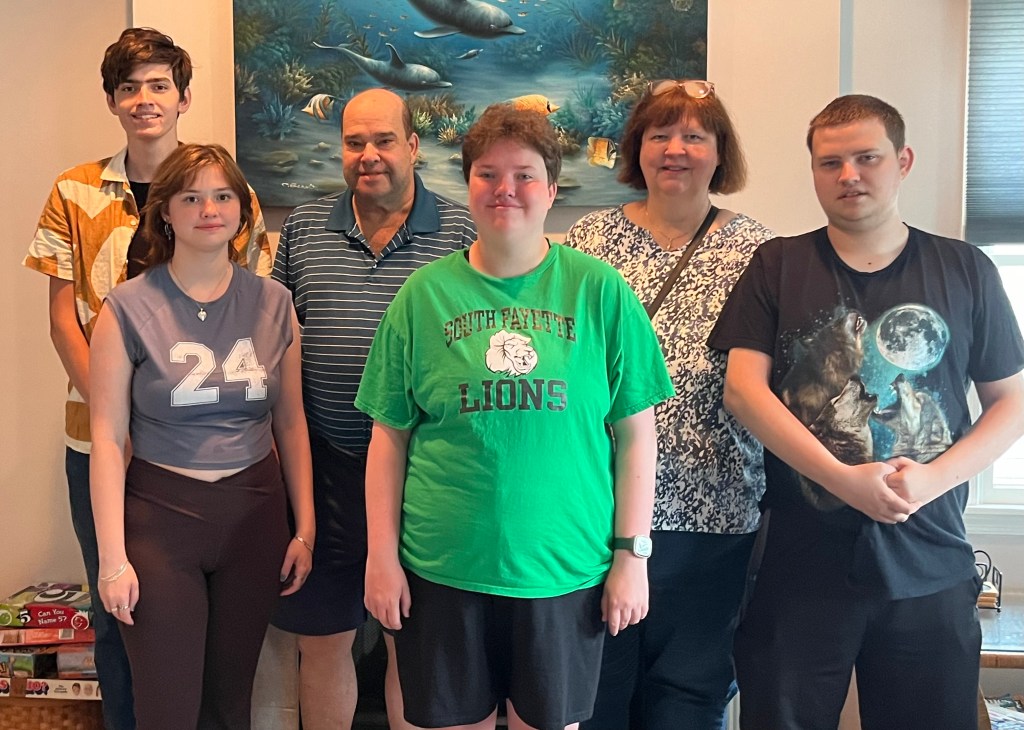
“Ben, age 22, is a senior at Robert Morris University this coming year. He is studying Information Technology.
“Fin, age 20, is going to be a sophomore at Indiana University of Pennsylvania majoring in History with a concentration in Public History and possibly minoring in music or music history. Fin’s dream job would probably be in a museum, possibly at the Rock and Roll Hall of Fame.
“Twins Jayce and Nick, age 19, just graduated from South Fayette High School. Jayce has enrolled at Bella Capelli Academy in Robinson Township and will begin the cosmetology program in August. Nick will be a freshman at Pitt. He is majoring in Film Studies with his interest in video editing, and he will probably minor in music. He hopes to join the Jazz Band at Pitt. He plays saxophone (all of them—baritone, tenor, alto, and soprano) and bass clarinet. Honestly, he can play just about any instrument he picks up now.
“Shari, when you asked for my memories, I made some notes, then I tried to write this without looking at those notes, just to see what things came up more than once. I definitely had some old memories pop up! Then we talked, and when I got off the phone with you, Fin, my history-loving kid said, ‘I’ll go get the scrapbook. I was looking at it when we had the tornado warning a few weeks ago and were hanging out in the basement. Mom, you have stories to tell me.’”
[NOTE FROM SHARI: Mary’s scrapbook, which her kids have scanned for me, has helped with my memories, too. The scrapbooks and saved memorabilia of Mary and so many others have helped me immensely with the writing of this memoir. Finally, a huge thank-you to Crystal Motto, former designer, tech director, actress, jack-of-all-trades, and managing director of Brooke Hills Playhouse, for scanning thousands of old photographs. I can’t thank any of these people enough!]
The memories from the 1982 season continue in Part 21-B to be posted soon.
Ron Gamble, Shannon McCracken Blake, and Kelsey Hedrick will share their memories,
and Shari and Bill Deerfield will share their memories of John and Jim Wilson. Stay tuned!

 Life Without Lesson Plans