
By Shari Murphy Coote and Friends

THE ELEVENTH SEASON CONTINUED 1982
(“1982, The Season That Nearly Didn’t Happen“)
| THE SHOWS |
| The Music Man Opal Is a Diamond Blythe Spirit H.M.S. Pinafore Not in the Book U.T.B.U. |
| THE STAFF |
| Shari Harper Al and Betty Martin Karen Hall Harrigan Mary Freshwater Geib Jim Wilson John Wilson Jim Matterer Caroline Watson Kelsey Hedrick Debbie Patterson R. W. (dismissed) |
A LITTLE REHASH
Part 21-A told how and why our group dissolved the old for-profit corporation known as the Brooke Hills Playhouse and reorganized as a non-profit corporation called the Brooke County Arts Council. It also detailed our discovery and remodeling of the second story of the Brooke County Museum where we began doing dinner-theatre productions in the fall, winter, and spring.
In addition, Mike Musante, Carl Marsh, and Mary Freshwater shared their Playhouse memories and stories. Now on to the memories of other Playhouse contributors!
RON GAMBLE REMEMBERS
Ronnie Gamble was one of the kids who had quite a run of shows at the Playhouse from 1982 to 1986. Ron grew up on Brady’s Ridge off of Washington Pike, not far from the Playhouse with two other Playhouse stalwarts—Carl Marsh and Mike Rager (who recruited both Ron and Carl!).
Ron’s first show was a production of You’re a Good Man, Charlie Brown at Wellsburg Middle School during the 1980-1981 school year, when he was in the eighth grade. Sue Ann Armstrong, who was the WMS music teacher, was in several shows at the Playhouse (on stage and in the pit). She directed the middle school show and added a few extra characters from the comic strip to give more kids the opportunity to be on stage. Ron played Pigpen in his first production.
Mike Rager’s first Playhouse show was Oliver! in 1979. He was so young, maybe seven years old, and he played Oliver Twist. A year later, Mike was in Oklahoma!, and in 1982, he invited, urged, begged, and pushed his friends Carl and Ron to audition at Brooke Hills. All three were cast in The Music Man. Ron had just finished his freshman year in high school.
While a student at Brooke High School, Ron was a member of the Concert Choir all four years and the Madrigal Choir for three years. When Rick Taylor, Norma Stone, and I started the Madrigal Dinner in 1984, Ron was our first jester, whom we named Gags Greatly. “I had to try to have a fake swordfight with Bill Lohr during the entertainment part of the dinner,” said Ron, “and I had to do it left-handed because my right hand was in a cast.” Before he graduated in 1985, he was also in the Brooke High production of The Pirates of Penzance.
“During the first set of tryouts for the Playhouse, I was cast as one of the members of the barbershop quartet in The Music Man, along with Carl Marsh, Jeff Lilly, and Jim Matterer.
“Then, during the second set of auditions, I got a part in the chorus of H.M.S. Pinafore. I’d already done the one Gilbert and Sullivan show on our big stage at the high school. Doing another G & S on the much smaller Playhouse stage, with the scenery representing the deck of a ship, was a much different experience. At the high school, we had tons of backstage space. At the Playhouse, there is hardly any, and it’s important to be super quiet because the stage is so close to the audience.
“I was in the chorus of Annie Get Your Gun in 1983, and I went to see many of the other shows at the Playhouse that summer.”

“Once Upon a Mattress was the opening show of 1984, and once again, was in the chorus.”

“Later that summer, I was cast in one of my favorite shows, Snoopy. I played Charlie Brown. Before Snoopy opened, Shari positioned the cast members for a publicity photo on the large scaffold that was being used to re-side the barn that summer.
“Our costumes weren’t ready yet, but costumes were cobbled together. Shari brought out the original Charlie Brown t-shirt, orange with the big black zigzag, from the first show at the Playhouse back in 1972. Whoever played Charlie in that production wasn’t as round as I was, so she started cutting the shirt up the back. I put the shirt over my head, my arms through the sleeves, and climbed up the scaffold for the photo with my naked back hanging out. It was a hot day. I didn’t mind in the least.” [NOTE FROM SHARI: Tom “T.C.” Cervone was that first Charlie. See Part 5B]
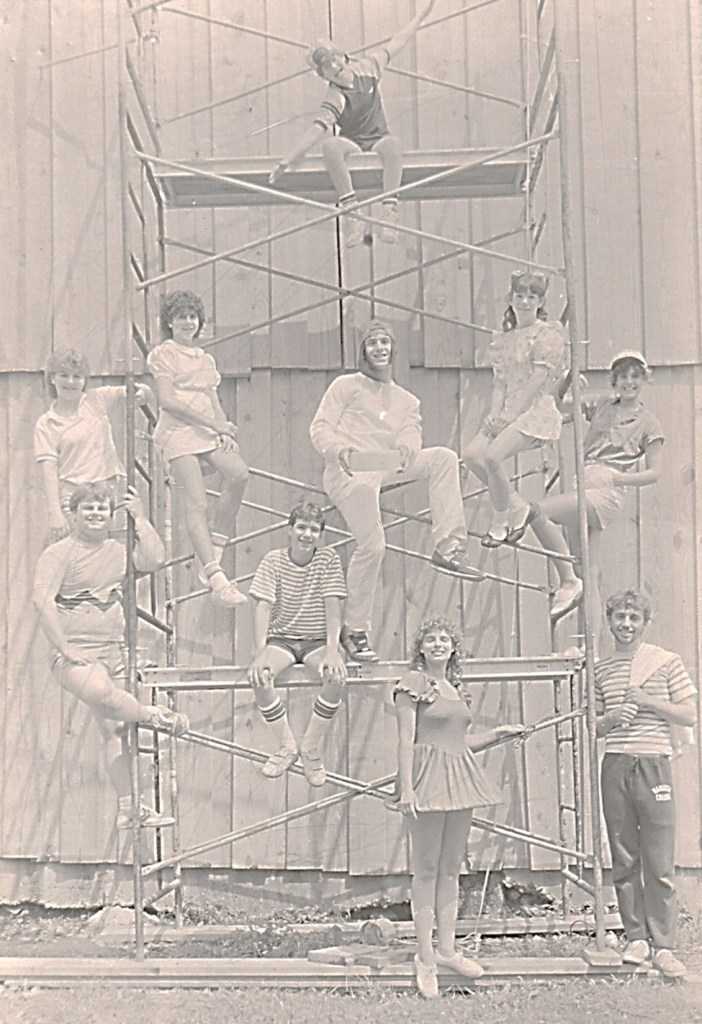
“Those of us in the cast of Snoopy started calling it The Show That Wouldn’t Die. Shari had been approached by a tour company about doing a show in the barn in October for several busloads of folks. She polled us, and we were all up for it.
“We had a brush-up rehearsal or two and did the show on a crisp fall day in the barn after removing the plastic sheeting covering the seats and reconnecting the light board. Our costumes weren’t made for a chill in the air, but we were in a lively show. The audience sat still, and maybe shivered, in coats, gloves, and hats, while we sang and danced our hearts out to keep warm. Following the performance, we learned how much they loved the show and the barn setting.
“Shari had also been contacted by Oglebay Park. They wanted to present a show, a dinner-theatre, for several evenings during the Christmas season in Glessner Auditorium, but there was a problem. Carl Marsh, who played Snoopy, the lead in the show, was moving to Florida with his family not long after the bus tour show. Terry Stuck courageously agreed to take over the lead. He worked with the cast during the brush-up rehearsals for the bus tour and sat in on the performance. Shari may have videotaped the show to help him as he learned the role, practically on his own.
“The cast got together again in December. By then, Terry knew all of his music (4 solos, a duet, and 5 numbers with the entire company), his choreography and movement, and his dialogue. During the show, his character only had 3 musical numbers off! Honestly, that guy is full of talent! So, we performed again that December in the beautifully decorated Glessner Auditorium, and for us, Snoopy! will always be The Show That Wouldn’t Die!
“I have another vivid memory from the summer of 1984,” said Ron. “I wasn’t just involved with the choral music department at Brooke High; I was also in the band. Each summer, we had band camp at Oglebay Park to learn our first half-time show for the fall. Band camp was two weeks before Snoopy opened. Band camp is a lot of fun, but it’s also a lot of work, physical work—marching, marching, marching while playing an instrument—morning, noon, and night!
“I had a Snoopy rehearsal the afternoon I returned from band camp, and I was exhausted. I called the Playhouse and told whoever answered the phone that I wasn’t going to make it to rehearsal. About 10 minutes later, I got a call from Shari.
“’Listen here, you,’ she said most emphatically, ‘if you’re not coming today, you’d better have everything perfect tomorrow,’ and she slammed down the phone. I was at the barn in under 15 minutes!”
Ron graduated from Brooke High in the spring of 1985, and he was cast in three Playhouse shows that summer.
“Some of my most self-conscious moments were at the beginning of the 1985 season. I was so happy. I was cast as Motel the Tailor in Fiddler on the Roof, a part with lines and a solo! Then I learned I was cast opposite the tall, beautiful Shannon McCracken. It was like someone said, ‘Ooo, it’d be funny if we had this little tailor marry someone 4” taller than he is!’ Of course, no one is nicer than Shannon, and we just got on with the show, and maybe we added a laugh or two.
“In 2023, when there was a Madrigal Choir Reunion Concert, I reunited with Shannon, who invited me to join the Ohio Valley Corale in Steubenville. I sang one time with the group, and then I was assigned to two churches in Wheeling, and the drive to and from took too much time, but I was happy to be back in touch with Shannon.
“I did two other shows in 1985, Fools, my first non-musical, and Two by Two, which is loosely based on the Noah story. I played Ham, Noah’s middle son. We joked as the middle kid, I was the Ham sandwich. Tracey Comer played my wife, and I had a slight crush on her.” [NOTE FROM SHARI: Since writing this memoir, I’ve learned about a lot of crushes during various summers. I was definitely clueless about the crushes when they were happening!]
“Al Martin directed Fools,” said Ron, “a show by Neil Simon who took some of the short stories of Chekov and rewrote them as clever little scenes. I’ll always remember Al, who was in one vignette, doing the scene where the speech from Shakespeare’s The Merchant of Venice was quoted. Al was a master, and I was thunderstruck by his talent. I never missed listening to that scene when he recited, ‘The quality of mercy is not strained; It droppeth as the gentle rain from heaven upon the place beneath. It is twice blest; it blesseth him that gives and him that takes.’”
Ron entered West Liberty State College that fall, and with his great voice, he was immediately tapped for the college’s Chamber Choir. “Each spring the Chamber Choir embarks on a tour,” said Ron. “My freshman year had been hard on me, and I wasn’t in a great place, but on that tour, I started thinking about my commitments to the Playhouse (I’d been cast in two shows before the tour began), and I started looking forward to getting into rehearsal. Then right on cue, my parents gave me the Peter Gabriel album So for my birthday, which has ‘Don’t Give Up’ on it. I listened to that over and over and got down to work.
“I had a small part in The Good Doctor, and later in the summer, Tim Eckard and I were the backup singers for Russ Welch’s character in They’re Playing Our Song.
I can honestly say with no shame that I love Brooke Hills Playhouse, the barn itself, the people who work backstage, and my fellow cast members. It’s where I learned to value everyone regardless of their sexual preference. I learned tolerance and acceptance. I have only great memories.”
In 1988, Ron met Renée Simmons from New Cumberland at West Liberty. One of his friends asked him, “Are you going to ask Renée out?” He finally got up his courage and asked. She accepted, and on the day of their date, “I crashed my car,” said Ron. His friends then told him he would have to ask her to Homecoming, and he did! They were married in 1989.

“I was planning to be a music education major at West Liberty and quickly realized that I would have to read music! I couldn’t read music! I was a drummer!”

Ron’s undergrad degree is in Communications. Renée has a B.S. degree in Theoretical Physics from Edinboro University of Pennsylvania and did some work toward her Master’s degree at The Ohio State University before she was diagnosed with lupus. In 1994, Ron entered seminary and graduated in 1999.
After serving two United Methodist Churches in Ohio for four years, Ron and Renée returned to West Virginia. Today, Ron pastors two Wheeling congregations, Hope United Methodist and New Life United Methodist.
“I had done a couple of shows at West Liberty and a couple more in seminary,” said Ron. “In 2024, Niccole Welch was directing Don’t Dress for Dinner at the Playhouse,” said Ron, “and Carrie Cronin recruited me to be in it. I got to play a mean guy! And that was a lot of fun.

“One of the first things I did when I got to the barn was check out the graffiti in the backstage restroom, and I found one of my contributions, ‘Hello, Snoopy, June ’84. Goodbye, Snoopy, Dec. ’84.’ [NOTE FROM SHARI: How many Playhouse alums rush to check out the backstage restroom graffiti when they return to the barn? A hell of a lot! It cracks me up that Ron even took a photo!]
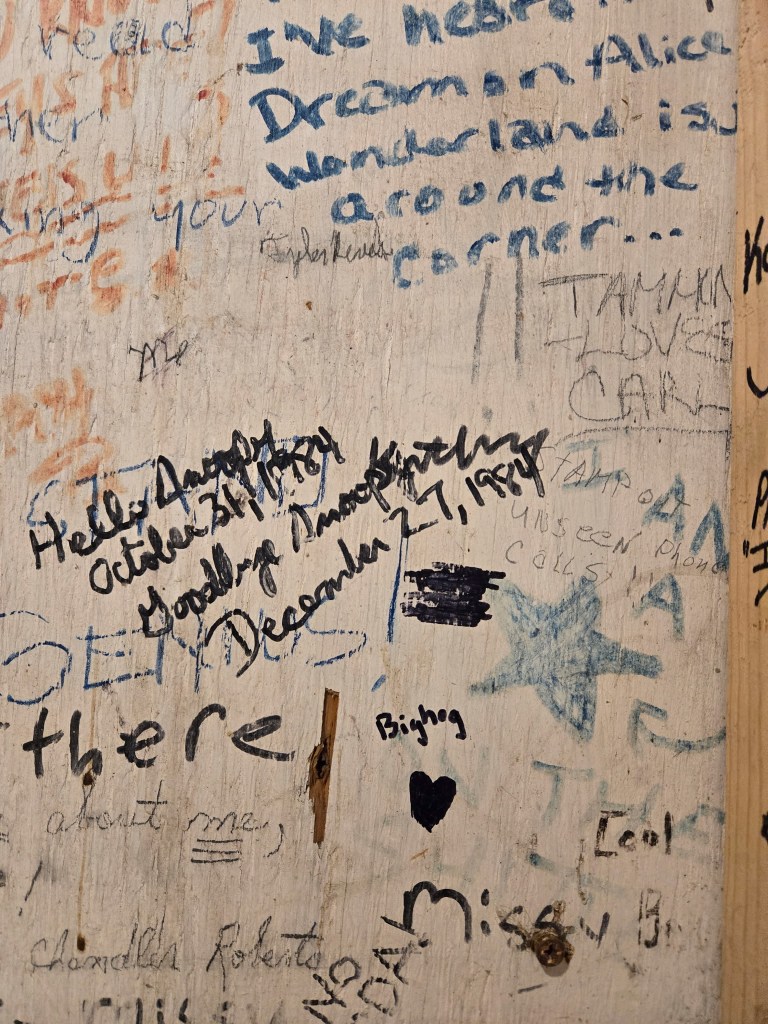
“In 2024, one thing was very different from my Playhouse experiences in the 1980s—the cast parties! The 2024 version was so mild. There was no beer! There was cake (good), and everyone had gone home by 11:00 p.m.!”
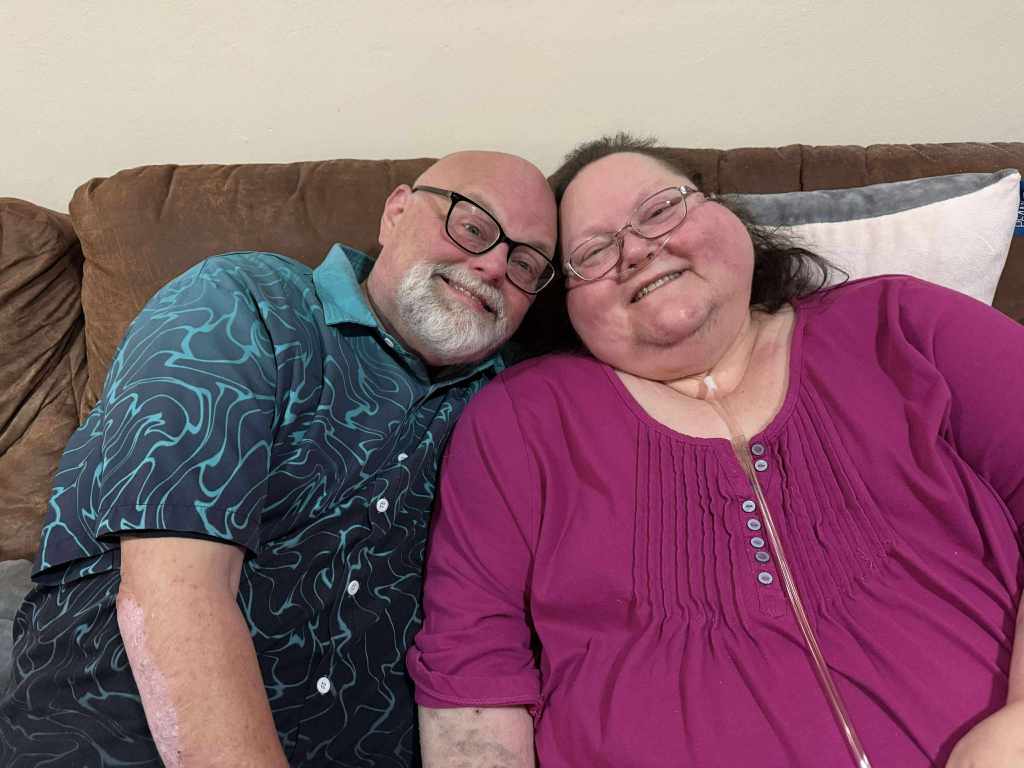

Christmas 2024.
SHANNON MCCRACKEN BLAKE REMEMBERS
“In 1980,” said Shannon McCracken Blake, “my mom (Jane Verner) took me to the Playhouse to see Oklahoma! It was so magical to me. I was fascinated, and I thought to myself, ‘I want to do this.’ Mom and I continued to go see shows at the Playhouse, and in 1982, the summer after my freshman year at Brooke High School, I went to the auditions at Brooke Hills. I was so excited just to be auditioning. I wanted to be in a show, but I didn’t care if I was only the last one in the chorus.
“I was cast in the chorus of The Music Man during that first set of auditions, and I couldn’t wait for rehearsals to start. My character even had a name, Maude Dunlop!
When rehearsals started, I learned that I had a lot to learn, but I just soaked it all up. Later at the second set of auditions, I got a part in H.M.S. Pinafore. I was in heaven.”

H.M.S. Pinafore, 1982
“In the following years, I was cast in Once Upon a Mattress (1984), and in Fiddler on the Roof (1985), I played, Tzeitel, Tevye’s oldest daughter.”

“When I think of the Playhouse, it just makes me happy. We were accompanied by these great pianists on this old, tinny, upright piano that was shoved in the corner in front of the proscenium. There was no air conditioning, and it could get really hot under the stage lights. There was no fancy soundboard or light board. There were no microphones. We were in a barn in West Virginia, but it was so intimate, so magical.
“And there was so much talent—the voices, the harmonies, and dynamics, the clever staging, the wonderful acting, the enthusiasm. These were everyday people who were so talented they could transport their audience to big cities and foreign countries and kingdoms and ships on the ocean. We were like a family at Brooke Hills, and I’m just so thankful to have been a part of it.”
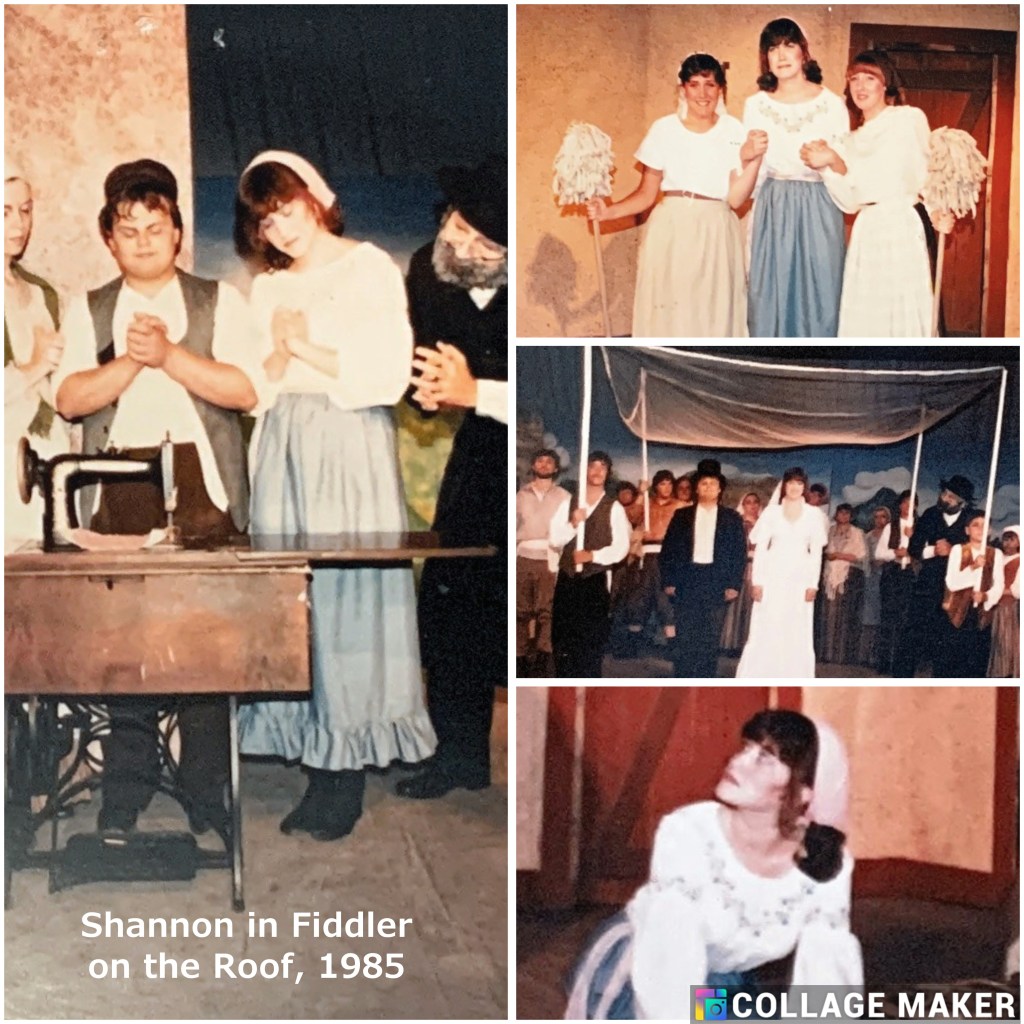
Shannon graduated from Brooke High School in 1985. She was in Patience at Brooke High and in the first Madrigal Dinner that Rick Taylor, Norma Stone, and I produced at Christmas in 1984. After high school, Shannon went to West Liberty State College, where she earned her degree in English and Music Education and met Todd Blake. They were wed after graduation in 1989.
Todd joined the U.S. Army and became a medivac helicopter pilot. Todd’s work took the couple to army bases in Wiesbaden and Frankfurt, Germany, and Shannon got involved in a theatre group in Frankfurt. She was also a part of a traveling group that performed at the Alte Oper, a big concert hall in Frankfurt. She had a lot of fun doing a variety show in Germany, too.
Back in the States, Shannon and Todd’s two sons were born at Ft. Bragg (now Ft. Liberty) in North Carolina. When Todd was deployed to Korea, Haiti, Iraq, and Afghanistan, Shannon stayed in the United States with the boys. Eventually, Todd was stationed at Ft. Rucker in Alabama, where he served as a trainer for 18 years, and Shannon taught school. Todd recently retired after 32 years of service.
Today, older son Logan is a graphic designer in Atlanta, and Travis is at West Virginia University studying to be an athletic trainer.

“One of the memories that sticks out for me,” said Shannon, “is of Charlie Calabrese. You always knew when he was in the audience because of his big laugh. You knew when you’d done well, hit your mark, by Charlie’s laugh. I’ve now seen shows all over the world, but the ones I saw at the Playhouse were the best, and I appreciate the Playhouse even more. It’s a treasure.”
Shannon and Todd live in New Cumberland, W. Va., and Shannon and her mother, Jane Verner, sing with the Ohio Valley Chorale.
KELSEY HEDRICK REMEMBERS
In the spring of 1982, my sister Kay Murphy Cilone and one of her friends went to see Oliver! at East Liverpool (Ohio) High School, where her sons went to school but were not in plays. She and Diane both thought the kid who played the villain Fagin was outstanding, so they waited around after the show to tell him how much they enjoyed his performance. Kay also had another motive. She had read in the program that the kid was interested in theatre, so after telling him how good he was, Kay told him that there was still a vacancy on the summer staff of the Brooke Hills Playhouse, about 35 miles south in Wellsburg, West Virginia.
Kay wrote down the name of the Playhouse along with my name and phone number. She encouraged him to give me a call. The next morning, she called me and told me about this kid named Kelsey Hedrick, who would soon be graduating from high school. She said he was a really nice kid, and he was a talented kid who might be giving me a call about a summer job. Kelsey did call, and we chatted about him, what he’d done theatrically, about the Playhouse, the pay, the living arrangements, and what his responsibilities would be. Based on Kay’s recommendation and that chat, I offered him a job. It was a good move.

East Liverpool High School, 1982
Recently, Kelsey and I talked again, 43 years later! Kelsey said, “My high school counselor, Jim Martin, asked me to be in a show,” said Kelsey, “so that’s when my love of theatre started. I didn’t have much growing up. I lived with my grandmother, who was wheelchair bound, and I helped with her care. I wasn’t outgoing, maybe that’s why Mr. Martin asked me to be in a show, to bring me out of my shell. Anyway, I really liked being on stage, and then I got involved with martial arts, and I still am.
“When I arrived at Brooke Hills, I’m not sure who I met first, but I was taken around and then upstairs to see the theatre. Al Martin was on the stage painting the flats that would comprise the library scenery for The Music Man. I was in awe! I walked up on stage and tried to take a book off the shelf! That’s how real it looked. Al was painting the chair rail, and I couldn’t believe the depth he’d given it. I put my nose right up to it to see how he had made everything look so real. We introduced ourselves and started talking. He was such a great guy.
“Next, I met Jim Matterer, who was the company cook that year, another nice guy. Pretty soon, I’d met the rest of the crew, moved into the big yellow house not far from the barn, and been put to work.
“That summer we did six shows, and I was in three of them, three right in a row, the third, fourth, and fifth–Opal Is a Diamond, Not in the Book, and H.M.S. Pinafore. Of course, we all had jobs on the other shows as well. We all built and painted scenery or ran the lights or props or stage managed, just whatever was necessary, and I loved every minute and every job.”
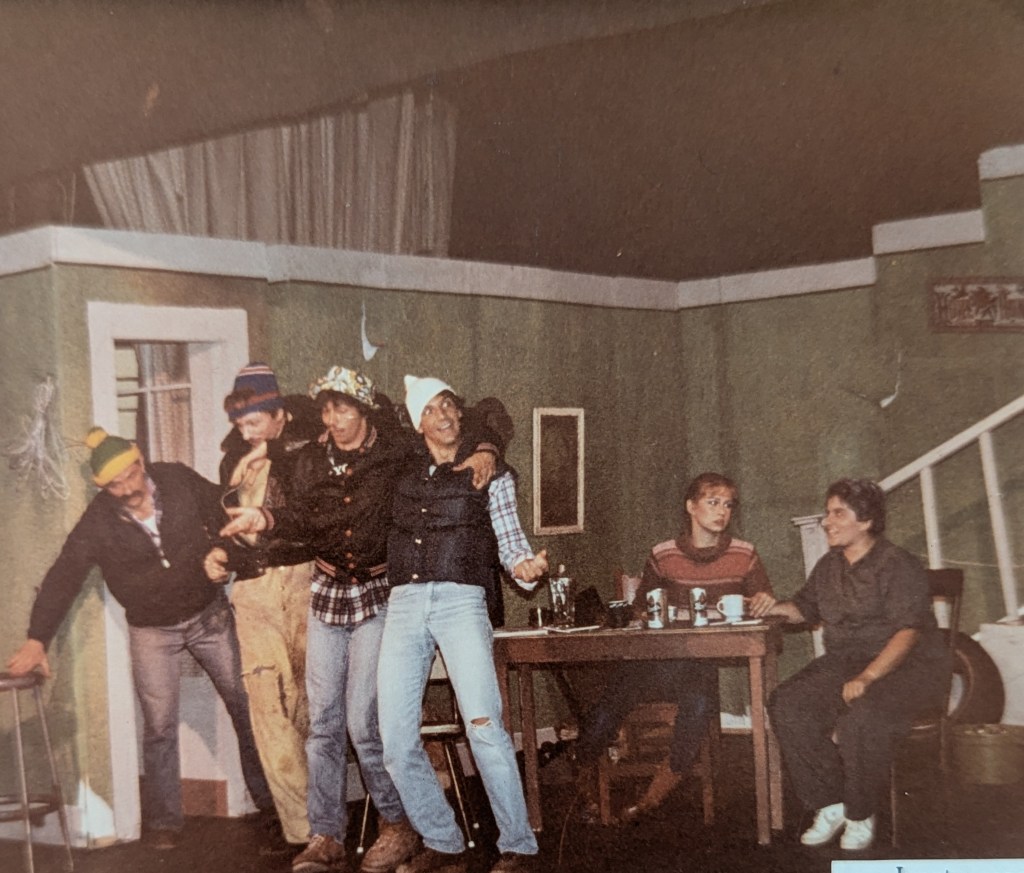
in Opal Is a Diamond, 1982
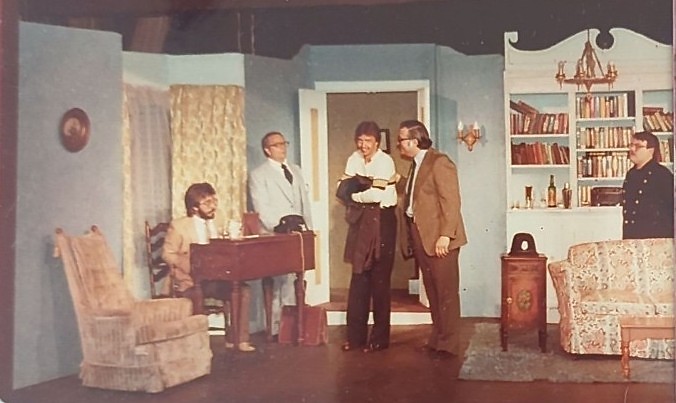
Not in the Book, 1982
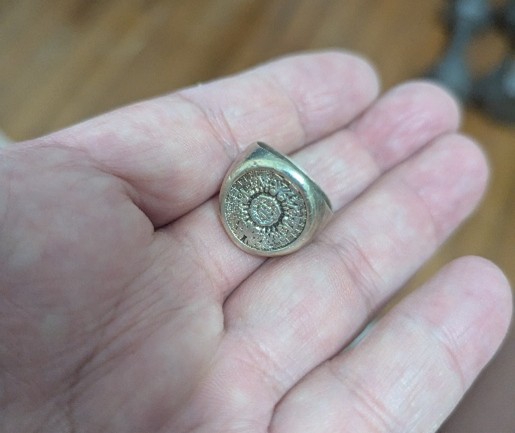
“I remember at one cast party, Susan Price [NOTE: probably the Blythe Spirit cast party], who worked for an airline but also sold jewelry, brought some jewelry to the party and gave us all a piece. I received one of two silver Aztec calendar rings that she had with her. I had that ring for years, but eventually it was lost. I called Susan to see if she still had the other one, but she didn’t. Twelve years later, my little brother John was in an East Liverpool bar when, for some reason, the bartender, who was talking to the guy beside John, reached behind him and brought out a jar with all kinds of goofy lost stuff. He poured it out on the bar, and John saw my ring! My ex-wife had lost it! I got it back, and I still have it!
“Early in the season, I learned I had two abscessed teeth. I got them taken care of, but I couldn’t work for a couple of days. I don’t remember her name, but a nurse, who lived just down the road from the Drover’s Inn, had a nice, finished basement with a spare bedroom and air conditioning (!), something we didn’t have at the Playhouse. I stayed there for a couple of days while healing.
“I met Ken Kasprzak when we were in Opal Is a Diamond together. Later that season, we were both in H.M.S. Pinafore, and Ken invited everyone to his house for the Pinafore cast party. “Sometime during the evening, I went looking for the restroom. I opened one door, but it was his bedroom. His bed filled the whole room! The door opened right onto it. I opened a second door and was embarrassed to find there was someone in there. I lowered my head immediately and backed out, apologizing profusely. The person didn’t say anything. Odd. I peeked in and discovered it was a fully-dressed manikin in the bathroom! LOL! (A few years later, Ken and I both played card players in The Odd Couple at the Camelot Dinner Theatre in Weirton.) “I played Dick Deadeye in H.M.S. Pinafore. I wore an eyepatch, hunched over, and dragged one foot. My favorite line was, ‘Aye, I’m ugly, too, ain’t I? And youse hates me, too, don’t you?’ Dick wasn’t a pirate, but I think I used a little ‘pirate’ accent. Now, I hunch over and say that line to my grandkids—full-pirate. They howl with laughter, then they say it!”
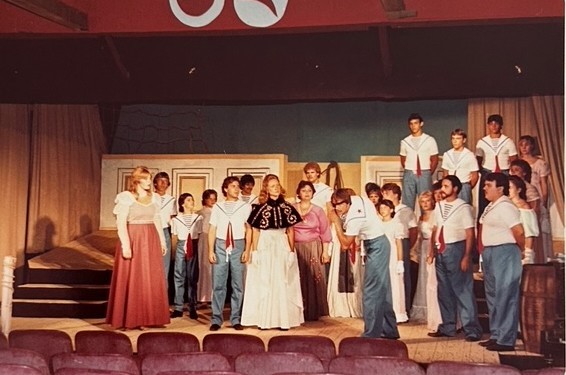
“I also remember how impressed I was with the costumes for that show. The sailors looked great, because our uniforms were so clever. We all wore light blue hospital scrub pants and nice white t-shirts. The trick was that the costumers, Norma Stone and Caroline Watson, had made square, sailor collars with red ties for all of us that went on over the t-shirts. We looked great!
“I learned a lot during Pinafore. I’d never heard of a raked stage before, but Al Martin and Rich Ferguson, the co-set designers, had designed one for this show. We (the staff) built a stage on top of the regular stage, and the top stage was raked, that is, higher in the back than it was in the front. Shari explained that this was where the terms upstage (the higher part of the stage in the back) and downstage (the lower part of the rake, closer to the audience) had come from. Stage left and right always made sense, upstage and downstage, not so much. In high school, it seems like someone just said, ‘Stand here, or go there!’
“During Opal Is a Diamond, I learned something else that I still do today. Russ Welch had mastered the trick of sneaking up behind someone, touching the back of their knee, and barking like a dog. I don’t care how many times he did that to you or anyone, it always produced a startled jump and a squeal or a yelp or a scream! I decided to master that little piece of business as well, and I now get the same reaction as Russ–every time but one.
“Several friends and I were in New York City one year seeing shows and having a good time. We’d been drinking, and we were walking through Central Park when we caught up with some girls. We walked behind them at a reasonable distance for a while when one of the guys dared me to ‘bark.’ Remember, ‘drinking.’ I caught up with the group, bent over, touched her leg, and barked. She wheeled around as I popped up with a big, friendly grin on my face, and she slapped me so hard that I wore a handprint the rest of the day! Only friends get the bark now.
“I have such great memories,” Kelsey said. “One day, I was taking a little walk in the park before work started, and I came across a guy out in the Playhouse yard who was sitting and sketching. I walked toward him and saw that he was drawing the barn, board by board. His name was Russ Shaffer, I think, and as we talked, I learned he was an artist and an art teacher in Wellsburg. A little later that summer, I saw him again. He brought me a signed copy of the sketch of the barn from the day we met. I met a lot of really nice people that summer.”

Two years after Kelsey’s summer at the theater, he married and moved to Dallas, where he became a ‘skip tracer.’ He worked for a rental company that leased furniture, and when people didn’t pay the rent on whatever they had leased or when they left town, Kelsey tracked them down, got a court order, and then went after the miscreant, accompanied by a policeman. “It was this job,” said Kelsey, “that got me interested in police work.
After five years of marriage and a son named Kelsey, Jr. (who also has a son, Kelsey), he was divorced. Back in East Liverpool, Ohio (ELO), our Kelsey took the police test in 1995 and became a city police officer.
Kelsey in uniform
Since joining the force, Kelsey has been involved in a lot of incredible things. Each year, East Liverpool has a Pottery Festival to celebrate its historic and world-famous pottery/china businesses. Out of the blue, Kelsey was asked to do a window display for Anna Lea’s Realty, across from The Hot Dog Shoppe (a must-eat place in downtown ELO). He was passionate about the police force, so that was his theme. His display won first place, maybe because of his theatrical set-building and prop experiences! Then people started donating police memorabilia to Kelsey—uniforms, weapons, protective gear, and lots more. This led to Kelsey creating The Police Museum in 2002, in what was once the ELO jail that had housed prisoners in a bullpen and a number of cells. The museum is still in business (except that it’s free!) and has numerous displays, both static and interactive.
Next, Kelsey was asked to consult on the creation 759 Dresden Ave., a documentary film about an unsolved ELO murder, and in 2017, he was involved with The Last Run of Pretty Boy Floyd, a second documentary. As a matter of fact, Kelsey has quite a collection of donated documents pertaining to Floyd, and he’s invited to speak on Floyd’s last three days by groups from all over the country.
Kelsey remarried in 2009, and he and Angel have four children and 10 grandchildren between them. He battled testicular cancer in 2000 and survived a painful hospital stay in 2018 when scar tissue blocked his bowel. He is an avid martial arts participant and a frisbee golf player. He’s even designed frisbee golf courses!
Kelsey retired from the police force in September 2025, and he is now a private investigator whose primary job is to locate missing children and families.
No longer acting, Kelsey and Angel now attend plays together. “I’m so glad she likes going to shows,” said Kelsey. “That summer at Brooke Hills changed my life. I didn’t have much of anything growing up. At the Playhouse, none of that mattered. I was just one of the crew and one of the actors, and we were all there because we had this common love of theatre. Everyone was just great. I still proudly tell people, ‘I’m a character actor.’ The Playhouse never left me.”
THE 11th SEASON ENDS
AND THE BROOKE COUNTY ARTS COUNCIL BECOMES A YEAR-ROUND OPERATION
U.T.B.U. (Unhealthy To Be Unpleasant), that crazy farce that we first produced in 1973 left our audiences and all of us in the company rolling in the aisles as the final show of the season. We started the summer with just over $3,000 in the bank, thanks to Bubba, our first production at the Brooke County Museum. Mary Freshwater’s scrapbook had an end-of-the-season financial statement showing that we brought in $18,650.47 in program ads and ticket sales, and we finished the season with $5,886.79 in the bank!
Maybe most significantly, we would be doing the 3-woman comedy/drama Vanities in October as another dinner-theatre at the Museum in October, and we planned to produce Heavenly Body there in the spring. This meant we could raise the salaries for our staff members in 1983 from $35 to $50 a week without breaking a sweat.
Once again, we sponsored a bus trip to New York City in November. The cost ($200, double our original cost when we first started these trips in 1975) covered round-trip transportation by bus, two nights in a hotel one-half block from Times Square, and orchestra tickets to four Broadway shows! 90 people, two full bus loads, went with us!
MORE IMPROVEMENTS AT THE MUSEUM
After the 1982 summer season, I started working on a grant for our newly formed Brooke County Arts Council to insulate the museum space, purchase and install electric baseboard heaters, and install a new electrical service. In other words, we wanted to winterize the second story where we would be doing shows. This was something I could do with a baby at home while others worked on the fall production in our new space.
The electrical service and heaters were installed by the guys in the Electricity and Electronics class at Brooke High School under the supervision of their teacher, Barry Kirtley. That volunteer labor counted as our part of the matching funds for the grant. Eddie Henderson was hired to blow in the insulation, and he gave us a greatly discounted price. The improvements made the museum much more usable and desirable, but the plywood over the window holes needed to go.
We got estimates for the big windows, their installation, and the mounting of a little engraved plaque on each window showing the name of the donor. The total cost for good double-pane, insulated windows, installed, was $300 each. A whopping 22 windows needed to be purchased–$6,600! We did not have that kind of money, so we initiated a campaign in which we asked various individuals and civic and fraternal groups to donate $300 each. We made a big list of possible donors—Wellsburg Civic League, Wellsburg Elks Club and their Women’s Auxiliary, Wellsburg Moose Club and their Women’s Auxiliary, Wellsburg American Legion, Wellsburg V.F.W., Wellsburg Kiwanis Club, Brooke High Key Club, Brooke High Drama Club, Wellsburg Garden Club, Wellsburg Shakespeare Club, Masonic Lodge, Eastern Star, Wellsburg Lions’ Club, and others. Then we divided up the list, and different people approached the groups for money. A few organizations chipped in enough for two windows. It didn’t take long, and by the time rehearsals for the spring show began, the windows were ordered and installed.
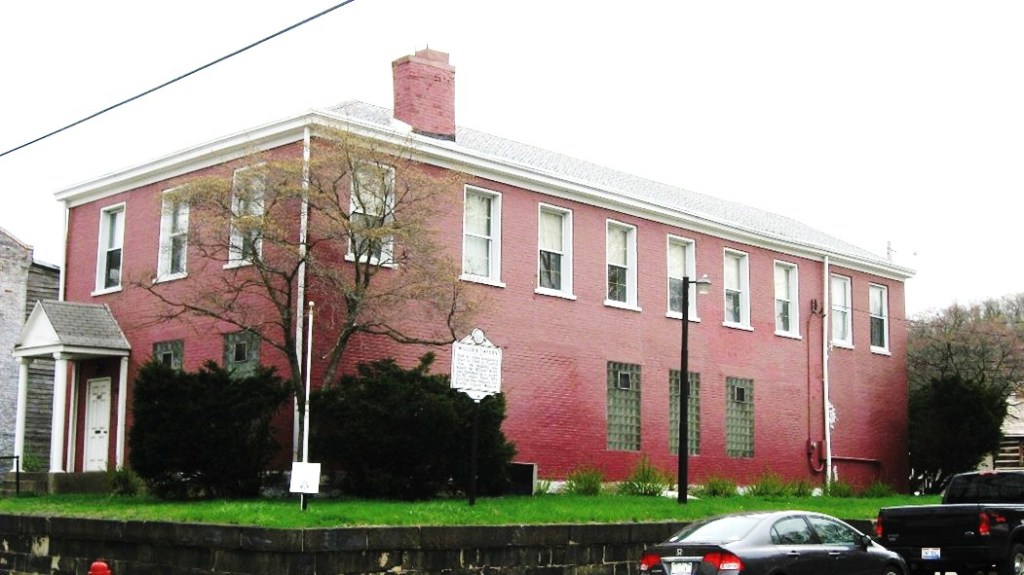
I don’t know if this was the original color or not, but it had been red in the past.
Doing shows at the museum made so much sense, money-wise, for our group. Once again, the Wellsburg United Methodist Church was gracious enough to lend us their chairs and tables, but we had to get a group of folks together to go to the church, take down the tables, fold up the chairs, load them onto a pickup truck, and cart them from 11th and Charles to 6th and Main in downtown Wellsburg. The tables and chairs had to be offloaded, carried up the steps to the Museum, and then up even more steps to the second floor, where they were set up. On Saturday evening after the show, the process was reversed, so the church could use the tables and chairs on Sunday morning. We did it all over the following weekend. This was the worst part of producing dinner-theatre shows. Once again, Betty Cunningham catered, and once again, we made money!
Since we had finished the Playhouse season in the black, and we’d be doing another show at the museum in the spring, we used the profit from Vanities to buy our own tables and nice padded folding chairs! I can’t tell you how much having our own tables and chairs meant.
Another nice thing about doing shows at the museum was that we had something for the Playhouse staff to do when the last show of the Playhouse season was up and running. The crew built the scenery for the fall show at the museum, gathered props and furniture, and put up the set and lights. If we had the foresight to choose a show early enough, our crew could have constructed the spring show as well. We never had the foresight.
In the mid-1980s, after presenting shows, special events, lectures, and concerts at the museum, one of the circuit court judges discovered the second-floor space and tried to appropriate it for his office! He was dead-set on taking it over, now that it looked great, had windows, and was winterized. I appealed to the commissioners, who seemed powerless compared to the judge, so I started writing letters to the editors of the local papers. This turned up the heat on the judge who answered in the paper. I rebutted. He finally backed down, and we were still using the space when I departed the Upper Ohio Valley in 1995. After confronting the judge, the commissioners appointed me to the Brooke County Museum Board, a job I didn’t need, but one that cemented our ability to use the museum. I was immediately elected president!
The next problem occurred around 1993 when we were asked to make the second story handicap accessible. We got estimates on installing an elevator, the county’s first choice, and then on a chair lift that could be mounted on the steps near the rear of the building. Both of these choices were crazy expensive. Even if we had installed either of these, the problem of getting up the outside steps to the front porch from the sidewalk would need to be solved, probably by building a ramp, another big expense.
I wrote letters back and forth to the county guy in charge of accessibility, and then he got the Prosecuting Attorney involved! I explained that the county owned the building. I explained that other groups used the second story. I questioned why the letters weren’t being addressed to the Brooke County Museum Commission instead of the Arts Council. I appealed to the County Commissioners (who didn’t seem to know what was going on!). For about two years, this went back and forth, and we continued to do plays. I could never understand why the Arts Council was expected to bear the entire cost of making the museum, a county building, accessible. It also housed the county museum, but the county wouldn’t even assume the ramp construction costs. I left in 1995, and I think we only used the second story for storage after that, a loss for the Playhouse, Wellsburg, and the entire area.
In 2019, Miller’s Tavern, built in 1797(!), still in great shape, and listed on the National Register of Historic Places, was torn down by the county to add an annex onto the Brooke County Courthouse. Believe me, there was plenty of empty property near the courthouse which could have been used for the annex, but instead, this lovely old building in the Federal style with its 12”- to 14”-thick walls, was demolished.
Some local politician was quoted at the time of the annex opening as saying, “The completion of the annex is seen as a symbol of progress and a bright future for the county.”
“Ha!” I say. That annex is a symbol of the need for more courts and jail space in the county. Some progress! Miller’s Tavern was a symbol of our historic past and a bright spot of culture that deserved preservation. For a county that is slowly and sadly dying, it’s such a shame that the plays presented at the museum had to stop.
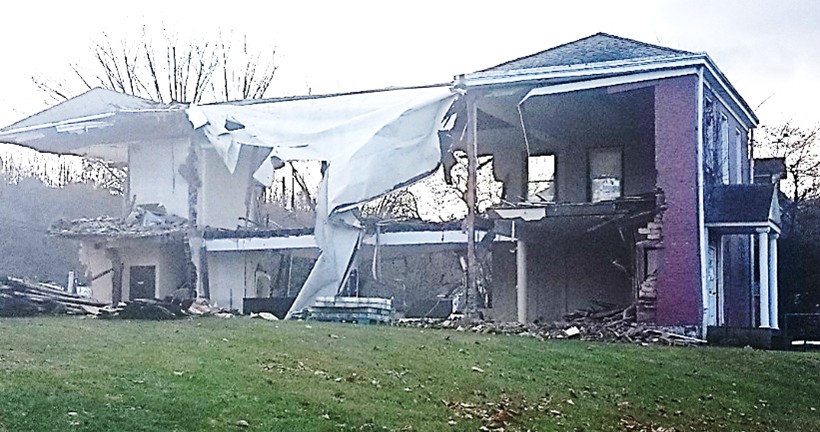
2nd floor: performance space. Right end, front porch facing the Ohio River.

As I write this in November 2025, I’m sad that the museum is gone. The good news is that Brooke Hills Playhouse lives on. In 2025, it successfully produced its 54th season.
The Brooke County Arts Council board is now reading scripts and will soon announce the 55th season of shows to be presented in that old barn, aka the Brooke Hills Playhouse, in Brooke Hills Park in 2026.
Next up: 1983, the 12th summer season in the barn!

 Life Without Lesson Plans
Shari
As always – a great read. I am amazed how you are still connected to all the folks who were part of the theater.
I did find one change in the following excerpt: “Back in the States, Shannon and Todd’s two sons were born at Ft. Bragg (now Ft. Liberty) in North Carolina.”
Ft Liberty has been renamed back to Ft Bragg – just named after someone else name Bragg. This was done by SecDef Hegseth earlier this year (don’t get me started on Hegseth!!).
Cheers
Rudy
Sent from my iPad
>
LikeLike