
by Shari Murphy Coote and Friends

THE TWELFTH SEASON, 1983
THE SHOWS
Annie Get Your Gun
The Rainmaker
Lunch Hour
The Solid Gold Cadillac
Something’s Afoot
See How They Run
*The Prince and the Pauper (presented by the Heatham House Youth Theatre from Twickenham, England), Aug. 2 & 3
THE STAFF
Shari Murphy Coote
Susan Grigney
Al Martin/Betty Martin
Paula Welch
Bob Athey
Karen Hall Harrigan
Anne Roberts
Caroline Watson
Jim Matterer
Mary Freshwater Geib
Jim Wilson
John Wilson
Gloria Snyder
A VERY STRONG SEASON
Our season began in April when we produced another dinner-theatre at the Museum, a cute little comedy called Heavenly Body. I don’t think it was as money-generating as Bubba had been the spring before, but it still brought in $2,000+, and we had a nice nest egg going into the Playhouse season at the barn. I can’t remember why the Anchor Room Supper Club in Beech Bottom catered the dinner instead of our friend Betty Cunningham. There may have been a date conflict.
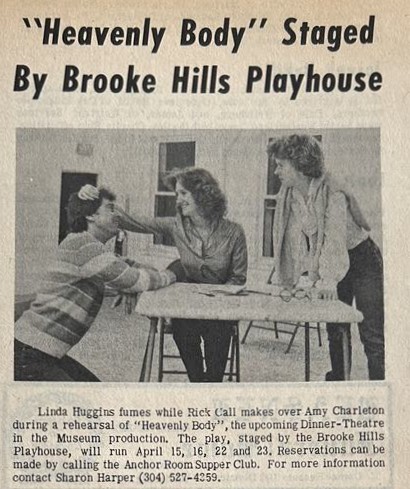
From the Museum show in April, we moved on to the Playhouse season in May. I felt really good about this 1983 season at Brooke Hills. The play selection was balanced–big, well-known musical, a sweet, romantic comedy with themes of hope, self-assurance, and how love can change lives, a romantic comedy, a great, old chestnut where the little woman triumphs over corporate greed and duplicity, an hysterical musical spoof of Agatha Christie mysteries, and a riotous farce to close the season. In addition, our friends from England returned with a delightful rendition of a great Mark Twain story.
AND look at that first-rate staff. They were great hard workers, they knew how to have fun, and their complaints were few. Probably, more important than anything was that nine of the twelve staffers had been on the staff the year before and knew the daily routine
In Part 21-A of this memoir, Mary Geib Freshwater remembered that the Brooke Hills Park Board had determined that the yellow farmhouse near the Playhouse needed to be razed. Since our crews had lived there for several years, we needed an alternative. Who knows where this idea came from, but we purchased two used travel trailers and parked them behind the stage end of the Playhouse for the crew members’ living quarters. Electrical service was run to the trailers, but they weren’t plumbed, and the crews used the Playhouse restrooms and shower.
A FEW AL MARTIN STORIES
For some reason, the season newsletter announced that the 1983 season was dedicated to Al Martin. I can’t remember any special reason, but in truth, we could have dedicated every season to him. He could do it all—act, direct, teach, build, paint (a real master at scene painting), mentor, and serve as a role model of gentlemanly conduct (except for that one time when he built a window unit around one of the upright beams in the lobby! He got so mad that he threw a hammer fortunately not in anyone’s direction!).
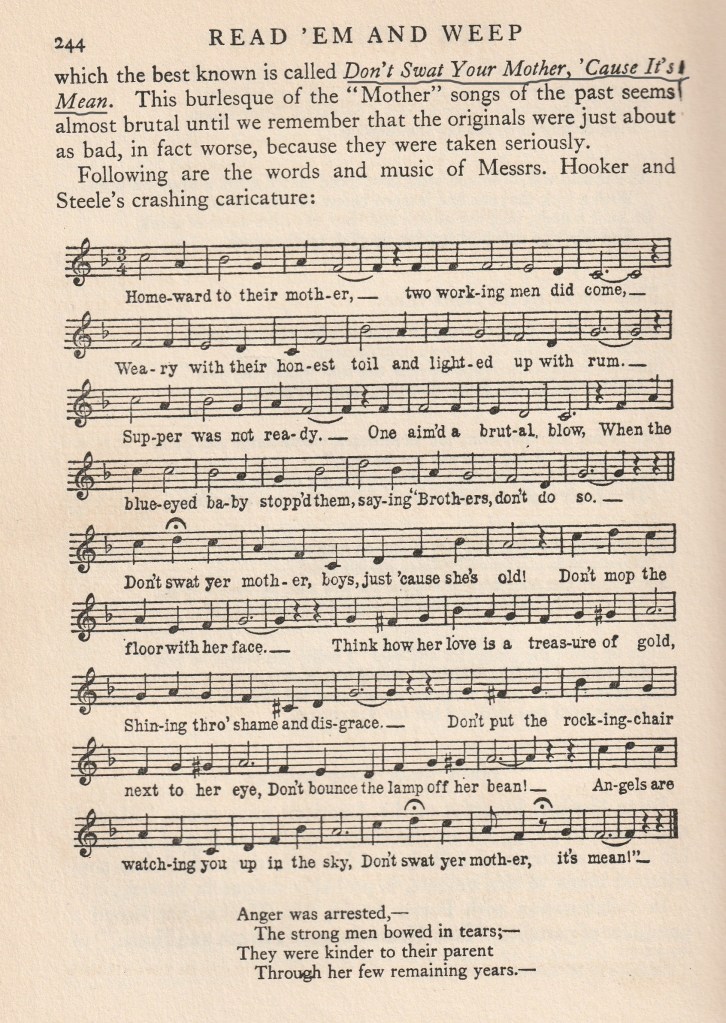
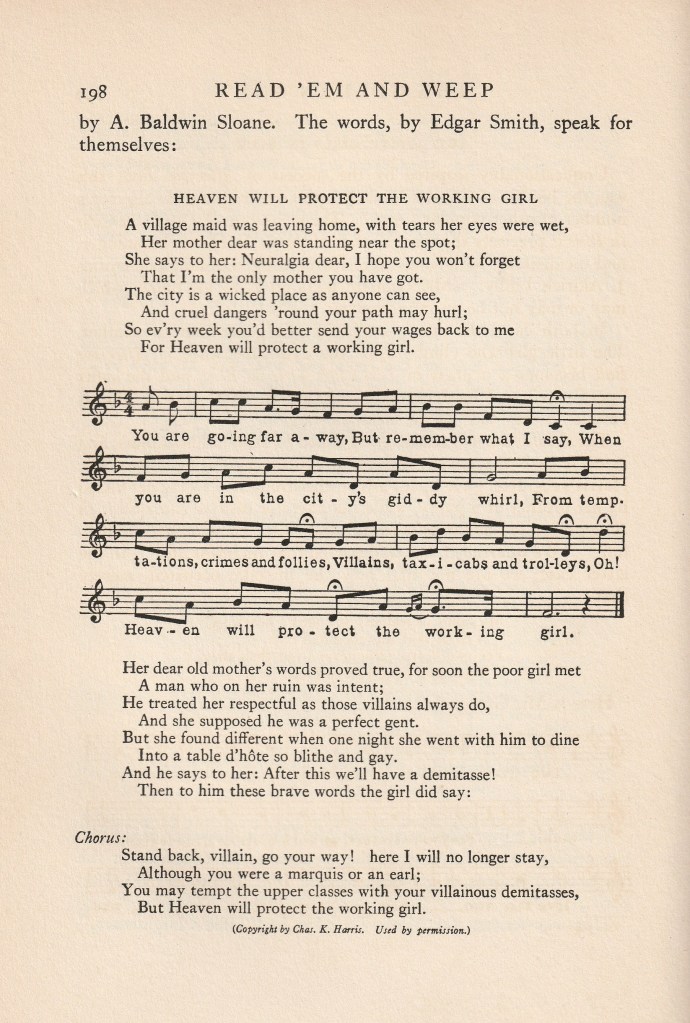
Around the cast party campfires, he would sing great old songs like “Don’t Swat Your Mother, Boys” and “Heaven Will Protect the Working Girl.” We couldn’t get enough of those songs which he’d sing so sincerely and innocently. He’d have us in stitches. I wish I could remember the titles of more of his songs. Here are the two he sang most often and which I found in a book titled Read ‘Em and Weep, the Songs You Forgot to Remember ©1926 by Sigmund Spaeth. I’m sure some of you will remember Al singing them.
“DON’T SWAT YOUR MOTHER”
by Brian Hooker & Porter Steele ©1919
“HEAVEN WILL PROTECT THE WORKING GIRL”
by Edgar Smith and A. Baldwin Sloane (Published 1909)
[NOTE from Shari: The first part and the third part, where no music is provided, were recited dramatically by Al, often accompanied by stock gestures.]
One day late in May 1977, very early days for the theatre, I was frantic. I’d been in town collecting props, and I returned to the Playhouse to discover no one had dealt with lunch. When I looked in the larder, so to speak, it was pretty bare. Because this was Al’s first summer without his wife Tommie, who had died late in 1976, I was very protective of him, and I felt horrible that he hadn’t had any lunch. (Of course, he was perfectly capable of making his own lunch, but no one dared to eat something that might be on a dinner menu later in the week.) I had one of the kids put out the fixings for peanut butter and jelly sandwiches, something that was always available for a snack, but rarely served for lunch.
I learned that Al was upstairs working on a set, so I climbed the stairs, dreading to break the news that it was PBJ or nothing! Al was sweeping the stage.
“Al,” I said. “I am so sorry. I completely forgot about lunch, and there’s hardly anything to eat until I go shopping tomorrow. Would it be okay with you if I made you a peanut butter and jelly sandwich?”
“A PBJ?” said Al, now leaning on his broom in thought. “Hmm, when did I last have a PBJ?”
I don’t think he expected an answer, but I said, “Gee, Al, I don’t know.”
“When was Coolidge President?” he said. I cracked up. It was a great line reading and a great line, and it made me feel like a PBJ was the most wonderful thing I could give him at that moment.
Al always wore khaki shorts or slacks, a t-shirt, and deck shoes. One day, with Al in his shorts uniform, one of the staff members looked down and then said, “Al, you have on two different socks.”
We all looked, including Al, and indeed he did have on a white sock with red stripes and a white sock with blue stripes. Al looked back up and innocently said, “Hmm, isn’t that strange? I have a pair just like this one at home?” He really was one of the most kind and clever people I’ve ever known, and I know many others have the same feeling.
The summer of 1983 marked the beginning of something very impressive and important to the ongoing life of the Brooke Hills Playhouse. Diana Mendel auditioned and was cast in her first, but by no means her last, show on the Playhouse stage.
DIANA MENDEL REMEMBERS
Diana Watts Mendel grew up in Wellsburg, and I think we first met in church. For sure, we went to junior high and high school together, although she was a year younger. I wish I could say we were good friends back then, but in reality, we were acquaintances. In high school, we were both on the Student Council (along with 32 other members) and in the Tri-Hi-Y (74 other members), but I don’t think we had many interactions. We were both Girl Scouts, but in separate troops, and when we compared notes, we both remembered going to scout day camp in Brooke Hills Park with lots of other scouts, so probably little interaction there. That’s a shame because later in life, we both developed a love of theatre and a passion for the Brooke Hills Playhouse. I was one of the founders, and Diana has been a major player in keeping it going.

Diana went to Wellsburg High School, where she and Joe Mendel were both in Mrs. Mestrovic’s freshman homeroom. They went to see a James Bond movie on their first date, and Joe’s mother, Helen, drove them. Following their high school graduation in 1966, Diana headed to Marshall University, and Joe took off for Stout State University in Wisconsin to get his degree in Industrial Technology. Diana remembered that Joe rode his motorcycle, even in those freezing Wisconsin winters, because he didn’t have a car.
Along the way, Diana transferred to West Liberty, where she received her degree in Language Arts Comprehensive, Grades 7-12, which emphasized English, Speech, Drama, and Journalism. “I spent most of my time in the Journalism Department,” said Diana, who eventually became the journalism teacher/newspaper sponsor, an English teacher, and the yearbook sponsor (both hard copy and digital version) at Brooke High School.
Above left: Diana Watts, senior picture, Wellsburg High, 1966
Diana and Joe married, and in the early 1970s, they bought an old gas station at the lower end of Wellsburg. After remodeling the building, Joe opened The Bike Shop, selling and repairing motorcycles. [NOTE FROM SHARI: Not long after the shop opened, I bought my one and only motorcycle from Joe, a black and silver Yamaha 100 Twin Jet, which I rode, much to my parents’ dismay, for several years.]
The gas station property also included an adjacent house. Diana and Joe took to calling it the House of Horrors because it took six years for the couple to complete all the necessary renovations before they could move in. Their children, Julie and Chris, completed the family. Diana takes up her story and path to the Playhouse.
“I still don’t know what it is inside me that is driven to perform, act out, exhibit. I see myself as an introvert, drawn to quiet places wherein my imagination holds reign. Yet there is that stage with a spotlight meant for me. From tap dancing as a seven year old and up to dancing solo at school assemblies, from acting in my high school play to working as a crew member in college shows at West Liberty, from understanding with the quickest mastery the importance of stage costuming to a stern admonishment by THE Dr. Helen Kelly, my director, for wearing red socks in a sad Irish play (Riders to the Sea?), I performed. Why? Because I had to perform! (By the way, my inappropriate decision to wear RED socks was not intentional, but how could I tell Dr. Kelly that I dressed in the dark so as not to disturb my husband?)
“I vowed inwardly never to wear red socks again as I began my teaching career at Beech Bottom School. Somehow, that aforementioned spotlight coaxed me into writing a school play each year for my students and choreographing several dances in the mix as well. I couldn’t have done a show without the brilliant help of Russ Shaffer and his art classes, who created perfect scenery with ease.
“In the midst of all of this, three of my favorite people passed away: my beloved, wonderful grandmother in September 1981, my sweet, ailing mother-in-law in October 1981, and my strong, funny brother-in-law in April 1982. I pondered why I could still be alive when these wonderful people, whom I loved so much, were gone. What was my purpose? Did I still have time to find it? Should I even seek it? Was I seeing a spotlight in the hazy distance?
“I do know that while my childhood friends wanted to play cowboys and Indians, I insisted on giving them all parts to play. I loved making up characters and putting them into situations. We lived across from the Alpine Movie Theater in Wellsburg, and for 25¢, I could stay all day and watch the movies over and over. Maybe that’s why, years later, still seeing that spotlight, I finally auditioned at the Playhouse.
“In 1983, I drove out to Brooke Hills, not caring whether I got a part or not. It was just something I needed to do. I was handed a script by the director, who politely introduced himself as Al Martin. He asked me to turn to a certain page and read the lines of a certain character. I started reading. I didn’t feel like I was acting; I was just reading, and I really liked it. That evening, I got a phone call. I had been cast.
“That spotlight shone brightly on me and the cast in my first show at Brooke Hills in 1983, The Solid Gold Cadillac. I played the female lead in this great little comedy with so many lessons for today about corporate greed and corruption. It was a refreshing reminder of a time when high government officials in Washington divested themselves of their corporate stock and cut their corporate ties before being sworn in. My character, Laura, with only 10 shares of stock, continually questions the corporation board and exposes their culpability, something that would probably never happen today. For her heroic stand, the thousands of other minor stockholders present Laura with a gold Cadillac, and thus the name of the play.”
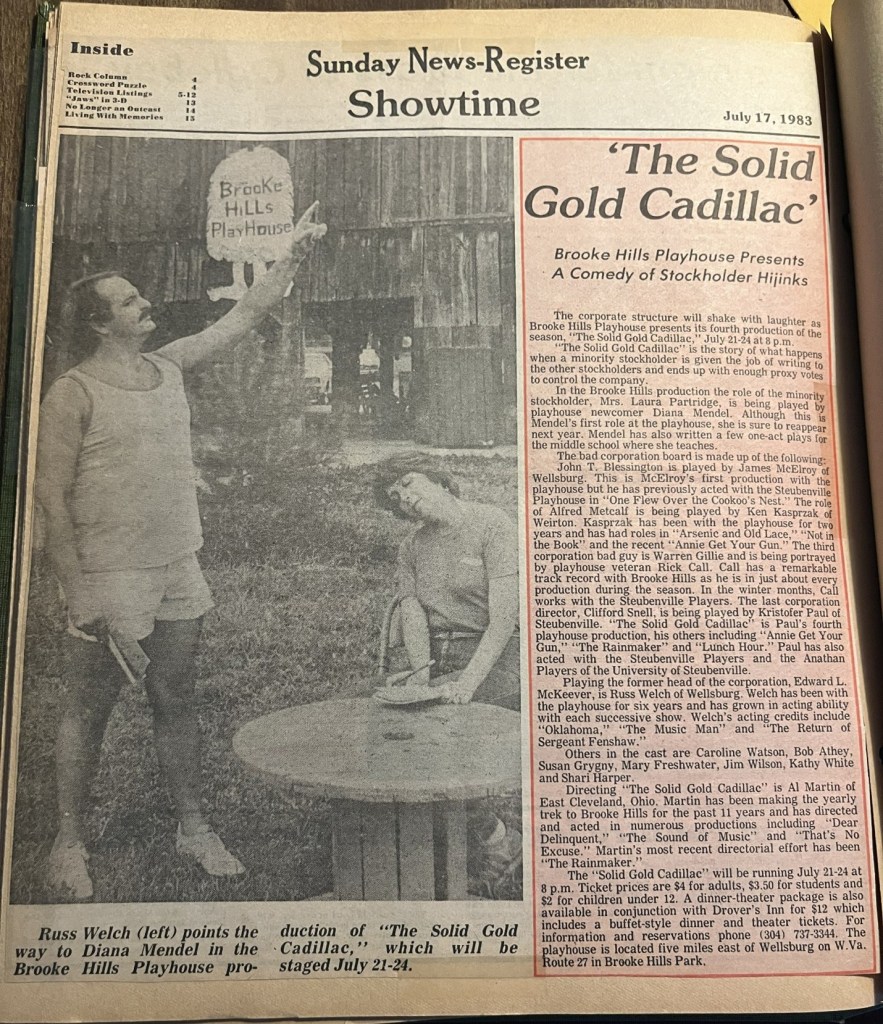
“My husband and father-in-law came to see the show,” said Diana, “the latter taking pictures, which is a no-no! I also got acclimated to stage presence in the dark when I mistakenly stepped off the stage and practically fell in someone’s lap in the first row during a scene change! Ooh, so sorry!
“Incidentally, Shari told me that when she looked at the program insert with the cast list, she discovered that she had a small part in the show. She hadn’t even remembered, but maybe that was because she was listed as ‘A Little Old Lady!’ She was 36 at the time. LOL.
“That began my stint spanning 43 seasons at the Brooke Hills Playhouse, with me acting in at least one show for the majority of those years, and assuming many other roles to help get a show on. I can’t believe I directed a musical, They’re Playing Our Song, in 1986. I had great technical support from Shari and the crew. We had a car onstage! Well, not a total car, but certainly a car look-alike.”
[NOTE FROM SHARI: Since Diana was directing, I took on the challenge of “building” the car. I was clueless about how this would work, but I went to the lower end of Wellsburg to Al’s Auto. I wandered around the junk yard looking for inspiration and found it! Propped up against a car with a missing fender was this perfect chrome frame for a windshield. It was nice and lightweight and held its shape when I picked it up and put it aside. Next, I found a dashboard piece that the windshield frame could rest upon, then a grill with headlights intact!
I took my finds to the office, and I offered an ad in the program in exchange for the parts. The offer was accepted.
Back at the Playhouse, my “concept” took shape. We attached the windshield to the dash, and I’m a little woozy on this, but I think we mounted the grill and headlights on a stand. Next, someone had the bright idea of making the headlights work, so they were wired up to a car battery and some kind of crazy dimmer (so as not to blind the audience since the “car” faced the seats).
During the scene shift, one person controlled the fly line dropping in the dash/windshield, one person carried on the grill stand, the two actors each carried a stool on stage, and sat “inside the car” with the guy miming holding the steering wheel. I wish we had a photo of this. For me, it ranked right up there with making a silent butler for The Odd Couple, my set design for Annie, and directing A Funny Thing Happened on the Way to the Forum as one of my proudest “creations.”]
“I loved being in There Goes the Bride (1986),” said Diana, “and working with Al Martin in On Golden Pond (1985). I can still remember the scene Al and I shared as father and daughter. It felt real and raw. I remember there was a huge cast in You Can’t Take It with You (1989), and I think I wore a lovely gown.”

“Acting and directing became an anticipated hobby. From Cheaters and What the Butler Saw, I found myself then directing Bus Stop in 1991. The technical crew deserved an award for this show, as well as the actors playing the cooks. We had an actual working stove on stage! The actresses made food whose aroma wafted through the audience. I believe we had running water on stage as well. What an astounding undertaking, technically! That was all so amazing to me, as I often could see in my mind what I thought could be achieved on stage, but that show was incredibly impressive and beyond what I could have imagined.
“In the 1990s, with The Cemetery Club (1993) and Steel Magnolias (1994), I worked with Playhouse veterans Linda Huggins and Sippy Hayman, two actresses who graced the stage with phenomenal character representations. It was a delight to share the stage with them! They were always wonderful! By the way, I first met Linda at Girl Scout Day Camp, held in the big shelter down past the barn in Brooke Hills Park. I still remember thinking, ‘Such a pretty girl, but she’s so tall,’ which is pretty funny if you know Linda as an adult. She’s many things, but she’s definitely not tall.
“I also loved directing The Fantasticks in 1995. I tried to depict it as closely as it was written, even though a female actress bound her breasts each night so she could play one of the fathers!
“And on it went. Season after season, I knew I would be doing something at the Playhouse and something at the museum for murder mysteries. I directed and acted with so many wonderful actors—Russ Welch, Roger Van Horn, Rob De Santis, Rick Call, Terry Stuck, Jim McElroy, Rick Taylor, Charlie Calabrese, Bob Lane, and many others. There is just so much talent in our Ohio Valley! “As many of you know, live theater is full of surprises, and some of them are memorable. I was having shoulder problems one summer, and the show I was in had costume changes. Trying to change clothes in the near-dark, with a bad shoulder, resulted in me making my next entrance with my skirt on inside out! Perhaps the biggest surprise was that no one in the cast or audience ever said anything!”

“During one performance of some show, when my son Chris was young, he came down the aisle and sat on the front of the stage. He was very quiet and completely engaged with the show, but it was a little disconcerting. When I asked him later why he had done that, he said, ‘I just wanted to get a better view.’ Well, that made sense.
“One summer, members of the National Guard held maneuvers in the park. I had a 10:00 Saturday morning rehearsal, so I came in early and opened up. There were beer cans everywhere, and when I went upstairs, I discovered an 18-year-old girl asleep on the sofa that was part of the set for the show that was running at the time. She, some guardsmen, and others had partied in the Playhouse and had broken into the dressing room side door to see what was upstairs. Since the Playhouse crews no longer lived in the mobile home at the back of the barn, we had numerous break-ins over the years. It was always aggravating and required extra work for our volunteers, but the barn has withstood the onslaught so far!
“Over the years, we’ve produced several Agatha Christie plays. I was directing one of them, and we were short a couple of young guys. I ‘stalked’ Facebook for a while until I found two who agreed to be in the show. When I arrived at the barn one morning, I saw that we had been broken into again! This time, it was the two new guys who were there to run their lines, helping each other memorize their parts. How does a director get mad about that?
[NOTE FROM SHARI: In earlier parts of this memoir, there were sections titled ‘Theater in the Wild,’ where I told the stories of dogs or cats wandering on stage during a show. There was also the flock of pigeons which took up residence during the winter of 1973, I think, and didn’t want to leave in the spring. What a mess they had made!
I can’t remember what year the barn swallow couple discovered a beam to their liking in our lobby, sometime in the mid-1980s. They returned every summer, built a sack-like nest attached to the side of the beam, left their ‘calling cards’ on the lobby floor day after day until their babies flew, and finally, the family departed. Diana told me that, like the swallows returning to Capistrano each year, generations of barn swallows continue to return to the Playhouse to this day, 2025!
It’s like the animals know the barn is their domain and not ours. Our mothers would ask us, ‘Were you born in a barn?’ I don’t know anyone who answered, ‘Yes, as a matter of fact, I was!’ but generations of swallows were!]
“Our biggest problems with animal invaders over the years have been caused by raccoons,” said Diana. “We do see an occasional groundhog, and I fear one lives under the barn’s paved floor, and we now have several barn swallow couples, but we’ve gone to war with the raccoons. One particular raccoon we named Jeffrey. He cleaned out our concession stand several times. He could open one of our refrigerators with his little raccoon hands and wreak havoc there. One night, he opened the fridge and drank 12 cans of Mt. Dew. I only wish we could have seen how he handled all that caffeine!
“When Shari left in 1995, some things changed, while other things will never change. Most importantly, the Playhouse continued, and memories continued to be made.
“When we did Noises Off in 1997, our managing director and designer, Crystal Motto had designed a great set on a large turntable. In Act I, the audience saw a box set depicting a lavish living room. For Act II, the turntable was rotated, so the audience saw the back of the set—the canvas-covered frames, the backs of windows and doors, nothing painted, the prop table, etc. Occasionally, the brakes on the turntable wouldn’t get set properly, and an actor, me included, would make this sliding entrance, limbs akimbo, attempting to stay upright. This was always difficult for me as my character often entered carrying a plate of sardines, of all things! The cast started to think the stage crew was setting the brakes late, so they could enjoy the crazy ‘flying’ entrances!
“By 1999, I resigned from teaching, and a series of small adventures began. My husband bought a 34-foot sailboat, Breathless, and we roamed the Intracoastal Waterway for about two years, docking in Annapolis, Maryland, for several months before trekking down south through the Dismal Swamp, on down through waters sometimes calm, sometimes rough and rowdy. It’s quite the geography lesson when life is seen from a sailboat moving 7 miles an hour. It gives you an entirely different perspective because the scenery slowly changes. I think we only went aground twice!
“Joe and I then traveled to London, and I knew I had to spend more time in my ancestral land, so I took a position teaching English and drama at Didcot Girls’ School in Didcot in 2004. I taught there for two terms, and they begged me to stay on, but the commute just didn’t make sense. Ha! At that time, the pound was worth about twice the amount of a dollar, so the money was great!
“Teaching in England had some eye-opening differences from teaching in America. Students never really know your name; they simply call you “Miss.” Ginger-haired girls are not favored by others. Classes had every type of learner you can imagine. Some were barely able to speak and read. Some were complete genius. And I had to teach my Year 9 girls Macbeth, which we went to see on a class trip to Stratford-Upon-Avon. I loved teaching in England, but everyone I loved was back in West Virginia. “By 2004, I was back at the Playhouse, directing the musical Seussical. Terry Stuck was absolutely fabulous as the lead, but every night, during one of his numbers, a precious little girl, not much older than three, stole the scene, just by being so cute. The audience loved every little move she made, while Terry was singing and dancing and working his butt off!
“My daughter, Julie Barnhart, who had spent parts of many summers at the Playhouse, was elected president of the Brooke County Arts Council in 2005, and I became the treasurer.

“We implemented a week in between shows to get prepared for the next show. No one except musicians was paid, and we squeezed every penny to manage costs. For the past 20 years, we have done our best to put on shows our patrons would love. We grew the Playhouse and hope it continues to grow.
“My daughter, Julie, son Chris, granddaughter Chelsey, and grandson Mason have all acted in Playhouse shows. It warms my heart to feel their support and encouragement and love for the arts!
“In these past 20 years, there have been times when I have had to act in two shows and direct one of them. I have also had to go on for another actress who quit one day before opening! She wanted a smaller part, so I took her part, Nana, with a script in my hand the first weekend. We certainly didn’t let anything stop us from putting on five shows every summer.
“We initiated the ‘Save the Barn Campaign’ around 2018-2019 to get some funding for electrical work we knew needed to be completed, and Shari’s help in securing a $30,000 grant from the West Virginia Department of Culture and History paved the way for that to happen.
“A major storm hit the area in the early spring of 2019, and the northwest corner (behind the audience) of the barn’s roof and part of the back wall were ripped off. Fortunately, the park’s insurance (as the owner of the barn) covered the cost of the repairs, and our ‘Save the Barn’ funds could go to other needs.”

A VER
“When Covid hit in 2020, I realized we couldn’t hold a 50th season anniversary in 2021 unless we had a show in 2020, so I decided to direct and produce The Red Velvet Cake War, ‘a riotously funny Southern-fried comedy’ by the team of Hope Jones Wooten. That was our only show that season, but we had a season!
“After that, I read many Hope Jones Wooten plays,” said Diana, “and we produced many of them over the next several years. My personal thespian group of the highest order is composed of Sheila Cavalette, ReGina Pino, Connie Knollinger-Wendel, Crystal Sharma, Rob De Santis, Dan Harry, and Joe Pino. They brought Hope Jones Wooten characters to life in the most hysterical, crazy, can’t-stop-laughing scenes that our patrons absolutely loved!”
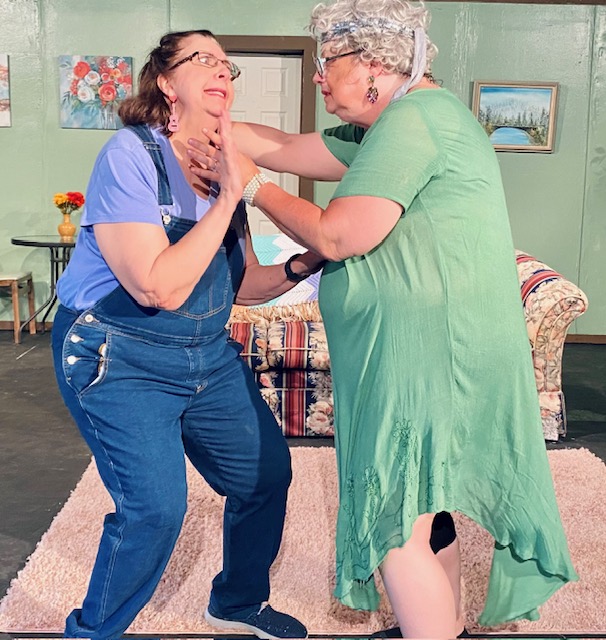
Diana and Joe’s daughter Julie became very ill in 2016, but she continued directing the children’s show every year, even after her liver illness worsened. Diana and Julie’s daughter Chelsey were always by her side to help in any way they could.

“Near the end of 2024,” said Diana, “Julie wound up in the hospital again. We had hope for Julie until the very last moment when her numbers plummeted as her body started shutting down. We never dreamed we would lose her as we were being told a liver transplant was near. Of course, all of that changed on December 23, 2024. It was a really hard hit.”
Julie Mendel Barnhart
July 21, 1968 – December 23, 2024
“The 2025 season at the Playhouse was surreal without Julie. I did absolutely nothing creative on stage. I did run the box office, and I wrote another murder mystery, Ripped from Whitechapel, which was performed on November 8 (my birthday) at Beech Bottom Community Christian Church.
“So, here I am, now at 77, and again I ask myself, ‘What is my purpose? Should I seek it? How much time do I have left? Has the spotlight gone dark? Is it time?’
“I think perhaps it is time. I have resigned from the Brooke County Arts Council Board. I want to pursue my writing and stay close to my husband and my dog, Sunny. I will always support the Playhouse in whatever way I can. The Playhouse will continue with a very talented group at the helm. I can’t wait to see all that they will accomplish.
“I have tried to come up with a list of shows I have acted in or directed. Unfortunately, it is incomplete because I didn’t keep mementos from shows early on, and my memory isn’t as sharp as it once was.”
[NOTE FROM SHARI: From 1983 onwards, Diana has been a driving force at the Playhouse. While I don’t usually include a complete list of shows our folks have done over the years, I think that Diana’s numerous contributions merit special notice. Over the span of four decades, Diana has served as: actress, director, choreographer, script writer, publicity person, painter, set decorator, arts council member, president, and treasurer, program creator, show producer, box office manager, stage manager, concession cashier and popcorn popper, go-fer, and major donor. She has worked tirelessly behind the scenes and onstage. This incomplete list testifies to her stage talent and overall dedication.]
Diana Mendel’s Playhouse Credits
Acting (A), Directing (D), Choreography (C), and Writing 
1983 The Solid Gold Cadillac, A
1984The Second Time Around, A
1985On Golden Pond, A (I played the daughter the first time and the mother the second time when Chelsey directed); The Butler Did It, A
1986They’re Playing Our Song, D
1987The Foreigner, A
1988Move Over, Mrs. Markham, A
1989You Can’t Take It with You, A
1990Cheaters, A; What the Butler Saw, A
1991Bus Stop, D; The Nerd, A
1992Rumors, A
1993The Cemetery Club, A
1994Steel Magnolias, A
1995The Fantasticks, D1996 No Sex Please, We’re British, A
1997 Nurse Jane Goes to Hawaii, A; Don’t Dress for Dinner, A
1998 Noises Off, A
1999—2001 Sailboat adventure with Joe
2003—Taught high school English, W. Va. Northern Summer School
2005 Love Letters, A; Plaza Suite, A
2006 Seussical, A
2007 Love, Sex, and the I.R.S., A
2010 Anne of Green Gables, A
2011 Laughing Stock, D (Chris, Chelsey, and Mason were in the show); bf F, W (Children’s show, directed by Julie)
2012 The Mousetrap D (I actually stalked college guys on Facebook to fill parts!); Conducted a drama workshop, then produced a Variety Show featuring the short plays and skits written and performed by the workshop students; The Marvelous Wonderettes, D, C
2013 Where There’s a Will, There’s a Way (murder mystery), W, D, A; Arsenic and Old Lace, A; The Haunting of Hill House, D (with Chris in the cast)
2014 Survival at Any Cost (murder mystery), W, D, A; The Game’s Afoot, D; Vanya and Sonia and Masha and Spike, D (with Mason in the cast)
2016 On Golden Pond, A (played the mother, Chelsey directed), Cat on a Hot Tin Roof, A; Blithe Spirit, D
2017 Play On, D, A (Julie in the cast); Nana’s Naughty Knickers, A (actress dropped out one day before opening; I was on stage the first week with script in hand; Chelsey directed), Farce of Nature, D (Chelsey in cast)
2018 The Marvelous Wonderettes Dream On, D, C; Farce of Habit, D, A
2019 Ghost of a Chance, A (Chelsey directed); Daytona Playhouse—A Bad Year for Tomatoes, D & Stage Managed
2020 The Red Velvet Cake War, D (Our only show of the season due to COVID.)
2021 Four Old Broads, D; 50th Season Reunion with Open Mic Night, Meet and Greet, and Playhouse Rewind, a retrospective from the Playhouse’s first 50 seasons, D and Produced
2022 Honky Tonk Hissy Fit, D, A; Nana Does Vegas, A (Chelsey directed)
2023 Things My Mother Taught Me, D; I’ll Get My Man, A; The Last Round-Up of the Guacamole Queens, A
2024 Rex’s Exes, D, A; Spirit Never Dies (murder mystery), W, D, A, at Beech Bottom Community Christian Church
2025 Ripped from Whitechapel (murder mystery), W, D, A, at Beech Bottom Community Christian Church
LETTING GO
With her sheer force of will and her incredibly generous nature, Diana Mendel has kept the Playhouse going at times. Over the last 20 years, she has personally donated around $20,000 to that end. Usually, she alone produced the shows she directed, meaning she hired people to complete the set, and she bought costumes, props, and whatever was necessary to get the show staged.
“All my work at the Playhouse remained the same until Julie’s passing in December 2024,” said Diana. “In 2025, I decided to do the children’s show in Julie’s memory, but I misjudged the popularity of the program booklet I had created for the show. Sadly, Clay, Julie’s husband, passed on April 20, and the 1500 copies of the program, about four inches high, proved inadequate for the attendance.” Diana personally paid nearly $2,000 for a second printing, which she felt “was only fair.”
Throughout the last 20 years, Diana has created all the tickets, using her computer, printer, ink, and card stock. “And voilà,” she said. “I think that’s some magic right there.” Of course, with Diana absorbing the cost, the Playhouse profited. “It was something small I could do to keep money in the bank.
“One of my favorite things was selling tickets in the box office over the years,” said Diana. “It was a delightful time because I got to talk to everyone who came to see the show! I’ll miss that.”
[NOTE from Shari: I agree! I, too, loved talking to our patrons. Another section of this post relates a favorite box office memory of mine.]
“When Charlie Calabrese died in 2021,” said Diana, “I used my journalism skills again as I took over his job of writing newspaper publicity articles for each show. I just finished that task at the end of the 2025 season. New blood will pick up the gauntlet!
“Being at the Playhouse was never dull; it required work and attention to detail and a love for all that resulted. I managed all advertising campaigns and created the programs every year, along with the inserts for each production. Again, things were never dull.
“Other than my marriage, my relationship with the Playhouse has been my longest. Longer than my teaching career, longer than many friendships. I treasure it and always will. Thanks to you, Shari, and Bill and John, the founders, and so many others who contributed mightily through the years, the Playhouse lives on!”
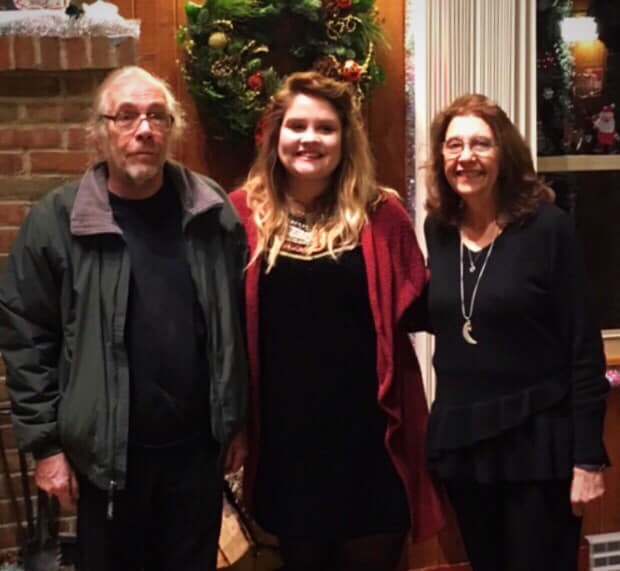
“I realize that the deaths of my loved ones brought me to the Playhouse, and the death of my beloved daughter 43 seasons later nudges me to realize that my time has come to a close. That wonderful spotlight has dimmed for me but will be shining brightly on so many others on the Playhouse stage.
“Thank you so very much for this opportunity to be involved, an opportunity that has truly impacted my life.”
[NOTE FROM SHARI: Diana, you have done so much over so many years to keep the Playhouse alive. Those who came before and during your tenure and those who are yet to come can never adequately thank you for your dedication and for your sincere belief in the magic of live theatre in general and the Brooke Hills Playhouse in particular.
Up until the middle of the twentieth century, little summer theatres like the Playhouse thrived all over America. About the time the Playhouse was starting in 1972, however, hundreds of those theatres were folding, and many more would close over the next decades.
My guess is that thousands of people helped to get the shows on at the Playhouse over the 54 seasons to date (2025), and many thousands more sat in the audience supporting those efforts and being entertained. Some played small parts; some played large parts; some played a few; some many, but you and your family, Diana, have, without a doubt, contributed more than any of us. We can never thank you enough for ensuring that the summer theatre tradition continues in that old barn we lovingly call the Brooke Hills Playhouse.]

Evan Oslund, Sarah Tennant. I’ll Get My Man, 2022
TWO DEGREES OF SEPARATION
Diana mentioned how much she enjoyed being in the box office and greeting our audience members. I, too, had some great experiences while running the box office, but this is my favorite.
Peg and Bill Zwecker from Bethany were Playhouse regulars. Bill was quite the character who often wore lederhosen, those leather shorts with suspenders, woolen knee socks, shirt, tie, vest, jacket, and Tyrolean hat that was worn in his native Austria, where his family were aristocrats. Bill stopped over at the Playhouse one afternoon to pick up some tickets, and we got to talking. Bill, who often went by Baron Zwecker von Zweckenburg, had a doctorate in chemical engineering, and he had made a fortune in the field. He fled Europe in the 1930s after the Nazis took over his native Austria. He was a great conversationalist.
“I was raised in Vienna,” Bill said on this slow day at the Playhouse. “Everyone there went to the opera. My family knew whether the opera was worth seeing or not, if the serving maid at breakfast was in a fine or a foul mood. By foul, I mean she would slam the plates on the table and stomp around the room.
“Peg and I have returned to Austria for visits. We take the slow way, by ship, and take our car with us!”
It all seemed pretty exotic to me, but I could have listened to his stories forever. Eventually, I got to know the Zweckers better through my good friends Louise and David Owen of Belvedere Farm on Rt. 88.
Peg (Margaret B. Hamilton Zwecker) was also very interesting. She was a journalist, a syndicated columnist, and the fashion editor for the Chicago Sun-Times and later the Chicago Daily News. She traveled back and forth between Chicago and Bethany nearly every week. For a while, her column ran beside “My Day,” the column that Eleanor Roosevelt wrote from 1935 to 1962. Once, I asked if she had met Mrs. Roosevelt. Peg said, “When Mrs. Roosevelt was in town, we occasionally might chat over our desks at the office.” Imagine, she knew Eleanor Roosevelt!
Peg, in her role as fashion editor, was often credited with helping to popularize Halston, the designer whose career took off when Jackie Kennedy started wearing his “pillbox hats.” That is the tip of the iceberg. It seemed like Peg had met “everyone who was anyone” at some time or other.
She was still writing in the late 1970s, when one evening, she and Bill came rushing into the empty lobby after “places” had been called. I was working the box office, and I told them to go upstairs and find a seat. We’d take care of their tickets later.
Peg came over to the box office at intermission, and as we were chatting, she said, “My flight was so late this afternoon. I was afraid we were going to miss the show. Actually, I was glad we had a little delay. I had a late lunch with Helen Hayes, and I might not have made the flight at all if it hadn’t been delayed.”
I said something like, “You had lunch with THE Helen Hayes, and you’re seeing a show at the Brooke Hills Playhouse this evening? That’s a galactic jump!”
She just laughed and said, “Oh, we love the Playhouse! We’re so glad you’re here.”
Good grief! Peg had had lunch with THE Helen Hayes, the woman whose acting career eventually spanned 80 years and who was widely accepted as the First Lady of American Theatre, and Peg was worried about missing one of our shows! It was as if Helen Hayes had in some way blessed the Playhouse. Forty-plus years later, I still get goosebumps when I think of that incident!
I had dinner with the Zweckers at the Owens’ one evening when they told a crazy story.
A squirrel had somehow gotten into the Zwecker home in Bethany, and Bill was chasing it all over the place with no luck. He just couldn’t keep up with the speedy squirrel. He finally got out his gun and shot at the intruder INSIDE the house. Unfortunately, he missed the squirrel, but the bullet went through the wall, where it hit Peg in the arm in the next room! Peg was taken to the hospital, and the gun was taken away from Bill.
I don’t know how many charming people I’ve met in my life—few. I’ve been blessed to know many talented people, many kind and generous people, many clever and brilliant people, you get the idea, but the Zweckers were charming, and I’m so glad they loved the Playhouse.
Bill died in 1997, and Peg died in 2010. They were survived by their children, Janet and son Bill, who was also a journalist.
BILL DEERFIELD AND SHARI REMEMBER JIM AND JOHN WILSON
Henry and Dolly Wilson, owners of Wilson’s News across the street from the Wellsburg Post Office, had always supported the Playhouse, buying annual program ads, sponsoring shows, and buying several season coupons every single year since the Playhouse was founded. The summer following the Wilsons’ generous gesture of providing all the materials needed for refurbishing the second floor of the Brooke County Museum, one of our active players, Anne Roberts (see Part 15-B), suggested that we hire the Wilson twins, Jim and John, for the summer. Anne was their teacher at Weirton Madonna High School, and she directed the guys in plays at school. They were about to graduate that spring, 1982.
I talked to the twins and didn’t soft-soap the job. We paid $30 a week that summer. Work started at 10:00 a.m. and finished after rehearsals on dark days (when no show was playing), usually around 9:30 p.m. or 10:00 p.m. and at 10:30 or 11:00 p.m. on show nights. There would be a lot of dirty work and a lot of physical work, which would not be a problem once I met these two towering guys. There was the occasional day off. That was all fine with them. They were workers!
Bill Deerfield was one of our staff members during the summers of 1985 and 1986. Although they didn’t all work together at the Playhouse, Bill had some great memories of John and Jim from high school.
“I graduated from Madonna with the Wilsons,” said Bill. “Our director, Anne Roberts (who acted and directed at the Playhouse), was in her first year of teaching at Madonna. In December 1981, Jim and I were in A Christmas Carol together. He was Jacob Marley, and I was Scrooge. Anne’s little son Myles was our Tiny Tim. Her husband Skip built our sets and helped with light and sound.
“In the spring of 1982, we did Carnival. Jim was Marco the Magician, and I was Paul Berthalet. During the big magic show, Jim started singing on stage, then disappeared behind a small flash pod/curtain. John, his twin, instantly entered from the back of the audience in the same costume and continued singing the song while walking down the center aisle, ending up on stage to complete the “magic trick.” Of course, most of the audience knew what was going on, but it was a really cool moment, made even funnier because “Marco” grew a mustache between disappearing and reappearing! John had a mustache, and Jim didn’t!”

“Our birthdays are one day apart,” continued Bill, “so the three of us partied together for our 18th in June 1982, and we triple-dated for the prom that year. They were great guys. I hope they are doing well.”
When we hired John and Jim at the Playhouse, we batted 1000%. First, they had wonderful, easy-going personalities, enjoyed a good laugh, and they didn’t have a mean bone in their bodies. Then, they were just mischievous enough to be up for anything! They were both big and strong, maybe 6’3”, and weighed about 170 pounds. [NOTE from Shari: I’m totally guessing here.] They didn’t know much about stage carpentry, but they were interested in everything and always willing to learn.
They arrived right on time or a little early every day after their other jobs! They cut grass for several older ladies in town and carried in deliveries at the family store before coming to work!
On the morning of May 22, 1982, our crew, board members, and volunteers arrived at the barn for that first cleanup and audition day. We immediately had a big problem. The park turned off the water in the fall of 1981 after the last picnic in the nearby Kiwanis Shelter. We always shared our restrooms with the patrons of this shelter (and anyone else—hiker, cyclist, dog walker—passing through).
We turned on the water first thing upon arrival and soon discovered that we had a minor flood in the toolroom/kitchen. Although the water had been turned off, apparently, the pipes hadn’t been drained, and the pipes under our kitchen sink had frozen and burst. What to do? Al Martin (He Who Knew Everything) hadn’t arrived yet, and we needed water—especially for the toilets for nervous auditioners.
I asked the crew if anyone knew anything about fixing pipes. We were all clueless, but then John raised his hand and said, “I think Mr. Serevicz knows how to fix pipes.”
Money being tight, I said, “Do you think Mr. Serevicz would help us out?”
“He’s a good guy,” said John. “I think he would.”
“Why don’t you go ask him?” I said, and John headed back to their car.
About an hour later, he returned, copper pipe, torch, tools, and I don’t know what all in hand. I just looked at him.
“Mr. Serevicz taught me how to fix it,” said John.
I admit, I was a little skeptical, but what the heck? It was worth a try. “Okay,” I said. “The kitchen pipes are all yours. Jim, you should give him a hand.”
They went off to the kitchen. Someone found a couple of containers and drove up to the park club house for some drinking water. The rest of us went back to sweeping, removing the plastic sheeting from the audience seats upstairs, dusting, cleaning out the prop closet, and getting the barn as ready as we could without water.
Around lunchtime, Al and Betty Martin arrived, and we broke for lunch, probably peanut butter and jelly sandwiches and potato chips. John reported that he was nearly finished. Actually, I think that he was finished, but he was a little nervous about turning the water on. The twins met Al at lunch, and afterward, he accompanied them back to the kitchen. He looked everything over and said it was time to turn on the water.
The water was turned on. The new pipe and couplings held, and we were back in business. I gave John two season coupons to give to Mr. Serevicz when he returned the man’s tools that evening. Big expense averted!
Before long, our new electronic light board needed to be installed. Al and I could usually handle electrical problems, but this one had something to do with something we weren’t comfortable with. While discussing the problem at lunch, Jim spoke up.
“Mr. Serevicz knows about electrical stuff,” he said.
After lunch or maybe that evening, Jim had a “consultation” with Mr. Serevicz. Once again, Mr. Serevicz came through. The next day, Jim confidently fixed the electrical problem under the watchful eyes of Al, and once again, Mr. Serevicz saved the day (or at least the cost of hiring an electrician).
[NOTE FROM SHARI: My brother Mark was a good friend of Mr. Serevicz’s son, and day after day at the dinner table, Mark would tell us what Mr. Serevicz was up to. I talked to Mark recently. He said, “Mr. Serevicz was a true Renaissance Man. He tied fly fishing flies. He made a chess set and then a violin! He made arrows and set up a practice course. I don’t think there was anything he couldn’t do or learn to do.”]

One afternoon in 1983, I wanted to hang some black masking material at the back of the stage. I was going to attach the cloth to the big beam that was the bottom of the triangle that composed the roofline, maybe 12’ above the stage.
Since the scenery for the present show was up, there wasn’t much room for the ladder to lean at a good angle between the back wall and the set. I asked Jim and John to hold the nearly vertical ladder while I climbed up to the beam with the cloth and a staple gun. I hooked my leg over a rung so both hands would be free and started hanging the cloth. When I could reach no farther, I said, “We need to move the ladder,” and I started to lean backward to unhook my leg when the ladder began to move, sideways along the beam!
“Whoa!” I shouted down at John and Jim, “What the hell are you doing?”
One of them said, “Moving the ladder.”
“I’m still up here. You can’t move the ladder with me up here.” I was not happy, and I was a little scared, maybe a lot scared. Being near the top of a moving ladder is not where one wants to be. All I could think about was that I had this little baby I was responsible for, and these guys were going to make him an orphan! I started to unhook my leg again.
“Shari,” one of the twins said. “We would never hurt you. Just hold on.” He sounded so sure of himself and his brother, and he was so sincere. They were big, strong boys, so I settled down and held on.
The twins easily hoisted the ladder and me a couple of inches, moved the ladder a few feet to the right, I did some more stapling, they lifted and moved the ladder again, I stapled, and we worked our way across the back of the barn without me having to climb up and down the ladder a dozen-plus times.
Earlier in this memoir (in Part 20-B, “Ken Kasprzak Remembers”), I told of the only time I had to fire someone. That guy was not at all happy with me. He was screaming not nice things at me as he stormed toward the parking lot, then he turned and charged back toward me with his fists raised. The twins were between us in a flash, and they backed him up to his car, where his wife was waiting. Honestly, Jim and John just had an instinct for protecting people, and they had the size to do it.
John played the train conductor and a townsperson in The Music Man, and Jim ran lights for the show in 1982. Later that summer, they both appeared as sailors in the chorus of H.M.S. Pinafore. They ran various crews for the other shows.

We were very fortunate when Jim and John returned for the following summer, 1983. John was Pawnee Bill, and Jim again ran the lights for Annie Get Your Gun, the opening show of that season. Of course, they also built and painted scenery, ran the light board for other shows, helped with scene shifts, you name it, throughout the summer. They would do anything asked of them, and for the summers of 1982 and 1983, they were wonderful additions to the Playhouse staffs.
Their sister-in-law, Cindy Wilson, told me that both guys are living in Virginia. Jim lives in Haymarket with his second wife, a wonderful woman from Brazil. Jim has 4 grown children, and all are doing well.
Jim started his own company (Power Quality, a high-tech service company), which operates in Virginia, Maryland, and the District of Columbia. [NOTE FROM SHARI: I think fondly of sending him down to town to consult with Mr. Serevicz about our electrical problems! I think it made an impression!]
John lives in Berryville with his current wife, a lovely woman from the Philippines, and he has 3 grown daughters and 3 grandchildren. John is a master electrician and fields most of the work for Jim’s company. [NOTE FROM SHARI: I guess Mr. Serevicz’s plumbing skills didn’t stick with John! LOL!]
Cindy wrote, “I think you would easily recognize both guys if you ever bumped into them on the street. They haven’t changed at all, except for maybe a few gray hairs!”
SHERRY VELTRI RUSCHELL REMEMBERS
Sherry Chappell Veltri grew up in Weirton, West Virginia, and she had done several shows with the Steubenville Players and one show, The Best Little Whorehouse in Texas, with the Capital Music Hall Players in Wheeling. “I was the court reporter for Judge Callie Tsapis and then for Judge George Spillers,” said Sherry. “We worked the entire First Circuit, Hancock, Brooke, and Ohio Counties. Judge Spillers was in Best Little Whorehouse in Texas with me. We would be in court and talk about having Whorehouse practice that night! Too funny.”
[NOTE: Judge Spillers was our group’s nemesis for a while in 1988 as he tried to appropriate the upstairs room in the museum, which our group had renovated, for his office.]
Finally, in 1983, Sherry was living in Wellsburg, and she decided to audition at the Playhouse. She was cast immediately in the season’s second musical.
“I was cast in Something’s Afoot that season,” said Sherry. “It was a fun script with catchy music that spoofed detective novels. The cast was strong, too.
“The chandelier in the show was rigged for a crazy bit where it would start to drop on an actor who would move in the nick of time. The chandelier would lift back up until the song brought the actor back to center stage, then it would start to drop again, and the actor would move. It would go up and down several more times during a song, much to the audience’s delight. Sometimes audience members reacted out loud, saying things like, ‘There it goes again’ and ‘Missed again!’”

“One night when I was singing,” said Sherry, “the chandelier came crashing down in the middle of my number! It was a real chandelier, but the fixtures for the light bulbs had been replaced with painted toilet paper tubes topped with ping pong balls to look like light bulbs. The hot glue holding everything in place gave way, and I had to finish my song stepping over ping pong balls and toilet paper tubes while trying to stay serious. Of course, the rest of the cast offstage in the wings didn’t help as they were laughing like crazy!”
In 1985, Sherry married Leo Ruschell, who was originally from nearby Avella, Pennsylvania, and in 1986, she returned to the Playhouse stage, first in the musical Promises, Promises and then in the farce A Bedfull of Foreigners. Sherry said, “My character in A Bedful of Foreigners was supposed to have a French accent. I tried and tried, but I couldn’t do it. Thankfully, the director let me switch to a German accent, which I could do!”

Sherry did two shows in 1987, playing Queen Guinevere in Camelot and then the slob Olive in The Female Odd Couple with Bev Brady playing Florence, the prissy character.
“Al Martin directed The Female Odd Couple,” said Sherry. “A couple of times when we got a little stressed during rehearsals, Al would say, ‘Time for a break.’ And we’d go out in the yard and play a little volleyball!’ We all loved him.” Sherry was in one of our off-season shows at the Brooke County Museum as well during her time with us—Is the Real You Really You? and she said, “I also remember doing Murder Mystery parties at the museum. That was fun.”
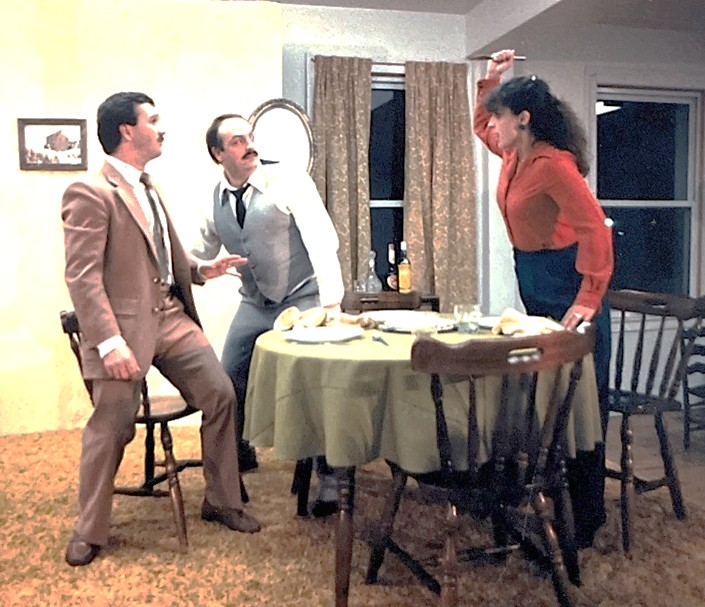
Leo worked for Delta Airlines, and in 1987, the couple moved to Atlanta, where their daughter, Elizabeth, was born in 1992. The Ruschells moved to The Villages in Florida in 2020, and in addition to playing tennis, golf, softball and beach tennis, Sherry has done two shows: Calendar Girls in 2023 (“We did our own calendar,” said Sherry. “It was so much fun. We were nude but COVERED!”) and The Pirates of Penzance in 2024.

as Queen Guenevere in Camelot, 1987
“I made great friends at Brooke Hills,” said Sherry. “There was such great camaraderie, everyone working together to get the show on and to make it as good as it could be. I love all these memories of Brooke Hills. I really enjoyed my time there. I wish I could have done more.”
Looking at the cast list for Camelot, I noticed that there was a line that said, “Horrid. . . . . . . . . . Asia Ruschell.” In the show, Horrid is the dog of Lord Pellinore, the comic, aging knight, played by Rich Ivaun in our production. Rich is a big, tall guy, and Sherry’s little Asia is a 3-pound Maltese, “the runt of the litter,” said Sherry. It was a great comic contrast to Rich.
Thinking about Asia, I called Sherry, who was driving home from a rehearsal of The Last Round-Up of the Guacamole Queens! I was so thrilled to hear she was doing a show! I asked if she remembered bringing Asia to a few rehearsals to get to know Rich and then to the show each night. Sherry said she really hadn’t thought about it! I then wondered how Asia enjoyed the cast party!
Sherry is now retired from court reporting but not from playing sports and doing the occasional show. She also makes time to visit with daughter Elizabeth and granddaughter Avella at their home in Atlanta. (“Yes,” said Sherry, “Avella was named for Leo’s hometown!”)


SEASON TWELVE COMES TO AN END
At the end of the season, our attendance was down by 487 patrons from 1982, not enough to cry over, but still, a little disappointing. Fortunately, we were in the black, a good measure of some success. We just didn’t surpass the prior attendance, and that’s always a little sad. I only know this statistic because Mary Freshwater Geib had pasted the financial reports for 1982 and 1983 in her scrapbook!
ONE BUMP IN THE ROAD
We did have a couple of rough strike nights. A strike entails taking down one set and putting up the one for the next show. In summer stock, where the shows are opening and closing bang, bang, bang, the strikes began around 10:30 p.m., when the final performance on Sunday evening was over, and the audience had retreated to the lobby. This made for a late night, but we were very organized and usually had the new scenery up and braced, and the furniture moved in between 1:00 a.m. and 2:00 a.m. Of course, some sets had no flats, only set pieces and strategically hung masking curtains. Those strikes were usually easier than taking down one box set and erecting another.
One time when going from box set to box set, we discovered that a flat was missing as the new set was going up. This was panic time. The elements of the set (flats) were laid out in the yard or the lobby and painted in pieces a week or two before the strike. A missing flat meant that someone (the designer) had to remix paint and match the colors of the base coat and the texturing or “wallpaper” design. (Texturing—a technique used in the theatre to give the illusion of depth to the wall surfaces.) A missing flat really slowed down the strike.
On Monday, the set would be “dressed,” which means curtains and paintings would be hung. Bookshelves would be stocked. Chair rails, baseboards, and crown molding would be painted or affixed. Chandeliers, sconces, and lamps would be hung and wired. Stage lights would be focused.
Why the rush? Well, the set needed to be up and operational (doors and windows working, furniture in place, props on stage or on prop tables positioned backstage, stage lights hung and focused) for the technical rehearsal on Monday evening, the first time the actors would be onstage, the first time they would be using actual doors and windows, light switches, kitchen appliances, staircases, whatever the script called for. That missing flat was a nightmare, but the crew rose to the occasion. The set, missing the one flat, went up that night. The missing flat was painted the following morning (dried by the sun and a couple of hairdryers) and was added to the set by early afternoon. Tragedy averted!
RANDOM NOTES
1—One of the staffers during the 1983 season, Bob Athey, acted in five of the six shows and ran properties for the sixth show. All of that in addition to building and painting scenery and props, hanging and focusing lights, doing his daily assigned chore (cleaning the dressing rooms, lobby, restrooms, or house or running K.P.), and of course, playing volleyball after lunch and dinner. How and when did he ever have the time to memorize his lines? I don’t know, but he was always solid on stage.
2—We often found ourselves having to build pieces to fit the requirements of the script and the set. Some of those pieces are a little time-consuming but not really challenging. For instance, we built a very light-weight bar in Fiddler on the Roof. It was a frame covered in muslin, painted to look like wood, and was on casters for easy shifting. We built a large window seat with a hinged top for Arsenic and Old Lace where bodies waiting for burial in the basement could be hidden. We built a nice liquor cabinet and several desks over the years. We built a long countertop, complete with a foot rail, and a “grill” along the wall for the café in Bus Stop. Year after year, we met the challenges, building bay windows, French doors, dog houses on wheels, and numerous other crazy things that playwrights like to throw into their shows!
In 1983, our big challenge was building the poof for Something’s Afoot, not because it had to hold four people at one time (easily solved with extra bracing), not because it had to move (easily solved with casters), but because it had to move on its own! That meant that someone had to be inside the thing to push it along and be able to see where he was going because it didn’t just move back and forth (which could have been solved with strong fishline, maybe), but it had to “dance,” that is circle the stage, do a little back and forth, maybe a spin! It was a huge challenge. Fortunately, Travis Smith, Linda Huggins’ young son, was up for the challenge, and he did a masterful job! Of course, because we have no front curtain, that meant that Travis had to be in the poof with his protective gloves and kneepads before the audience was admitted to the house at 7:30 with nothing to do for about an hour! Now, that’s a trouper!
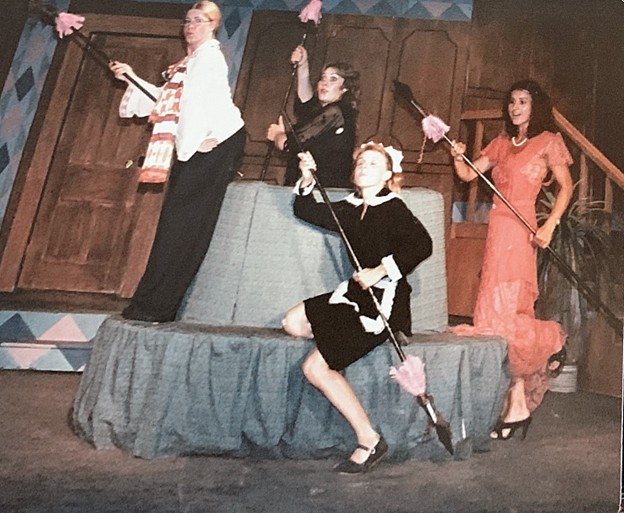
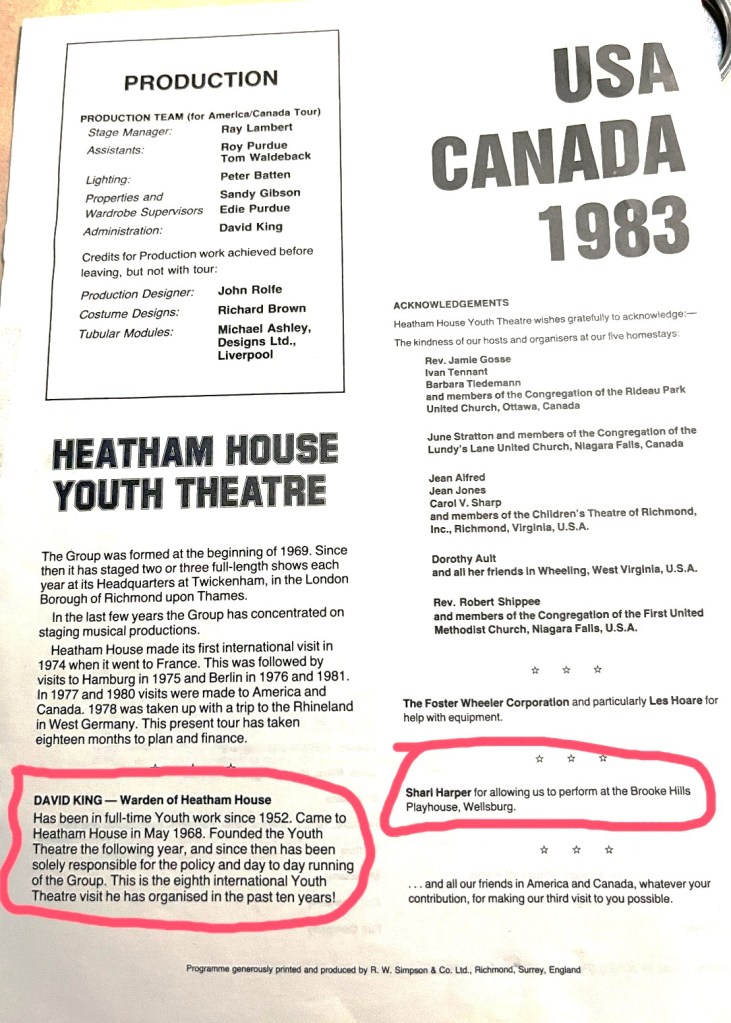
3—The Heatham House Youth Theatre returned to the Playhouse with a wonderful production of Mark Twain’s The Prince and the Pauper. The cast was composed of kids ages 12-18, and parents/chaperones made up the crew running scene changes, props, lights, costume changes and laundry, and unloading and loading the group’s buses. Nancy Patterson from Wellsburg arranged housing and meals for the group with families in Wellsburg.
The “warden” (director) of Heatham House, David King and his wife Rosemary and I had kept in touch since their last visit in 1980, and even though this was the group’s last theatre tour, we kept up our friendship with Christmas letters. My husband Richard and I had a fun lunch with the Kings in Portsmouth, England in 2007, and David and I continue our Christmas card exchange to this day—45 years later!
4—Once again, we sponsored a trip to New York City over the Veterans’ Day Weekend, and this year we upped our game. For years, the trip cost $100, but more recently, the cost had gone up to $225, so instead of taking the long bus ride to the city, we flew! We had three busloads of theatre lovers join us for a total of 105 people! Here are the details of that much easier trip from the newsletter we sent out as the second half of the season was about to begin:
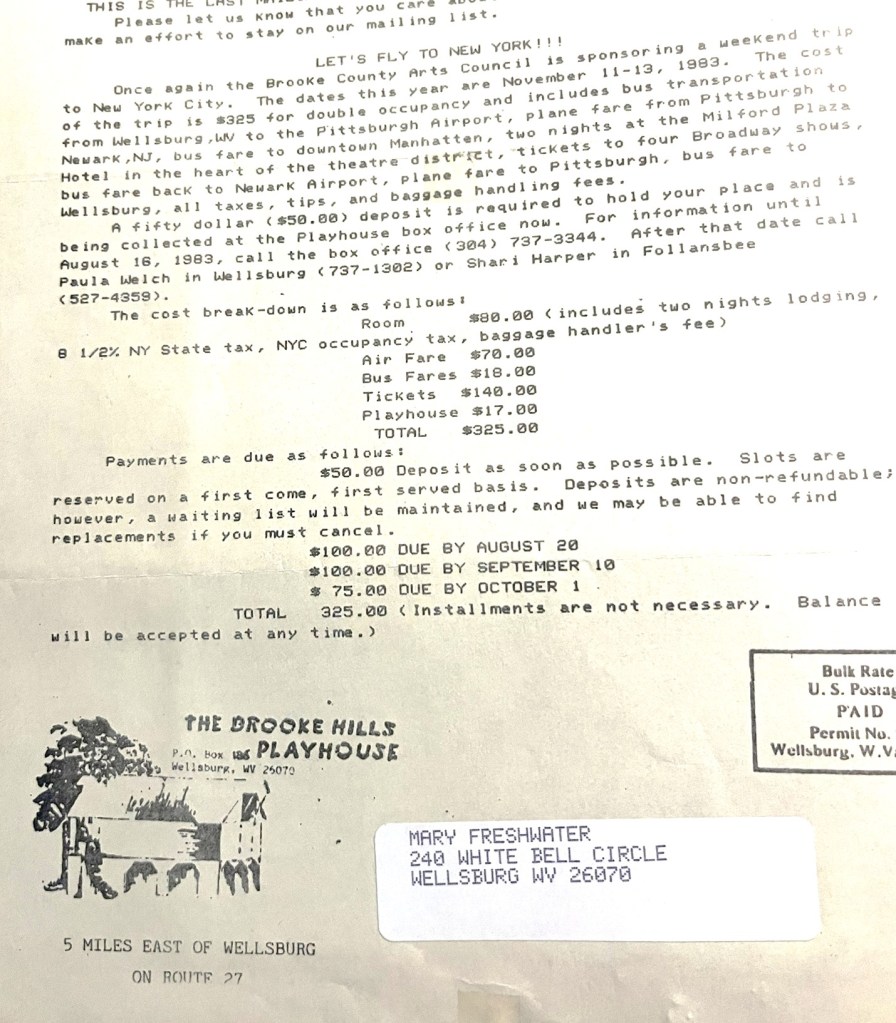
SOMETHING TO LOOK FORWARD TO
That mid-season newsletter also announced a BIG, really, a GIGANTIC, project for the 1984 season. We had received a grant to cover the cost of materials (wood siding and hardware) and scaffold rental to re-side the barn. The grant required a match, and the labor for the project was considered our in-kind donation; in other words, the new look wasn’t going to cost our group anything but sweat. Our refurbishing of the Museum’s second floor in 1982 turned out to be a little bump in the road compared to the mountain we had challenged ourselves to climb in 1984. As you know, it’s a big barn, 83’ long, 28’ wide, and 26’ high (or very close to those numbers). The 1984 season would be a challenge, but we were young and crazy and enthusiastic and up for anything.


 Life Without Lesson Plans
It’s so funny that Sherry mentioned the chandelier crash and the toilet paper tubes and ping pong balls all over the stage. I remember that like it was yesterday! I don’t remember what exactly caused it to crash that night, but I remember the toilet paper tubes and ping pong balls all over the place and Sherry moving about like everything was normal! I had forgotten that we had someone inside the poof for the whole show. That was funny. “Something’s Afoot”’was one of my favorites (after UTBU). Someone had to have cue cards to manage to get the lines “punting, painting, swimming, rowing, biking, hiking, dominoeing” in Fabulous Weekend. I don’t remember who it was that had to sing it and was flustered by those lyrics! They are permanently etched into my brain!
Mary GeibSent from iPhone
LikeLike
Jeepers. Who knew that my mom and I would be the idea for the Brooke Hills Playhouse. I knew Shari and contacted her with idea. My mom was on the Brooke Hills board so she suggested the use of the barn to become a playhouse.
After reading Shari’s collective memoir over the years it is amazing that the Playhouse was so terrific. The stories are a riot and so many people were terrific. Thank you Shari for your fantastic Playhouse and so many fabulous actors and others who helped.
Cheers, Marti Hubbard
LikeLike