
by Shari Murphy Coote and Friends

THE THIRTEENTH SEASON, 1984
THE SHOWS
Once Upon a Mattress
George Washington Slept Here
Pool’s Paradise
The Second Time Around
Snoopy
There Goes the Bride
THE STAFF
Shari Harper Coote
Al Martin/Betty Martin
Paula Welch
Karen Hall Harrigan
Terry Stuck
Jeff Lilly
Keith Shepherd
Paul Harris
Mary Freshwater Geib
Gloria Snyder
Michael Perkins
A BACK-BREAKING (BUT AMAZING) SEASON
Once again, we started the season in March or April at the Brooke County Museum, where we produced some show that I can find no record of! I’m certain we did a spring show, because our treasurer, Linda Huggins, wasn’t shy about pointing out that we would need the money to start the season at the Playhouse. The money from those museum shows provided a nice monetary cushion to pay royalties and salaries before ticket sales began coming in for the Playhouse. Besides, once we remodeled the upstairs of the museum in 1981, we’d have been crazy not to use the space and do a spring show.
We were still doing six shows a summer at the barn, and since we now had a board of directors, we had to come up with a way to choose what shows to produce. As people on the board heard about plays or musicals that sounded interesting, they would pass along the title to me, and I’d order a script for the show. I’d read the script, and on the inside of the cover, I’d write a very short opinion of the show with a “yes” or a “no” beside my initials, then pass it on to someone else to read.
When reading a script, we had to consider a lot of things: size of the cast, complexity of the scenery, any bits of stage business requiring gadgets or costly props, and the likelihood of having people show up for auditions to fill the roles. We’d pass the scripts from person to person, and then we’d meet to discuss the shows. We had developed a “formula” of sorts for putting the season together. We’d open with a big musical (limit the size to 28 cast members), followed by three comedies (one being a farce) or two comedies and a mystery. We’d slate a second musical (but with a smaller cast) and finish with a comedy or a farce. The board set the opening dates for the barn, the first set of auditions (usually the Saturday in May before Memorial Day), opening night, the second set of auditions, and closing night.
We had become a nonprofit organization in 1982, and the transition had been very smooth. Now, it would start to pay off.
A FACELIFT FOR THE OLD GAL
Sometime in the spring of 1983, Joe Thomas, the Brooke Hills Park manager, asked me if I had a wish list for the barn. I gave it some thought. The construction date of the barn is not formally documented, but when the Playhouse was granted permission to use and renovate the barn in 1971, Tom Boyd, an elderly Brooke County farmer and member of the Brooke Hills Park Board, often referred to the structure as a “pre-Civil War apple barn.” Mr. Boyd was a great friend of the Gist family who deeded their farm and its structures (barn included) to the citizens of Brooke County for the purpose of creating Brooke Hills Park.
The structural posts and gable timbers of the barn are large, hand-hewn beams. These are connected with pegged mortise and tenon joints. It’s obvious from looking at the “bones” of the barn that it’s old, and “pre-Civil War” is not a stretch. The posts and beams of the barn were and still are in amazingly good shape.
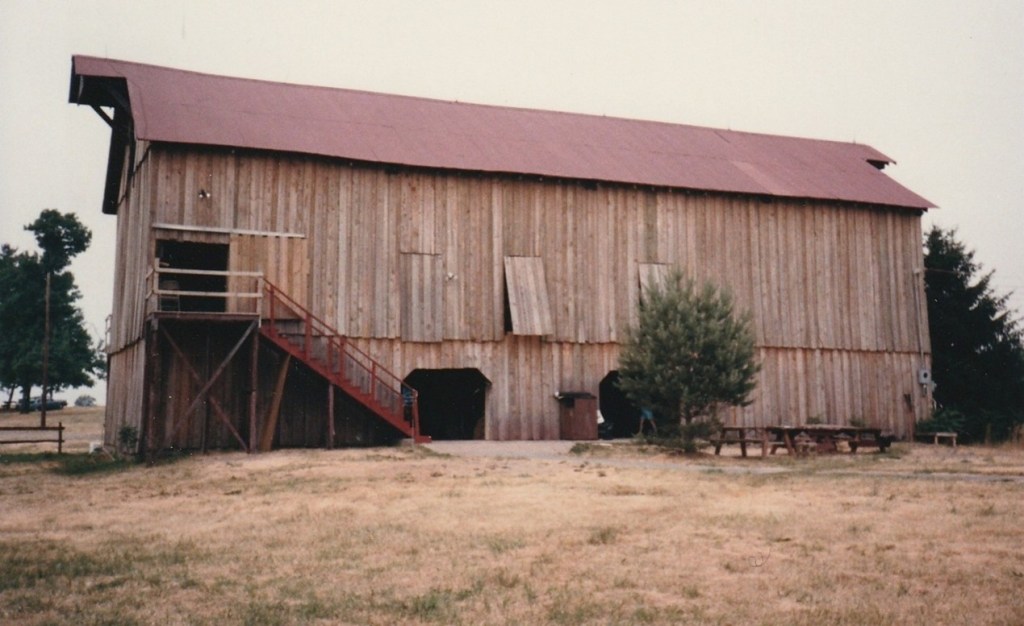
The barn siding, however, was in bad shape when we took it over in 1972, and it just kept getting worse. Some of the vertical boards were curling up on the end so badly that a small child could have fallen through the gap! Most of the old siding was composed of vertical boards side by side with another board over the joint where the verticals met. By 1983, many of the overlay boards were missing, so there were open slits between the vertical boards. (We jokingly called those gaps “Air Conditioning by God.”) One section of the barn siding on the ramp side had been replaced sometime in the past with 1”x4” horizontal siding. It was a mess.
This sketch by Brooke County Art Teacher and great friend of the Playhouse, Russ Shaffer, will give you an idea of the shape of the siding.

I knew that new siding would be a big ask, so I gave Joe a few items that would be nice to have. He asked how much I thought the re-siding materials would cost. Then, almost as an afterthought, he asked, “You’re a nonprofit, right?” Thankfully, we were!
I had no idea about what a project like that would cost, but I knew someone to ask. I measured the barn and went off to Robert Scott Lumber in Wellsburg to talk to Charles Beall, the owner, the same man who had generously let us carry over a balance of $1,256 at the end of our first season, through the winter and part of Season Two, when we could finally settle up!
I had only thought about lumber. Mr. Beall knew we’d also need a lot of nails AND scaffolding! There was another thing he mentioned. He said barnwood would shrink, so we had to order the wood early and let it “cure” for some time before we could put it up on the barn. The other consideration for the amount of lumber to order was the overlap on the board and batten siding technique we would be using. He explained board and batten, and then he applied the overlap to his calculations for how much barnwood we would need.
I filled out a little paperwork and gave it to Joe. It wasn’t long before we learned that our group had received a grant to re-side the barn. We announced the grant’s receipt in the 1983 mid-season newsletter.
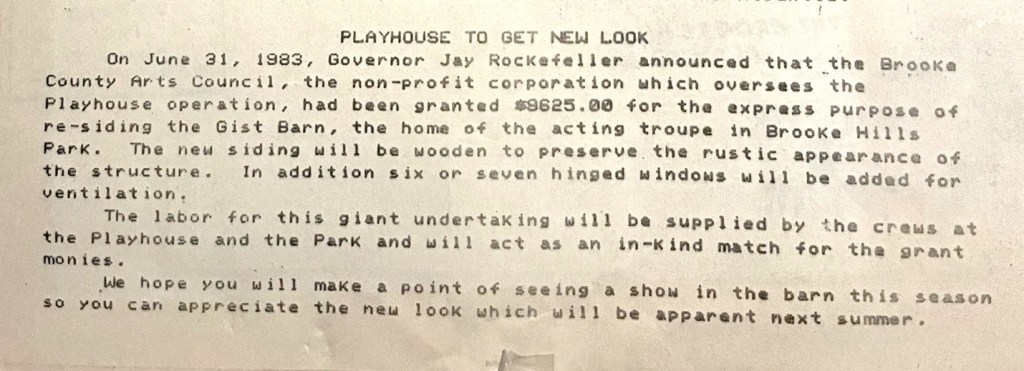
In early 1984, Mr. Beall ordered the lumber and started the curing process. It would be delivered in early June when the work would begin.
When the park board was informed of our plans, they said they would get us some help with taking off the old and putting up the new siding. They volunteered some park workers and county jail inmates that had worked on other park projects. That was great news. Unfortunately, those inmates and park workers never materialized, but one day a tall, lanky guy named Greg Meyers showed up and volunteered to help.
Greg was an ironworker (bridges, skyscrapers, other construction jobs) who was laid off at the time, and his wife, Betty Gaye Postlewaite Meyers, had sent him out to the Playhouse to help us. He was a godsend! He worked tirelessly, and he really knew what he was doing. For the first week or so, he wouldn’t eat lunch with us as he said he knew we worked on a shoestring. Eventually, we talked him into staying for lunch by telling him he was wasting too much time going home and back! Another guy named Jim Curry also helped on the siding project when he could. Neither of those guys had to break for rehearsals or prop runs or preparation for an evening show. Their help was immeasurable.

The guys on our summer staff (Terry Stuck, Jeff Lily, Keith Shepard, Paul Harris, and Michael Perkins, who joined the staff after the first show) were incredible. All, except Michael, were recent grads of Brooke High School, where they had been active in the drama program, and they really didn’t know they were signing up to re-side a big barn. They wanted to put on plays, but for a part of each day, they were putting up scaffolding, leveling it, removing old siding, schlepping new siding up the scaffolding, nailing on new siding, taking down scaffolding, and moving it to a new position before putting it up again. I don’t think any of them had done that kind of work before, yet they were so hard-working and seemingly tireless. Well, except for Jeff! LOL! You’ll read his siding experience soon.
The guys on the staff and Al Martin were also building all the scenery, rehearsing, acting in, and running the six shows that summer. They put out a Herculean effort, and I know we all felt a big sigh of relief and a huge sense of pride when the re-siding was finished, a couple of months later.

A few of our onstage regulars also worked tirelessly on the project. Russ Welch and Rick Taylor worked day after day on the siding at the Playhouse that summer, and they were both still in plays as well! I know there were a few other actors who also lent a hand, and everyone’s help was so appreciated.
Rick said, “I was and am afraid of heights, so I was no help on the scaffolding. I carried a lot of lumber, did a lot of hammering on the lower boards, and held boards in place for the guys on the scaffold to nail in place. You can’t imagine how hot it was that summer, and I know those guys working up on the scaffold were even hotter than I was! Another thing I remember is how heavy those boards were! I think the ones for the top story were 20’ long! I was no wimp, but carrying long pieces of treated lumber was hard, hot work!”
Just as a side note, Rick and his friend Nolan Van Gelder were also painting a house in downtown Wellsburg that summer. Rick was also the Music Director and acted in the opening show, Once Upon a Mattress, and the second show, George Washington Slept Here. When he had the time to memorize lines and music, I have no idea!
Likewise, staff member Terry Stuck had a full summer. He played the troubadour in Once Upon a Mattress, acted in George Washington Slept Here, Pools Paradise, and There Goes the Bride. He was the stage manager for The Second Time Around and ran the lightboard for Snoopy. And of course, as a staffer, he had his daily chores and worked on scenery construction
Terry said, “I have a ton of memories about that summer. One guy who helped on the siding did most of the really high work, because so many of us were afraid of heights! [NOTE from Shari: Greg Meyers] I also remember Big Jim. He was a strong guy but didn’t say much. He was beastly strong. We teased Paula Welch that he had a crush on her. 😂 [NOTE from Shari: That was Jim Curry.]
“I also remember that Paul Harris built a hope chest for his girlfriend that summer. Al Martin helped him with some of the cuts and planning. He was working on the barn and in shows, but somehow, he found the time for that hope chest.
“We were working on scaffolding a lot, and the old wood was tossed to the ground. I’m sure other stuff just fell to the ground. One day, I stepped on a nail that went in my foot and between the bones of my big toe and next toe. Shari, you had to take me to the E. R., and I had to get a tetanus shot. My foot swelled up so much I could barely get a shoe on for a few days. It was so bad, you made someone else do the scene change tasks that were mine in whatever show we were doing at the time! [NOTE from Shari: We made several trips to the E.R. that summer! OUCH!] Looking back on this summer and its huge “extra-curricular” project, I am so impressed with what the 1984 staff accomplished, and I wonder how any of them got any sleep! I hope they all thought that the end result, with the barn looking like new, was worth it! I thought it was nothing less than BEAUTIFUL!

SWEATING IT OUT!
One thing that had worried me about the new siding was airflow. When people would ask, we’d always say that the Playhouse was “air-conditioned by God.” Those old vertical boards had shrunk so much over the decades that there were plenty of spaces through which breezes came through and gave the audience some relief from the heat.
The first five years or so from first opening in 1972, the funeral homes in town had those cardboard fans with a fat, wooden popsicle stick-like handle that they supplied us with. We mounted little boxes near the doors. People picked up a fan on the way in and deposited it in the box on the way out. The funeral homes got some advertising, and audience members got a little handmade breeze.
We wouldn’t have those spaces between the boards with the new siding, and it was going to get hot in that barn. When I started pondering the possibility of putting in windows, Greg jumped right on board and suggested that we put in three “kick-out” windows on each side of the second floor. When the windows were closed, the sides of the barn looked solid, but the windows would be hinged on the top and open outward at the bottom. They weighed a ton, and most of us had to sit down on the side aisles of the house (where the audience sits) and push open the windows with our legs. While holding the window open with our legs, we put a 2”x4” on the bottom of the window and the barn floor to hold the window open! Those windows were wonderful and gave us so much more cross-ventilation than the cracks ever did. Greg and the guys made the windows and then tackled the doors on the high porches leading into the second floor, where the theater itself was. The original doors were double doors that were hinged on each side and opened outward. They were secured each evening with a 2”x4” in brackets across the inside of the two doors. The new doors were sliding barn doors, and Greg took care of sizing the tracks and affixing the hardware.
Ironically, Greg had never seen a play, and we had to practically beg him to let us treat him to an evening out with his wife. I think he said he had a good time, but I don’t remember if he ever saw a second show! In 1985, I thought about ceiling fans, and I called on Greg, who came right out, assessed the situation, and got to work. He installed four fans on extended pipes from some upper beams to get the air down closer to the audience. The fans were a great addition, and the seats under the fans became very popular.

After that summer, Greg would stop at the barn to check on us once or twice a season for a couple of years. I always knew I could call on him if there was something special that needed to be done.

The barn has that “weathered” look again!
ANOTHER BIG CHANGE
ring the past three winters, over the weekends, I had been dragging a clumsy, awkward, heavy, one-piece Commodore PET Computer home from school to learn BASIC and some very elementary computer programs. In 1982, the company introduced its Commodore 64, consisting of a keyboard, a disk drive/CPU, and a monitor.

Two of my gifted students, Bill Cawthorn and Ed Watson, were interested in learning about computers. We did a couple of fundraisers and bought one of these very affordable machines for our class. Now I was dragging three pieces of equipment home, but they were much lighter and more manageable while requiring two trips to and from the car.

Before long, I bought my own Commodore 64 set-up, including a printer for my home. No more lugging! I thought I had died and gone to heaven. No more typing press releases on my old college typewriter. Making edits and corrections was a breeze, and printers and copiers meant no more carbon paper!
Before long, I created a database for our mailing list, and I could print out labels, no longer addressing the Playhouse newsletters by hand. Eventually, I was also composing the program inserts (casts and crews of each show) to take to the professional printer to put in the program booklets. Next came creating newsletters, rehearsal schedules, audition forms, weekly chore lists for the crews, and more! It was all wonderful!
TWO DEGREES OF SEPARATION
Sometime in the 1980s, a woman named Joan (unfortunately, I can’t remember her last name) came from her home in New England to teach summer program art classes at Wheeling Jesuit College. She was an artist of some renown. She had produced and exhibited an entire series titled “Beached Whales” which consisted of large canvases overflowing with extremely large women in bathing attire! They were very colorful and might have been meant as self-portraits as Joan was pretty big herself, both in height and width, and she was very jolly about it!
Joan discovered the Playhouse early in the summer and immediately bought a season coupon or two. After the show, she would hang around and chat with the casts and crews, and we soon discovered that she had been Carol Channing’s roommate at Bennington College for a year or two and that they were still in touch! Golly! Carol Channing!
One of the things Joan told us was how Carol would do anything to promote whatever show she was doing at the time. Apparently, she’d go and talk to civic and fraternal organizations, Chambers of Commerce, garden clubs, whatever. Later, that was confirmed when Carol Channing revived Hello, Dolly! on Broadway for the third time in 1995. I read a magazine article that said she would speak to civic clubs of any size in New Jersey, New York, and Connecticut to sell tickets.
We had been doing the same thing since 1974, providing entertaining 20- to 30-minute programs for civic organizations throughout the valley. Program chairpersons loved us! We got free publicity, and sometimes we’d get a nice donation and lunch or dinner!
Joan was very entertaining and loved sharing stories with us, but she also shared part of her Wheeling Jesuit salary. One evening, she handed me a check for $300! That was a wonderful surprise and a nice chunk of change!
THE SHOWS
Of course, the reason we were killing ourselves on the barn re-siding was to enhance the place where we were producing plays and musicals. We opened with the cute musical made popular by Carol Burnett on Broadway. Once upon a Mattress was the re-telling of the Hans Christian Andersen fairy tale “The Princess and the Pea.” Even though it was an older show (opening on Broadway in 1959), it really didn’t age because it was set in a mythical kingdom. In 1996, it was revived on Broadway with Sarah Jessica Parker playing the princess. One of our staffers, the artistically talented Jeff Lilly designed and painted the detailed set parts with the help of Al Martin. It was Jeff’s first set design. Russ Welch played King Sextimus, a mute, and he nearly stole the show with his miming, mugging, and hilarious antics.
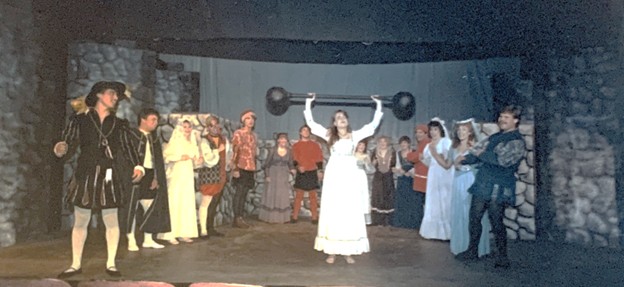
Beth Ann McElwain, playing the princess is center.
The second show was what we call a “chestnut,” that is a show that’s been done over and over through the years. George Washington Slept Here had its Broadway opening in 1942, but its dialogue is still funny to this day. The comic plot revolves around a young, urban family who buys a “fixer-upper” in “the sticks,” and all of the situations presented by the old house, quirky neighbors, costly repairs, and the fact that it was really Benedict Arnold who had visited! Susan Price and Rick Taylor led the large cast of 18 with its numerous laughs and identifiable situations for any homeowner!
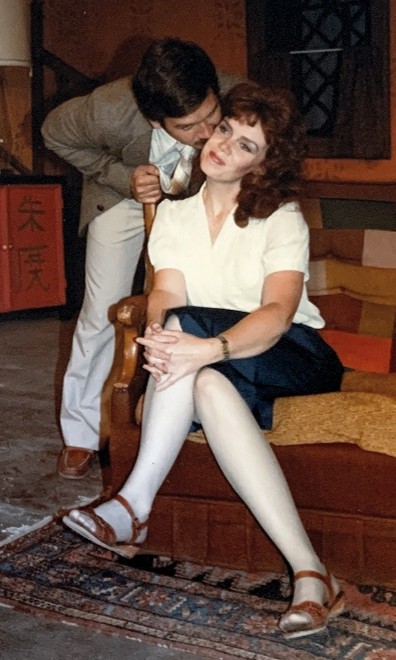
Pool’s Paradise is the sequel to the popular British farce, See How They Run, which we had produced the previous summer. Both shows take place in a little, out-of-the-way, English vicarage, and we had kept the scenery from See How They Run over the winter, a very nice cost- and labor-saving move. Rick Call once again played the vicar, The Rev. Lionel Toop, and Linda Huggins played his wife Penelope who drives the misadventures in the plot, including a betting pool, leaving Lionel often in the dark and then cleaning up the mess.
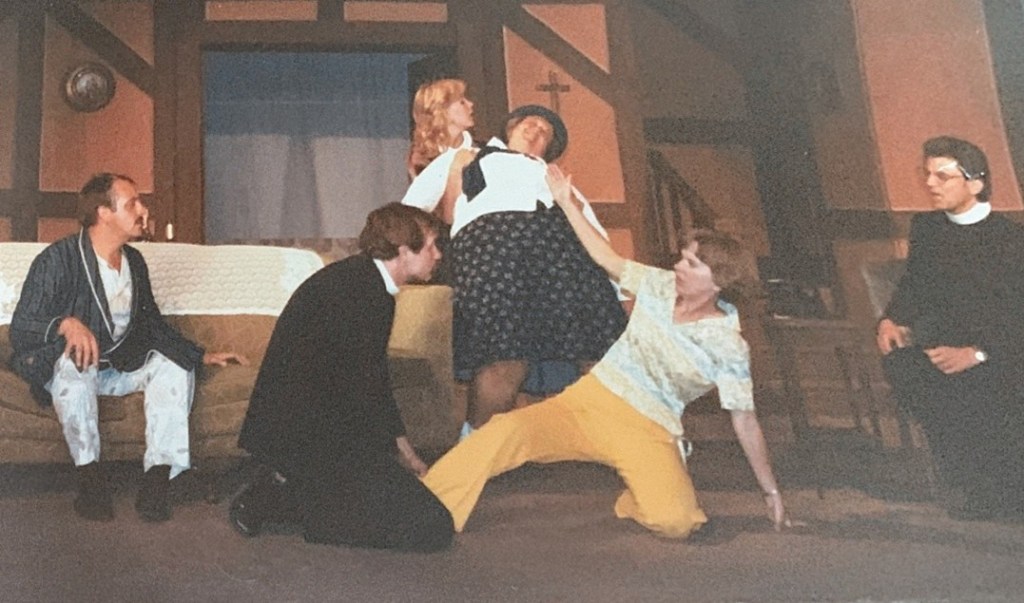
Linda Huggins on the floor, Rick Call
Terry Stuck, one of our young staffers this season, who went on to perform in shows at the Playhouse for thirty(!) seasons, had to jump in and take over the part of the local constable four days before Pool’s opened. It wasn’t a large part, but still, it’s always a heroic thing to do, and he would jump in again in December when he took over the lead in Snoopy!
The Second Time Around was one of those nice comedies that gave us a chance to bring Jean Carlson, “an actress of a certain age,” back to the Playhouse to play opposite Al Martin. Jean, like Al also from Cleveland, Ohio, had done shows with Al all over the Cleveland area for decades.
The plot revolves around a widow and a widower who have fallen in love, but they declare to their children, all married adults with children, that they will be living together without benefit of marriage, so they can keep their Social Security benefits. Both his kids and hers are horrified! Comedy ensues.

As you can imagine, Snoopy! isbased on the characters of Charles Schultz, and it was the second musical of the season, featuring ten of our talented, young actors. The kids called Snoopy! “the show that wouldn’t die.” We resurrected the show for a large multi-bus tour that visited the barn in October, and then we took the show on the road to Oglebay for dinner-theatre shows in Glessner Auditorium around Christmas. For that resurrection, Terry Stuck, who had run lights for the performances at the Playhouse, took over the lead role as Snoopy because Carl Marsh and his family had moved to Florida! [NOTE from Shari: Carl’s memories are in Part 21-A).
There Goes the Bride, a classic, comic farce, by the writing team of John Chapman and Ray Cooney rounded out the season. We had produced two other Chapman/Cooney farces in past years to audiences who were nearly rolling in the aisles with laughter: Not Now, Darling (1975 & 1981)and Move Over, Mrs. Markham (1977 & 1988). In Bride, a busy executive tries to plan his daughter’s wedding after he’s taken a bonk on the head, is concussed, and is hallucinating about a beautiful young blonde. It may sound hokey, but it is truly hilarious.
JEFF LILLY REMEMBERS
Jeff Lilly was on the Playhouse staff in 1984, but his Playhouse tenure started years earlier. Jeff is proud to tell anyone that he is from the Village of Beech Bottom. “I just always loved that I grew up in a village,” said Jeff, “and I still tell people, ‘I’m from the Village of Beech Bottom. It’s a village, not a town, a village in West Virginia.’ The village part was cool, but villages are small, and that’s the downside. Everyone in Beech Bottom knew what everyone else was doing. I met Lorie Jones, my best friend for life, in first grade, and by the time we were teens, everyone gave us a hard time if we stayed out late!

“My mom and siblings were wonderful; my dad and I really didn’t get along. My middle school art teacher, Russ Shaffer, was very encouraging, and I had other wonderful teachers, like Diana Mendel and Skip Roberts, who were later active at the Playhouse, and I had many great friends. I graduated from Brooke High School in 1981, but I had already started my association with the Brooke Hills Playhouse by then.
I have so many great memories from my time at that old barn,” said Jeff. “As a matter of fact, in the late 1960s, when I was 8 or so, our family attended the Wellsburg Masonic Lodge picnic for many years, and those picnics were held in the Gist Barn, before it was Brooke Hills Playhouse. We’d eat, and all the kids would play in the big field nearby. There was an old grand piano upstairs. [NOTE from Shari: See more about that piano and its fate in Part 6B of this memoir.] At some point in time, I had discovered that I could play a piano, I guess by ear. I just seemed to know how to play. My mom would let me go upstairs in the barn, and I’d play that big old piano.
“After a while, I’d be asked to go downstairs so this group could get set up. After we ate again, this fabulous group of square dancers would perform with a band. The caller was just amazing, and I was mesmerized. I remember thinking, ‘This is a magical place,’ every year at that picnic.
“I eventually made a ‘piano’ out of a cardboard box, and I’d ‘play’ that. I could hear the music in my head. Eventually, I got a mini organ in my teens, which I loved playing. My father hated it, even though I discovered that he played. I also could play guitar.
“Later in 1977, my older sister Gloria took me to the barn, which was now so different. Now, the huge old piano was gone, and there were theater seats upstairs. We saw Fiddler on the Roof that night. During the song “Sunrise, Sunset,” the cast members, each with a lighted candle, came out into the aisles, nearly surrounding the audience. I felt engulfed. Again, it was magical. They were singing so beautifully, so close to me. It was like I was in the show.
“In the summer of 1978, I saw The Sound of Music at the Playhouse, and that fall, when I entered Brooke High, I got involved in the music department. Pretty much everyone in my music class had been in The Sound of Music! That spring, 1979, I wasn’t thinking of auditioning, but everyone in the music department was asking, ‘Are you going to audition?’ ‘Are you?’ ‘Are you going to audition?’ When someone asked me, I just said, ‘Sure, I’ll audition.’ Before I knew it, I had been cast in Oliver! and rehearsals started right away! It was magical, too!
“Shortly after I arrived at the Playhouse, Shari, you discovered that I was musical and equally artistic. Maybe my teacher and your friend Russ Shaffer told you. At any rate, you had me design some program covers and then some show posters to put up in the little display case by the box office window. Then you or Paula asked me to come up with a T-shirt design. I had this idea that involved a ribbon, but Lorie was much better than I was at ribbons, so she did this design that had a ribbon with the words ‘Where the Magic Begins…’ flowingly written along the ribbon. It was the first thing Lorie did at the Playhouse, but she went on to make and run props, paint scenery, usher, and just do whatever needed to be done, but always behind the scenes.
“I was hooked. When the second set of auditions was held in 1979, I auditioned again. This time I was cast in the fun, fun melodrama The Return of Sgt. Fenshaw as Maurice, a French-Canadian henchman to the play’s villain. I loved, loved, loved this show. I had a hump on my back, and every time I’d enter, it would be on a different side, like Igor in the movie Young Frankenstein. Soon, people in the audience started to notice and make comments like, ‘Look, his hump moved,’ or ‘It’s on the other side.’ They just laughed and laughed.
“Also, my ‘master,’ played by John Barto, often patted me on the head and gave me a biscuit when I did something right, and I’d pant like a dog. It was just crazy funny.” [NOTE from Shari: The show’s opening number, ‘Frigid Falls,’ is about the little town where the show is set. I’m writing this 46 years later, and Jeff sang me this song as we talked on the phone! That is a lasting memory!]
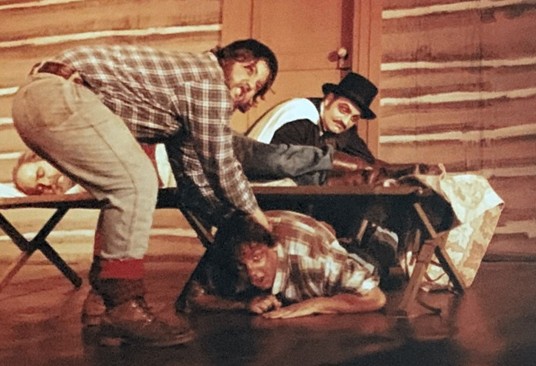
and Russ Welch, the villain (because villains always wear a top hat, cape, and tuxedo!)
“I was still in high school, but in the spring of 1980, I couldn’t wait to get to the Playhouse to audition again. Again, I was cast. This time in Oklahoma! C.R. Wilson, a dance teacher and choreographer from Steubenville, choreographed this show for us. The one thing I distinctly remember is the guys’ dance number. It wasn’t easy, but I was in the middle of the line, and though not a great dancer, I was determined to get it down pat! That number got huge applause every evening. The audience would begin cheering before the dance was over, and they applauded and cheered all the way through to the end. I was so proud of all of us!
“It was around this time that Lorie and I really enlarged our friend circle. We were joined by Paul Harris, John Workman, Caroline Watson, Karen Kafton, Terry Stuck, Keith Shepherd, Jane Paull, Monica Rasz, and Carl Marsh, all of them doing shows at the barn. It was a great coming-of-age time for all of us, and we were so happy to be doing it together. We had this special bond, like a family. I love them all to this day.
“My biggest memory from this time and going forward is of the cast parties. We always had a campfire, sometimes hotdogs, sometimes corn on the cob that was cooked right in the firepit. Paula often brought a big, decorated cookie. We’d smoke the occasional joint. Some had a beer or more. Paul and I would often pull out our guitars, and we’d all sing and harmonize on rock songs, show songs, camp songs, even an occasional hymn. It’s too bad no one ever recorded those parties, because there were tremendous voices in that group, and we sounded great. And that is not the weed or beer talking!
“I had a car, so I drove a bunch of us home. I remember one morning around 6:00 a.m. (a normal post-party home arrival), I was standing in our kitchen. My dad came down, saw me, and said, ‘You’re up early. You must have a big day.’ I didn’t have the heart, or the nerve, to tell him that I was just getting home!
“I remember Al Martin yelling, ‘LET IT FALL!’” [NOTE from Shari: It seems like every strike night there would be some sweet volunteer, usually a new cast member, who would stay to help on strike night. We would dismantle the old set, flat by flat. Sometimes a person would hold the flat as it was being detached; sometimes no one was there, and the ‘detached’ flat (a light wooden frame covered by canvas) would just float to the floor. It’s kind of mesmerizing to watch. Invariably, if a flat was dropped, a new helper would make a dash to “catch” the flat which often resulted in the flat getting twisted, sometimes incurring a broken frame. If we were lucky, the newbie was stopped in his or her tracks, by that command in Al’s booming voice, “LET IT FALL,” and the flat proceeded in its gentle float to the stage floor. I hasten to add that Al was not the only one to yell this. Occasionally, a whole chorus of ‘LET IT FALL!’ would ring out.]
“At this time,” continued Jeff, “Shari was doing the scenery for our Brooke High shows in the winter, and one time when I was new to the scenery side of theater, a flat started to fall on the Brooke High stage. I’m sure someone yelled, ‘LET IT FALL!’ but I didn’t get it. I grabbed for it, hoping to stop its fall. Instead, it broke. All the guys who were helping her said, ‘Mrs. Harper is going to kill you!’ She didn’t, but she wasn’t happy. We used tall, 12’ flats at the high school, and they weren’t cheap to build!
“I graduated from Brooke High in the spring of 1981, and once again I was looking forward to the Playhouse. Godspell opened the season, and I was cast along with many of the ‘Family’ members: Paul Harris, John Workman, Caroline Watson, Karen Kafton, and me on stage, Lorie running props, and Jane in the orchestra. We were joined on stage by three of the Playhouse staff members, whom I dubbed the Gilligan’s Island crew. Bill Hossack was Gilligan, and Cathy O’Dell and Kendra Stingo were Ginger and Mary Ann. Judy Porter Hennen was our director, and she was a genius. The script was pretty vague. She set the show on a child’s playground, and it was magical. Bill Hossack WAS Jesus, so kind and caring, and he brought us into his magic circle, making everything seem so real. It was an amazing production.
“Al deJaager, who was the music director for some of the Playhouse shows and the choral music professor at West Liberty State College, now West Liberty University, generously offered me a full scholarship, but there was no way I was staying that close to home with my dad being so mean to me, so off I went to West Virginia University in the fall of 1981. My strong suits were art and music, but I stuck with art because it seemed more stable. While I was in Morgantown, I had an internship at the PBS TV station, and when the internship was over, they hired me. “Lorie had gone to art school in Pittsburgh but wasn’t completely happy, so I asked her to come to WVU so we could have classes together. That was rich. She got to Morgantown and switched to theatre design! (I wonder how much the Playhouse played in that decision?)
“After my freshman year, I was back in Beech Bottom for the summer, and appeared in The Music Man. That was a great experience. I, along with Jim Matterer, Ron Gamble, and Carl Marsh, made up the barbershop quartet. Since none of us had ever sung barbershop before, we had to work extra hours like crazy with Music Director Al deJaager to develop the close harmony and those ringing chords. I know we sounded great, because cast members and audiences told us over and over.

“Back in Morgantown that fall or maybe the next, I started taking computer classes, CAD-CAM classes, and I took a photography class or two. Shari did a million jobs at the Playhouse. The newspapers only accepted black and white photos back then, so she would take some photos of a play in rehearsal, go home that evening, spend time with Andrew, put him to bed, then head downstairs to the coal cellar that she had converted into a dark room. She’d develop the film because in those days, there wasn’t overnight developing, and then she’d print up some pictures to go with the press releases she would have written. Who knows when she had the time?
“One of those summers, she asked me to start taking the publicity photos, developing the film, and printing the pictures, so I spent a lot of time at her house. Shari also had a small computer, so while I was waiting for film to develop or prints to dry, I’d get on her computer and do who knows what? But that sparked my interest in computers, and it made a huge impact on my life. You’ll see.
“I wasn’t in any shows during the 1983 summer, but I may have done the photography, but both Paul Harris and I returned to the Playhouse in 1984, and this time we were on the STAFF! We lived in a travel trailer out behind the barn. I remember that something about the electricity wasn’t right, and occasionally, we’d get a little zap! Also, the trailers (there were two) had no plumbing, so we used the restrooms and the shower in the barn. We never had to worry about driving home after cast parties. We just walked (staggered?) over to our trailers!
“This was a super busy summer at the barn. Not only did we do six shows, but with the help of some of our adult actors (I distinctly remember Rick Taylor and Russ Welch working nearly every day), we re-sided that big, old barn. It was a mammoth project. First, we’d remove a section of old wood from the second floor and then from the first. Then we’d nail up the new wood on the lower level and then replace the section above it.
“Not long after we’d gotten started, I drove a nail through my little finger. I really hadn’t been much help, and Rick looked at me and said, ‘You can’t do this anymore. Go help with food. Big hooray! That day I made tuna and egg salad sandwiches served with chips for lunch. Rick was thrilled as Paula, our cook at the time, had gotten a deal on rice and was serving it at noon and dinner!
“Remember that in addition to the barn work, we were also building and painting scenery for the shows, having rehearsals, gathering props, making costumes, and on and on. Al and Shari oversaw the productions, and Rick and Russ handled the barn siding. The staff worked on both.
“I designed my first show that summer, Once upon a Mattress, and painted it as well—hundreds of stones to represent the walls of a castle. I also played the court jester in the fun show.

“I acted in the final show of the season, There Goes the Bride, where I played a much older person and had to grey my hair and do age makeup for each performance. (I’m sure Lorie did my makeup!) After the curtain call on opening night, I remember coming off stage with this great feeling and saying to myself, ‘I killed it!’ The next morning at breakfast, Paul looked at me and said, ‘Jeff, you stole the show last night!’ and I knew I had. The rest of the run was okay, but that opening night was amazing.”
Jeff was so handy to have around that summer because he had so many talents. He painted those original wall panels for the set of Bride and was the stage manager for George Washington Slept Here. Then he designed, built (he’d improved his tool skills by then!), and painted the set for Snoopy! The other staff members were working on building sets, finding props, and setting lights for the shows, but they were also working their tails off on the barn siding, so Al and Jeff did much of the scenery work.
“One of my most vivid memories,” said Jeff, “is of the backstage toilet stall. There was graffiti on nearly every inch of the walls, making you feel like you were in a jokebook while you were sitting on the throne! It had a Laugh-In feeling, if you remember that old TV comedy show. Each of us was always looking for a little inch of white space to post our thoughts and gags.”
That summer, 1984, was Jeff’s last Playhouse season. He returned to the university and completed his BFA (Bachelor of Fine Arts) degree in graphic design and returned to the Ohio Valley, where he got a job in Bellaire, Ohio. “And I got FIRED! which just crushed me,” said Jeff. “I finally decided I had to do something, so I decided to move—to New York City or Washington, D.C. Honestly, I just flipped a coin, and Washington won. I got this tiny, little apartment and got a job at a little newspaper. I was working all the time and getting no sleep. I was making it but not really MAKING IT.”

Jeff made the decorative wall hangings.
“I don’t even remember how this came about, but I got a call to come to McLean, Virginia for an interview. I went. The company was BDM, and they had big government contracts for the CIA, the Department of Defense, and DIA (Defense Intelligence Agency)! They offered me an incredible salary, fabulous perks, and a 401k. They hired me because I had computer experience! Remember, that all started in Shari’s dining room on her little Commodore computer and then my classes at WVU!”
“I became a computer artist with a security clearance and a high level of secret work. I really couldn’t believe how my life had evolved. One year I worked with a woman who worked on the series of Jane’s Books [NOTE: The Jane’s Weapons series includes comprehensive references on various military weapons, such as Jane’s Weapon: Naval, 2022/2023 Edition, Jane’s Weapons: Infantry 2023-2024, Jane’s Guns Recognition Guide, etc.] We were creating these incredibly detailed drawings of all kinds of weapons. When the woman became pregnant, I took over.”
During Jeff’s tenure, his group went from black and white drawings to multi-colored drawings. It wasn’t long before Jeff became the Art Director and was running the department. He said, “I was so young, still in my twenties. I didn’t even know what a big job I had until much later in life.”
Soon, the company received a big NASA contract, and Jeff and his team produced all the documents for Desert Storm and then produced incredible 4-and 5-color plates for the Hubble Space Telescope to distribute to scientists, universities, space facilities, and the public. “I loved my job!” said Jeff. “The work was challenging, but it was also so interesting, and I worked with great people. As computers got better and better, we artists got better, also.”
There was one small drawback. Jeff was gay. “The policy was ‘Don’t ask. Don’t tell.’ at that time, but it was difficult. I still liked to perform, and for a while, I was a NASA artist by day and a drag queen with a stage persona and an act at night!
“I truly was a workaholic, and one of my biggest projects for NASA was a series of 7 gorgeous posters detailing the 6 divisions of NASA. After that huge project, I really needed a vacation, so I went to New York, and while there, I visited the Hayden Planetarium. That’s when I knew for sure how ‘big time’ my job was because the observatory had all of my NASA posters on display there in the lobby!”

The set was sent to every high school in the U.S. in the 1990s.
“After 13 years, BDM lost the NASA contract,” said Jeff, “and they had to let 100 of us go. I picked up the phone and called my boss and thanked her for the 13 best years of my life! She cried! Everyone else was complaining, but how could I complain? I had 13 wonderful years with the company, and stuff just happens.
“I had been living with a guy, and for a while, things were great; however, things became iffy, scary even, as the layoff loomed, and I was done with that. I cashed everything out and had a shitload of money. Around this same time, my mother got cancer. I loved how she always took care of me, especially when Dad would say he hated me. So, the guy moved out, and Mom moved in. (I should add that when I went to college, Mom had divorced Dad.)
“Eventually, Mom said she wanted to die in West Virginia, so we moved to Martinsburg somewhere around 2001 or 2002. I was running out of money, and all I did was worry and eat, eat, eat!
“When I was 39 years old, two weeks before Mom’s death, my sisters visited us. One day Mom said, ‘There’s something I want to tell you.’
“I thought she wanted to talk to my sisters, so I said, ‘I’m going to go lie down.’
“Mom said, ‘Stay. This is all about you.’
“Well, that was a shocker, but what followed was even bigger!”
“‘Jeff,’ my mom said. ‘Your father isn’t your father. I had an affair. You’re my only child that I know exactly where you were conceived, and that was in a graveyard.’
“I wasn’t shocked. I was thrilled! And I loved that I began and would end in the same place!
“Who was or is my dad?” I asked.
“‘He was a friend of the family,’ she said, and with that she gave me a copy of the man’s obituary. He had been a long-time family friend!
“There was a photo with the obituary, and I had another shock. I looked just like him! I also learned from the obituary that I had another sister! ‘Tell me something about my father,’ I said.
“She gave me a good description, and she said he was a good person. I actually had some memories of him as he had been with us one time on a picnic at Oglebay, and he had helped me catch my first fish at Schenck Lake. He also came to see some shows at the Playhouse and to my high school graduation. He was almost like a nice ghost in the background of my life. Mom said I would have liked him.
“Curious about this “new” sister, I did some investigating, and I discovered that the sister I had never known had been murdered, shot to death by her husband. She did, however, have a daughter, and I contacted her. She told me many great stories about her grandfather, my real dad, and her mother, my sister.
“Not long after my mom died, my old boyfriend showed up again and was kind of stalking me! What to do? Call Lorie, of course.
“Even though Lorie was married, she immediately said, ‘Come stay with us.’ I arrived at their home outside Asheville, North Carolina, where Lorie and her husband Alan, a jeweler, were making jewelry and selling their work on eBay. I started making jewelry as well, but then I began just selling imported beads.
“Before long, I knew something was ‘off.’ Alan was very demanding. It wasn’t long before Lorie filed for divorce, and Alan was out of the picture. By this time, however, I was broke. So, I filed for bankruptcy! Lorie and I lived together, and we got in the best shape of our lives. I was getting over Mom, and Lorie was getting over Alan, and we walked and dieted like crazy! But what was I going to do? I was still broke!
“When I was working at NASA, I had a daily Starbucks. (This is when Starbucks was just becoming a thing.) Just when I moved to Asheville, Starbucks was opening its first store in the area. I’d always liked the Starbucks vibe and how they made their customers feel special, so I applied for a job. As a matter of fact, I soon learned they meant it when they said, ‘We don’t serve coffee, we serve people.’
“Lorie and I had a “date” every three weeks, meeting in Hot Springs, North Carolina at a spa for a soak and a toke. I was living in this small apartment that had no air conditioning (!), and on those dates, I fell in love with this small town where a part of the Appalachian Trail goes right down Main Steet. Lorie then had this idea—I should buy a camper and move to Hot Springs.
“Eventually, I found a mobile home for rent on 1.7 acres of land for a summer test run. By fall, I had fallen in love with the land and the place I now call home. To me, it was heaven on earth! I was tired of renting and had saved $20,000. I asked the owners who lived nearby for a price. There was no response. Then, when I was about to give up, they said, ‘$25,000.’ I knew I could swing that, and it was then that I knew my mother’s spirit had something to do with that great deal.
“Since 2011, I’ve been living in my mobile home just outside of Hot Springs, bordered on three sides by 250,000 acres of the Pisgah National Forest. I’m 63 now, happily retired with my pensions from NASA and Starbucks and my best friend nearby. This fall, Lorie and I will be celebrating our 57th year of being best friends since we met in first grade.”

LORIE JONES BOEHM REMEMBERS
In our conversation, Lorie started off by laughing and saying, “Jeff (Lilly) has the long-term memory. I have a very good short-term memory, so instead of Playhouse memories, I have Playhouse feelings, especially a feeling of community. Jeff and I, best friends from first grade, were artsy. I had artistic talent, and Jeff was musically talented. When we got to high school, we weren’t necessarily the “popular kids.” We hung out in the art and music wing, kind of off to ourselves.
“At the Playhouse, however, there weren’t groups. There was just all of us, this bunch of people with a common purpose—put on a show. We felt safe, and we felt appreciated. Jeff and I were just kids, but we were accepted for our contributions by the adults. And we had a great group of kids to hang out with.
“I know we all loved those evenings when we had a campfire. Paul Harris would play his guitar, and we’d all sing James Taylor songs. I can’t remember what we’d laugh about, but we laughed a lot, not just in the evenings, but while we were working during the day.”
Lorie wasn’t on the actual Playhouse staff, but she was an incredibly talented volunteer. She’d paint scenery, work on props, hand out programs, and run the light board for shows. Jeff recruited Lorie to design one of the Playhouse t-shirts.
Because Lorie worked strictly behind the scenes, we have no photos of her volunteering hundreds of hours at the Playhouse. Why we didn’t take candid photos, I don’t remember. Too busy, I guess, but Lorie was a beautiful girl as her high school senior photo attests.

After graduating from Brooke High School in 1981, Lorie went to art school in Pittsburgh, but eventually, Jeff enticed her to transfer to West Virginia University where she changed her major to Theater Design, graduating with a BFA in the field in1986. She was then offered a graduate assistantship in Theater or Art to work on her MFA.
“Theater in college,” said Lorie, “was so different from summer stock. In college, we put in 16 hour days. We worked on shows nearly all day and all night. I was tired of that routine, so I turned down the assistantship and moved to Boca Raton, where I was the visual merchandiser for a huge Bloomingdale’s. I oversaw the bedding displays, the linen lines of all the famous designers. It was a great job.”
By chance, Lorie accepted a job working in an institution for individuals with Intellectual and Developmental Disabilities. She had found her perfect niche. For 36 years, she has been working in different roles in her field.
Lorie became a Certified Behavior Analyst and ultimately the Regional Director of a large nonprofit overseeing 100+ employees in 24 counties in and around Asheville, North Carolina. Outside of work, she’s a member of the Town of Fletcher Board of Parks and Recreation.
Now, Lorie and her partner, Christopher, live in Fletcher, not far from Jeff, her childhood friend. After 36 years on the job, Lorie recently cut back on her workload to working four days a week. Hopefully, she’ll get back to her artistic roots soon!
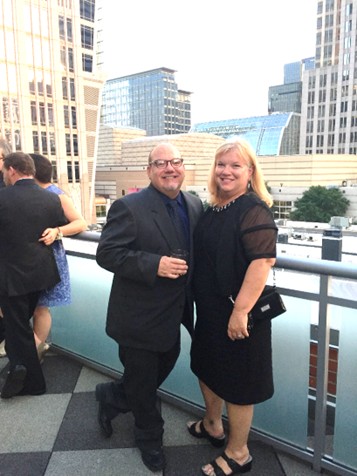
Charlotte, North Carolina, 2018
STEPHANIE BALDWIN SCHUTTE REMEMBERS
In 1981, Stephanie Baldwin transferred to Wellsburg Middle School, where I was teaching, and where Stephanie was in my class for the gifted. Each year, the American Legion in town sponsored a Gettysburg Address Contest for sixth graders, and I was asked to coach the Wellsburg Middle School participants. Stephanie was one of my “coachees,” and we got to know each other better. She came in 2nd. Darn!
Over the course of that year, even with my time off for having a baby, I’m sure I talked about the Playhouse, as Stephanie’s gifted class only had a few kids in it. For some unremembered reason, twelve-year-old Stephanie wanted to be in a show, and in the late spring of 1982, Stephanie showed up at the barn for auditions. She was cast in The Music Man as one of the kids who would become a member of the River City Marching Band.

“Rick Taylor was playing the part of Harold Hill in the show, and he and his family were living in the old, red brick Traubert house,” said Stephanie, “just at the top of the hill on Washington Pike going out of Wellsburg. I lived a few lanes past his house on Parkway Drive, and he would pick me up for rehearsals then bring me home afterward. He was a music teacher, and I was already taking piano lessons, so I think we talked a little bit about music on those trips.”
Apparently, Stehanie liked the experience as she showed up for the second set of auditions that summer as well and was cast in the chorus of H.M.S. Pinafore. We could say that Stephanie was another one of those great kids who grew up at the Playhouse. From her first show in 1982 until her last show in 1991, Stephanie spent hour upon hour at Brooke Hills, and eventually, Maxine, her mom, became involved as well, as a seamstress. More on Maxine later.
The summer of 1983 saw Stephanie go from the stage to the orchestra pit, such as it was. For Annie Get Your Gun, Stephanie joined piano accompanist Janice Arbogast, along with Kim Allison and David McMullen, both on flute, in the area directly in front of the proscenium on the barn floor designated as The Pit. Stephanie sat on the bench with Janice, turning the pages for Janice and cueing the flutes.
“Janice taught me so much about being an accompanist for a show,” said Stephanie. ‘If a singer gets lost and you have to drop something,’ Janice said, ‘drop the right hand, because the singers will carry that line, while the left hand keeps things moving.’ That was valuable advice!”
Later that season, Stephanie turned the pages for Amy Charleton Portale, who was the accompanist for Something’s Afoot.
In 1984, when she was 14, Stephanie was back on stage playing Violet in Snoopy!, which featured ten of our young actors, nearly all of whom had several acting credits already. “This was a really fun show,” said Stephanie. “First of all, we got to act like kids, the kids we read about in the Peanuts comic strip and saw in the Peanuts cartoons. Also, I had a huge crush on Paul Harris, who was on the Playhouse staff and a sophomore in college with beautiful eyes. I had planned to take Spanish in high school, but he told me to take Latin instead, because I’d study both the language and learn the ancient myths. Also, Miss Ashworth, the Latin teacher at Brooke High, took her students to Latin contests, which were not only fun but also showed us a bigger world. He was right, and I enjoyed learning about classical Rome. It would come in handy much later in life as well.”

Stephanie Baldwin, Mary Beth McElwain, Donna Jo Reitter, Janice Arbogast,
Paul Harris, Ron Gamble, Carl Marsh
The Playhouse reprised Fiddler on the Roof to open the 1985 season, and Stephanie was back in the Pit with Janice Arbogast on piano. Later that summer, however, Stephanie, just a sophomore in high school, was the accompanist for the musical Two by Two about the biblical character, Noah. “Scott Martin, the director, wasn’t too happy,” said Stephanie, “and was pretty skeptical about having such a young and inexperienced accompanist. I resented Scott’s attitude, and I was scared to death. I was also determined. I practiced every waking hour and thankfully, won him over.”
When Stephanie was a sophomore at Brooke High, during the 1985-1986 school year, she came to me for a favor. I was teaching at the high school by now, and Stephanie had discovered that other schools in the valley had chapters of S.A.D.D., Students Against Driving Drunk [NOTE: Now Students Against Destructive Decisions], and she wanted to start S.A.D.D. at Brooke High. “I had watched an after-school special about a girl who was killed by a drunk driver, and it made a huge impact on me. I also knew there was a lot of drinking and driving going on among my fellow students,” Stephanie said. To start the club, she needed a sponsor, and she asked me. I was already coaching the JETS Academic Team and the Quiz Bowl teams, writing and directing the Madrigal Dinner, doing scenery for the musical, directing shows at local colleges, serving as president of the Brooke County Arts Council and Chair of the Brooke County Museum Board, managing director of Brooke Hills Playhouse, and working hardest at being a mother! I had as much as I could handle, but how could I turn down Stephanie? I couldn’t.
We started S.A.D.D. that year and began presenting awareness activities that were well-attended. The thing just grew and grew. Several years after Stephanie graduated, the club was the largest in the school with over 300 members! It even spawned a Clown Troupe (sponsored by two parents who were also substitute teachers, sisters Martha Henderson and Pat Peel), which presented “comic shows on serious topics” at the elementary schools revolving around topics like smoking, peer pressure, honesty, cleanliness, etc. I had to find other sponsors to help, and we divided the club into S.A.D.D.-A for freshmen and sophomores and S.A.D.D.-B for upperclassmen. It was all Stephanie’s fault! We got it started, grew it, and then she left me holding the bag until I resigned in 1995! LOL!

We were so proud of Stephanie in 1986 when she auditioned for and was accepted to attend the prestigious Interlochen Center for the Arts Summer Institute in Interlochen, Michigan. “My aunt, who lived in Michigan,” said Stephanie, “told my parents about Interlochen and thought I should go. We looked into it. I recorded something I was playing on the piano (no easy feat at that time), and I sent it in with my application. I got accepted, and my parents managed to scrape together the $2,000 cost, and off I went to Michigan for eight weeks. It was a pretty phenomenal experience.” Sadly, that meant she wasn’t at the Playhouse that summer.
At home for the summer before her senior year at Brooke High School, Stephanie was back on the piano bench as the accompanist for Camelot, the 1987 season opener, paired with Sandi Anderson, who played the synthesizer. In the spring of 1988, she graduated from high school and appeared in Annie! “I remember one of my favorite things in this show was singing in the trio with Carrie Cronin and Cathy Brooks,” said Stephanie. “Later in the season, I was in one of the craziest and most fun shows ever, Sgt. Fenshaw of the Mounties. The audience was ‘rolling in the aisles,’ and the cast was having as much fun, or maybe more! I think between shows, my mom and I got me ready for my freshman year at the University of Dayton.
In the fall of 1988, Stephanie went off to college, and except for 1991, when she played the housekeeper in The Sound of Music, her Playhouse summers were over. She went on a mission trip to Kentucky one summer, and she had met Greg Schutte, her husband-to-be, at the University of Dayton during the school year. She had grown up.
I wish I could remember how Stephanie’s mother, Maxine, got involved in the summer of 1990. I know that we definitely needed help with making the nun’s costumes for Do Patent Leather Shows Really Reflect Up?, and I have a feeling that I just called and asked for her help. I had a book that had simplified patterns for all kinds of costumes, including a nun’s habit, and I remember going over that book’s pattern with her.
Anyway, Maxine made the nun’s habits in 1990, and she made more when we reprised The Sound of Music in 1991. Over the years, those costumes were used again and again as we produced many of the shows in the Nunsense series. I even borrowed one of the nun’s costumes when my mother asked me to do a short one-woman show on Hildegard of Bingen, the Medieval abbess, writer, healer, and mystic. So, Maxine made a lasting contribution to the Playhouse in addition to making Stephanie practice the piano (which may or may not be true, haha)!
Stephanie graduated from Dayton in 1992 and married Greg in 1993 in a very musical service, as Greg is also a talented musician. They have 7 children, all of them talented musicians and home-schooled by Stephanie.
Today, Stephanie continues to teach piano, having picked up more students in the fall. In her 2025 “Mid-January Christmas Letter,” Stephanie reported she had applied, interviewed for, and was hired to teach the Intro to Latin classes at nearby Chesterton Academy, where her younger kids now attend high school. “Teaching piano,” she wrote, “is no problem. Teaching Latin takes every single brain cell I have.”
While their children grow up and scatter, Stephanie and Greg continue to live in Beavercreek, Ohio, near Dayton.

WE DID IT!
I still find it hard to believe that we made it through the summer of 1984. The Playhouse is housed in a really big barn, and we re-sided that behemoth with volunteer labor! We also produced 6 shows between May 17 and August 12. All was accomplished in 13 weeks! I know I thanked the crew earlier in this piece, but what they accomplished that summer was remarkable and truly a labor of love, so thanks again!

 Life Without Lesson Plans