

Season Four, 1975
THE SHOWS
Not, Now, Darling
Black Comedy
Pool’s Paradise
Dial M for Murder
Critic’s Choice
That Championship Season
Abie’s Irish Rose
Londini and His Cavalcade of Magic
THE STAFF
Bill & Shari Murphy Harper
John & Judy Porter Hennen
Al & Tommie Martin
Norma Stone
Rich Ferguson
Tom (T.C.) Cervone
Mary K. Hervey DeGarmo
Bobby Shreve
Steve Krempasky
Lisa Higggins
Bob Hahn
Jo Lynne Nugent
Marie Bonacci
Madelon Rasz
BIGGER IS BETTER
1975 was a great season. We increased the size of the “paid” staff, and our volunteers remained faithful. John, Bill, and I were still not taking a salary, but we didn’t have to put up any more “capital” to get the season up and running. We had “charge accounts” now at Robert Scott Lumber, Murphy’s 5 & 10, and City Plumbing which helped, and we were able to pay our monthly bills.
This was the first season that we “hired” students who intended to be scenic designers/tech directors and had taken college classes in design. I think they had already had a couple of their designs built and used. Our incredibly talented crew had Bobby Shreve and Steve Krempasky designing and building the scenery and taking a lot of pressure off Bill, Al, and the rest of us. Scenery and lighting-wise, we just did what those guys told us to do. Of course, we were constantly building costumes and props, and tragically for all the crew, I was still cooking the evening meals with welcome meal donations from parents and community supporters every so often.
Bobby and Steve elevated the quality of the sets. They used the burlap outlined with wood technique (see photo above) for the first two shows, but they soon started building regular stage flats–8’ high of varying widths, frames constructed of wood 1”x3”s, covered in unbleached muslin which stiffens when sized and painted. The third show, Pool’s Paradise, was our first show ever completely constructed with flats.
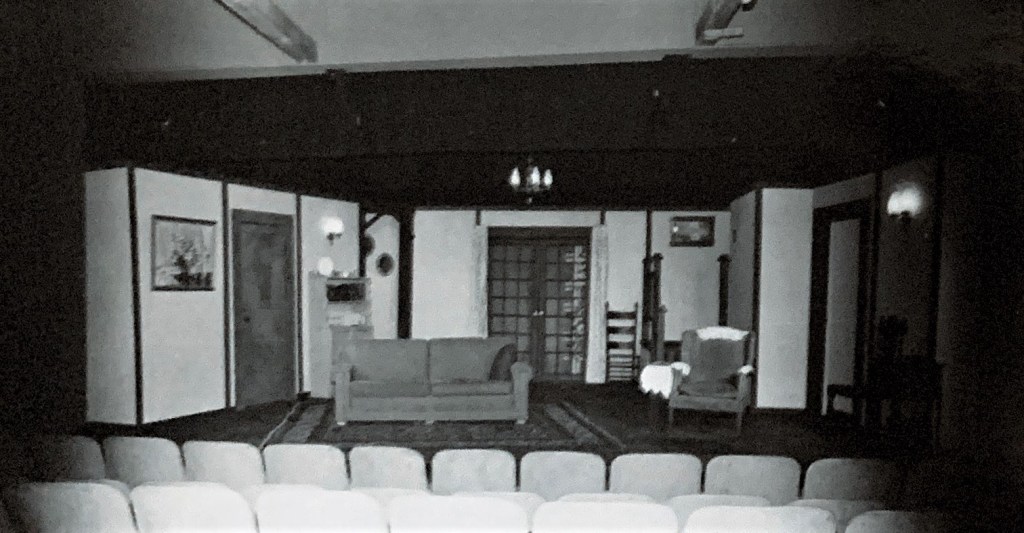
The show took place in a small English vicarage.
At intermission, I asked a few of our regular patrons what they thought of the set. They thought it was great, but they hadn’t even noticed any difference from the previous sets! I took them over to the bulletin board and showed them the sets from the first two shows. They remembered them and thought they were nice. After the show, a few of those same people said they now saw the difference, but they were amazed at how they had bought into the burlap sets as easily as pie!
The fourth set combined the burlap technique with a few flats mixed in. Building up an inventory of flats to rotate from week to week took some time. From the fifth show on, our box sets were strictly constructed of flats. Of course, musicals often mixed flats and backdrops or just black curtains with set pieces, like a cut-out and painted tree or a haystack or a grandfather clock.
In truth, those of us working backstage, and even the actors, missed the old burlap sets for a while. The burlap “walls” allowed everyone backstage to see through the burlap and watch everything that was going on out front. With flats, there would be a peek hole through the muslin occasionally, but for the most part, if you were backstage, you could hear the show but not see it. Flats, too, were a lot more expensive. Flats took more lumber to build the frames and also required muslin, screws, glue, and paint. You might think it funny that I even mention screws, but each corner of a flat is secured by a triangular piece of ¼” plywood that is secured by 11 screws! The keystone-shaped pieces that secure the cross braces each take 10. That’s a minimum of 64 screws for a simple 4”x8” flat. The flats with openings for windows and doors take even more! In those early years, we didn’t have drill/drivers, so every damn, ¾”, #8 screw was screwed in by hand! We did have a couple of spring-loaded ratchet screwdrivers which helped—once you got the hang of the technique for using them! Anyway, screws cost money, and money was always short.
IMAGINE, TWO EXCELLENT DESIGNERS/TECH DIRECTORS!
Bobby Shreve and Steve Krempasky have both gone on to great careers. Bobby was with us for one season and Steve for two.
The following article is reprinted from WVU Magazine, Summer 2018:
“Bob Shreve Has the Enviable Job
of Making People Smile for a Living“
[Bob has] spent most of his career designing theme park attractions for Disney and Universal. And, yes, he also gets paid to ride roller coasters all day. “After you ride it 50 times, it’s not like the first time you rode it,” he admits with a laugh. “But at the same time, a ride’s a ride. They’re a lot of fun.”
Shreve’s route to the “happiest place on Earth” was, like any good roller coaster, a circuitous one. Growing up the son of a military man, he was moving constantly – bouncing around with each new posting. As Shreve, MA ’80, Theatre Design, describes it, he was only born in West Virginia “by accident.” His pregnant mother made a brief pit stop in Fairmont to say goodbye to a few relatives before moving to Germany for a stint. But Shreve and his twin brother had other plans, arriving two-and-a-half months early.
The family returned to West Virginia when Bob was in high school, which is when he first discovered his love of theater. He was cast in a junior class production of “The Boarding House Reach,” a comedy about a precocious little boy who reminded him of himself. “I got smitten,” Shreve recalled.
He studied acting and directing. After earning his master’s degree at West Virginia University, he taught at WVU.

of “Abie’s Irish Rose.” Note Judy’s not-so-period shoes!
NOTE: I learned recently from Tommy Pasinetti that Bobby also worked for Dollywood. Bobby is now retired from teaching at the Savanah School of Art and Design in Atlanta, Georgia.
Steve Krempasky was our talented Tech Director/Designer during the summers of 1975 and 1976 following his junior and senior years at West Liberty. Steve grew up in Macedonia, Ohio and graduated from a Jesuit high school. The Jesuit connection brought him to Wheeling College in 1973. Steve had gotten involved in some shows in high school and liked it. Unfortunately, Wheeling didn’t offer a major in drama.
Steve came in contact with Stanley Harrison via a summer program, and Stanley offered him a work-study job at West Liberty. He transferred and made his way to the Playhouse.
Steve remembered several things from his time at the barn. In The Girls in 509, a crazy, old farce, a massive cage had to drop from the “ceiling.” Steve called it a “Death Trap,” and it nearly was. The cage was rigged on pulleys and manually dropped. It had to be large enough to fit over the actresses playing the old biddy and her niece (Muriel Shennan and Cathie Barger (now Cathie Barger Spencer, see section about Cathie later in this post)), who at one point unwittingly trap themselves. We couldn’t build a cage that was light enough to be completely safe for the actresses and yet would still drop quickly. Keeping it level was a problem. Getting it down fast enough was a problem, and making sure the “victims” of the trap were on their mark before dropping the thing was a problem. One night the trap became unbalanced. Bob Hahn was playing the bad guy when the trap dropped and glanced off Bob’s head, then got hung up on Bob’s shoulder. Hurting, he managed to shrug the massive contraption off of him until it fell to the floor with Bob finally trapped inside. The show, however, was very funny, and nobody died!
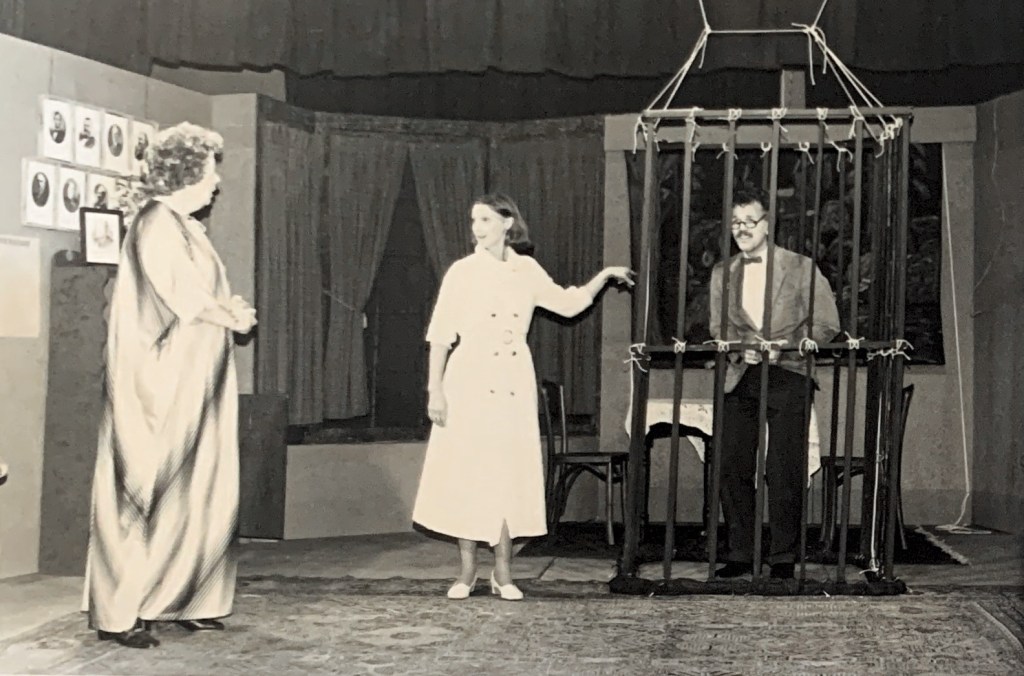
in The Girls in 509’s “Death Trap.”
One of my favorite memories of Steve is a set he designed. Bill Harper had found some sheets of plastic from which the outer covering of golf balls was stamped. Clever Steve used those sheets to build a creative, decorative touch for the Dial M for Murder set.

were stamped could add such a nice, decorative touch to a room?
(White things with circles left and right.)
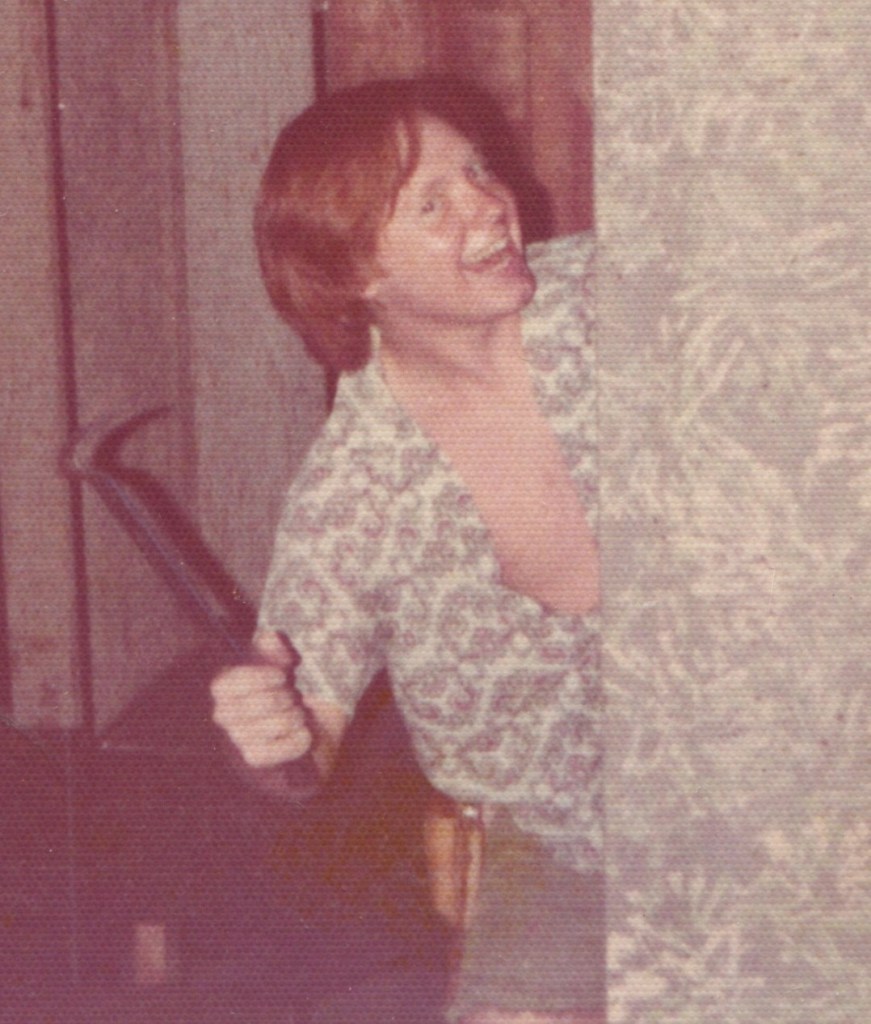
Steve also remembers hearing the announcement from the Brooke Hills swimming pool most evenings during the show. “The concession stand will close in fifteen minutes” would often be heard by our audiences during a pause in the action. Another memory was about Davy Crockett, the first show of the 1976 season, and a big mistake on our part. Our thinking was that we should do something relating to American history for the American Bicentennial. The script took itself too seriously. All the costumes and most of the props had to be built (a lot of work!), and very few people cared about poor, old Davy. All I can say is, “We did it. It was poorly attended. It was not a good start to the season.” (Left: Steve being Steve, 1975)
Following his graduation from West Liberty, Steve worked for Theatre West Virginia out of Charleston for their bus and truck tour around the state, serving as a truck driver, working on scenery and lighting, and performing bit parts. Shortly after that gig, Steve went on to Wayne State University in Detroit as a member of the Hilberry Classic Theatre Company, earning his M.F.A. in Scenic Design in 1979.
After graduation Steve was named the Managing/Artistic Director of the Billings Studio Theatre of Billings, Montana, where he produced, directed, or designed over 100 shows. Leaving Billings in 1988, Steve became the Managing Director of the Oak Ridge Playhouse, Oak Ridge, Tennessee, where he met his wife, Mary Scott, a nuclear safety engineer and community theatre actress. Steve and Mary have two grown children, Scotty and Anna.
In 1990, Steve moved on, becoming the Executive Director of the Bijou Theatre Center in Knoxville, Tennessee. Steve said, “As the manager of East Tennessee’s oldest operating theatre, circa 1909, I worked with many local performing arts groups including Theatre Knoxville and the Tennessee Stage Company. I presented over 200 musical and touring artists while employed there. Also, I was the Chairman of the annual Knoxville Jazz and Blues Festival 1990-1996.
“In 1996, I left Tennessee to become Vice President of Theatre Operations for the new Whitaker Center for Science and the Arts in Harrisburg, Pennsylvania,” said Steve. “I helped build the $51,000,000 facility and start its programs while guiding the award-winning operation through its first 10 years. While in Pennsylvania I presented over 500 touring artists including performances by the Philadelphia Orchestra, Tony Bennett, Greg Allman and even Weird Al Yankovic. I also designed shows for the Harrisburg Opera, Theatre Harrisburg, Dickinson College, and the Open Stage while freelancing across the country.”
Today Steve and Mary live in Farragut, Tennessee, a suburb of Knoxville. Steve has his own business, MASSKUS PRODUCTIONS, which produces special events, concerts, and fundraisers, and he consults with more than a dozen, varied, area theatre groups. He is a busy guy as he is also the current President of Tennessee Presenters Corporation (a state-wide consortium of performing arts presenters), Past President of the Smoky Mountain Blues Society, Executive Director of the Farragut Business Alliance, and a “FELLOW” of the American Association of Community Theatre.
One final Playhouse thought from Steve, “We could often be found at Betts’s Bar!”
A HARD LESSON LEARNED
One incident during this fourth season led me to establish a policy that I used for the next twenty years.
The seventh show of the season was an old chestnut called Abie’s Irish Rose which had a 14-member cast. At that time there was a governor’s program for underprivileged youth called something like Clean Streams. The director of the program in Brooke County was one of my fellow teachers, John Pizzutti. Early in the season, John called and said that there would be a picnic for the Clean Stream kids in Brooke Hills Park at the end of their program, and he asked if he could bring the kids to a performance—free of charge.
The picnic was on a Tuesday, and we didn’t have a performance that evening. We talked it over with the cast, and everyone thought it was the right thing to do, meaning they were willing to come in on their off evening, get into period make-up and costume, and do the extra performance.
The day of the picnic arrived grey and rainy. We watched the three, yellow, school buses arrive around 4:00 p.m. and head toward the large picnic shelter over the hill from our barn. The crew set up the stage and props. The cast trickled in and got to work in the dressing rooms. Two hours later, I was sweeping the lobby when I looked up to see the three, yellow buses coming up the hill, heading our way. I went back to the dressing rooms to tell the cast that the kids would be arriving momentarily, and if they were ready, we might be able to start a little earlier than the 7:00 curtain we had planned.
I went back to the lobby in time to see the buses pass our driveway and head toward the park entrance. I thought that was strange, but I didn’t panic because to enter our parking lot the buses would have had to make a hairpin turn. I was sure they were heading to the swimming pool parking lot to turn around to give them a straight shot into our parking lot. I waited. And waited. No buses.

I got into my car and drove up to the pool. No buses. I drove up to the park clubhouse and learned that the buses had left the park. To say I was furious was gross understatement.
I drove back to the Playhouse, broke the news, and apologized to the cast. They could go home. I went to the box office (This was before the days of cell phones) and tried to call John’s house—no answer. Of course, he wasn’t home yet. He was still on a bus—getting farther and farther away from the barn! There really wasn’t anything to do except lock up the barn and go home.
Later that night, I got a hold of John and blasted him for leaving us in the lurch. His answer was, “Well, it was raining.”
“Raining? So what? The barn has a roof, you idiot,” I said. “You had a picnic in a shelter with a roof, what’s the difference? Huh? What’s the difference?”
“I don’t know,” he said.
“Well, you did know we were putting on a special performance just for you and your group! We had 14 people in period makeup and costumes and a bunch of others waiting to work backstage, and you just drove on by! Rude! You’re just rude! You didn’t even have the courtesy to tell us you weren’t coming!”
“Gees, Shari, I’m sorry.”
“Yeah, thanks for that. That makes it all better. Bye, John.”
So, what did I learn from that incident? I learned that unless people have a stake in something, they don’t value it. For instance, we gave every cast and crew member two complimentary tickets for every week they performed or worked on a show. Those people might share their comps with friends or family members or save them for their own personal use to attend other shows in the season. I would guess that 95% or more of those comp tickets were redeemed.
Often civic groups or event sponsors would solicit us for tickets to raffle off or to award as door prizes, and we were happy to share some comps with them. I’ll wager that less than 20% of those tickets were ever redeemed.
The tickets given to cast and crew members had value. People used those tickets because they wanted to see a loved one in a show or the cast and crew used them because the comps acted like a small payment for being involved in a production. Those comps that were donated didn’t have any value. For the most part, the people who received them didn’t have a stake in the plays, and they went unused.
Over the years, we continued to donate tickets to organizations, but when a large group, such as Clean Streams, asked for a special performance for free, we did this. The group had to pay a reduced price upfront for each person in the group, say $3-$5. On the day or evening of the special performance, the group would get their “deposit” refunded in whole at intermission. We were never left in the lurch again.
CATHIE BARGER SPENCER
(NOTE: Cathie’s first Playhouse show was in 1974, but I wasn’t in contact with her until recently, after the memoir entry about the 1974 season had been posted.)
Cathie Barger was a senior taking a drama class at Wheeling Park High School in 1974. Tom Pasinetti, one of the Playhouse’s first company members, was doing his student teaching with Fran Schoolcraft, the amazing Wheeling Park drama teacher, that year, and he encouraged Cathie to audition at Brooke Hills Playhouse.
Cathie and her friend Liz Hare both tried out that spring and both were cast in Harvey. Ironically, Cathie was cast as Mrs. Chumley, the oldest character in the show, and she was probably the youngest person in the cast. (NOTE: Cathie has now appeared in two other productions of Harvey at Towngate Theatre in Wheeling, once as Myrtle Mae and once as Vita Louise. Said Cathie, “I love the show, and I’ll audition for it whenever it is produced!”) The guys must have wanted Cathie to return as they gave her a whopping $5.00 for gas money!
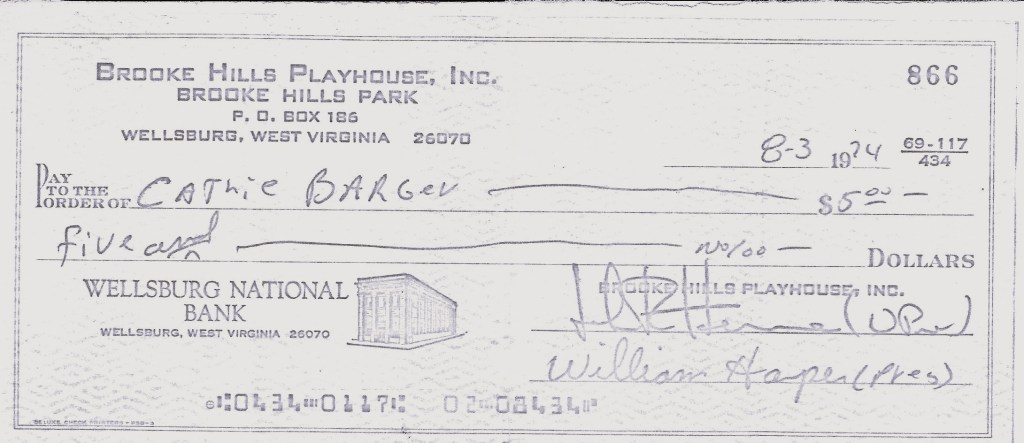
Cathie did return to Brooke Hills the following summer (1975) appearing in Black Comedy and also playing the fun part of Ida, the maid, in Pool’s Paradise.
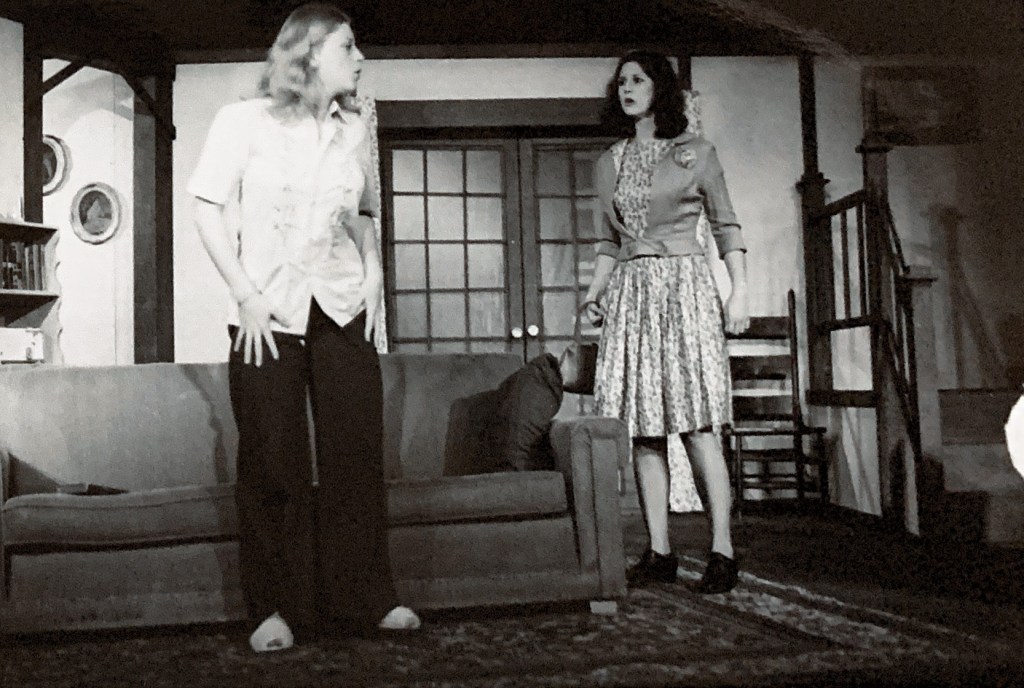
in the 1975 production of Pool’s Paradise.
Cathie went to Westminster College for a semester before transferring to West Liberty as a theatre major. She left after a year and then returned as a Speech Pathology major while taking some theatre classes. At that time, one couldn’t finish a Speech Pathology degree at West Lib, so she transferred again, this time to West Virginia University. It wasn’t long before she discovered that she didn’t like her chosen field, so she took a job at the phone company transferring back to Wheeling. She also returned to the Playhouse where she did numerous shows in the following years. Many of those shows were with Rick Call and Rich Ferguson. She remembers several incidents with those two leading men.
In one show, she and Rich Ferguson were on stage. Richard, a profuse sweater, was facing downstage. It was a hot night, nothing unique in the “air-conditioned by God” Playhouse, and Cathie’s character was turned in profile facing Richard. She watched as a growing bead of sweat rolled down Richard’s nose and hung on the end. Richard then turned to Cathie. The sweat drop flew, hitting Cathie in the face as Richard moved in for their kiss! “Not the most pleasant memory,” laughed Cathie.
In 1989, Cathie played the lead, June, an aerobics instructor, in Bottoms Up!, written by our friend Gregg Kreutz and first produced at Brooke Hills before its publication. (NOTE: More about Gregg and Bottoms Up in a later post.)
At some point, Cathie, as June, was alone in her hotel room. There was a knock at the door, then several more knocks. Cathie remembers thinking, “There’s never been a knock on the door in this scene before.” “I just stood there,” said Cathie, “trying to figure out what to do. Then Rick Call started calling, ‘June, June, June’ while knocking. I mean, what was I going to say if I answered the door? It seemed like forever, but Rick stopped, and I heard him running around backstage when he realized his mistake. We all just carried on, never even attempting to explain those strange knocks!”

Another time, Cathie was onstage with another Playhouse regular, Linda Huggins, who was wearing a big gardening hat. “We were beside each other,” Cathie remembered, “and Linda turned upstage, her head completely hidden from the audience by the hat.”
“I forget my line,” whispered the usually stalwart Linda.
“Just as I started to cover,” said Cathie, “Linda remembered her line. As is usually the case, she muffed, and I stood there with some ‘egg on my face’.”
After working 20 years at the phone company, Cathie went to work for Social Security for 14 years and did a number of shows at Towngate Theatre in Wheeling. In 2001, Cathie acted in her last show at the Playhouse (NOTE: Hopefully not her last show at the Playhouse ever!), The Female Odd Couple, and she also married Tom Spencer.
In 2019, Cathie realized that she regretted not completing her degree in theatre at West Liberty, so she has taken up where she left off, completing one or two theatre classes each semester. In 2022, Cathie made her directing debut (The Book of Will) at Towngate and decided to take a Shakespeare class in the English department. She fell in love with The Bard and started a Shakespeare discussion group at Towngate which led the Wheeling theatre to add a Shakespearean show, Twelfth Night, to the 2023-2024 season.
Today, Cathie and Tom live with their dog and four cats in Wheeling.

at Towngate Theatre in Wheeling in 2023.
BOB HAHN
Bob Hahn, a native of Follansbee, W. Va., had just finished his junior year in college when he auditioned at the Playhouse in 1975. He was cast in two shows this year—the fun, British farce Not, Now, Darling with his West Liberty acting and directing professor, Stanley Harrison, and the mystery Dial M for Murder, wherein he played the bad guy opposite Linda Huggins. The following summer Bob acted in five of the eight shows, which was quite a feat. He played another villain in Davy Crockett, and was also the bad guy in The Girls in 509. He was in Never Too Late, No Sex Please, We’re British, and The Odd Couple, where he was paired withStanley again. Stanley played the fastidious Felix, and Bob played the slob Oscar. They were great on stage together!
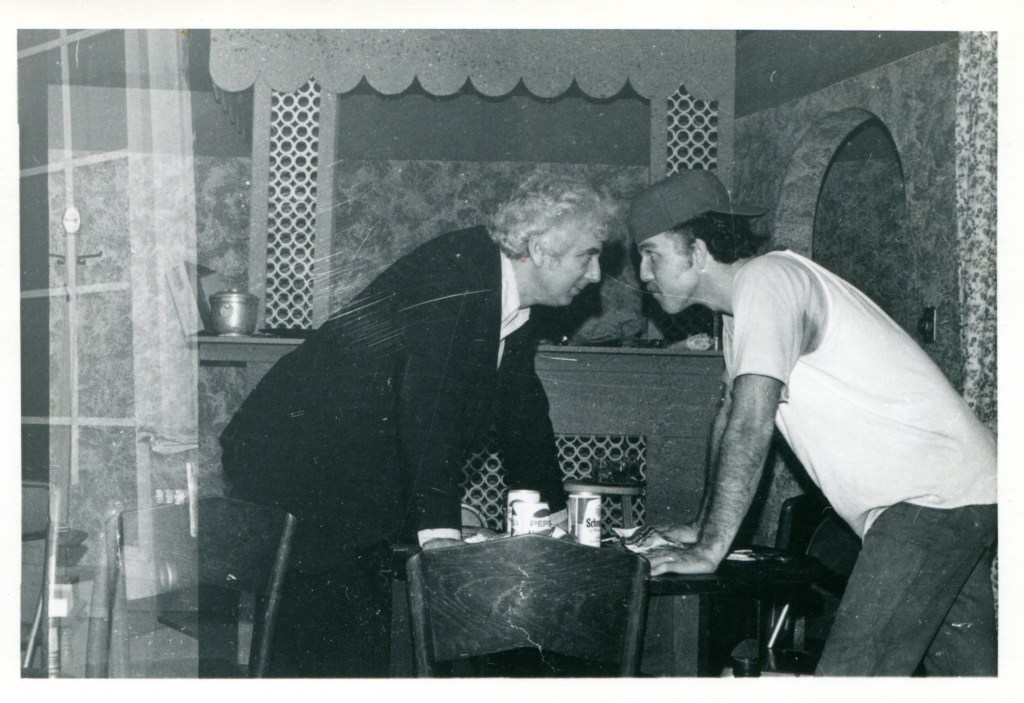
Bob remembers one night during a performance of The Odd Couple when either he or Stanley “went up,” that is, lost his place in the script. The two of them looked at each other and realized that they’d skipped a half-page. “Somehow,” said Bob, “we went back to the place where the skip began, ran those lines, then jumped over the part we’d already done, and got back on track! At intermission, we were both amazed at how we did that, and I’m sure no one in the audience knew it had even happened.”
[NOTE: I can assure you that the episode had caused the stage manager and the backstage crew to break into a sweat and probably hold their collective breaths until Bob and Stanley found their place in the script and carried on.]
Bob also remembered something I’d forgotten about. The shows rehearsed during the day, on weekends, and early in the evenings before the shows. At times, we would be rehearsing three shows at once. Rehearsals might be held in the lobby, in the yard, or in the nearby Kiwanis picnic shelter. Many people, like Bob, were in multiple shows.
“We moved the picnic tables out of the shelter on Monday, and the shows’ designers would draw the floorplan (outline) of the sets on the shelter floor with different colored chalk,” said Bob. “One show might be outlined in blue, another in pink, and a third in white. In the morning, I might be rehearsing on the blue set outline and then on the white one in the afternoon. You had to be careful to enter and exit through the correct colored markings on the floor, and keeping them straight could be a challenge!”

The labels (Side Room, Kitchen, Coffee Table, etc.) would not be written on the shelter floor.
After those two summers at the Playhouse, Bob spent two summers at Theatre in the Park near Wheeling, West Virginia, and in the fall of 1978, he relocated to Knoxville, Tennessee where he began his theatre career at the Clarance Brown Theatre, a professional house, affiliated with the University of Tennessee.
[NOTE: Ironically, Tom Cervone (T.C.) who was a Playhouse mainstay for our first five seasons and thus acted with Bob, eventually made his way to the University of Tennessee, also, where he received his M.F.A., became a theatre professor, the managing director of the Clarence Brown Theatre, and eventually the head of the drama department.]

Over the years, Bob spent 5 summers acting in Billings, Montana with our former designer and tech director—Steve Krempasky. Back in Knoxville, Bob served on the Board of Directors of Theatre Knoxville for 20 years, and in 2009, he returned to West Liberty where he was an adjunct professor of theatre who put together a touring company doing children’s shows. The group performed in elementary schools all over the Ohio Valley. “One of the coolest things,” said Bob, “was that the company performed at Edgewood Elementary School, where I had been a student many years ago.”

Bob’s last show was in 2007, a production of Richard III in Harrisburg, Pennsylvania. Living in Knoxville today, he has kept meticulous track of his theatre career. He’s acted in 151 plays and has directed 90, a massive volume of work.
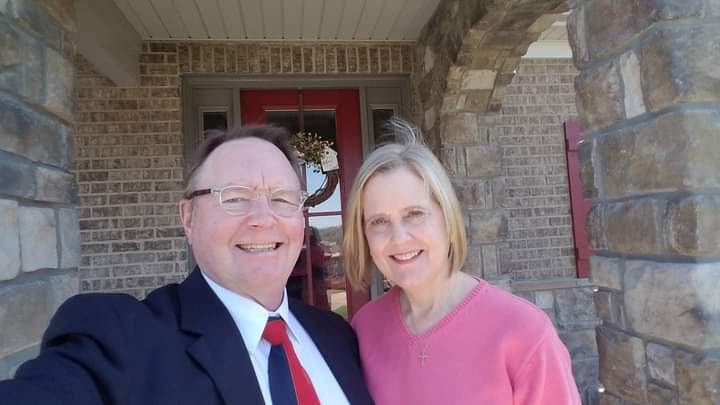
(Left: Bob, 2023)
THE ONE THAT GOT AWAY
We always held two sets of auditions. One set was on the Saturday and Sunday before Memorial Day weekend for the first half of the season, and one before the Fourth of July weekend for the remainder of the season. A young West Liberty music major turned up for the first auditions in 1975 and was cast in the second show.
Sara Wiedt was from nearby Avella, Pennsylvania and had just completed her junior year at West Lib. She was cast in Black Comedy, a long, clever one-act that is often paired with the more serious White Lies. (NOTE: For some, long-forgotten reason, we had elected not to do White Lies.) Sara had previously done the show while attending Southwest Missouri State before she transferred to West Liberty.
She came by the Playhouse sometime during the following week and picked up her script. The show would go into rehearsal around the first of June. A few days later, Sara stopped by the barn again. This time she returned the script and told us she was unable to do the show. She had a very good reason. She had been selected to perform with Pittsburgh’s Civic Light Opera (CLO) for the summer, a very big deal!
Sara graduated from West Liberty in 1976, did graduate work at Carnegie Mellon University on a full stipend, performed with the CLO from 1975—1978, and did several shows at New Jersey’s prestigious Paper Mill Playhouse. Sara admits that she was never interested in the academic side of college. “I just wanted to perform,” said Sara, “and West Liberty gave me a lot of opportunities. Where else could I have played Portia at so young an age?” Sara spoke highly of Al de Jaager, her music teacher and mentor at West Liberty. “Al was always there for me,” said Sara. “He helped with my schedule, and he looked out for me, knowing I really just wanted to perform. He came up with a way for me to get my degree.”
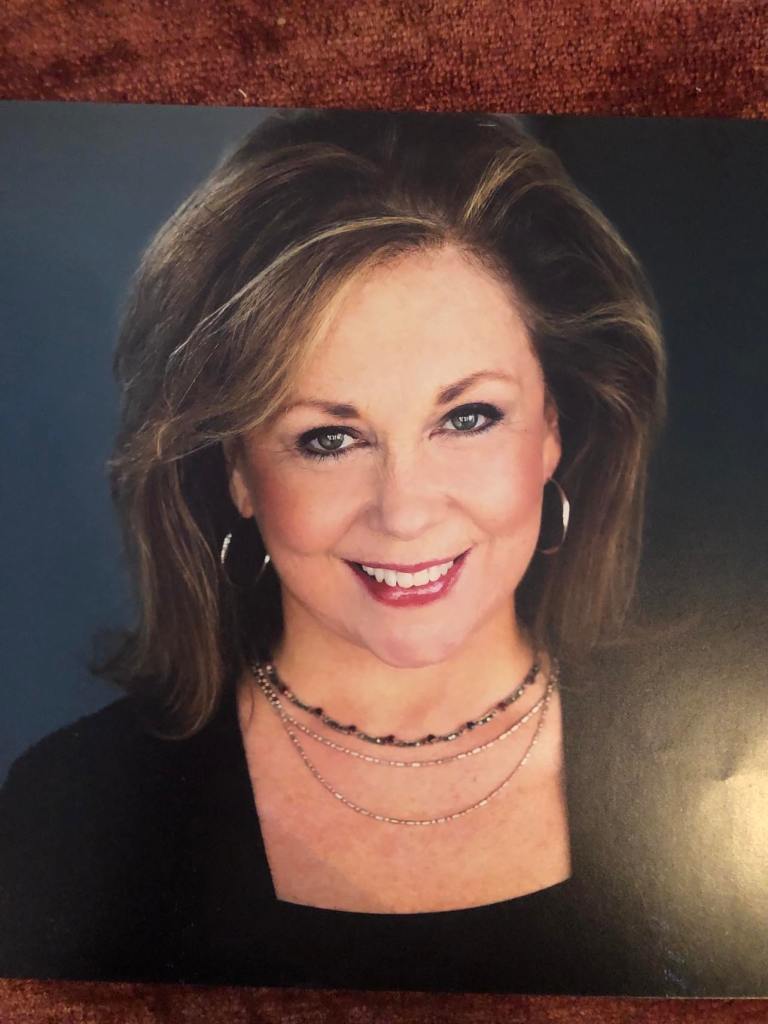
In 1979, Sara headed to New York City where she was cast in some Off-Broadway shows and performed in shows on two world cruises for Cunard, and Holland America. In between shows, she took classes (some with her acting prof from West Liberty and Brooke Hills veteran Stanley Harrison, who had also migrated to New York). And she worked a number of “survival jobs.”
Left: Sara’s favorite résumé shot. “I wish this one had been used on West Liberty’s Wall of Honor,” she said.
In the spring of 1991, having been in NYC for 12 years, Sara was working at the perfume counter in Macy’s and saying to herself, “Sara, you’re 38 years old. You’re going to have to go home.” Shortly after that chat with herself, she ran into a girl she had worked with at the Papermill Playhouse, who asked if Sara was going to the upcoming open auditions at the Metropolitan Opera. Sara hadn’t even known about the auditions, but she prepared a piece to sing and borrowed an outfit. On her day off, she went to the auditions, and when she arrived, she signed in with the union singers. “The normal chorus master had just died, and it was a little chaotic. No one seemed to notice how I’d signed in, so I just went with it.
“I was very nervous,” said Sara, “but they kept moving me along. When I sang, the ‘judges’ were very supportive.” (NOTE: You can hear them on Sara’s audition tape encouraging her.) Sara was hired as a soprano in the Metropolitan Opera chorus. “I was in my prime as a singer, and I spent 21 years at the Met, eventually transitioning into a mezzo-soprano as well as a soprano. I retired from the Met with a full pension in 2012.”

Over the years, Sara performed with all the big names in opera–Pavarotti, Rene Fleming, Domingo, Conductor James Levine, and hundreds more. “My language training had not been very strong,” laughed Sara. “I was okay with operas in French, German, and Italian, but the ones in Russian or Czech were very difficult. I would prepare hundreds of 3”x5” note cards for each song with the lyrics written out phonetically! I took them with me everywhere, practicing and singing–even in the bathtub!”
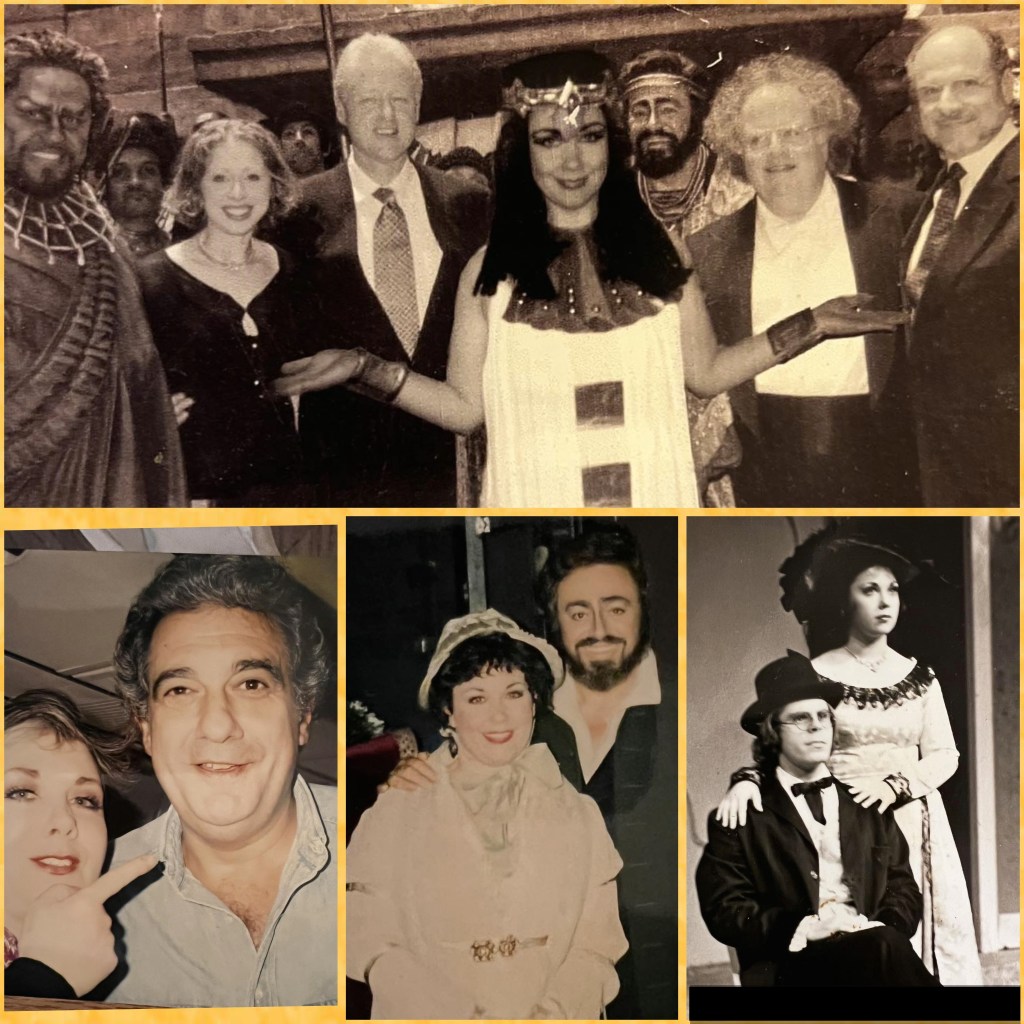
our own T.C. (Tom Cervone)
in West Liberty’s production of “A Flea in Her Ear.”
Sara was married for 20 years to a performer she met on one of her cruise ship jobs, but today she lives in an apartment on Riverside Drive overlooking Central Park and at the age of 70 hopes to meet someone with whom to share her life.
It makes me so happy to know that Sara, the one who got away, had such a wonderful career. It’s not so far from Brooke Hills Playhouse to a big-time career in New York City after all!
HOW TO BREAK YOUR OWN HEART

the Weirton Daily Times.
We made a bold move when deciding on the plays for 1975. We still had stars in our eyes and hopes of one day presenting a well-balanced season—comedies, dramas, musicals, reviews, concerts, you name it, we wanted to produce it. This season was a start on that plan. It contained Broadway comedies (Black Comedy, Critic’s Choice), British farces (Not Now, Darling, Pool’s Paradise), a murder mystery (Dial M for Murder), a full-blown magic show (Londini and His Calvalcate of Magic. We were all surprised at how really good this young guy was!), an old chestnut (Abie’s Irish Rose), and our first drama (That Championship Season).
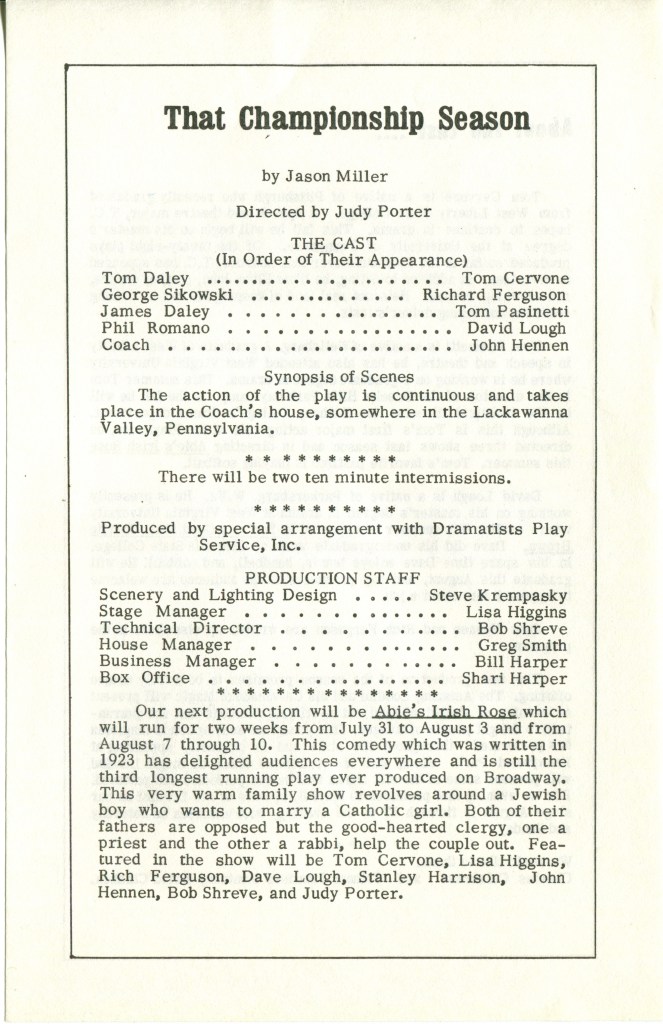
Sadly, with That Championship Season, we nearly sunk our ship. We had an excellent cast—John Hennen played the aging coach. Tom Cervone (T.C.), Richard Ferguson, Tom Pasinetti, and David Lough played four of the players who won the state basketball championship twenty years ago for their beloved old coach, who is now dying of cancer. The play had won a Pulitzer Prize for Drama and the Tony Award for Best Play. Judy Hennen directed the heck out of the production, and when our drama prof, Stanley Harrison, saw the production, he was nearly speechless. The show was that good. So, what was so damning?
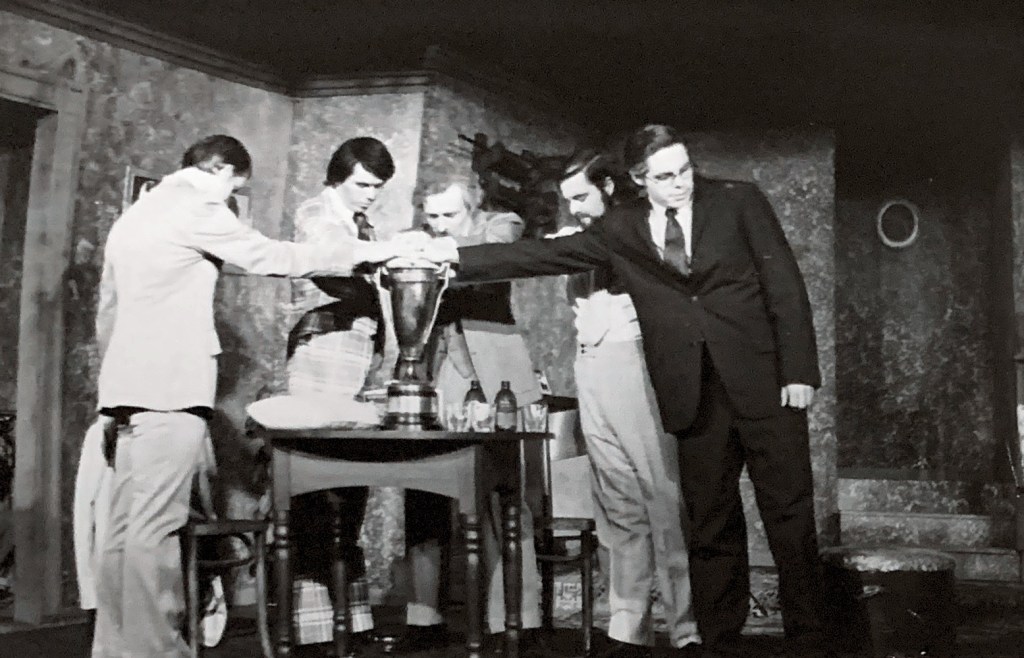
Rich Ferguson, Tom Cervone
The show dealt with so many tough subjects—infidelity, dirty politics, double-dealing, bullying, wealth derived from strip mining, bigotry, misogyny, alcoholism, racism, antisemitism, and hate. I assure you it was a great production, but we had “trained” our audiences to expect a fun evening full of laughs at our playhouse. That Championship Season was not what they had come to expect—at least that’s my take on what happened. A few people walked out each night. The more polite ones just left during one of the intermissions. There were some good laughs in the show, but some of those came at another’s expense and were somewhat cruel. I think the show made some people uncomfortable, and others didn’t consider it entertaining to watch people’s lives and relationships unravel. We got several disparaging phone calls about the show and at least two letters. My mom and dad really didn’t like the script, but they were too kind to leave early. I got their opinion a few days later but in a nice way. Many of those who bailed on the show were hard to win back.
The Playhouse opened in 1972, and I left after directing the opening show, Oklahoma, in 1995. During those 24 seasons, we never produced another drama. The comedy-drama Same Time Next Year and several mysteries were as serious as we ever got. It was a hard lesson to learn, but learn it we did. The 1976 season would provide lots of laughs and family entertainment across the board!


You replied to this comment.
LikeLike
Hi, Gary, Thanks so much for your kind words. I’ll make sure Cathie gets you message. Not everyone reads the comments on the blog. –Shari
LikeLike
Hi Shari,
div dir=”ltr”>I just wanted to say how much I
LikeLike
Shari,
This was amazing ….the number of screws in a setting, what to do with black burlap, problems that occurred, and all the amazing actors and crew members. I was not at home in Wellsburg during a lot of the shows and I would have loved to have seen many of the plays. You must have kept copious notes about everyone and things that happened although with email you can get current info easily. Love your writing. These memories are terrific. Thank you for doing these stories.
Cheers, Marti Hubbard
LikeLike
I don’t know if I ever replied to this lovely note or not. I’m terrible at using the many aspects of the website I use for the blog. I just discovered this comment place! Thanks so much for your lovely comments! Sorry to be so long in replying!
Love,
Shari
LikeLike