
by Shari Murphy Coote and Friends
Season Six, 1977 (Continued)
[NOTE: For a list of the shows and staff and many more memories from 1977, see Part 15-A. The summer of 1977 was chock full of good things at the Playhouse—our first sell-out, many new people auditioning and getting cast, the production of original shows, and another great designer and tech director who was as great onstage as offstage. Thanks to the many people from that year who have volunteered their memories, you can read more great stories from 1977 here, in The Brooke Hills Playhouse: A Collective Memoir, Part 15-B.]
THE SEASON CONTINUES
The 1977 season was a long one because once again, we produced NINE shows. The productions were spread over 10 weeks, but as usual, the staff was hired for 13 weeks. The first week was always hectic. We had to clean out the barn, truck in the lighting equipment, large saws, and hand tools, and hold auditions. Once we got the third show under our belt, a rhythm had been established. We would be running one show on the stage, two more shows would be in rehearsal, and the sets for those shows were being built and painted. Props and costumes were being assembled. Publicity was being written and distributed, and twice a day, after lunch and again after dinner, we all played croquet in the yard.
We were still occasionally using a black burlap set, but by this season we had a large inventory of flats that could be used over and over again to construct lovely box sets, if required. We also had a fair number of various types of window and door units which could be switched in and out for variety. Add to that the creativity and ingenuity of our designers. Our sets were looking great.
I included photos from six of the shows in Part 15-A. Here are a few pictures from the season’s three remaining shows.
MY FAT FRIEND
My Fat Friend was a little comedy that would certainly be considered politically incorrect by today’s standards. Diane Higgins, who certainly was not fat, played Betty the lead in the show, with its “ugly-duckling-turns-into-a-swan” plot. I’m not sure why we didn’t rent a “fat suit” for Diane (too expensive, pre-Internet and couldn’t locate one?), so she just “layered up,” and I’m sure that was hot, hot, hot! The plot revolves around Betty thinking she has to lose “a ton for Tom,” a potential suitor. Friends are eager to help with dieting and exercising, and she does lose pounds for Tom who was oblivious of Betty’s weight in the first place.

Thanks again,
Keith Mills
P.S. Married 42 years, 2 kids, now living in Weirton and continue to take the grandkids to at least one show a year.
VERONICA’S ROOM
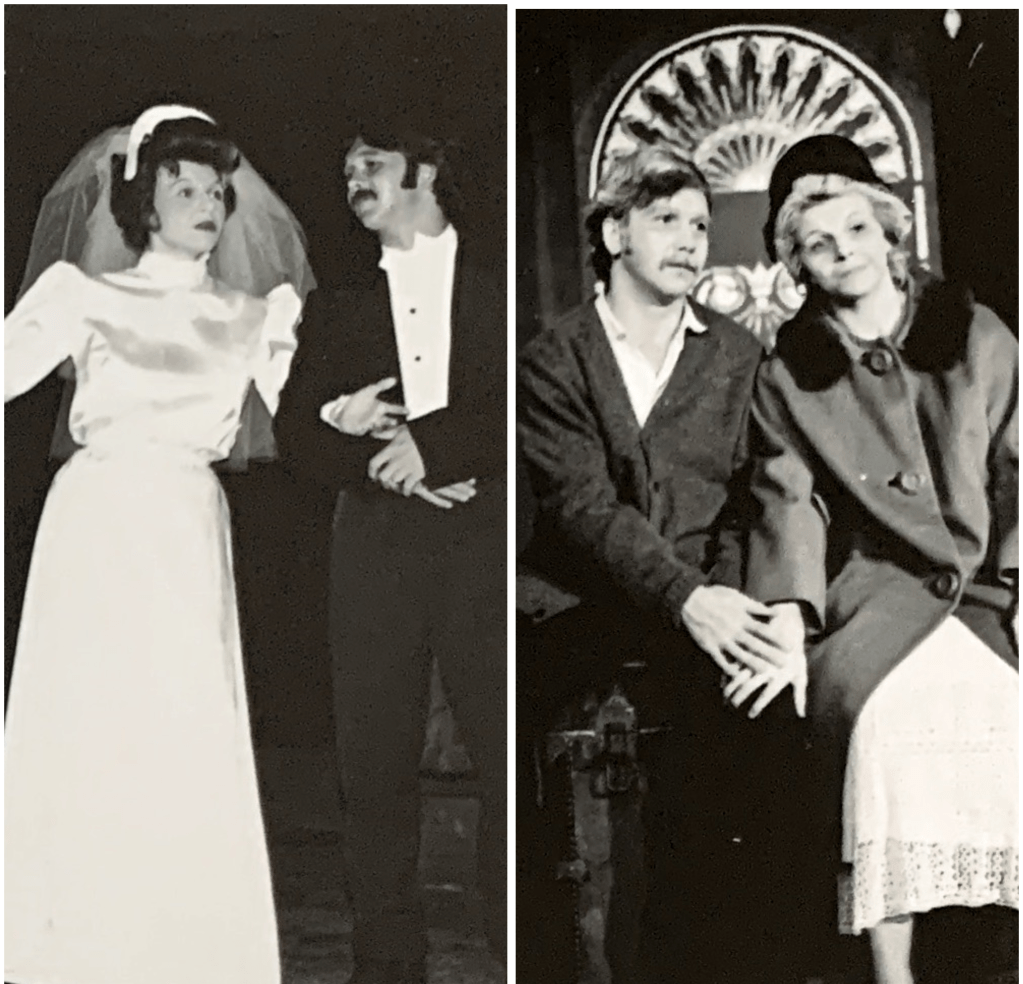
Veronica’s Room was written by Ira Levin (Rosemary’s Baby, The Stepford Wives, Deathtrap, and others), which should tell you something about the weird factor of Veronica’s Room. The plot had numerous twists and turns and included serial killing, necrophilia, kidnapping, numerous disguises and impersonations, time-warping, and I don’t know what else!
Rusty Painter, who played a good-looking kidnapper and necrophiliac and loved playing a bad guy for a change, said, “My best line was cut out. I was supposed to
say, ‘All I need is right here,’ while I pointed to the dead Linda.” Apparently (thankfully!), someone decided that the necrophilia component in this creepy show went too far and wasn’t needed.
The cast was great, and I’m sure many people loved the show. I wasn’t one of them and have often wondered why we ever chose this show to produce. It only ran for one week, and that was too long for me.
I DO! I DO!
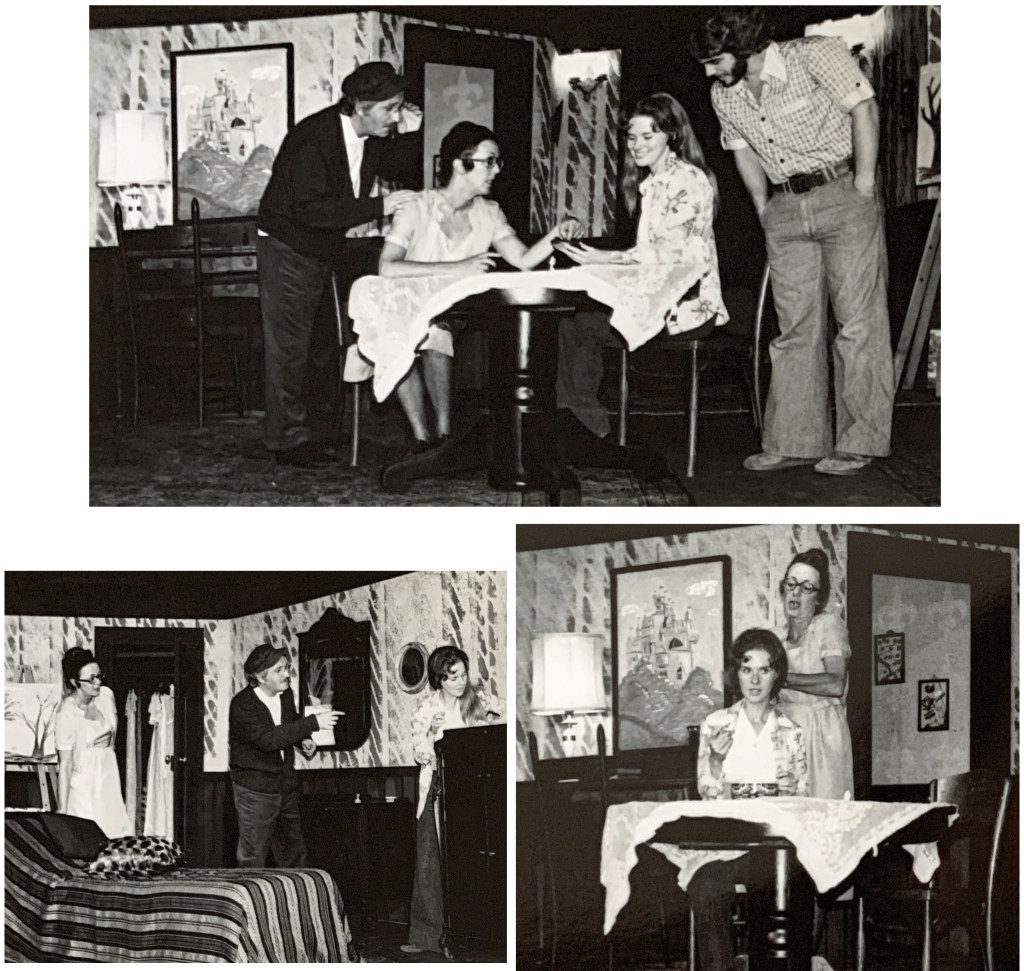
Up next was I Do! I Do!, the musical version of The Fourposter which we had produced in 1972, our inaugural season. The two-character play featured Judy Porter Hennen and Stanley Harrison. Written in 1950, the plot covers 35 years, from 1890 when the couple are newlyweds to 1925 when they are moving from the home where they consummated their marriage, welcomed their children and watched them grow up, and faced the ups and downs of married life. The entire play takes place in the couple’s bedroom, featuring the large, fourposter bed of the play’s title.
I Do! I Do! also had just two characters. It starred Judy Hennen Porter, but with Rick Taylor this time. Judy was thrilled to be doing the show again, albeit now a musical. Rick was a little hesitant. He had had his first lead just several weeks before when he opened this season as Tevye in Fiddler on the Roof. “As I said before,” said Rick, “I knew I could handle the music from any Broadway show, but I had seen Judy on stage at West Liberty, and she was so good. Her acting ability was pretty intimidating, and I wasn’t very confident or comfortable with my acting yet. But how lucky was I? Judy was so supportive and encouraging; she put me at ease. We really meshed.
Ironically, Judy’s memories about the show mirrored Rick’s. “The two of us were on our own. We were it,” said Judy. “I had been in two or three musicals back in high school, but this was different. Rick had a powerful, singing voice, and I was somewhat intimidated.”
Judy said, “I went into rehearsal thinking, ‘I’ve done this show before. How hard can this be?’ But this was with music and a different actor. I’ve learned that every play is unique. Actually, every production of the same play is unique. The people on stage with you affect how the show goes and how you approach the character. So, this was a new ballgame, but Rick was so easy to work with and so complimentary. He boosted my musical confidence. The results were outstanding. We had great audiences, and they loved the show.
“Years later,” said Judy, “several people told me that they’d heard Rick say, ‘That show really changed my life.’ I’m so glad to have been a part of it.”


MOVE OVER, MRS. MARKHAM or
THEATRE IN THE WILD, PART 4
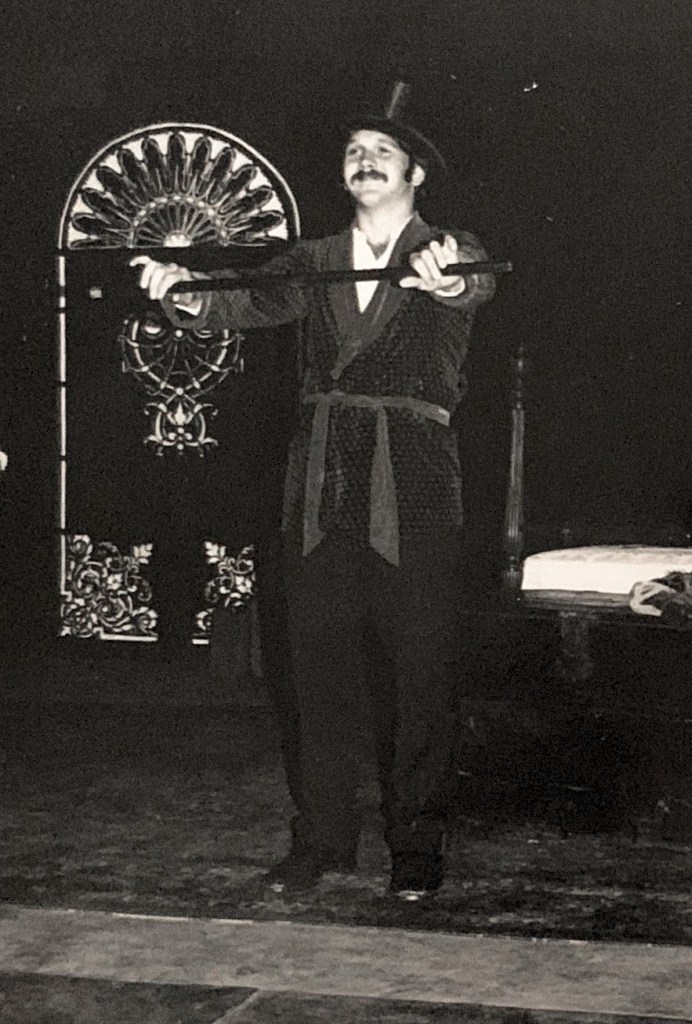
The season’s final show was the hysterical British farce, Move Over, Mrs. Markham. Rich Ferguson played a rake in a proper suit and bowler hat, the picture of British propriety. The play required a split set, a raised bedroom on stage right and on stage left, the living room of a luxury apartment that was undergoing renovations.
Rich’s character has borrowed the flat to use as a trysting place for an affair he is conducting. He enters and starts to tidy up and ready the flat for the arrival of his lover. Unfortunately, as Rich was scurrying around chilling champagne, arranging flowers, and testing the bed, a large black Labrador retriever wandered on stage through the apartment door which Rich had intentionally left ajar. Rich was not an “animal person,” and in the back of the house, I moved to the edge of my seat in horror when the dog from nowhere entered, trapping Rich (who was fluffing pillows in the bedroom) onstage alone with a rather large dog. The audience was enthralled at this “plot twist.”
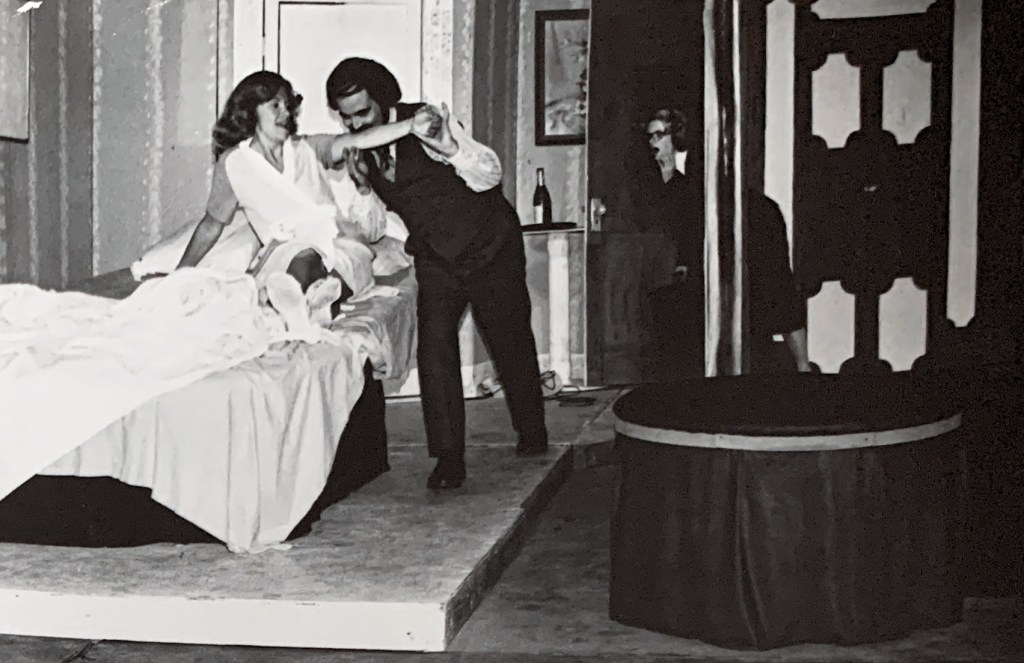
Rich exited the bedroom crossing into the living area and stopped short when he saw the dog! The dog stopped, too. I can’t even imagine what Rich was thinking, but with the most staid and proper stance, he lifted his upstage arm in indignation, flexed his elbow, and pointed decisively toward the door. That damn dog looked quizzically at Rich, standing there stoically pointing, took a last look around, turned, and headed back toward and out the door! Richard most properly straightened his waistcoat and carried on in stoic British fashion with his assignation preparations.
I think the audience was collectively thinking, “What did we just see?” I knew what I had seen, and I was in awe! Richard’s performance was inspiring, and thank goodness that dog was well-trained! I don’t think we ever discovered where the dog came from!
THAT’S A WRAP!
The sixth season ended like any other with a little sadness, a little relief, and a large sense of accomplishment. While the final show was running, during the day, the crew had been taking all the lighting equipment that wasn’t used in the last show to Bill and my apartment’s large basement in downtown Wellsburg. We had also taken the big tools—table saw, radial arm saw, router, and most of the hand tools to our house. On Saturday evening after the show, we had our last cast party of the season, always full of memories and stories.
On Sunday, the crew packed up their personal belongings, and the final show closed that evening. The house emptied, and the cast, crew, and volunteers dismantled the scenery and stowed it in the scene dock on the barn’s first floor near the dressing rooms. Some larger set pieces were stored in an outbuilding in the park. Some people took down the big, black, masking curtains that had hung on stage all season (see pictures from I Do! I Do!). Others put up ladders, took the stage lights down from the barn beams, coiled the lighting cables, put them and the curtains in a truck and hauled all to our apartment as well. The box office person boxed up the office equipment (ha, ha—a stapler, some rubber bands, rubber date stamp, a few pens, leftover box office report forms, and blank tickets and season coupons).
On Monday, we swept out the house and stage for a final time, covered the seats with large sheets of plastic, and secured the barn doors at the back of the house. The pews and cable-spool “tables” that decorated the lobby were moved back into the kitchen. The hand tools were boxed up as was the make-up. Costumes were taken to another outbuilding which the park let us use for costume storage. Leftover foodstuffs were given to anyone who wanted them, and the ancient refrigerators were defrosted, dried out, unplugged, and left with the doors propped open. The stage door was secured, and the large door leading from the lobby to the toolroom/kitchen was locked with a long steel pipe which passed snugly through U-bolts.
Around 4:00 p.m., the Playhouse looked like a barn again. We promised each other to stay in touch, told each other to “break a leg” over the winter, said we’d see each other in the spring (and many would be back), and said our goodbyes. It was August 22, 1977, and for me, school would start in a few days. School—Playhouse. My years only had two seasons—School Season and Playhouse Season. By 1977, I had six of those 2-season years under my belt. At that time, I never dreamed that I would eventually have 24!
**********************************
SOME WHO MADE THE PLAYHOUSE A SUCCESS
**********************************
RICK AND TERESA TAYLOR REMEMBER
In 1977, we opened the season with Fiddler on the Roof. It was a huge hit with sold-out performances. It was our first show with the SRO sign by the box office. Additionally, the Playhouse gained a great multi-talented family who became onstage favorites and dedicated offstage volunteers for 33 seasons–Rick and Teresa Taylor at first, later their kids Katey and Nick.
Rick, a native of Washington, Pennsylvania, was a vocal music major and recent graduate from West Liberty, who had been hired as the choral music teacher at Brooke High School in the fall of 1976. Norma Stone and I got to know him when we all worked on the Brooke High musical that spring, and Norma and I convinced Rick to try out at the Playhouse, as he had been in a couple of shows at West Liberty.

With his vocal prowess, Rick was immediately cast as Tevye in Fiddler, even though he had never played a lead before. “I was scared to death,” he said. “One evening, we were all playing volleyball after dinner before we had to get ready for the evening’s performance. I got stung on the foot by a bee! I hobbled around the stage that night. Fortunately, as Tevye, I was wearing these too-big boots that he (I) didn’t tie, so I could get my foot in them.”
To end the 1977 season, Judy Porter Hennen and Rick starred in the 2-character musical, I Do! I Do!
“I had watched Judy in shows when we were at West Liberty State College,” said Rick. “She was such a good actress, and she could sell a song. I majored in vocal music and was confident that I could sing and deliver an emotion every time. I was still learning the acting part, but Judy and I seemed to mesh, and she helped me grow onstage. I was glad that I had started with Fiddler. Tevye was the perfect character for me to begin playing leads. I loved this little, Russian milkman who struggled with his neighbors to survive in the face of antisemitism. Tevye taught me so much about acting, and I just kept learning.”
The following season, 1978, Rick played Captain Von Trapp opposite Beverly DeBord as Maria in the opening show, The Sound of Music. Ironically, Bev had played one of Rick’s daughters the season before in Fiddler. Oh, the crazy quirks of theatre! Rick also started serving as the Playhouse music director, a job he went on to perform for decades, and he also started recruiting our fabulous piano accompanists for the musicals.
Rick was comfortable onstage, and our audiences loved him. Over the years, he played the lead in Fiddler (twice), Oklahoma (twice), Annie, Music Man, and so many more. Initially, all Rick wanted to do was sing, but he developed into quite an actor, and we eventually coerced him to branch out to comedies.
Rick vividly remembers his first non-singing role. He played the nerdy messenger from God, Sidney Lipton, in Neil Simon’s God’s Favorite. “It was so much fun,” Rick said, “but the heat was ungodly that week, and my costume consisted of a sweater with a big Superman Diamond with an ‘S’ on the front for ‘Sidney,’ a hat, coat, gloves, you name it. Rich Ferguson played the lead, and the two of us could have filled a bucket with sweat each evening. It was rolling off of us!
“We were always allowed to invite members of our immediate family to the dress rehearsal, and sometimes there was a critic or two in the audience as well. On this evening, I entered through the chimney/fireplace without my glasses! (I’d taken them off backstage because of the sweat!) The glasses were integral to the scene, and Richard Ferguson was not the least bit happy with me! I started ad-libbing like crazy, and Rich gave me the ‘what-are-you-doing’ look. We went backward then forward and finally got around the problem and back on track. After the blackout, Rich was still mad at me and said, ‘If I could kick your ass, I would!’ Rick went on to appear in numerous other comedies. It was blazing hot onstage, but it was pretty chilly in the dressing room,” said Rick.

Rick was a super-valuable off-stage asset as well, working nearly every strike night of any show he was in and many others that he wasn’t in. In 1984, we re-sided our big, old barn. Handy with a hammer, Rick was at the Playhouse day after day that summer, helping our small crew tear off siding, moving scaffolding, and putting up the new 16’ and 12’ boards. It was a mammoth job, and his help was appreciated beyond measure. He was also in shows that summer, and I’ll bet he had no trouble sleeping each night from May through August!
I asked Rick about his favorite roles. “Tevye, his humbleness and relationship with God are without a doubt number one, but I also liked the swagger of Harold Hill in The Music Man even though ‘Trouble’ was the hardest thing I ever had to learn! Finally, I loved playing Arthur in Camelot. It was one of my favorite stories as a kid, and I always played knights and conquests in the backyard when I was grounded. Honestly, though, I could hardly get through the reprise of ‘Camelot’ at the end of the show. I had tears in my eyes night after night, and the emotion in my voice was sincere. If I played Arthur now (now that I’m actually old enough), I’d have to apologize to the audience every night for busting out in tears!”
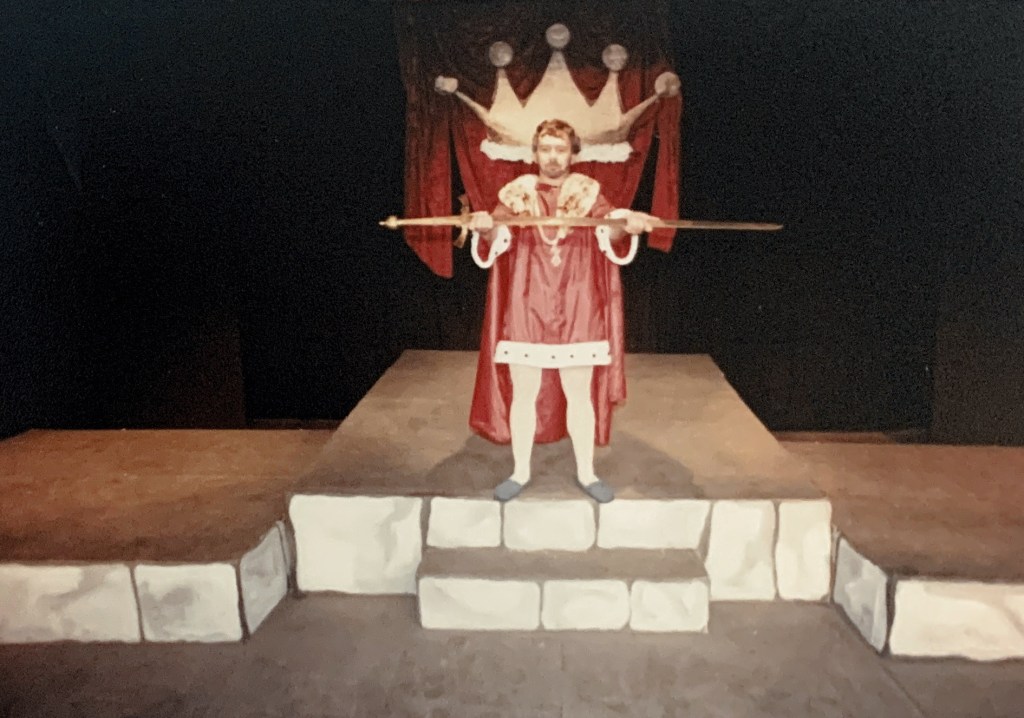
Directing Rick as Miles Gloriosus, and really the whole cast, in A Funny Thing Happened on the Way to the Forum in 1980, is one of my fondest memories. It is such a great show, and I think this was the most pliable cast in the most free-wheeling show I ever directed. The show was a hoot, and nothing was off the table. The cast inspired me, and I was able to come up with one piece of crazy business after another for the leads and the chorus members to get extra laughs. (I need to add that the Sgt. Fenshaw casts were also up for anything!)
Rick wasn’t the lead in this show. Instead, he played a pompous, Roman general, a braggart to the max, extremely impressed with his looks and his accomplishments. I had poor Rick doing things like pushing people down and “kicking” them here and there while he strutted around the stage singing about his conquests.
My favorite bit was when by gestures, he ordered the chorus to make a kneeling pyramid. He climbed up the pyramid, grabbed the light bar upstage of the proscenium, and sang while swinging like a gorilla! Rick was very athletic and always up for anything, but he had second thoughts about the swinging thing until he brought down the house on opening night and every night thereafter. It was show-stopping.
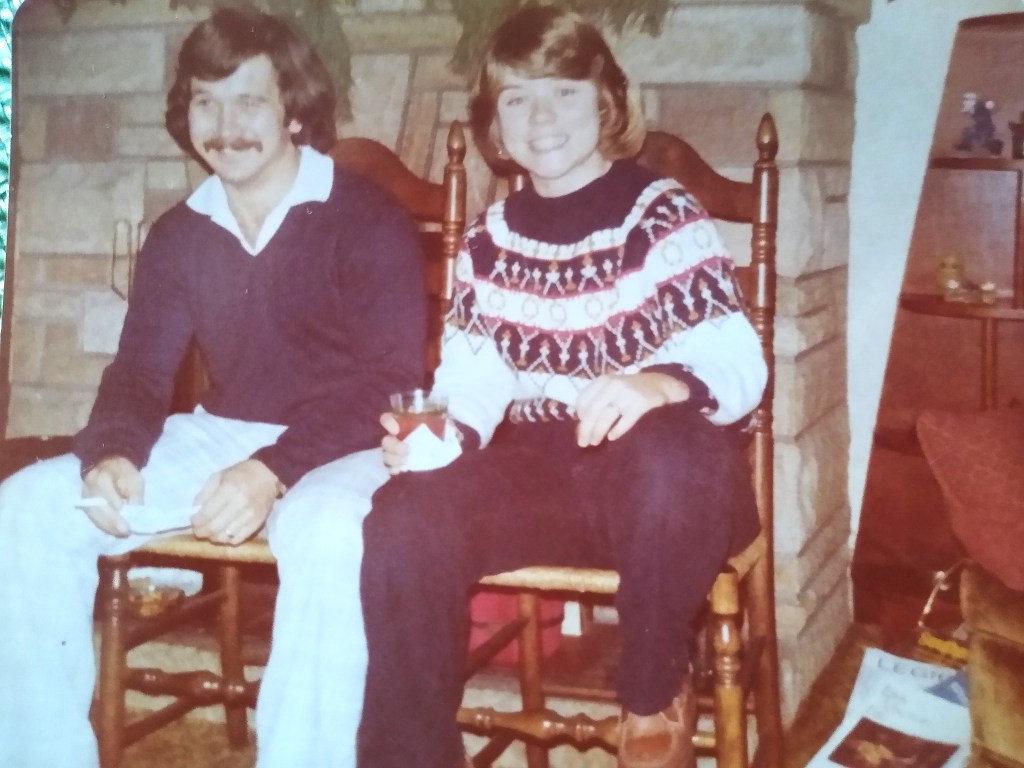
Rick’s wife Teresa Taylor eventually got involved in the Playhouse as well. Teresa served as the Playhouse cook for 2 delicious years. I remember one evening the crew and I were having dinner on the picnic tables. The entree was yummy sloppy joes. Teresa came out, and we started praising the meal (everything she cooked was great). Eventually, she ‘fessed up. “I’m glad you liked it. I wasn’t going to tell you it was venison from the deer Rick shot last winter.” That was followed by dead silence, but someone eventually said, “Well, it’s really good.” And we went back to cleaning our plates.
Teresa had moved often during her youth as her dad, a J. C. Penney’s manager, was often transferred. She graduated from Jefferson High School in Charles Town, W. Va. and graduated from West Liberty with a degree in music, specifically guitar.
She and Rick met while singing in the Campus Life Singers after Teresa’s family moved to Rick’s hometown, Washington, Pennsylvania, and they were married in 1975 while they were both students at West Liberty. When Teresa graduated from West Liberty in 1977, she was hired as a teacher of the gifted in Brooke County.
Later she taught middle school music and choir, and eventually, Teresa became a traveling, elementary, music teacher in Brooke County. Teresa, with her guitar, traveled throughout the county teaching music, strumming, and singing, often sitting on the classroom floor surrounded by her adoring young students who would sing along.
Before long, Teresa, too, started performing at the Playhouse, and I remember especially her wonderful performance in Pumpboys and Dinettes during the 1991 season. She and sisters Heather and Emily Vulgamore, The Dinettes, lit up the stage with their voices and personalities. Come to think of it, Rick was in that show, too. What a fun evening in the theatre that show provided our appreciative audiences.
Teresa said, “Rick and I also performed together in Annie, The Music Man, Oklahoma, and Guys and Dolls. The most fun for me, however, was performing in the choruses of the Sgt. Fenshaw musicals, and the craziest times for me were in Nunsense. There I was in a nun’s habit even though I had a fear of nuns since going to Catholic school for 6 years! Everyone in the cast had a blast, both on stage and laughing ourselves silly in the dressing rooms.

“And would it be appropriate,” said Teresa, “to mention the amazing cast parties at the barn or on Rick’s and my back porch when we watched the sun come up? How about when we climbed the fence surrounding the park pool and went swimming in our underwear? (Maybe that should stay secret!) Lots of great memories!”
But that’s not all! Teresa and Rick’s children, Katey and Nick, grew up in the Playhouse along with my son Andrew, and the daughters of Paula and Russ Welch, Niccole and Terra. They would pull old props and costumes from the storage areas and put on their own plays while their parents rehearsed or cleaned or built or painted scenery.
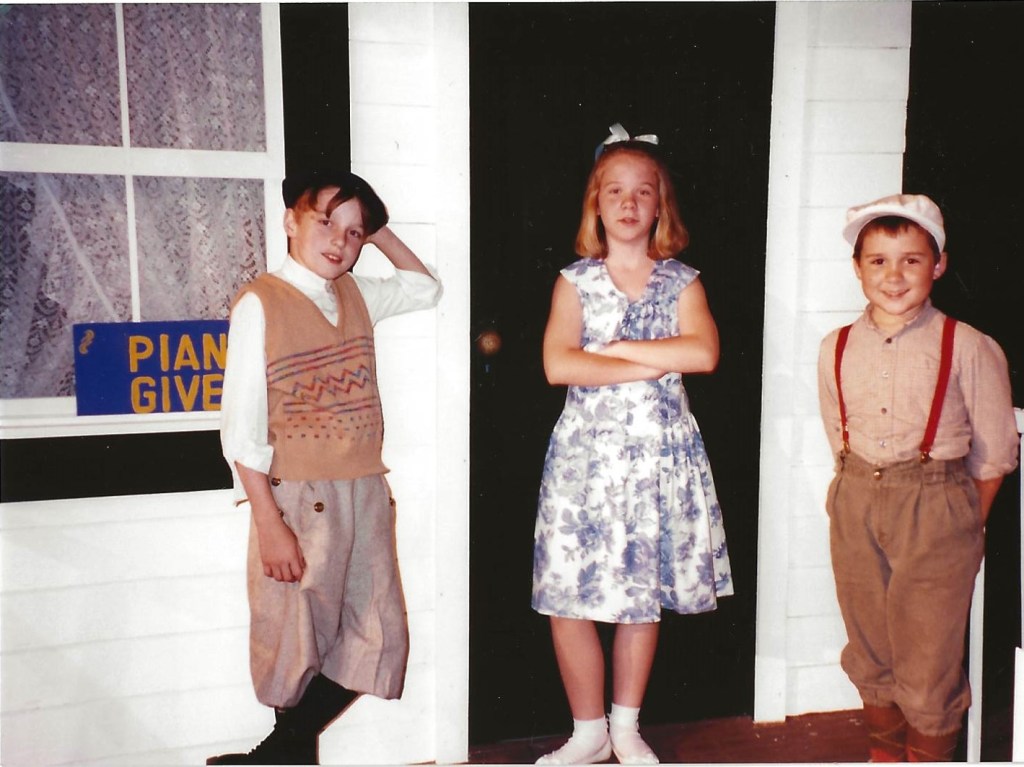
Occasionally, when there was a simple set for the show running that week at the Playhouse, I’d take the kids upstairs, and I’d videotape a show with the kids. They were all so clever and well-behaved and a joy to have around. AND maybe most importantly, they liked watching plays from a very early age. They never made a peep during a performance, and they often knew every line in the show! Eventually, both Nick and Niccole were hired to work as paid, Playhouse staff members.
Rick retired from Brooke High School in 2009. It’s hard for me to imagine Rick not teaching. He was a natural. Norma, Rick, and I did so many shows together at Brooke High, including spring musicals (South Pacific, Fiddler on the Roof, West Side Story, Narnia, and so many others), 16 Madrigal Dinners, and various revues (The Club Soda and Sodas and Sundaes, and Songs), and it saddens me to think that our trio won’t be staging any more shows together. Rick also retired from the Playhouse stage after the 2009 season. His last show was Route 66.
As an interesting note, Rick and Teresa’s son Nick, a Playhouse child, actor, staffer, and West Liberty graduate, took over his dad’s job as the music teacher/chorus director at Brooke High when Rick retired.
Teresa retired from teaching in 2010 and is as busy as ever. She serves on the Brooke County Library Board, is a member of the Wellsburg Shakespeare Club and the Brooke County Retired School Employees, and she loves to quilt. The Taylors still live just a few miles from the Playhouse and are both involved in many activities at the Franklin United Methodist Church, where Rick is the choir director and Teresa is a choir member.
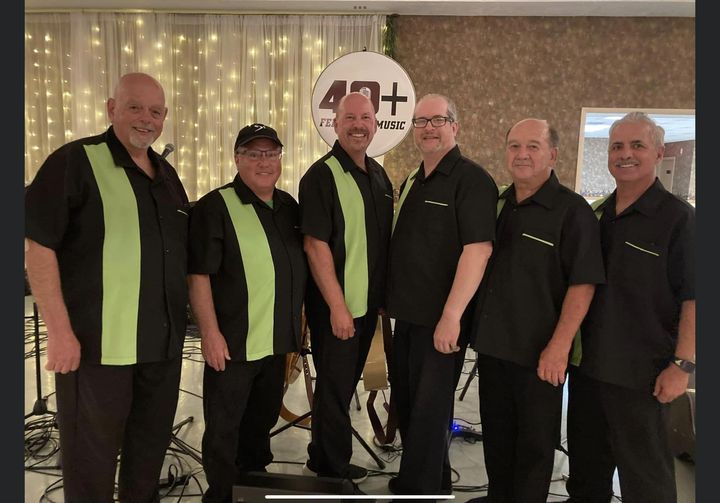
In 2013, Rick, Terry Stuck (former Playhouse staffer and long-time actor), and three other guys formed a band called 40+. They are all wonderful musicians and perform up and down the Ohio Valley. In addition to the band, Rick spends time golfing, hunting, fishing, and being with family.
“I loved so many things about my time at the Playhouse,” said Rick. “I loved looking out into the audience and seeing my kids sitting in the front row, taking in every word. When Katey was pretty little, I remember looking out and seeing Charlie Calabrese, the radio show host who often reviewed and always promoted our shows on air before he began acting then directing at the Playhouse, sitting with little Katey. The barn has regular theatre seating where the padded bottoms automatically fold up when you stand. There was big Charlie holding down the seat for little Katey through the entire show, so she wouldn’t get folded up!
“I loved doing shows with my wife Teresa,” said Rick. “We played opposite each other in Annie, Guys and Dolls, and together in the small ensemble show Pumpboys and Dinettes.
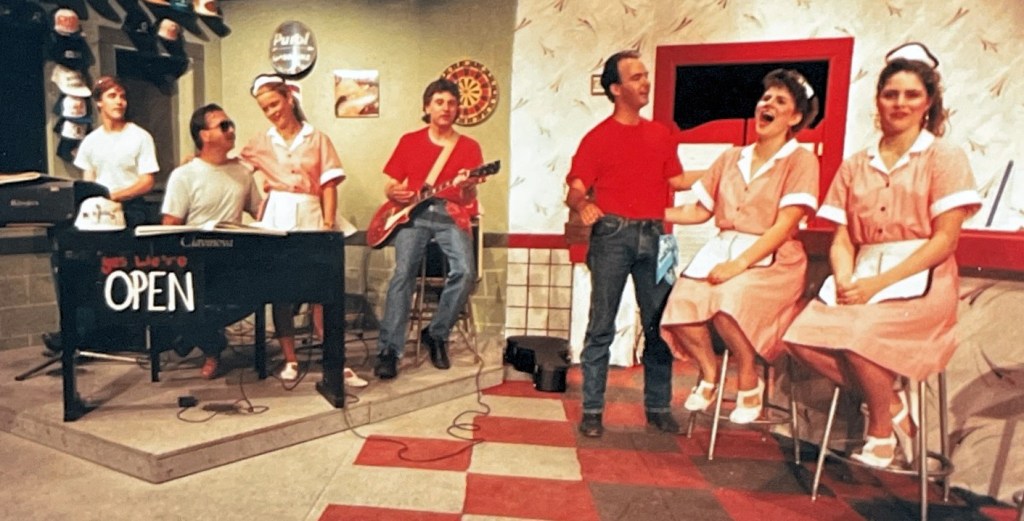
“I wasn’t supposed to play Daddy Warbucks in Annie,” continued Rick, “but the guy who was cast had to drop out, and I had to play the role with Teresa playing my secretary. By the way, Carl Marsh, one of my choir students, took over my part as Rooster. Carl was one of my Madrigal Choir members at Brooke High. That choir always performed in Medieval costumes which meant the guys wore tights and pumpkin pants. I always said, ‘Carl Marsh could walk down any hall in Brooke High in tights, and no one would mess with him.’ He did many shows at the Playhouse, worked on the staff, and went on to become a career Marine. Shari tells me there will be more about Carl in a later Memoir post.
“You all blessed me with so many great roles and opportunities. I never expected to be able to do all the things you allowed me to do, so many wonderful things I’d never even thought about. I had done some singing in shows at West Liberty, but I never caught the acting bug until the Playhouse. Heck, I never even thought about being in shows until Shari and Norma begged me to try out. It changed my life so much, and it was 99% for the better. Remember, Rich Ferguson did want to kick my ass!
“Playing Daddy Warbucks was a lot of fun. I am probably the shortest person to ever play the part! The real drawback with that role was the skullcap, so I’d be bald. Talk about hot! Then each night you, Shari, and Norma would strap a pillow on my front to give me some belly. Also, hot! I’d do just about anything for a role, but I wouldn’t shave my mustache, and Shari, who directed the show, was okay with that. She knew she wasn’t going to win that fight,” said Rick laughing.
“I certainly fell in love with the stage, and I know it made my mother so happy and proud. I loved that. I just soaked it all up. I took any part. I only had 5 lines in Bus Stop. Didn’t matter. It was fun. I was the bus driver!”
In 2023, Rick’s former students went to the Brooke County Board of Education and requested that the auditorium be named the Rick Taylor Auditorium, honoring his 32 years of service, a wonderful tribute to their teacher. The auditorium has been so named, the only school facility in Brooke County named for anyone!
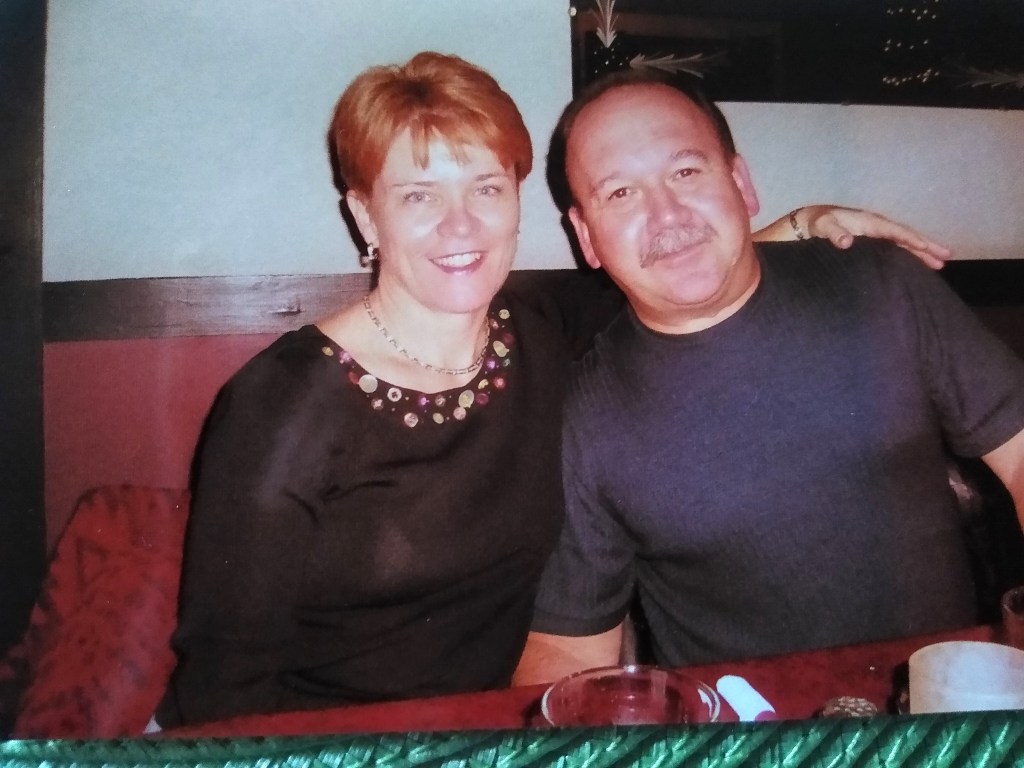
RUSTY PAINTER REMEMBERS
Rusty Painter was one of Norma Stone’s students at Brooke High School. With good looks, great voice, and charming stage presence, Rusty was a natural. Norma was directing the spring musicals at BHS at this time. Rick Taylor, Brooke High’s new choral music teacher would direct the music, and I was doing scenery and lights. In the spring of 1976, we did South Pacific at the high school with Rusty playing Emile DeBecque. Following that show, Norma encouraged Rusty to audition at the Playhouse, and he did.
“Norma really made an impact on me. She was encouraging and got me involved at the Playhouse, which was a great experience—new friends, acceptance on a whole new level, new experiences.
“I was cast in two shows in the summer of 1976,” said Rusty, No Sex Please, We’re British and Dames at Sea. I played the British Rail Service delivery man and had one line in No Sex Please, but I was so happy to be a part of something that I felt was really important. Dames at Sea was altogether different. There were only six people in the cast, and in addition to dialogue, there was lots of singing and dancing for all of us. We had to take tap dancing lessons! That was crazy and so much fun!”
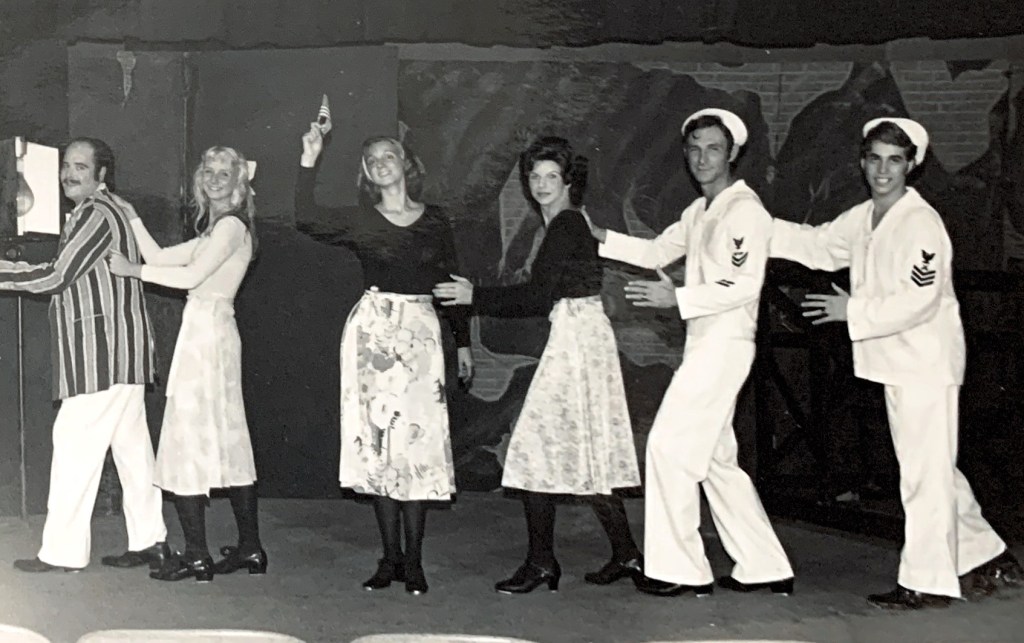
“The following season, 1977, I had just graduated from high school, and the Playhouse did eight shows/musicals and the Tom Ott mime show. I was in five of the plays and one of the musicals. I practically lived at the Playhouse, and it was a great summer. The next two summers I did one show each, but they were both outstanding, original shows, by Scott Martin, who was on the Playhouse staff. In 1978 and 1979, I played the earnest, bumbling lead Sgt. Fenshaw in both Sgt.Fenshaw of the Mounties and The Return of Sgt. Fenshaw.”

If you’ve ever been in the barn in the summer for a show, you know how hot you can get sitting in the audience. For a long time, the two funeral homes in Wellsburg gave the Playhouse bunches of those cardboard fans on a fat, wooden popsicle stick so the audience members could fan themselves during the show. In the Fenshaw shows, Rusty had to wear the bright red, wool, Canadian Mountie uniform under the stage lights! Hot, hot, hot! And one of the two shows had a snowstorm! The flakes were some kind of plastic, so they didn’t melt, but they did stick to his sweaty face and hands! The cast was always brushing the flakes off of him, his costume, and themselves!
“Thinking back over my time at Brooke Hills, I think of all the things that I learned. Bill Harper taught me how to make wallpaper with a feather duster! Loved that!
During Fiddler on the Roof, I played the Russian boyfriend of one of Tevye’s daughters. During one of the musical numbers, I got hurt. I finished the show, and then Rich Ferguson took me to the Emergency Room in Wheeling. He stayed with me the whole time, and it was pretty late when I was treated and released. On the way home, he stopped somewhere along the way and got me something to eat. Later that season, he taught me how to be flamboyant! I had to dress in a girly robe (with black socks and garters!) in Natalie Needs a Nightie and pretend to be gay. Rich was gay, and he helped me to be a little over the top, but not too much, enough to be very funny, not enough to be gruesome.

“I also met so many great people. Al Martin was an inspiration and such a gentleman. One year for his birthday I gave him an old newspaper printed in the year of his birth. I’d found it in an abandoned house up on 49 Hill where I lived with my mom, dad, and four sisters. He read every word in that paper. I loved the wonderful way he made me feel for that small gift.
“Anne and Skip Roberts were super to me. I remember watching Skip as he welded together the massive steel sculpture that stood in the Playhouse yard and greeted audiences for some years. I also spent a lot of time in the Roberts’ home in Bethany. I was just a kid, but they included me and fed me and listened to me. In 1998, they stopped by my home in Virginia Beach for a visit. I was really honored that they would do that. I told Skip that I would like to buy one of his sculptures for my house or yard. He said to stop by their home when I was back in the Valley visiting family. I did, and Skip gestured to his sculptures and said, “Take your pick.” It’s still one of my most prized possessions.
“More than maybe anything, I remember the smell of the barn. Not a bad smell, an old wood smell. Very comforting. A whiff of old wood still takes me back to the Playhouse. Later, I did one show, Kiss Me, Kate, at the Towngate Theatre in Wheeling, and that’s the last show I was in.
For a couple of years after high school, Rusty worked for Frito-Lay delivering the goods to stores and vending machines. “I can’t believe they let me take that big van/truck home, but they did!” said Rusty. “I’d roll up to the Playhouse in that truck for rehearsal or a performance, and the cast would come get a salty treat! On a lot of days, Chris Cipriani would be hitching to the Playhouse, and I’d pick him up at the foot of 10th Street Hill in Wellsburg. We were in a bunch of shows together.”
Eventually, Rusty went to the Wheeling Barber College, and he finished the course in 6 months. “I didn’t have the Frito-Lay truck anymore, so most of the time, I hitchhiked to school in Wheeling.” The college hired him to manage several of their salons called Your Father’s Mustache. “I was 20 years old,” said Rusty. “What did I know? I guess I did okay, because they sent me to new locations often—Pittsburgh, Cleveland, back to Pittsburgh, Lynchburg, and Virginia Beach.
Eventually, a guy backed me in Virginia Beach, and I had my own salon, Haircut 100, for 23 years. I have autographed photos of some of the celebrities whose hair I cut. I cut Robert Plant’s hair in 1995. Big deal for me.

“I’ve been in Virginia Beach for 41 years now, and I love living at the beach. I have a daughter, Haley, and a son, Russell Labana Painter IV, and Max, my 11-year-old grandson. I’m semi-retired, but I rent a chair and still have loyal customers. I also like to work on cars. I’m waiting for a water pump right now for my 1956 Crysler New Yorker.”
I asked Rusty if he would ever like to do a show again. He said, “It’s funny. I pass the Virginia Beach Little Theater every day. I’ve got a lot of tattoos now and really long hair, but no tats on my face or hands! Haha! I ought to stop in someday.”
“You ought to start by going to see a show,” I said. He agreed.
“I always took the kids to church,” said Rusty, “because that’s how I was raised. I can’t tell you how many times I was asked to play Jesus around Easter! Long hair, you know? The church people would say, ‘We’ve even got the costume.’
“I’d tell them, ‘I’ve got the costume, but I’ve got to get the bloodstain out of the side.’ Some of them got it. Some didn’t.”
“Now, here’s what the Playhouse gave me,” said Rusty, “confidence in myself. When you get a haircut from me, you get the haircut and a show! One lady even told me, ‘The first time you did my hair, I didn’t like it, but I really liked you, so I came back!’ Cut and a show! I’m on every day.”
CHRIS CIPRIANI REMEMBERS
“I had been in Miss Stone’s (Norma’s) freshman English class at Brooke High,” said Chris, and I was a ‘jag off.’ When I was registering for my sophomore classes, I wanted to take drama, and Norma was the drama teacher. I told her I wanted to take her class, and she flat out told me, ‘Chris, this isn’t a fluff class. You can’t mess around. We work hard, and we’re serious about what we do.’ I was shocked, but I told her I’d work hard, and I did. Maybe she was shocked.
“The musical at Brooke High that year, the spring of 1977, was South Pacific, and Rusty Painter was playing the male lead, Emile DeBecque. I was running track, so I didn’t tryout, but Norma came to me and said, ‘I need someone to run the sound board. You wouldn’t have to attend all the rehearsals, just a few before we open.’ So that’s what I did.
“After the musical, Norma said that auditions were coming up at Brooke Hills Playhouse. I’d never given that a thought, but Rusty was trying out, and he said he’d give me a ride.
“I credit Norma Stone for giving me a chance and for moving my life in the right direction. I did audition at Brooke Hills. I was a rising high school junior, and I got parts in three shows that summer. I played Nahum, the beggar, in the opening show, Fiddler on the Roof. I still remember my first lines:

“Alms for the poor. Alms for the poor,” I said.
Rich Ferguson, who was playing Lazar Wolf, the butcher, said, “Here, Reb Nahum, is one kopek.”
“One kopek?” I answered and got a little laugh. “Last week you gave me two kopeks.”
“I had a bad week,” said Rich.
“So, if you had a bad week, why should I suffer?” I said, and I got an even bigger laugh. It was great!
Chris was too young to be on the official, paid staff at the Playhouse, but he spent a lot of time at the barn and worked on scenery or did anything else that was needed. He remembered an incident where I was taking some staged publicity shots for Fiddler after dress rehearsal. At some point, Rusty Painter put his foot up on Tevye’s milk can, and I snapped a picture, which made it into the paper. According to Chris, when the paper came out, I said, “Good grief! People will come to the show and wonder where the scene with the Russian suitor of one of the daughters and the milk can is!”

Chris’s mom saved the program inserts and newspaper clippings from Chris’s shows at the Playhouse (which has been a treasure trove for this writer!) One item from the Wheeling Intelligencer was written about U.T.B.U. in 1982. (U.T.B.U.=Unhealthy to Be Unpleasant) The accompanying photo shows Chris, who played the mad bomber, in very short shorts and Dulcie McVicker, who played the U.T.B.U. secretary, rehearsing outside in the Playhouse yard. Chris said, “I had completely forgotten how short men’s shorts were! And my kids can’t stop laughing!
“I was also in Rated X-tra Special,”said Chris, “a show that was created and directed by Norma and featured a cast with a few pre-teens and lots of teenagers. Some of you may remember Red Donley. He was from Wellsburg, and he had a noontime show on WSTV, the Steubenville TV station. The cast of Rated X all trouped over to Channel 9, and we did one of the musical numbers, “There Is Nothing Like a Kid,” on live TV.
“In the show, we all introduced ourselves in the opening number “What a Wonderful Thing to Be Me” by saying what we wanted to be when we grew up.
“Rusty said, ‘I want to be a fruit farmer, so I can get a lot of dates!” He got a big laugh.
“My answer was, ‘I don’t know!’ The other kids said things like, ‘No, really, what do you want to be?’ and ‘What do you mean?’
“And I shrugged and said, ‘No, really, I don’t know.’ (“Actually,” said Chris recently, I still don’t know!”)
“I had two “firsts” in Rated X-tra Special, I sang my first solo and my first duet on stage. Later,” continued Chris, “I was in Finishing Touches, my first real play directed by someone who didn’t know me at all—Al Martin. That cast was talented. I was also listed in the program of Natalie Needs a Nightie as the Master Electrician, which means that I ran the lights.
“Earlier in the memoir, Shari, you talked about Old Sparky, the ‘light control board.’”
[NOTE from Shari: Sparky was 12, old, manually operated, rheostat dimmers mounted on 2” X 4” boards on the floor downstairs in the hallway outside the toolroom/kitchen. The dimmers were controlled by 1” X 3” boards with holes drilled into them. The boards’ holes slipped over the rheostat handles. Holding the boards, the Master Electrician (a very lofty title for the person running the lights), rotated them clockwise for ‘Lights Up’ and counterclockwise for ‘Lights Down.’ Whoever ran the lights wore a headset, and the stage manager upstairs fed the person downstairs the cues: “House lights down,” “Lights up,” “Cue 3,” Cue 67,” “Lights down,” etc.]
“Natalie was a comedy,” said Chris, “and the light cues were nothing fancy, just up and down. At the end of Act Two one evening, I heard Sharon Rush, the stage manager, give me a warning and then say, ‘Lights.’
“I tried to rotate the board counterclockwise, but it wouldn’t budge. I heard Sharon say, ‘Lights down,’ with some urgency in her voice. I tried again and again. Nothing! Sharon continued to say, ‘Lights down.’ I knew the actors were holding their places on stage waiting for the blackout, and I finally pulled the board off the handles and turned the dimmers down as quickly as possible one at a time.
“Shari, you and Sharon, came flying downstairs, and you said something like, ‘What the hell happened?’ I told you, and you said, ‘Okay. Are you okay?’ I was. Then you said something like, ‘Quick thinking, but for a minute, with lights going down one after another, I thought I was at a rock concert!’
“Shari recently explained to me that the control boards had to stay perfectly level for the handles to all move in unison. Oh, now, she tells me. Anyway, it only happened that once, and nobody seemed upset about it.
“Rusty was in all four of those shows, too, that summer, and he gave me a ride out to the barn most days for rehearsals and performances. If his schedule had a conflict, and he couldn’t pick me up, I’d hitchhike, or I’d hitchhike if I wanted to go out earlier. Getting a ride up the hill and out to Brooke Hills Park usually wasn’t a problem, but getting down the park road to the Playhouse was a long walk if I couldn’t get another ride!
“The next summer, 1978, I was in the chorus of Sgt. Fenshaw of the Mounties. Rusty played the Mountie, and again, he was my ride. I was in the chorus, and we had a lot of fun. Audiences loved that show.
“I graduated from Brooke High in 1979, but I didn’t do any shows at the Playhouse that summer. I had won the Drama Club Scholarship at Brooke High, and that fall I entered West Virginia University as a freshman drama major. I don’t know. I never really fit in at WVU, and I regretted being there. In the drama department as a freshman, you had to pay your dues, and I guess I was too impatient. I wasn’t happy, and in general, I’m a pretty happy guy.

“I did two shows at the Playhouse that summer (1980). I played Ben Benjamin, the son of Job in God’s Favorite and then the policeman in Wait Until Dark. One of my best memories of that summer was when Shari and the Playhouse gang took me with them to Betts’s bar. I had always wondered what the big, old building in downtown Wellsburg was, and finally, I knew! I think I was underage! [NOTE: More about Betts’s in a later post.]
“In the fall, I went back to WVU and was miserable, so I took the second semester off. One of my high school friends, George Whitehead, had been going to Kent State, but he also had taken the semester off because he wasn’t sure what he wanted to do.
“Georgie was working at Pizza Hut, and I was working at Shop and Save. One day George said, ‘I’m going to drive down to Fairmont and check out Fairmont State. You’re not doing anything. Why don’t you go with me?’ We were two 20-year-olds without a clue, but we drove to Fairmont, and we both transferred. It was a good decision.
“The summer after my junior year, I was back at the Playhouse and did three great shows—Blithe Spirit, Opal Is a Diamond, and U.T.B.U. (Unhealthy to Be Unpleasant), where I played William Uggims, a blind, benevolent bomber!

“At one point in U.T.B.U., I was sitting in a chair facing front with my cane across my lap. There was a table beside the chair, and on the table was a vase with flowers. I would turn, and the cane would swipe toward the vase. Ken Kasprzak, whom I was to be menacing, would grab the vase in the nick of time before I knocked it over and replace it when I brought the cane back to center. This happened a couple of times.
Then one night, Ken snatched the vase, and the flowers went flying! Somehow, Ken was able to catch the bouquet and plop it back in the vase just as he was putting the vase back on the table. It really was unbelievable, and the audience clapped and laughed and clapped some more. We just held for the applause, and honestly, it was a good thing I was wearing dark glasses, because I know my eyes were wide open in disbelief. Actually, I wanted to clap, too!
“Rich Ferguson directed Blithe Spirit, a sophisticated English comedy, by Noel Coward. I begged Rich, ‘Please, don’t make us do English accents.’ Susan Price and Amy Charlton were the only cast members who were any good at accents. The show was good, but it would have been so much better if we had just talked in our native “American.” Matz Malone from the Steubenville Herald Star reviewed the show, and we got slammed for one thing—our accents! I didn’t say anything to Rich, but I wanted to.”
Chris graduated from Fairmont in 1983 with a degree in Business Administration and a double minor in Speech and Theatre. Chris went to work for a national check printing company, then a pharmaceutical company, and then back to printing as a manufacturers’ rep. In 1988, he started his own business in Wellsburg, Any Forms and Checks, and in 2010, he knew his business had outgrown the long name, so he re-dubbed it Cipco Solutions.
In the meantime, Chris met and married his wife Cindy, moved to Wheeling, and became the father of Dominic and Gianna. Sadly, he hasn’t done any theatre since he graduated from college! Maybe he’ll take this as a hint!


ANNE AND SKIP ROBERTS REMEMBER
Anne Chandler Shaw Roberts is a native of Bethany, W. Va. Her dad was a history professor at Bethany College, and Anne graduated from Bethany High School in 1964, one of 28 graduates in her class. Anne went off the West Virginia University in Morgantown where she met Robert “Skip” Roberts, a graduate of Morgantown High School and also a WVU student.
Anne was an English major and ultimately graduated as a Language Arts Major (English, Speech, Drama, and Journalism). Skip was a biology major, and because his dad was a machinist and a farmer, and Skip liked working with and learning from his dad, he graduated with his degree in biology and a teaching certificate in Manual Arts.
Eventually, the couple married, and both received graduate degrees from Marshall University in 1977—Anne with an M.A. in drama and Skip with an M.A. in art. They returned to Brooke County where they rented the historic Markley Lewis House on Bethany Pike, as Mr. Lewis had died earlier in the year.
Actually, 1977 was jam-packed for the couple. In 1977, their son Myles was born, Anne auditioned at the Playhouse, and they both began their teaching careers—Skip at Wellsburg Middle School and Anne at Weirton Madonna High School.
Anne was cast immediately as Yenta, the matchmaker, in the opening show, Fiddler on the Roof, and from that summer until the close of the 1983 season, Anne acted in or directed a show or two each summer.

Skip also became very involved at the Playhouse. His background in carpentry, electrical work, metal work, plumbing and more meant that he was often called upon to resolve a problem in the old barn, and he often worked on Sunday evening strike nights.
Over the years, the Roberts family would contribute to the Playhouse in so many ways—working on stage, backstage, and off stage on everything from costumes to press releases.
Meanwhile, Skip had established himself as a metal sculptor, and he displayed one of his massive steel pieces in the Playhouse yard for a few years. I don’t know who named it, Skip or one of our crew, but it came to be known as “Ode to Bernoulli.”

Over the years, the Roberts family would contribute to the Playhouse in so many ways—working on stage, backstage, and off stage on everything from costumes to press releases.
Meanwhile, Skip had established himself as a metal sculptor, and he displayed one of his massive steel pieces in the Playhouse yard for a few years. I don’t know who named it, Skip or one of our crew, but it came to be known as “Ode to Bernoulli.”
I don’t remember how long, but for one summer or more, Anne handled Playhouse publicity. A gifted writer, we were lucky to have Anne churning out weekly ad content and press releases.
Anne has several vivid memories from her years at the Playhouse: “I played a nun in the 1978 production of The Sound of Music,” said Anne. “Of course, we needed nuns’ habits. We went down to the convent near Oglebay, maybe Mt. St. Joseph’s. and asked the nuns if they had any habits we could borrow. One sweet nun gave me a habit and said, ‘Be careful with that, Dear, it’s my only other one.’”
“I remember that trip,” said Shari, “and that habit. It was wool! If we had put that on one of our actresses, she might have melted away under the heat of the stage lights and the heat of the barn! We eventually borrowed or rented nuns’ habits from a little theatre somewhere near Pittsburgh.
“Years later, in 1990,” continued Shari, “we did a cute little musical called, Do Patent Leather Shoes Really Reflect Up? And once again we needed nuns’ habits. This time, the Playhouse bought the fabric, Stephanie Baldwin Schutte’s (one of our talented young piano accompanists and actresses) mother, Maxine Baldwin, volunteered to build the habits. We really got our money’s worth from that deal! We used those costumes again in 1991 (The Sound of Music again), 1992 (Nunsense), 1993 (Nunsense II), and I imagine several more shows after I left in 1995.
“I even used one of the habits when my mother asked me to come up with a program for one of her regional church groups,” said Shari. “I put together a one-woman show portraying the Medieval nun Hildegard of Bingen and wore one of Maxine’s habits!”
“During the 1982 season,” said Anne, “Myles played one of the town kids in The Music Man who joined Harold Hill’s band, and I played Mrs. Shin, the mayor’s wife, a fun character, if ever there was one. 7-year-old Myles wore plus fours, those pants that are cut off below the knee. His loose-fitting pants were held up with loose suspenders. One night, during a spirited scene, Myle’s pants fell down, and he had to hold them up for the rest of the scene!”
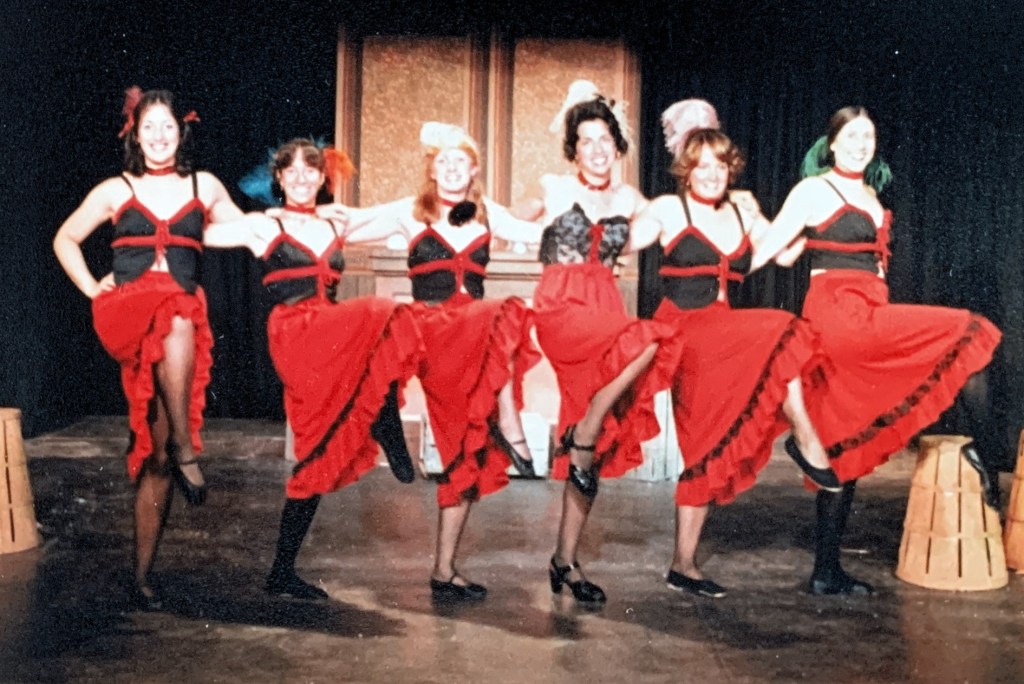
Anne wasn’t immune to stage gaffs either. “I was in the chorus of good-hearted saloon girls (and doubling as Indians) in the 1978 production of Scott Martin’s original show Sgt. Fenshaw of the Mounties. The chorus had so much to do in that show, and it was so much fun! In one scene, the saloon girls did a chorus line, high kicks and all. I was really into it, and one evening I kicked so high that I fell flat on my ass! The rest of the girls carried on while I got up, dusted off my rear, rejoined the merriment, and carried on!
In 1980, Anne directed a crazy, little comedy called Going Ape, and she directed a fun, little, musical mystery called Something’s Afoot in 1983. Ironically, a foot caused some angst for Anne, who was always willing to help find props, make a costume, or even shop for a character’s shoes!
In this case, the shoes had to be women’s pumps, and they had to fit Charlie Calabrese, a big guy who probably wore a size 12 or bigger in a man’s shoe. Who knows what he wore in a lady’s shoe?
“It seems like I trudged through a lot of shoe stores,” said Anne, “before I got lucky and found a store with a few large pairs of women’s pumps. I took several pairs for Charlie to try on, and we chose a pair that was plain black with a heel maybe 1” high. The shoes weren’t clunky. The heels came to a little point that Charlie actually mastered with a lot of practice on his part and a lot of laughs on ours. Then it was another trip back to the mall for returning the unneeded shoes. If I never have to shop for women’s shoes to fit a man again, it will be too soon!”
“We have so many wonderful memories of Brooke Hills,” said Skip.
Skip even ventured into acting playing the evil villain Roat in our 1980 production of Wait Until Dark. Anne said, “Skip was so good playing evil in the part that I wouldn’t let little 3-year-old Myles see his daddy in the role! I thought it might scar him for life!”
Chris Cipriani played the policeman in that show. “During the tech rehearsal,” Chris said, “Skip had to take a can of gasoline (water) and slosh it around the apartment prior to setting the apartment of this poor, blind girl aflame. Skip splashed water on the sofa, and Shari, who wasn’t directing, just watching, jumped up and yelled, ‘Wait! No, oh, no. You can’t do that. You can’t pour water on the sofa every night. It won’t dry out. It’ll get moldy. We’ll need that sofa again.’
“Still in character, Skip turned and looked out at Shari, and in that character’s menacing tone, he said, ‘Well, what would you like me to do?’ He was good, and it sent chills down our spines!
“Shari said something like, ‘Slosh it around on the floor, desk, chair legs, upstage of the sofa.’ Skip was good about it, but probably not happy. He knew that sofa would burn like crazy. The director gave Skip some blocking, and the rehearsal resumed.”

Recently, Rusty Painter, the first Sgt. Fenshaw, recalled Anne and Skip fondly. “Over a few summers, the Roberts and I became good friends, and we kept in touch,” said Rusty. “I had moved to Virginia Beach, and they visited me on one of their trips, and we had a great reunion. I told Skip that years ago I had ‘fallen in love,’ haha, with his metal sculptures. He told me to stop by their home in Bethany the next time I came back to see my family. When I visited them, Skip let me choose one of his sculptures. It’s one of my most prized possessions to this day.”
Sadly, Something’s Afoot was the last show that Anne did at the Playhouse. With both Skip and Anne teaching full-time and Myles getting older, their summers filled up quickly, but for seven summers our patrons enjoyed their multiple talents. Today, they live in Washington, D.C.
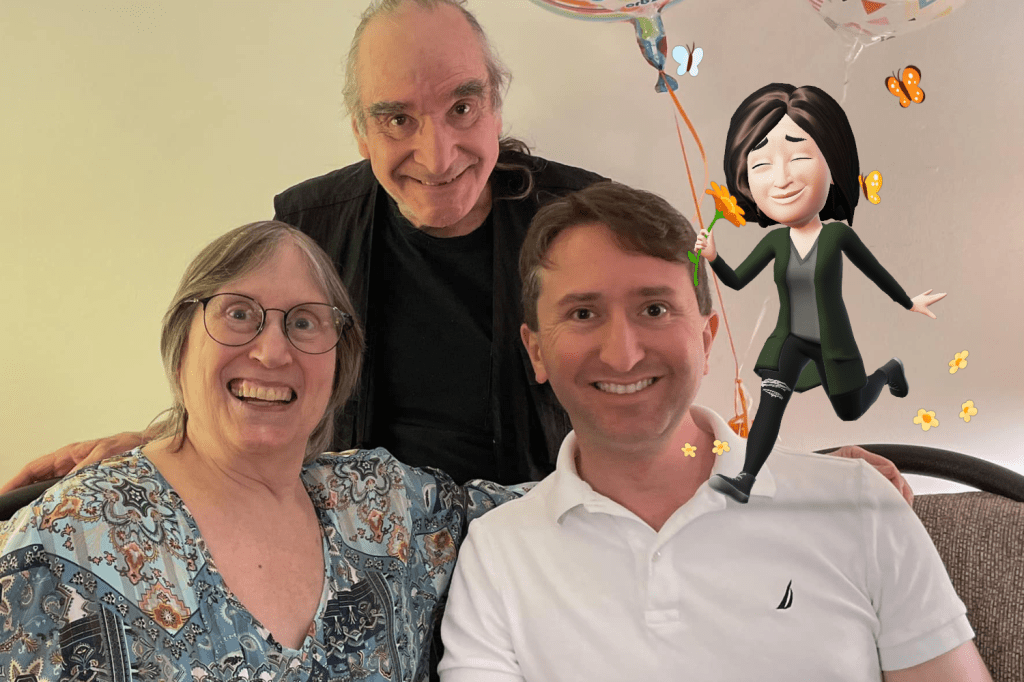
MYLES ROBERTS REMEMBERS
Anne and Skip’s son Myles was born in 1977, shortly before his mother was cast in Fiddler on the Roof. With a B.A. and an M.A. in drama, we were thrilled to learn that Anne, her husband Skip, and their young son had just moved back to the area. Myles officially started coming to the Playhouse on a regular basis when he was two.
Anne remembered that the Playhouse staff was always so kind and willing to watch little Myles (if Skip was unavailable) while Anne was rehearsing.
“One day,” said Anne, “some of us were sitting outside around a picnic table after rehearsal just chatting, and little Myles was playing there in the yard, very near all of us. Before very long, I heard this tiny, little voice calling, ‘Help! Help!’
“I knew it was Myles, but when I looked around, he wasn’t anywhere in sight, and he was still calling for help. I dashed in the direction of that sweet voice, through the lobby to the opposite side, the pool side, of the barn. There he was, hanging by his arms from the second board of the ramp railing, high above the ground. I ran up the ramp and rescued him. How he got there, we have no idea. Why he was there? I suppose he was curious, and if you have children, you know how they can disappear in a minute! I do know that after that, everyone kept a closer eye on my little guy.
“It’s not my favorite Playhouse memory,” finished Anne, “but it is my most vivid, and I’ve told Myles and others the story often.”
Myles said, “We were living in Bethany, when I started going to Brooke Hills, mostly with my mom who was often in shows, but my dad did shows as well. He also displayed his large metal sculptures in the Playhouse yard.”
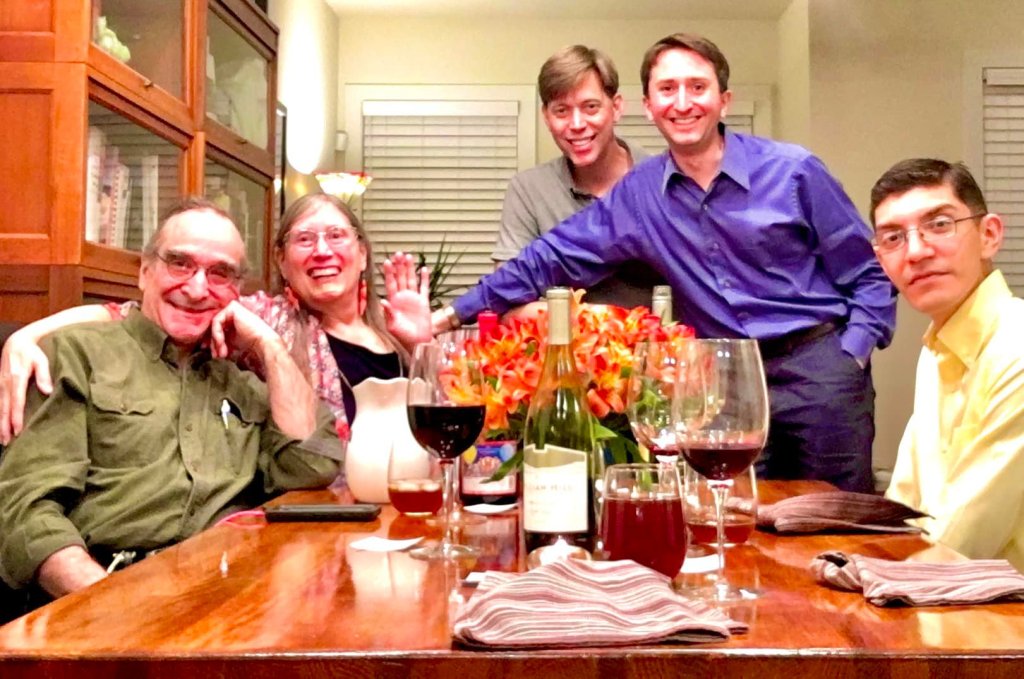
“I have several Playhouse memories,” said Myles. “I remember running around with the Welch girls, Terra and Niccole. That was always fun. I remember watching a watermelon-seed-spitting contest. I don’t think I participated.
“I fondly remember that one of the West Liberty students who was on the Playhouse staff one summer taught me to sing ‘The Itsy Bitsy Spider,’ a song with gestures that is always high on a kid’s Top Twenty Song list. And sometimes the staff members would take a break and walk me down the hill from the Playhouse so I could play around at the playground.
“On the Fourth of July, we would go to the Playhouse picnic at Shari’s Aunt Alice’s house in Wellsburg. We’d eat picnic and cookout food, and I could catch fireflies. Then we could watch the fireworks.
“When I was 5 or 6, I remember playing Hot or Cold? at a cast party to find something hidden, like a paperback book. Everyone would say whether I was getting hotter or colder as I searched around the picnic shelter near the barn. The hardest thing that I wasn’t able to find was a book hidden under Al Martin’s hat!
“Eventually, when I was 7, I was in a show, The Music Man, with a lot of other kids. I was a chorus member, and I ran around staying out of trouble while Mom worked. She was playing Mrs. Shinn, the mayor’s wife.”
[NOTE from Shari: It’s always wonderful to have kids in shows. Not only does it increase the size of the audiences, but the kids always seem to enjoy their time onstage and being a part of a production. They get to see how a show comes together and hopefully develop a life-long love of live theater. BUT…it’s always hard for kids to be quiet and behave when they are in the play, but not onstage. You have to drill being quiet into them, and then you need the right person or persons to ride herd on them to keep them quiet and make sure they make their entrances on time. It’s no easy task, but I’m a big advocate for kids being in shows and hopefully, continuing to audition as they grow up. With any luck, the kids become devoted to live theater their entire lives whether on stage or in the audience.]
“We left the Ohio Valley in 1990 between my 9th and 10th grade years,” said Myles, “and moved to Falls Church, Virginia where I completed high school.
“I went back to West Virginia for college and graduated from West Virginia University with degrees in political science and economics in 1996. After college, I worked at a big phone company that turned into an Internet company. I moved to the federal government to connect it to the Internet. After they were up-to-speed, I went to law school and then practiced law in Charleston, W.Va. to help cities borrow money to build schools, water systems, etc. The big city of Charleston eventually seemed too small, and today I work at the U.S. Patent and Trademark Office near Washington, D.C.
“Having the Playhouse as my early enrichment center added 30 points to my I.Q.,” Myles wrote. “I can’t imagine a better place for development. (I speculate, but I don’t exaggerate.)”
MEG STEWART KABIS REMEMBERS

Meg was one of my students at Follansbee Middle School in the 1970s. I did several musicals with the F.M.S. students, and Meg was always there for tryouts. In 1974, when she was in 6th grade, I directed You’re a Good Man, Charlie Brown with the kids. There aren’t many parts in the show, so I admit to breaking the copyright laws by adding some of the other Peanuts’ characters and changing some of the Peanuts’ comic strips into skits for the kids. Meg, who was in that show, was one of those kids who could light up a stage, but… It wasn’t that she couldn’t carry a tune. She could, but her singing voice just wasn’t as strong as some of the other kids, and they got the solos. I don’t remember how many characters I added, but everyone sang and danced in the ensemble numbers, and Meg was a standout.
Meg Stewart Kabis playing Ginger in Time Out for Ginger, 1978
Another year I directed Oliver! at F.M.S. The girl playing Nancy, the major role for a female, skipped school one day, and I had to dismiss her from the show. I asked Meg to play the part, but she preferred to play Bet (Nancy’s sidekick and a “no solo” part), so Margo Roccio, the original Bet, was tagged to play Nancy and according to Meg, “Margo was fantastic.” With short notice and only a few rehearsals, Meg jumped in with both feet and carried her new role as if she had been doing it since day one.
Meg’s mother told a story about arriving early to the opening night performance of Oliver! Someone let her into the house (audience) before the doors were supposed to open. She said it was pandemonium in there. The boys in their orphan costumes were running all over the place, climbing over and under the seats, chasing each other up and down the aisles.
At the designated time, the boys were called backstage. The doors to the house opened, and the audience came in. The house lights went down, and the curtains parted. There were those wild boys and the girls, looking pathetic and subdued, so dirty and pathetically hungry, holding out their bowls, marching down the aisles to the stage, and singing “Food, Glorious Food” like angels. Mrs. Stewart said the kids were great, the choreography was great, and the singing was great. She was a good critic. It was a wonderful show.
[NOTE: John Mark Cooper played Oliver in that production. A few years later in 1979, I was directing Oliver! at the Playhouse. John Mark, who had been growing and whose voice had been changing, came to tryouts and said to me, “I know I’m too big for Oliver, but I thought I might play The Artful Dodger.” He read and sang for the role and was cast immediately.]

Meg reached high school and started coming out to the Playhouse, auditioning when there was a part for her and volunteering to do anything when she wasn’t cast. She’d work on the crews–running lights or props, working scene shifts, helping with costume changes or just handing out programs. She had caught the drama bug, and she was all in! Her first onstage appearance at the barn was in a little review that our dear friend, high school drama teacher, and major volunteer, Norma Stone, put together for the middle school and high school kids. It was called Rated X-tra Special, and it was delightful. The kids danced and sang and recited, and their enthusiasm oozed out into the audience. That was in 1977.
In 1978, Meg remembers running lights for The Sound of Music. She was in the chorus of Sgt. Fenshaw of the Mounties and played the title character in Time Out for Ginger with her Brooke High School classmate David Law. She continued volunteering at the Playhouse in 1979 and 1980.
Recently Meg told me, “I was just so proud to be involved. I was surrounded by so many talented people, and they were all so nice to me. I never realized how much I was learning until I started taking drama classes at West Liberty. Oh, and being at the Playhouse was so much fun. I grew up there. From the age of 13 through 18, there was no place else I wanted to be.
Meg was the “Card Girl,” announcing the name of the upcoming scene or her own name (LOL) in The Return of Sgt. Fenshaw, 1979
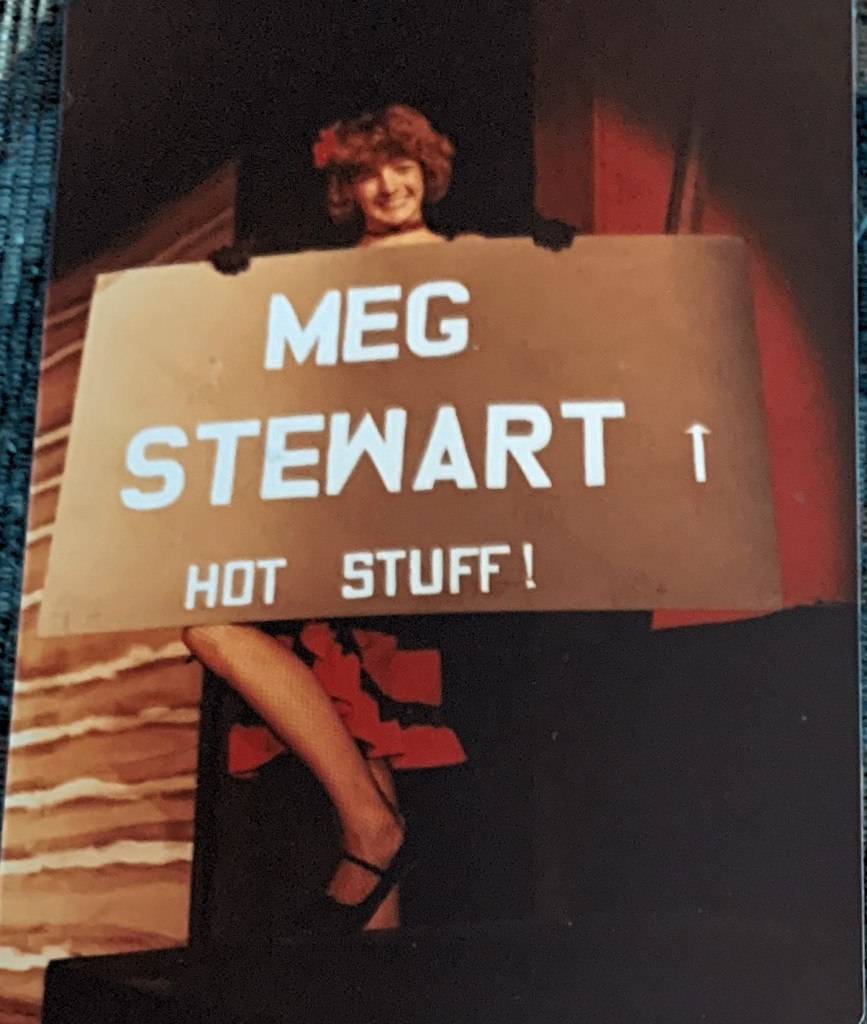
“I have one very vivid memory. During my years at the Playhouse, I would audition for everything. If it was a musical, I’d get up to sing, and nothing, NOTHING, would come out! I could act. I could dance. I could not sing by myself! Finally, for some show, I got up again to do the singing part of the audition. I know it was as painful for you, Shari, as it was for me. But this time I opened my mouth, and I sang. I’m sure it was tentative, and my singing voice was soft (as opposed to my acting voice!), but I looked out to the third row where you were sitting. I could see your face, and it was surprised and beaming. How proud you were of me! And how good that made me feel. Oh, I didn’t get a part in that show, but I still treasure that audition.”
Meg’s last show at the Playhouse was in the 1980 production of Oklahoma! She was a member of the chorus, and she danced the lead in the dream sequence.
After high school graduation in 1981, Meg went to West Liberty. The plan was to go to college for one year and then go to New York City. It didn’t work out that way. “During that first year,” said Meg, “I took five drama classes and an English class. I discovered that I liked writing, and I switched my major to communications.”
Meg’s first job following college graduation was writing user’s guides and training clients for a computer software company—about as far away from theatre as one can get! Later, she became a media relations assistant at Johns Hopkins in Baltimore. “I googled myself not too long ago,” Meg said, “and apparently the one thing I’m remembered for is the time I announced that the surgeons at Hopkins had removed a 108-pound cyst from a woman from West Virginia!”
A few years after college, Meg met Paul Kabis, who was playing on her brother-in-law’s soccer team. They married and now have three grown children, a geologist, a clinical exercise physiologist, and an ACTRESS!
While at American University, Meg’s daughter Anna connected with Elizabeth Chomko, an American University alum who wrote and directed the film What They Had. Not long after that, Chomko called Anna and asked if she would play the younger version of Blythe Danner’s character. Anna’s picture was used in a locket, and that locket photo appears on some of the movie’s DVD cases.
“Anna later auditioned for Where the Crawdads Sing,” said Meg, “and was cast as Tina, a friend of the protagonist. It was a credited part! She was in a few scenes and had one line!
In 2019, Meg and Paul moved to a house on Lake Murray near Columbia, South Carolina. Paul works in business management as Manager of Continuous Improvement, and Meg works part-time as a marketing coordinator for a small Maryland company.
Meg added, “Thanks so much for all the opportunities, life lessons, and fun I still carry with me from my Playhouse days.”
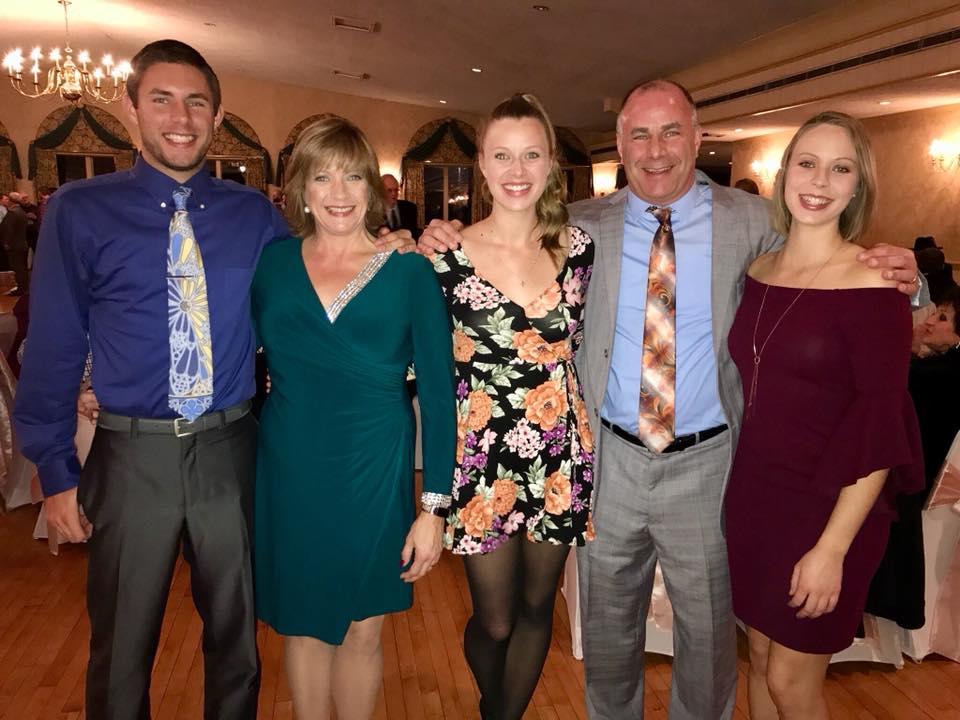
DAVID LAW REMEMBERS
One thing that I loved about my years at the Playhouse was casting young people in shows or recruiting them to run the light board, help with props, or usher (take tickets and hand out programs since we didn’t have reserved seats). Introducing kids to live theatre is so very exciting, and it’s so good for business! The parents, siblings, grandparents, aunts, uncles, cousins, and even neighbors of the kids onstage all buy tickets, and many come more than one night!
I first met David Law when he became a fifth grader at Follansbee Middle School. I taught 7th and 8th grade language arts, but David’s mom Phyllis also taught at F.M.S., so I “kind of” knew him before he became one of my 7th-grade students. I directed several shows at F.M.S., and David might have been in one or more of those. In addition, I helped Norma Stone (a Playhouse volunteer for many years) who directed the shows at the high school, and David was in a couple of those before graduating from Brooke High in 1981 and going on to West Virginia University.

In the summer of 1977, David did the young person’s review that Norma conceived and directed called Rated X-tra Special, and in 1978, he was in Time Out for Ginger with another Follansbee Middle School student Meg Stewart now Meg Kabis.
David’s most vivid memory from his time at Brooke Hills didn’t happen at the theatre. “For some reason,” said David, “I was riding with Shari to rehearsal this day. She said she had to make a stop before we went out the pike. We stopped at this big house in Wellsburg.”
David doing a Tom Sawyer-like number in Rated X-tra Special, 1977
[NOTE from Shari: The house was the home of my aunt and uncle, Alice and Bob Hamilton, at 1508 Main Street, Wellsburg. You may remember from this history that there was a flood in 1972, the first Playhouse summer. The Hamilton house basement was sure to flood. The Playhouse crew went to my aunt and uncle’s home and carried tons of the antique furniture, rugs, chandeliers, etc. that they had stored in their big basement out of harm’s way to the garage. This was one of the best things we ever did as we borrowed great “stuff” from them for props and set pieces the entire time I was at the Playhouse, 24 years!]
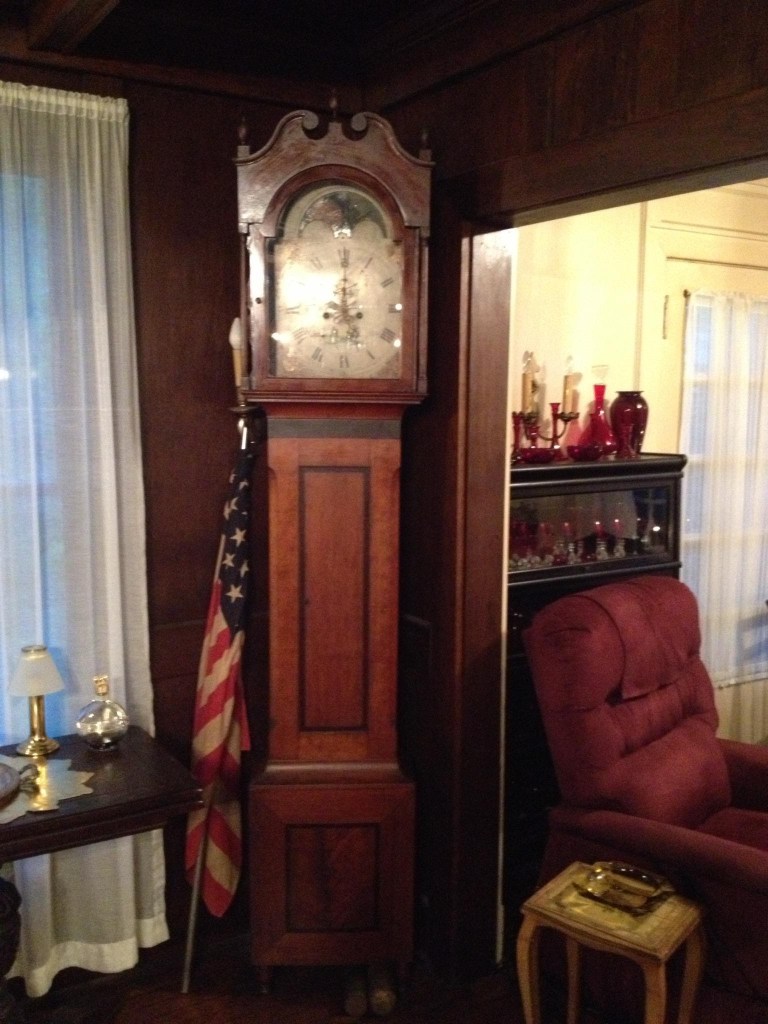
David continued, “It was a great house with lots to look at. Shari showed me this grandfather clock (above right). She opened the door to the body of the clock which housed the clock works. The pendulum had an inscription that read: R.D. Jackman Wellsburgh, VA 1822. “I thought that was the coolest thing! It was made before West Virginia was a state!
“And then I got another surprise. A horse came charging at me! It was the size of a horse, but it was the family’s Great Dane. I’d never seen a dog that big, and it was huge. Fortunately, it was nice, scary but nice.”

I didn’t remember this next incident, but David said that once I gave him $5. “Shari, you said, ‘You can give it to your mother for gas, but if I were you, I’d keep it!’” said David. “Now I tell my kids and wife that I’m a paid professional actor and singer. It kills them, but it’s true!”

Today, David is a cardiologist and lives with his wife Laura in Cape Girardeau, Missouri. They have four children and five grandchildren. Maybe when he retires, he’ll audition again!
Dr. David Law, M.D., Cardiovascular Disease, Internal Medicine, and Interventional Cardiology Specialist, ca. 2020
UP NEXT
The Brooke Hills Playhouse, A Collective Memoir, Part 16 is coming soon.
It contains stories and memories from the 1978 season.

 Life Without Lesson Plans
I loved these memories! UTBU was one of my very favorite shows when we did it at the Playhouse. Off-hand, I can’t remember my exact tech role—Stage Manager? Lights? I was on staff that season. In one scene, Ken was going to attack Chris with a giant axe, and, as is written in the play, the head of the axe falls off before he can connect with his victim. Chris, playing the blind actor, doesn’t know what happened. Ken’s line was, “Oops! I dropped my watch!” 😂 This has become part of my everyday vernacular when I drop something that makes a loud crash. My kids and husband have never even seen this play, and they all say it, too. It was a crazy and funny show, and I’d love to see it again sometime.
LikeLike
I love that show and the watch line, too. How about this one: “I’ll turn you upside down so fast, you’ll wonder where the floor went”?
LikeLike