
by Shari Murphy Coote and Friends
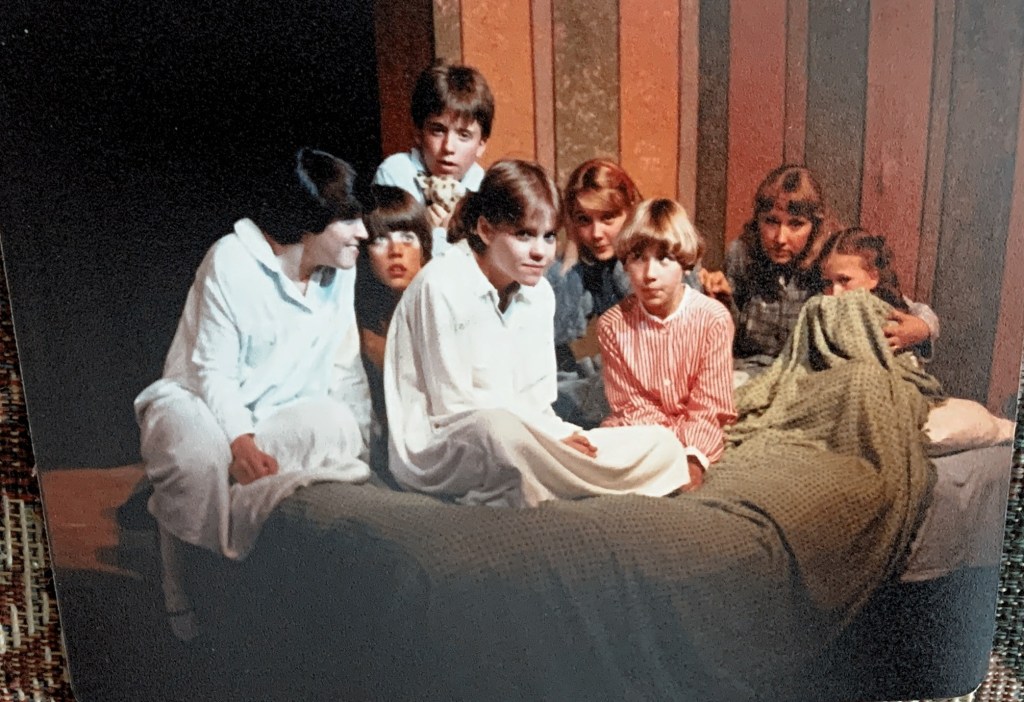
Season Seven, 1978
THE SHOWS
The Sound of Music
Time Out for Ginger
The Star Spangled Girl
Ladies in Retirement
Any Wednesday
Sgt. Fenshaw of the Mounties
THE STAFF
Bill and Shari Harper
Al Martin
Norma Stone
Jim Cirilano
Scott Martin
Sandi Liberatori
Judy Freshwater
Nathan Guttman
Donna Fitzpatrick
David Woodrow
AL MARTIN MAKES A SUGGESTION
AND SCOTT MARTIN JOINS THE STAFF
Several months before the 1978 season, around the time we were looking for our summer crew, Al suggested that we hire his talented nephew, Scott Martin, and that we produce one of the musicals Scott had written, specifically Sgt. Fenshaw of the Mounties. Al had never made any administrative suggestions, and he had worked tirelessly for us over the years. We jumped on both suggestions.


Sgt. Fenshaw, was written in the style of an old-time melodrama, and it was delightful. The music was wonderful, the hero was bumbling but lovable, the villain was dastardly, and the heroine was charming and beautiful. The cast loved performing the show, and the audiences were wild about it, jumping right in on cue to boo/hiss or cheer as prompted by a light-up sign over the stage. The following summer we produced the sequel, The Return of Sgt. Fenshaw, to more sold-out audiences.
Scott accompanying Sgt. Fenshaw of the Mounties
Scott is multi-talented, and he was on the staff for three summers–1978, 1979, and 1985. He directed and played the piano accompaniment for the Fenshaw shows. He also built and painted scenery, acted in several shows, and directed, not just the Fenshaw shows but other comedies as well.
Scott has now been a Los Angeles-based playwright, composer, actor, director and ASCAP member for over 30 years. In addition to hismusicals published by the Samuel French imprint of Concord Theatricals (Scream Queens – The Musical and Little Green Men), he has written the book, music and lyrics for Children of the Night (2010 L.A. Ovation Award nominee, Best Book of a Musical). Children of the Night is the fascinating true story of Bram Stoker, author, and Henry Irving, actor, and the creation of Dracula. Scott’s musical premiered at the Beverly Hills Playhouse after successful festival presentations at Musical Theatre West (Long Beach, California), The Academy for New Musical Theatre (North Hollywood, California), Chicago’s Stages Festival, and the inaugural Global Search for New Musicals produced by SONY and the BBC in Cardiff, Wales.
Scott with Patty Welch, Come Blow Your Horn, 1979

Scott has also written the book, music and lyrics for numerous family-friendly musicals and children’s shows including Rockin’ Robin Hood, High Noonish, The Maltese Chicken, Darn Dodgers, Xoro, The Be-Bop Bandito, The Road to Paradise, A Dickens of a Christmas, The Good, the Bad and the Jolly and the Sgt. Fenshaw trilogy of melodramas, among others. He has created comedy material and songs for several different corporate and industrial programs, improv revues and children’s theatre companies across the country. He wrote the books for Storybook Theatre’s long-running musical productions of Goldilocks… and Snow White… at Theatre West in Los Angeles, and his original songs are featured in the award-winning independent film The Ghastly Love of Johnny X, now available at Amazon, iTunes and Netflix. Currently in development: Bleacher Babes and Scream Queens 2 – The Musequel. (Information adapted from Scott’s online bio.)
AND WE’RE OFF!
1978 was a great summer for several reasons. We wised up and only did six shows which seemed like a walk in the park after those seasons with eight and nine productions. We had a full staff, a big relief after the small-ish staff of 1977. The Sound of Music (or as founder Bill Harper called it, The Sound of Money) was just as powerful a season-opening show as Fiddler on the Roof had been the previous year.
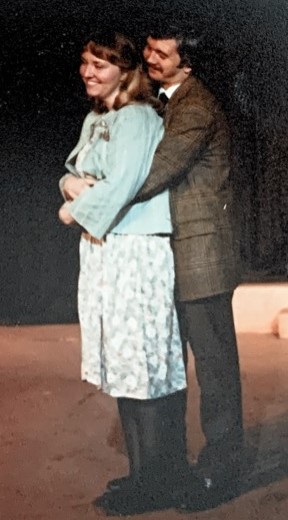
Looking back at some photos we have of the production, I really am amazed. The scenery was minimal. Many of the scenes were staged in front of the black curtain. I think that it’s a great testament to the talent onstage (an opinion backed up by the newspaper critics who reviewed the show) which transported the audience to WW II Austria, believably! Apparently, when the program tells an audience where the action on stage is occurring, the audience just fills in the scenery!
Beverly DeBord as Maria and Rick Taylor as the Captain in The Sound of Music.
I wish I had the box office reports from these early seasons, because once again we were selling out many nights, and not just the musicals, but the comedies and dramas as well. The big musicals at the beginning of the season seemed to set the pace for the summer.
The comedies, Time Out for Ginger, The Star-Spangled Girl, and Any Wednesday were all crowd-pleasers. Ladies in Retirement was a psychological thriller which slowly built to a murder onstage. An eerie denouement was a bit of a surprise. Like Angel Street in 1974, Ladies received some audible gasps and comments (“Oh, no!” “Oh!” etc.) from the audience! I’m sure that meant they were into the show!
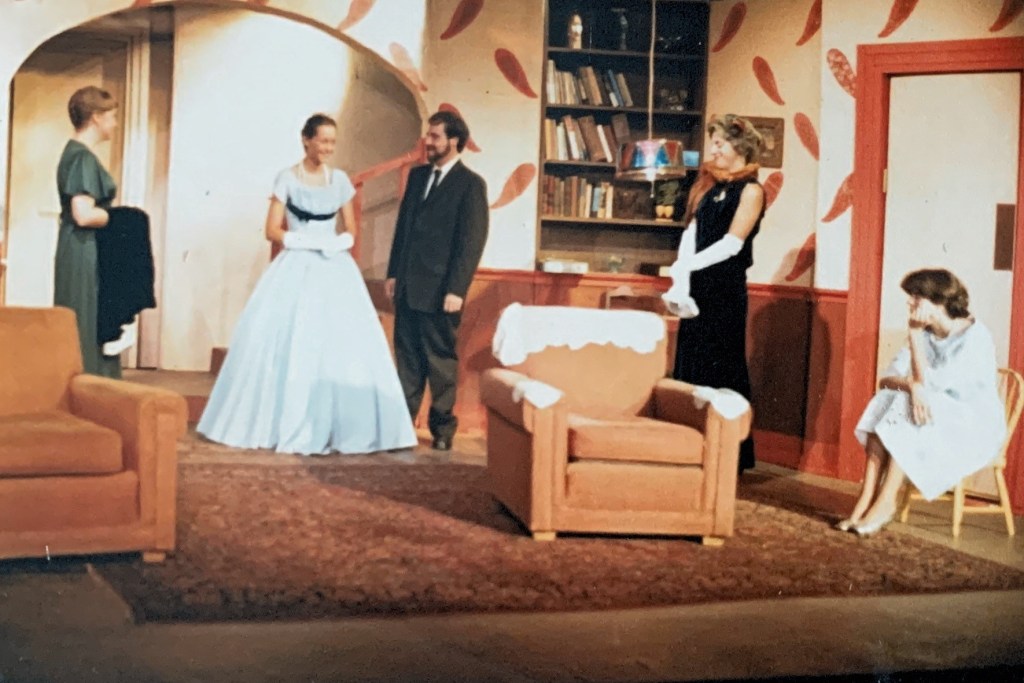
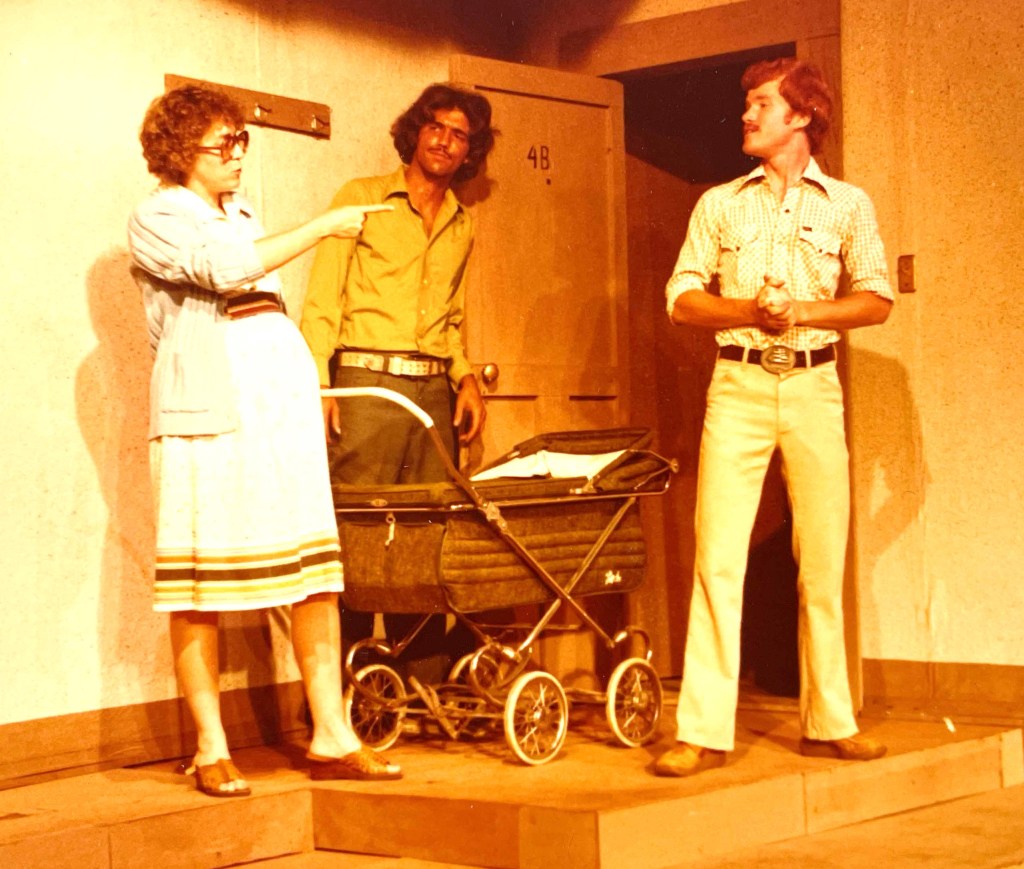
Here are some pictures from the comedies and drama of the 1978 season. The black curtains would reappear occasionally in the final show, Sgt. Fenshaw. The scenery was lovely for these shows with arches, fireplaces, staircases, and other architectural touches. The “wallpaper” for Time Out for Ginger looks a little over the top, but for the 1970s I’m sure it was spectacular! Sadly, we have no photos of Jim Cirilano’s great period set for Ladies in Retirement.
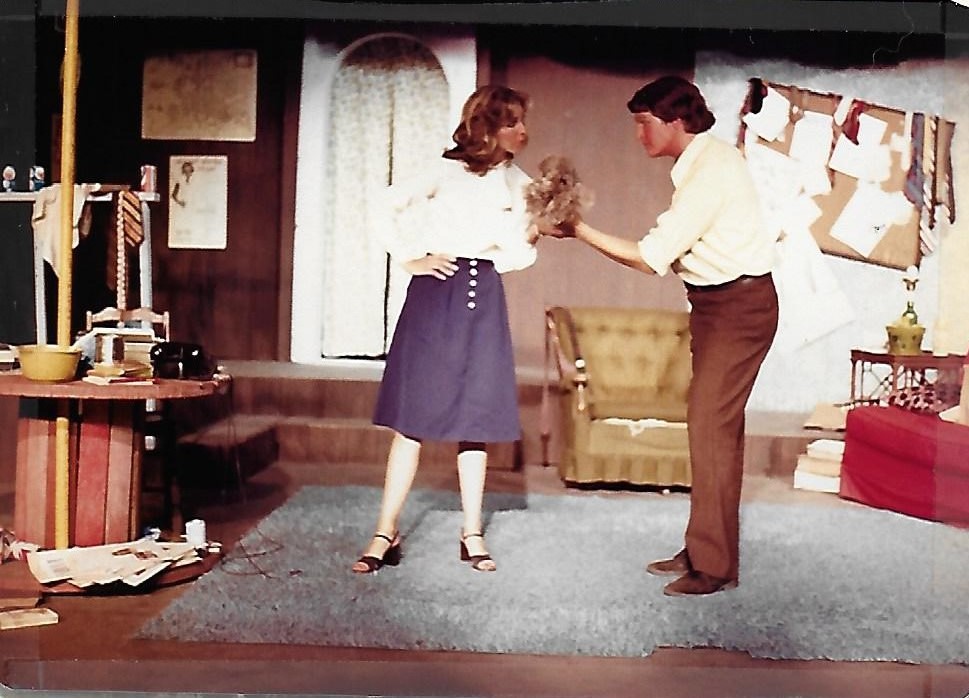


Scott and Becky Brown, Ladies in Retirement, 1978.

The final show of the season, Sgt. Fenshaw of the Mounties, written, composed, and directed by staff member Scott Martin, was a huge success. People loved to hiss the villain and cheer the hero. It started out strong, audience-wise, and kept getting stronger. During the second week of the run, some nights were standing room only with people standing along the side walls of the barn for the entire performance. Sadly, some people had to be turned away.
The simple melodramatic plot also included a lovable Indian tribe, saloon chorus girls with hearts of gold, a beautiful heroine, a boo-worthy villain, and an earnest but bumbling, handsome young Canadian Mountie.
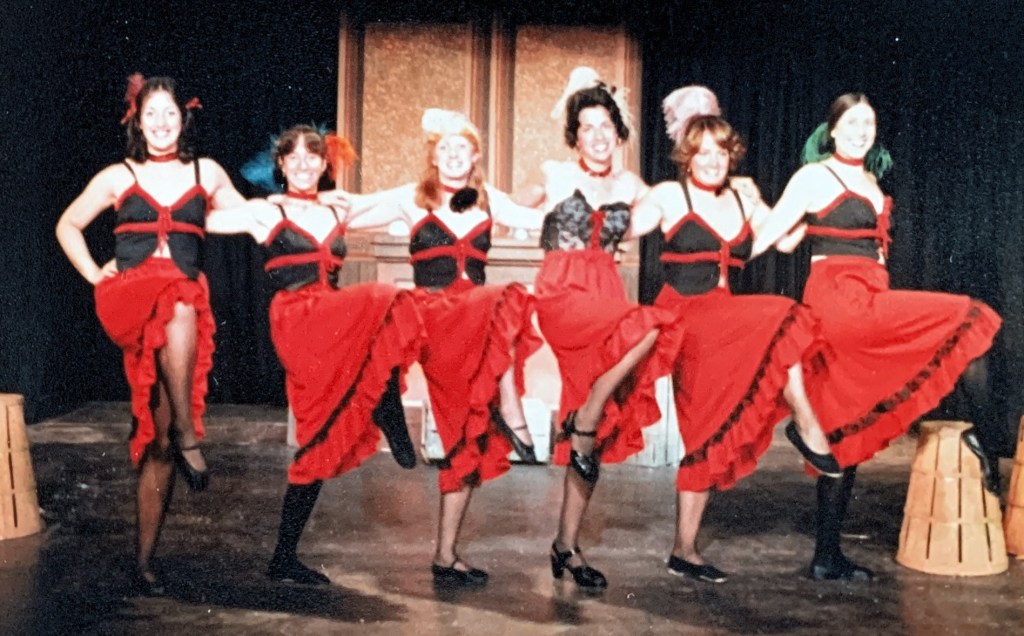
The show’s music was absolutely wonderful, and often during set-building in years to come, the staff would sing songs from the show. The action that Scott devised was ingenious and included a hilarious chase scene set to classical music. It is shows like this for which the expression “had them rolling in the aisles” was devised.
Rusty Painter was cast as the courageous and lovable but bumbling Sgt. Fenshaw. The talented Peggy Barki, a homemaker and mother from Windsor Heights, who would appear on our stage for the next 40 seasons, had debuted in The Sound of Music, and she was cast as the wife of the Indian tribe’s elderly chief. We did have a problem. We were lacking actors for two male parts–Chief Hihawaya and his right-hand man Hashafatha. (You might have to say those names out loud to get the joke!)
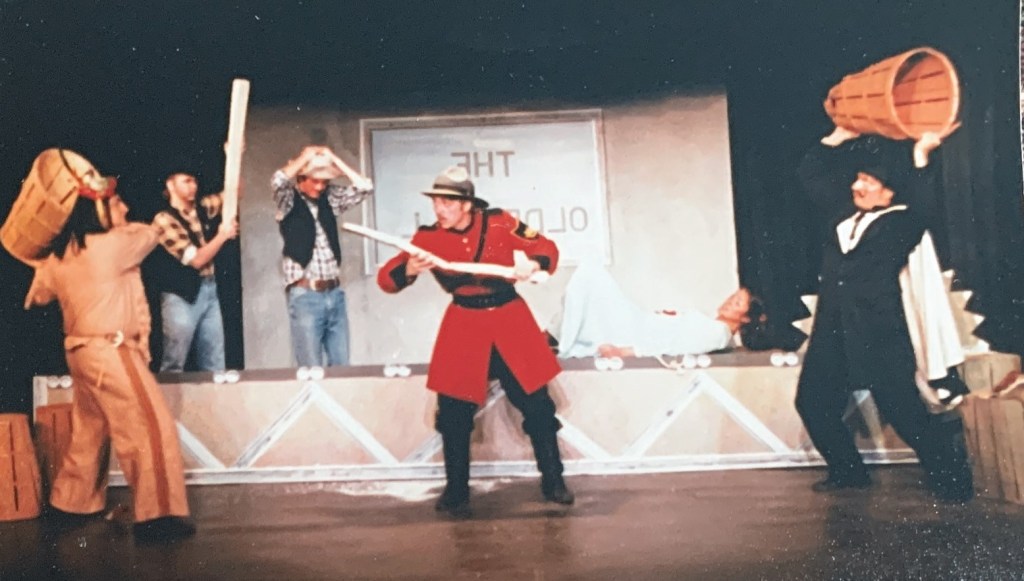
Bill Harper’s dad, who helped so much with the barn renovation in 1972, was a little guy, probably only 5’3”. Scott loved the idea of the chief being smaller than his wife, to be played by Peggy, so he asked Mr. Harper to play the part. And then Peggy had a great idea. She said something like, “I think my brother-in-law, Russ Welch, would be good on stage. He’s always clowning around, and he’s funny.”
Scott suggested that Peggy get Russ to come out to audition, and Russ came. Scott had him read a little and sing a little and cast him on the spot. And just like that the Playhouse had two new, awesome actors, that would bring down the house for decades to come.
Word traveled fast about the crazy, fun melodrama at the Playhouse, and the second week of the show had several sell-outs. Many people who were not family or friends of the cast came back for a second time. We would produce the show again in 1988 to sold-out houses again.
MAKING A VALIANT EFFORT
So… I only said two new, awesome actors (Peggy and Russ), because as talented as Mr. Harper was, an actor he wasn’t! He had his doctorate in one of the sciences from Duke University. He had his pilot’s license. He was a welder, carpenter, mason, pipefitter, plumber, electrician, roofer… and he had the tools and machines to accompany every trade! I am dead serious. He could do anything, and that first summer at the Playhouse, he used most of those skills and tools as we converted the barn into a theatre.
With Bill Junior’s help, Bill Senior built the Harpers’ lovely brick home, complete with a huge fallout shelter (remember those?) under the entire back yard and most of the two-car garage. He built a one-story six-apartment complex on Main Street in the Harpers’ hometown of Chester, W. Va. He led a crew of volunteers from the Oddfellows Lodge in Chester help him build a half-way house for recovering alcoholics. At one time he owned and operated a Kaiser (car) dealership in Chester. He taught 7th-grade science for decades. Sadly, he couldn’t act.
Actually, for all of his knowledge, it’s astounding that Mr. Harper could not learn his lines, and believe me, he tried. He finally resorted to cutting a bunch of tomahawks out of Masonite, numbering them, giving them a little paint on the front, and writing his lines on the back! Russ had a trial by fire being onstage with him for all of Mr. Harper’s scenes. It’s a wonder that Russ ever auditioned again!
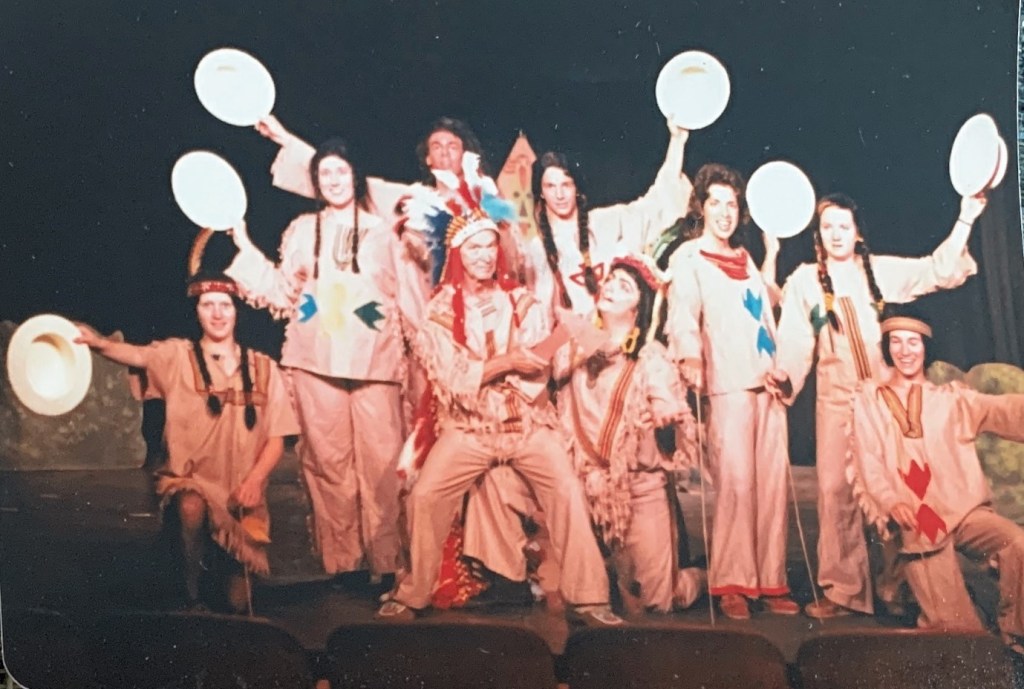
Russ and Peggy, however, were amazing, never getting flustered, dragging Mr. Harper from spot to spot, and keeping him on track. I will say that Mr. Harper was game. He acknowledged his lack of acting prowess, apologized often, AND most importantly, he showed up night after night and got us through the show, which I hasten to add was so popular and fun that some people came to see it more than once!
Russ was simply a natural, always aware of everything going on around him, never getting flustered, knowing just about everyone’s lines, and a good singer as well! Over the years, he may have been a steel worker by day, but by night on the Playhouse stage he was everything from a comic Indian to a cuckolded husband, a villain, a lover, a mute king, and more. We really hit the jackpot. He was a gold mine for us.
REMEMBERING PEGGY BARKI
Peggy Barki showed up for the first set of auditions in 1978 and was immediately cast by director Scott Martin as a nun in The Sound of Music. At the season’s second set of auditions, she was cast again by Scott as the Indian chief’s wife in Sgt. Fenshaw of the Mounties. She had a slight and endearing lisp and a sense of comic timing that was hard to match. She also excelled at physical comedy whether it was some crazy expression with her big eyes or a physical move. She was great with stage business, and she was funny.
Peggy’s older son Joe wrote, “My mom loved telling this story about the first play she was in. I was 5 that summer and got hauled to rehearsals with mom. The prop crew actually stole my toy bow and arrows to use in the play! At one practice, I was playing out in the theatre seats while the play was rehearsing on stage. The old man playing the Indian chief in Sgt. Fenshaw forgot his line, which was “Indian village.” He froze, and while he stood there, I yelled out his line from the back of the Playhouse. Everyone cracked up. Peg loved that story.”

Peggy was never cast as a romantic lead, but she played many “second bananas.” She’d be a maid or a snooty countess, a lowly nun or a back-slapping hayseed. Peggy was also the person who recruited her brother-in-law, Russ Welch, to audition, and that proved to be of immeasurable value, as Russ could do it all—act, direct, build scenery, enhance the barn itself, and he did it for decades.
This photo proves how much we needed a photographer at the Playhouse! I can’t recognize the show or anyone in the photo except for Peggy who was playing a maid!

Peggy’s dear friend, Linda Huggins Smith, was in many shows with Peggy. One show they did together entailed a lot of Bingo playing. “Peggy had a hard time memorizing her lines for this show, so she wrote her cues and lines on the Bingo cards!” said Linda. “One night, she looked at her cards and jumped in saying her cue, MY line, by accident! Russ Welch was the stage manager for the show, so while the others ad-libbed about the fake Bingo game we were playing, I excused myself, went off stage, and asked Russ where in the heck we were in the script.
“He gave me a line to get us back on track. I re-entered with the line which backed us up a little bit, but somehow it got us back in the flow. Listen, when Peggy got lost, she really got lost, but she could recover, and the show was fine. I don’t think the audience minded or even knew that we repeated a few lines!
“Another time,” said Linda, “we were in Vanities together, along with Susan Price, just the three of us. We were rolling along when suddenly, Peggy said, ‘I really don’t know what to say,’ and she really didn’t! Somehow, Susan and I got her and the show back on track. Just another Peggy adventure! These aren’t the only things I remember. In so many shows, the cast clicked, night after night, and the audiences knew they’d gotten their money’s worth and more!”
Peggy Barki

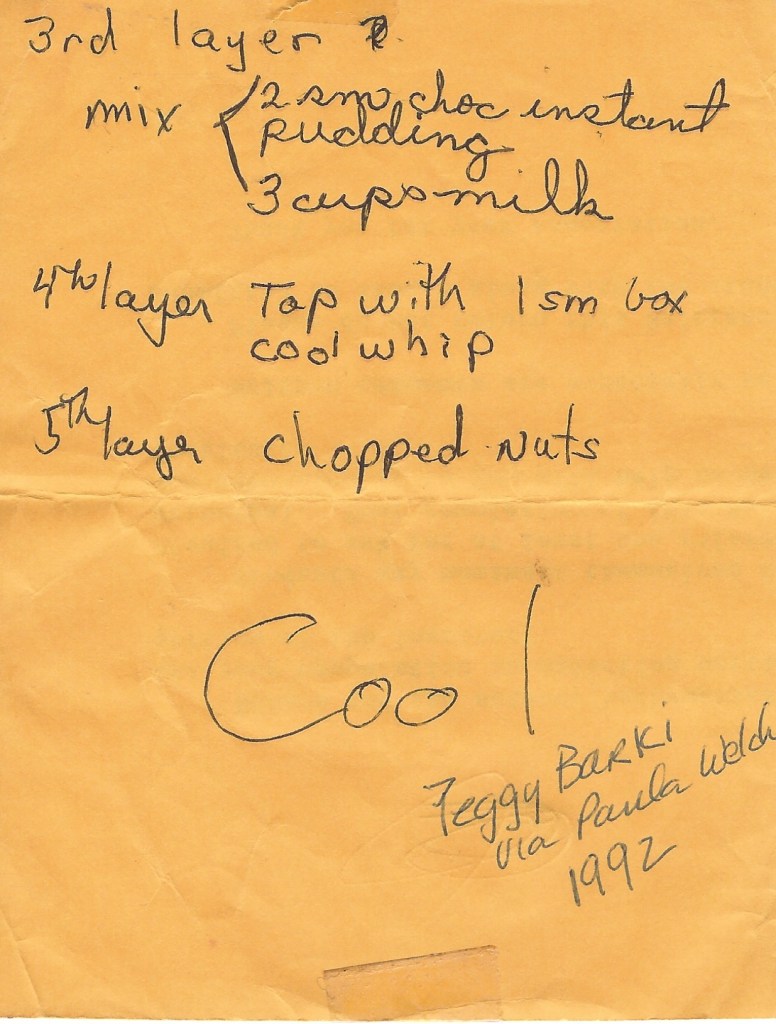
The crews and staffs also loved Peggy but for a completely different reason. Peggy was a gifted baker. She often brought treats for the crews, and she always brought something delicious for the cast parties. Here’s the recipe for her most popular offering, written in her sister Paula’s handwriting:
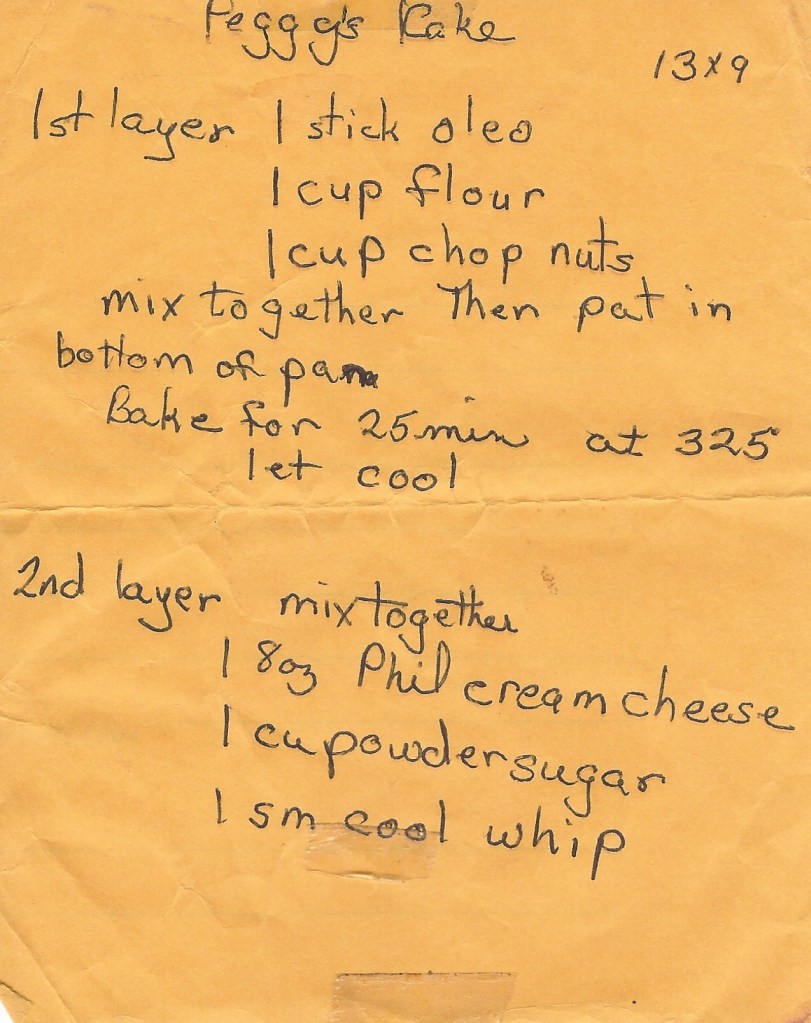
Sadly. Peggy died before the season started in March of 2021 at the age of 71.
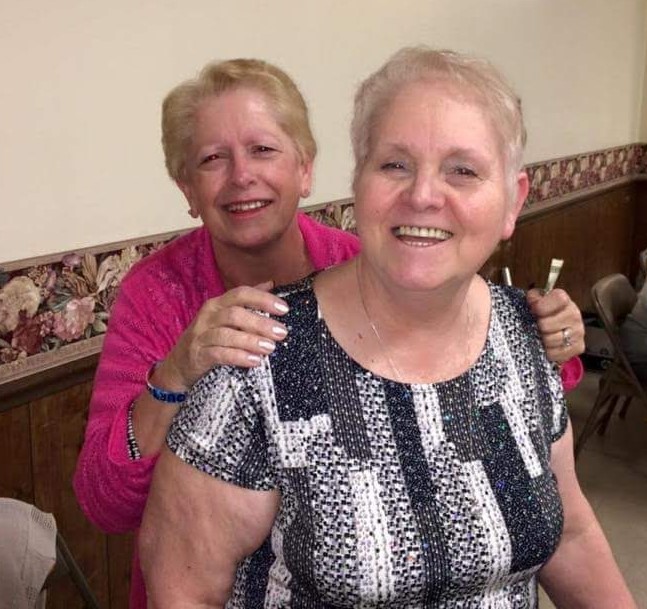
A NOTE ABOUT THE WELCHES
I have kicked myself a hundred times since March 6, 2023, when Russ died unexpectedly at home. To be honest, I still hadn’t gotten over Paula’s death in April 2018. I never interviewed either one of them for this memoir, and they were both such great contributors to the Playhouse’s success—41 seasons for Paula and 46 for Russ.
Russ and Paula both served on the board of the Brooke County Arts Council for decades. NOTE: In 1972, Bill Harper, John Hennen, and I incorporated as Brooke Hills Playhouse, a for-profit corporation, which was pie in the sky. In 1982, ten or twelve of us disbanded that corporation (Bill and John were gone from the Playhouse by then), and we started the Brooke County Arts Council as a non-profit corporation. We branched out by remodeling the large, upstairs room in the Brooke County Museum (once the historic Miller’s Tavern at 6th and Main in downtown Wellsburg). We started doing some fall, winter, and spring shows in that venue.
Russ and Paula were both totally committed to every aspect of putting on a play, and they were willing to do any job that needed to be done. Russ was slated to direct the opening show of the 2023 season. They are missed in so many ways.
REMEMBERING RUSS WELCH
Earlier in this chapter, I explained how Russ came to Brooke Hills Playhouse. His sister-in-law Peggy Barki invited him to audition, and he was cast immediately by Scott Martin as the assistant Indian chief in Sgt. Fenshaw of the Mounties.

It turned out that Russ was a natural on stage, always aware of everything going on around him, never getting flustered, knowing just about everyone’s lines, and a good singer as well! He was a quick study, memorizing volumes of lines and cues over the course of his career at the Playhouse, and he also acted at nearby theatres.
Russ as the evil villian Roger St. Clair in The Return of Sgt. Fenshaw, 1978
This is not to say that he was perfect. He did have a temper, which didn’t come out very often, maybe 6 or 8 times over the course of his long Playhouse tenure, but when the temper came out, it erupted. He would blow up then walk away, and eventually get back to being the Russ we knew and loved. Over the years (1972-2023), he may have been a steelworker by day, but by night on the Playhouse stage, he was everything from a comic Indian to a cuckolded husband, a villain, a lover, a mute king, and more. He was a star and a gold mine for us.
For me, Russ was a wonderful Judd in Oklahoma! and Starbuck in The Rainmaker, but my favorite Russ role was as King Sextimus the Silent in Once Upon a Mattress. It was a waste of his prodigious memory, since the role has no lines, but good grief, how incredibly expressive Russ was as a mute, a mime. There was never a doubt about what he was trying to convey, and the audiences absolutely loved him! The laughs he received nearly stopped the show night after night.

Russ, a Wellsburg native, was valuable in numerous ways. He wasn’t only at home on the stage, he was also very adept with tools. Over the years, he helped to re-side the barn, build the barnwood proscenium, add the backstage addition and porch, and work numerous strike nights. In time, Russ added directing to his repertoire.
Our small, amateur theatre never had understudies, and in the 24 years I was at the Playhouse, I only remember two times when an understudy would have been nice. I can’t remember the name of the show, but it was a comedy, possibly a farce. One of the guys in the show absolutely could not memorize lines, and he knew it. Following the evening rehearsal on the day before dress rehearsal, he turned in his script and rode off into the sunset. This had never happened before, so what to do?
We called Russ who was at home watching TV. He drove out to the barn that night and picked up the script. The next day when Russ got home from his shift at the mill around 4:00 p.m., he came out to the Playhouse, and the director ran him through the blocking (movement) a few times before that evening’s dress rehearsal. He went on with the script and a pencil in hand—underlining a word or phrase to emphasize and making notes to make his blocking clear.
The next night, opening night, I went onstage before the show started and explained that Russ had had to take over the part of XXXXX, that he just stepped into the part the day before, and that he would be carrying the script on stage.
Russ was outstanding, so outstanding that several people came up to me at intermission and asked what script-thing I’d been talking about! I said, “Didn’t you see that he had a small book in his hand that he would refer to?”
They all said something like, “I guess not,” or “No,” or “Hmmm. No kidding,” or “Must have been too busy laughing!” I tell you there is nothing so wonderful as an audience. They are in their seats, silently urging on the actors and always willing them to succeed.
Russ, always a quick study, went onstage the third night without the book! As I said, “The guy was a natural.”
NOTE: A number of years later, Diana Mendel was in The Foreigner when she was injured the morning of opening night! Heather Vulgamore Deerfield was the stage manager. The cast came in early and walked through the show, cue to cue with Heather who went on with the book that night. Again, I made the announcement about Heather carrying the script, and again most people in the audience didn’t even notice! Diana was back on her feet the next night, and she carried on as usual for the remainder of the run!
Diana also tells this story, “Just a few years ago, my granddaughter Chelsey was directing Nana’s Naughty Knickers, and two days before opening, the lady playing Nana didn’t think she could do it! This time I went on, the first week with a script in my hands, but by the second week, I knew all the lines!”

Russ and Paula’s daughter Terra remembered, “I didn’t really act with Dad, but he once told me that he knew he was doing a good job as Judd in Oklahoma! because Niccole and I were afraid of him! We never had any problems separating him from his characters any other time. He was proud of that.”
Russ as Judd in Oklahoma, 1980
Russ’s daughter Niccole said, “Dad had several favorite roles, but I think his absolutely number one favorite was playing Nicely, Nicely Johnson in Guys and Dolls and singing ‘Sit Down, You’re Rocking the Boat.’ His favorite shows were The Rainmaker when he played the lead, a charming con man, a role which challenged him, They’re Playing Our Song, Once Upon a Mattress, and really a ton of shows that weren’t musicals.
“I think in two different seasons in the late 1990s or early 2000s, Dad was in every single show, six I think. He was always in the Murder Parties the Playhouse produced when the summer season was over, and several times he went to the Kiwanis, Civic League, Rotary, or other community groups to do a little program and promote the Playhouse.
“I finally got to act on stage with Dad when we did Meshuggah Nuns. Dad played the rabbi, and I played Sister Robert Ann. Mom was so happy to see us on stage together that she sat in the back of the house, beaming with pride and crying like a baby each evening!
“Not long ago, I was working in the Playhouse box office, and a woman came up to buy tickets. She kind of looked at me and said, ‘Are you a Welch?’
“I said that I was, and she introduced herself. She was Kay Feola, and she was in They’re Playing Our Song with Dad. She remembered him fondly.”
If you talk to most of the kids who worked on the Playhouse staff over the years and many of Russ’s fellow cast members as well, they remember Russ for “barking.” This wasn’t an ordinary bark. He would come up behind you, reach down, touch the back of your knee, and bark so realistically that you were certain you were about to be bitten! Of course, you’d jump and turn around only to find Russ there with a shit-eating grin on this face, AND he could catch most of us with this joke many times over. I never heard anyone react calmly to a Russ Bark. No one ever said, “Now, Russ.” There was always a squeal or a scream from men and women alike!
Linda Huggins Smith was best friends with Russ’s wife Paula, so when she played opposite Russ (who had the lead) in The Rainmaker, Linda had to kiss her best friend’s husband. “I was so nervous about that kiss,” said Linda, “that I finally went to Paula and asked for her permission to kiss her husband! Paula just laughed and said to go ahead!”
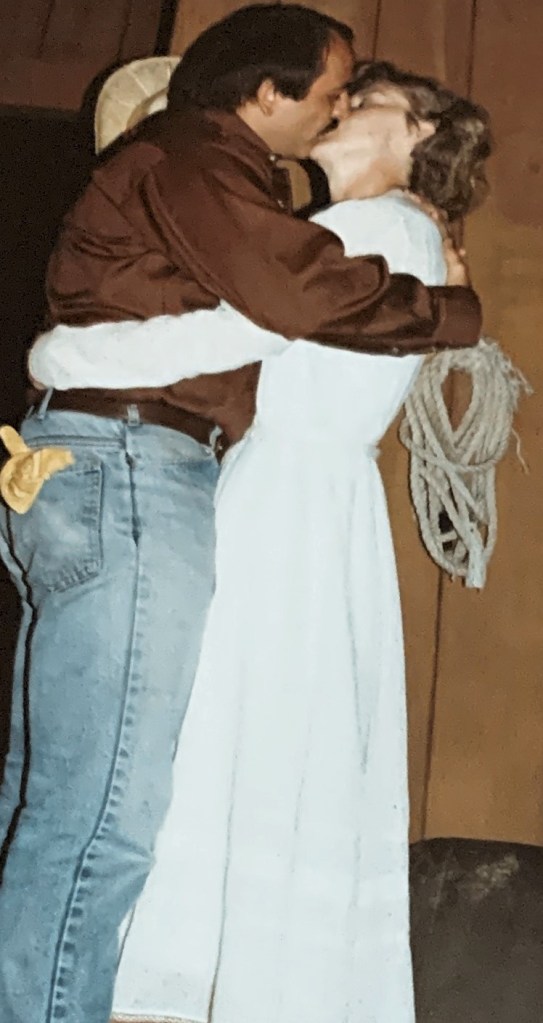
Russ left us way too soon, and he left a big hole in the Playhouse heart. He also left a wonderful legacy of barn improvements and Playhouse memories.
REMEMBERING PAULA WELCH
But wait, there’s more. Even though Russ’s wife Paula didn’t really get involved at the Playhouse until 1979, the year after her sister Peggy’s and Russ’s debut, it seems appropriate to honor her here with Russ.

In her own way, Paula was just as valuable as Russ, helping with costumes, props, box office, and really anything that needed to be done. She served as the company cook for 4 years, I think, and she always made spicy tacos, something that irked me no end. I would always say, “Just buy mild taco seasoning and buy some hot sauce for those who like spicy tacos. That way those of us who can’t take the heat can still enjoy the mild. I think it’s the only thing we ever fought over—good grief! Tacos!
Although Paula and Russ had two daughters, Paula was also a surrogate mother to most of the kids on the staffs over numerous seasons. She took sick or injured kids to the doctor and waited with them while they were treated. She listened to their complaints, fears, homesick stories, joys, and personal problems.
Cathy Brooks, a staffer from 1989 through 1992, wrote, “Paula was the resident mom to all of us who lived at the Playhouse for the summer. She cooked, she hugged, she gave us a smack upside the head when we needed it, which was a pretty regular occurrence!
“I recall a specific instance when I was upset about one of those things that only 20-somethings think are the end of the world. I don’t even recall what it was. I was hiding in the girls’ dressing room with tears rolling down my face, sobbing in bursts. Paula took one look at me as I stood there crying and unable to get any words out. She started cursing at the top of her lungs—for a solid minute!
“She then put her hands on my shoulders, smiled, and said “Did that help?” I smiled back and nodded. She then told me to wipe my face, blow my nose, get the hell back out there, and get to work.
“I adored her more than she could ever have known.”
Paula had one quirk that we all loved. When something on stage struck her as incredibly funny, she would “honk.” It was an indescribable laugh that came up her throat and out her nose and mouth, I think that’s how it worked! Many of the acting company aspired to receive a “honk” from Paula during a rehearsal. Every actor who ever received a “honk” would brag about it for weeks. Few were bestowed! We should have made badges that read, “I made Paula honk!” They would have been worn with pride.
I think it was the Playhouse that caused Paula to blossom. Before her time at the Playhouse, she was a great wife, mother, and Girl Scout leader, but as she became more active at the Playhouse, she also gained confidence in her abilities. She joined the Brooke County Rotary, and she was the club president three times and won the Paul Harris Fellow award. She became a mover, shaker, and chair of the Wellsburg Fourth of July Committee (a huge undertaking), and she became active in the Women of the Moose. She also became a Voting Precinct Manager, serving for many years. Paula became a civic whirlwind!

Paula and Russ lead the decorated bicycle group in the Wellsburg 4th of July Parade.
Like Russ, Paula was a Wellsburg native. Paula and Linda Huggins, who started acting at the Playhouse in 1973, formed a life-long friendship through their Playhouse connection, and eventually Paula went to work with Linda at the accounting firm owned by Linda and her father. Soon Paula was handling the Playhouse books and payroll. Paula also started directing shows, and she and Russ propelled the Playhouse forward for years.
The Welch daughters, Niccole and Terra, were practically raised at the Playhouse coming out to the barn day after day to play with my son Andrew and Rick and Teresa Taylor’s kids, Katey and Nick. Other kids, children of cast members or volunteers, often joined this group who put on little plays with props from the prop room and costumes from the storage shed. Sometimes they just played games, but those kids were at the Playhouse day after day in the summers.
Niccole said, “One evening Mom came home pretty late from the Playhouse. She walked in the door, and she was covered in paint—hair, face, hands, clothes, paint everywhere. Dad or Terra or I asked, “What happened to you?”
“Apparently, Mom, Cathy Brooks, and Heather Vulgamore (now Deerfield) were working feverishly on scene painting,” said Niccole, “when a paint fight broke out. She really didn’t want to talk about it. She needed to get cleaned up, but we knew she had had a blast.”
Paula’s good friend Linda Huggins said, “For some show, I absolutely could not get into my character. Paula told me that the right costume would help, and she set off to find it. She came back with this slinky black dress, which was certainly not me, not Linda Huggins. When I fought myself into this dress (it was really tight), it looked like it was sprayed on! But guess what? It wasn’t me, but it was the character I was playing. It was exactly what I needed to get into the role.
“The same thing happened when I was playing opposite Russ in The Rainmaker,” said Linda. Paula was at the rehearsal when Al Martin, our director, said he didn’t like the costume I’d brought in for approval. The next thing I knew, Paula had either found the perfect dress in our costume storage shed or had gone out an bought this great dress, this perfect dress. Al approved, and from then on Paula costumed me for every show I did! And she was very good at it!”
Above right: The dress Paula found for Linda to wear in The Rainmaker with Russ Welch. 1983

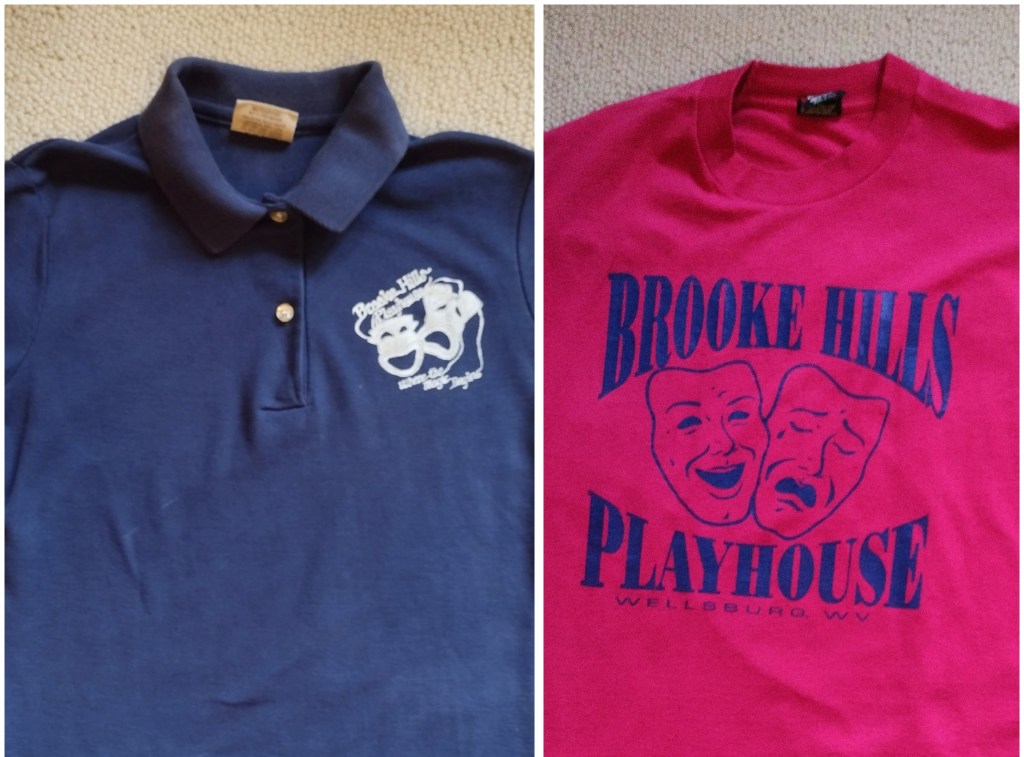
I don’t remember how it happened, I think Paula thought it was time for us to have a new T-shirt designed. We’d been using the same one since 1973. Anyway, Paula became our “Merch Queen.” Over the years, she had many T-shirts designed and ordered. She also did canvas bags, wallets, mugs, polo shirts (for dressier occasions—LOL), and I don’t know what all. She just took this on as a project, turned over the profits, and definitely added to our bottom line with her merchandise sales.


Paula and Russ always had a big, backyard picnic on the Fourth of July. Paula and her four sisters put out an amazing spread. The Playhouse crew was always welcome, and most of us would go to my Aunt Alice and Uncle Bob Hamilton’s for lunch and then to Russ and Paula’s for a swim before we ate dinner. They were always so gracious and generous. Some years the Playhouse would have a decorated truck or marchers with a banner in the 4th of July parade.
Sadly, Paula died in 2018 at the age of 71.
The Welch/Barki family was a gold mine of talent and energy for the Playhouse for over four decades. I’m so happy to report that Niccole, who was on the Playhouse staff in the 1990s, and her wife Olivia are now carrying on the family tradition by being active in many ways at the Playhouse.
TERRY STUCK REMEMBERS THE WELCH FAMILY
I have so many memories of Russ and Paula at the Playhouse. My entire time at the Playhouse included Russ, Paula and their daughters, Niccole and Terra. Russ was my cousin, and he was a big reason I ended up at the Playhouse. I was lucky enough to be on stage with all of them at one time or another. I think we were all on stage at the same time, but I cannot recall which show it may have been with any certainty.

Russ and Paula both directed shows that I acted in. I think the one I remember the most fondly is Route 66. Paula directed. Russ, Rick Taylor, Keven Dennis, and I were onstage, and Robertas Mizok was the accompanist. Terra was the Stage Manager. We were blessed to be able to take the show on the road and perform at the Center for Music and Art in Wintersville and also at a church in Wheeling.
Niccole and Terry in Annie Get Your Gune, 1983
The show is more of a musical revue than a traditional musical. Anyone who knew Russ, knew that he never felt confident in his musical abilities, but he was perfect for this part, and Rick Taylor was able to get Russ to trust himself. We had a great time doing Route 66.
I had some of the best times of my life at the Playhouse and was fortunate enough to share those times with my family. Russ and Paula, Niccole and Terra, all either acted, directed, built sets, struck sets, or worked in other ways with me, my daughters, Taylor and Emily, and my wife, Karen. The Playhouse truly was a family thing for us.
JIM CIRILANO COMES ON BOARD
Jim Cirilano was a Pittsburgh native and a student at Allegheny College when he came to work on the Playhouse staff. [NOTE: You may remember that Stanley Harrison, one of our drama profs at West Liberty, who often performed at the Playhouse in the early years, and Joanne “Tommie” Martin, Al Martin’s wife and one of our directors, had done their undergrad work at Allegheny. In addition, Al Martin had taught there for a year and was a guest lecturer for a number of years. Al still had some Allegheny connections which is how Jim heard about the Playhouse.]
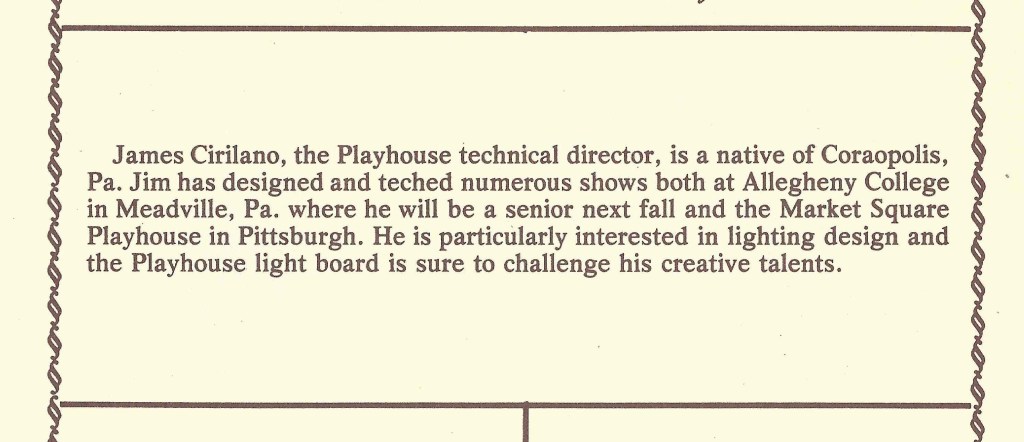
Jim’s blurb in the 1978 program booklet says he was the technical director for the summer, but he also designed shows, in addition to building and painting scenery and acting! He came to us with a wealth of talent and a lot of experience, making him a great Playhouse asset.
I recently heard from Jim who wrote, “I was at the Playhouse in 1978 and 1979, the summers of my junior and senior years at Allegheny College. Those were great times for me. We had some great people on the staff. I remember Al Martin and his nephew Scott Martin. I also remember Nathan Guttman, Joanie Eberhard, and some of their fellow students [NOTE: Sandi Liberatori, Donna Fitzpatrick, and David Woodrow] from Elizabethtown College that summer. Thanks for having me and having that theater. Those summers were really good times!!!”
At right: Jim Cirilano in The Sound o Music, 1978

Today, Jim is a lawyer and lives in Pittsburgh.
During the summer of 1979, Jim and our other Designer/Tech Director that year, Erich Zuern (more about Erich in the next chapter of this history), did a massive rewiring job installing raceway (a type of conduit with plugs for the stage lights) on the barn crossbeam closest to the stage and also on the barn crossbeam over the stage, directly behind the proscenium. Tech crews for the last 44 years have these two guys to thank for that big improvement!

[NOTE: I had a little flashback when Jim mentioned Nathan, a member of the staff. Nathan wanted me to cook Kosher meals for him, something I was clueless about. Besides, I had enough problems just trying to cook for the rest of the company! Nathan ate a lot of tuna fish that summer, poor kid, but he didn’t complain. Joanie, from Jim’s second summer, was bright and perky and an extremely hard worker, even though she wore an artificial leg from birth. Over the years, the Playhouse was blessed with numerous talented, hard-working, staffers. —Shari]
THE ELIZABETHTOWN COLLEGE CONNECTION
Bill Harper had worked on his M.F.A. at Wayne State in Detroit with a guy named Jack Sederholm. Jack had become the head of the Drama Department of Elizabethtown College in Elizabethtown, Pennsylvania. Starting in 1978, Jack started sending us some of his students to work on our staff. They were all good kids–lots of fun and willing to work hard, and some were very talented actors.


Jack sent us four staff members in 1978—Sandi Liberatori, Donna Fitzpatrick, David Woodrow, and Nathan Guttman. 1979—Erich Zuern, Joanette (Joanie) Eberhart, 1980—Erich Zuern, John Touloumes, Bill Hossack. 1981—Erich Zuern, Bill Hossack. 1983—Erich Zuern returned as a volunteer for part of the season.
[NOTE: I had a little flashback when Jim Cirilano mentioned Nathan, a member of the staff in 1978. Nathan wanted me to cook Kosher meals for him, something I was clueless about. Besides, I had enough problems just trying to cook for the rest of the company! Nathan ate a lot of tuna fish that summer, poor kid, but he didn’t complain. Joanie, from the 1979 season, was bright, fun and perky, and an extremely hard worker, even though she wore an artificial leg from birth. Over the years, the Playhouse was blessed with numerous talented, hard-working, staffers. —Shari]
SANDI LIBERATORI REMEMBERS
Sandi’s childhood home was Stowe, Pennsylvania, a small town near Pottstown, Pennsylvania, a suburb of Philadelphia. She and her husband recently moved back to Pottstown, about 5 minutes from where Sandi spent her formative years.
After graduating from St. Pius X High School in 1974, Sandi enrolled at Elizabethtown College in Elizabethtown, Pennsylvania as a music major. “I had taken piano lessons for 12 years,” said Sandi. “I was accepted on my audition, but the day I walked onto campus, I saw what my class schedule would be. I would be taking lots and lots of music theory classes—and that was not how I was taught piano. It freaked me out, and I immediately switched my major to Communications which covered theatre, journalism, and television and radio. The head of the department was a great guy named Jack Sederholm.”
“Jack and Bill Harper, one of the Brooke Hills Playhouse founders, had attended graduate school at Wayne State University together in Detroit, and they had kept in touch. When I was about to graduate from Elizabethtown in 1978, Jack asked me if I was interested in working at a summer stock theatre. Eventually, four of Jack’s students worked at Brooke Hills that summer: David Woodrow, Donna Fitzpatrick, Nathan Guttman, and me.”

Sandi proved to be an incredible asset to the Playhouse that summer. In addition to working on props and scenery, Sandi appeared onstage in five of the six shows that season, and that’s saying something!
”The Playhouse was the first time,” said Sandi, “that I saw adults working on a play, and it was the first time I lived that far away from home. That summer is an interesting and pleasant memory.”
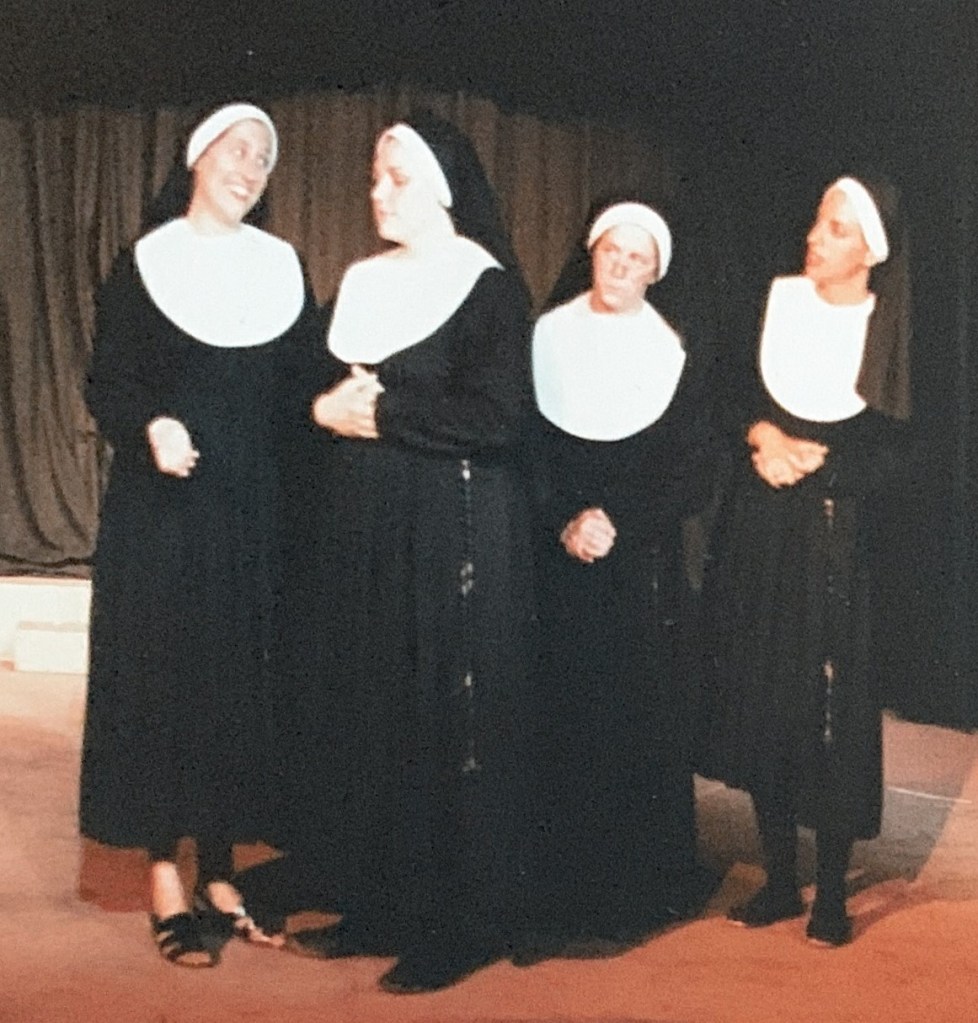
In the opening show, Sandi played one of the nuns in The Sound of Music. “I’d gone to Catholic school for 12 years, and now I was wearing a habit, an interesting experience. Ladies in Retirement fascinated me. It was a change. It wasn’t a comedy, and I had scenes with Scott Martin, who was multi-talented—musician, writer, director, actor. The show was strictly serious. And then there was the crazy, wild, and very funny Sgt. Fenshaw of the Mounties written by Scott. I was in the chorus, and I was also the “card girl” who came out between scenes with a big poster announcing the name of the upcoming scene.”
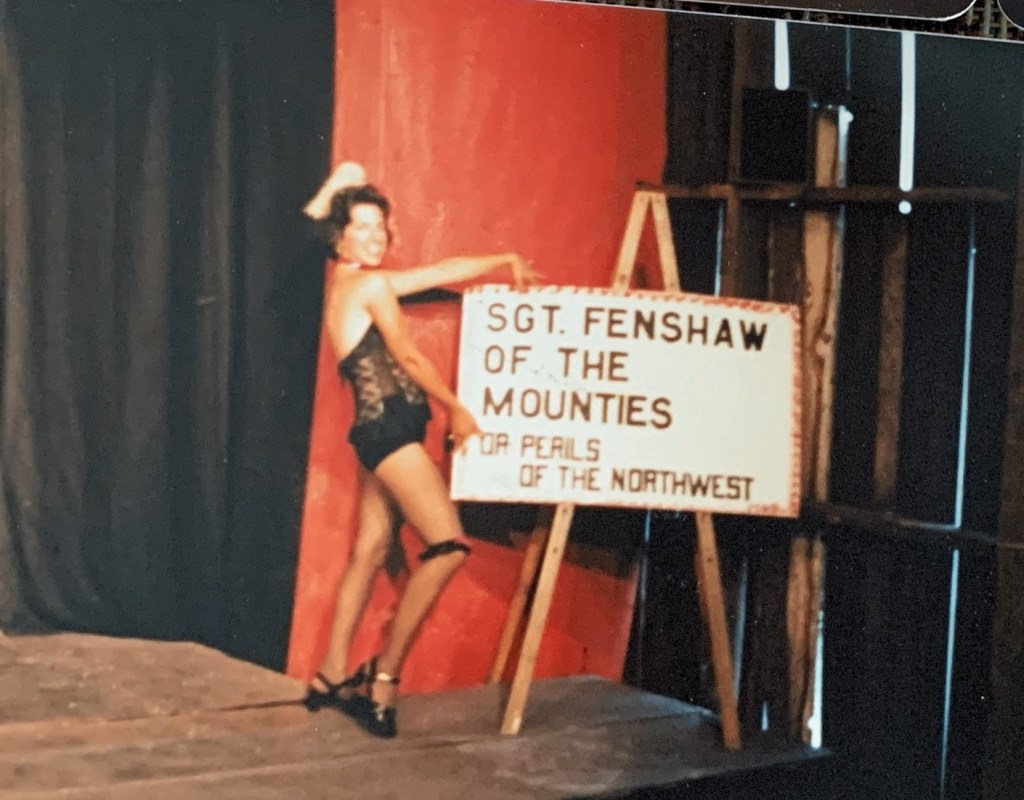
Scott Martin was also the director and piano accompanist of that show. He had Sandi enter, flash the Act/Scene poster around, place it on an easel, then flirtatiously remove an item of clothing. Dressed like a can-can dancer, Sandi started with her gloves, then her neck ribbon, and eventually, she worked down to removing her skirt which left her in a black crinoline. She would flip the skirt, and it never landed where she supposedly wanted it to go. She got laughs, cheers, and even whistles on every entrance and exit. What does Sandi remember? “I was always changing clothes in that show!”
Sandi played a maid in Time Out for Ginger and the young mistress in Any Wednesday. With all those lines to memorize on top of regular Playhouse daily chores and work assignments, it’s a wonder Sandi remembers anything about the summer at all!
After the Brooke Hills summer, Sandi worked for one year at The Pennsylvania Stage Company in Allentown, Pennsylvania, as an assistant to the Artistic Director and the Managing Director. “The theatre,” said Sandi, “was a lovely, little, converted church that was owned by the J.I. Rodale Company (publisher of Prevention magazine among other interests). The following year, I became the Marketing Director of the theatre.
“In 1981, I entered law school at Temple University. I didn’t have a burning desire to be a lawyer, but I was looking for something to do that involved obtaining a higher scholastic degree.” It was in law school that Sandi met her husband Eric, who was the friend of a housemate. During her second year at Temple, Sandi noticed that the lymph nodes on her neck had “popped out.”
“My mother said, ‘Maybe you have mono.’” Sandi went right to a local doctor and had a biopsy of the nodes done at the local community hospital. She was diagnosed with Hodgkin’s Disease (now called Hodgkin’s Lymphoma). The local doctors rarely saw this type of cancer; however, by pure luck for Sandi, another young woman had received the same diagnosis the previous year. The doctors knew what they were looking at this time.
“When it became common knowledge at school that I had this diagnosis, one of my law professors, who also had been treated for Hodgkins, said I should go to the University of Pennsylvania Hospital and see his oncologist. I was told that they saw many, many patients with this cancer, unlike the local hospital, and they would know how to deal with it. I had diagnostic surgery called a laparotomy/splenectomy, and following the surgery, I underwent radiation treatment.”
Over the next 40 years, Sandi practiced law, despite the fact that she had cancer four more times and today has heart valve disease from all of the radiation over the years. AND she is still practicing law. “I like the people I work with,” said Sandi, “and I don’t know what else I’d do!” She and Eric have two daughters, Sarabeth (35) and Amanda (31). Both of Sandi’s daughters were drama majors!

“After Brooke Hills, I’ve dabbled in community theatre for the rest of my life,” said Sandi. “I even sat on the board of a local theatre. At one time, our entire family was involved. For a production of The King and I, Eric built scenery, I played one of the king’s wives, and both girls were in the children’s chorus.
“Other than the shows themselves at Brooke Hills, I remember playing volleyball twice a day, once after lunch and again after dinner. I had played intermural volleyball in high school, and this was a treat for me.” (NOTE from Shari: Sandi was a killer player! She had no trouble getting picked for a team!)
“I remember an opening night party where champagne was involved,” said Sandi, “and I remember going into Wellsburg to do a program for the Kiwanis Club which met at noon. Richard Ferguson and I did a reading from Same Time, Next Year and answered questions from the audience about the Playhouse. Hopefully, we got some of the members to come see a show.”
“Some years ago, the girls and I drove to Nebraska for a visit with a friend. I took a detour and drove to Brooke Hills Park, so I could show the girls the barn theatre where I had worked one summer. No one was around, but I was happy to see the Playhouse still standing. And the girls thought it was very cool to see it. They had heard the stories!
“P.S. Thank you so much for the trip down memory lane. I consider Brooke Hills to be a part of my theatre education, and it really was a wonderful place to work.”
JOHN MARK COOPER REMEMBERS
(In September of 2024, John Mark wrote the following. In November, I called and talked to his mom, Bobbi.)
Shari,
Sorry for the delay in getting back to you.
I read your latest chapter (1977) and was thrilled to see you mentioned me! Very touching. You and that time of my life I hold very dear. Playing Oliver in the 5th grade at Follansbee Middle School which you directed was surreal in a way. I was so innocent at the time, and my mind soaked in everything. I remember memorizing everyone’s parts and all the songs. Special times.

I read your latest chapter (1977) and was thrilled to see you mentioned me! Very touching. You and that time of my life I hold very dear. Playing Oliver in the 5th grade at Follansbee Middle School which you directed was surreal in a way. I was so innocent at the time, and my mind soaked in everything. I remember memorizing everyone’s parts and all the songs. Special times.
John Mark as Oliver in the Follansbee Middle School production, 1977
The three years at the Playhouse were equally impactful. Making so many friends and learning so much while doing something that brought joy. That Tom Stobart who played Fagan in Oliver! at the Playhouse was something! [NOTE: Tom died in August of 2020.]
I thank God for bringing you into my life and for the impact you made on our community over all those years.

I do not regret my football career, and all that I accomplished through that sport. Sadly, I do regret stopping my involvement with the arts when I went to high school. However, music is still part of my life. At 58, I started playing guitar and now play rhythm in our church’s praise band. Who knows, maybe I’ll try out at the Playhouse again in my future!
Thanks again for the special shout out in your memoir. The best of times!
With warmest regards!
John Mark
BOBBI COOPER, JOHN MARK’S MOTHER, REMEMBERS
Without a doubt, we could never have produced shows with young people if it hadn’t been for their dedicated parents who hauled them back and forth to the Playhouse night after night and on weekend afternoons for rehearsals. Rehearsals for the comedies lasted two weeks plus the length of the run—another one or two weeks. Rehearsals for the musicals took four weeks, and they always ran for two weeks. Parents had to schedule vacations, camps, and other activities around those chunks of time during the summer. I only remember one “stage mother” in my 24 years at Brooke Hills, and she eventually backed off. Whew!
Bobbie Cooper’s son, John Mark Cooper, did three shows at the Playhouse over the course of three seasons—Rated X-tra Special (1977), The Sound of Music (1978), and Oliver! (1979). I talked to Bobbi recently, and she said, “Our family has great memories of the wonderful times we spent at the Playhouse. I or Bill and I drove John Mark out to the Playhouse. The trip took about 20 minutes, so we usually stayed in the park, but we also might run a short errand down the hill in Wellsburg, or we’d watch the rehearsal. One of the mothers told me that her child had been in other plays elsewhere, but the parents were never allowed to attend rehearsals. That wasn’t so at Brooke Hills. Parents were welcome.
“I remember that sometimes John Mark would get these coughing or sneezing fits. We never knew him to have allergies, but he did at Brooke Hills—maybe the surrounding fields, maybe the barn wood? We didn’t know, but we had to make sure he had allergy medicine in case he started sneezing!
“One of my favorite memories was in Rated X-tra Special. John was directed to dance with a girl who was much taller than he was. The girl would jump down off the 12”-high stage while John remained on the stage for their dance, something like a tango. It always got laughs.
“Of course, we loved attending the performances. They were always packed. The whole family was happy that John was involved.”
ONWARD AND UPWARD
Sgt. Fenshaw of the Mounties (see above) ended the season on a thrilling up-note. We struck the set, trucked the tools and lighting instruments to the basement of the apartment Bill and I rented in Wellsburg, said our goodbyes to staff members, and closed up the barn at the end of this, our seventh season, looking forward to the spring of 1979.

 Life Without Lesson Plans
Enjoyable.
Allen W Bird II
501.993.2047
LikeLike