
by Shari Murphy Coote and Friends
A HISTORY AND A DIVERSION: SOME TALES FROM BETTS’S BAR
INTRO
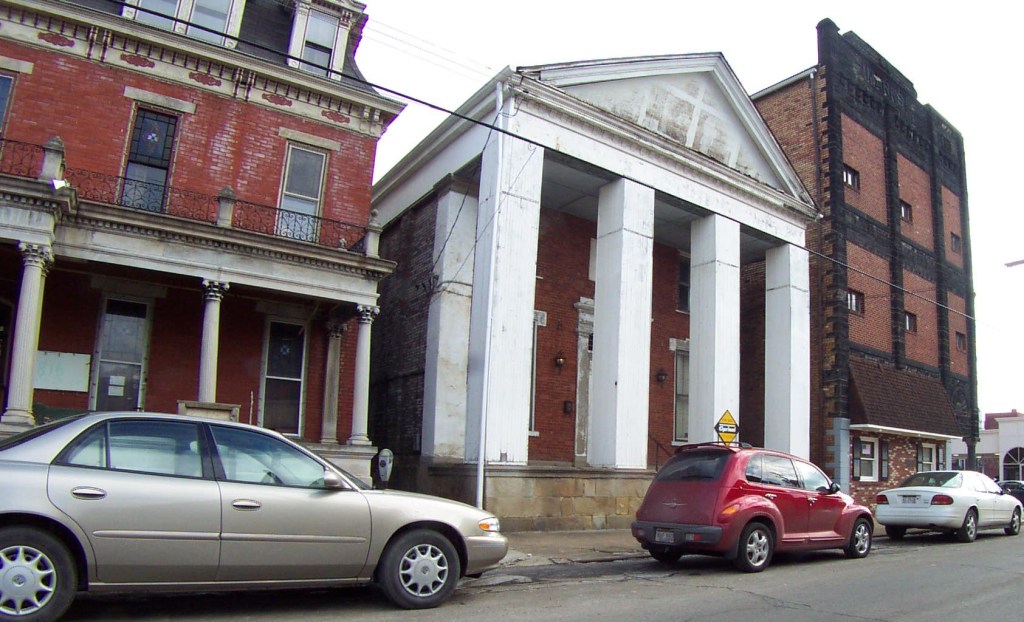
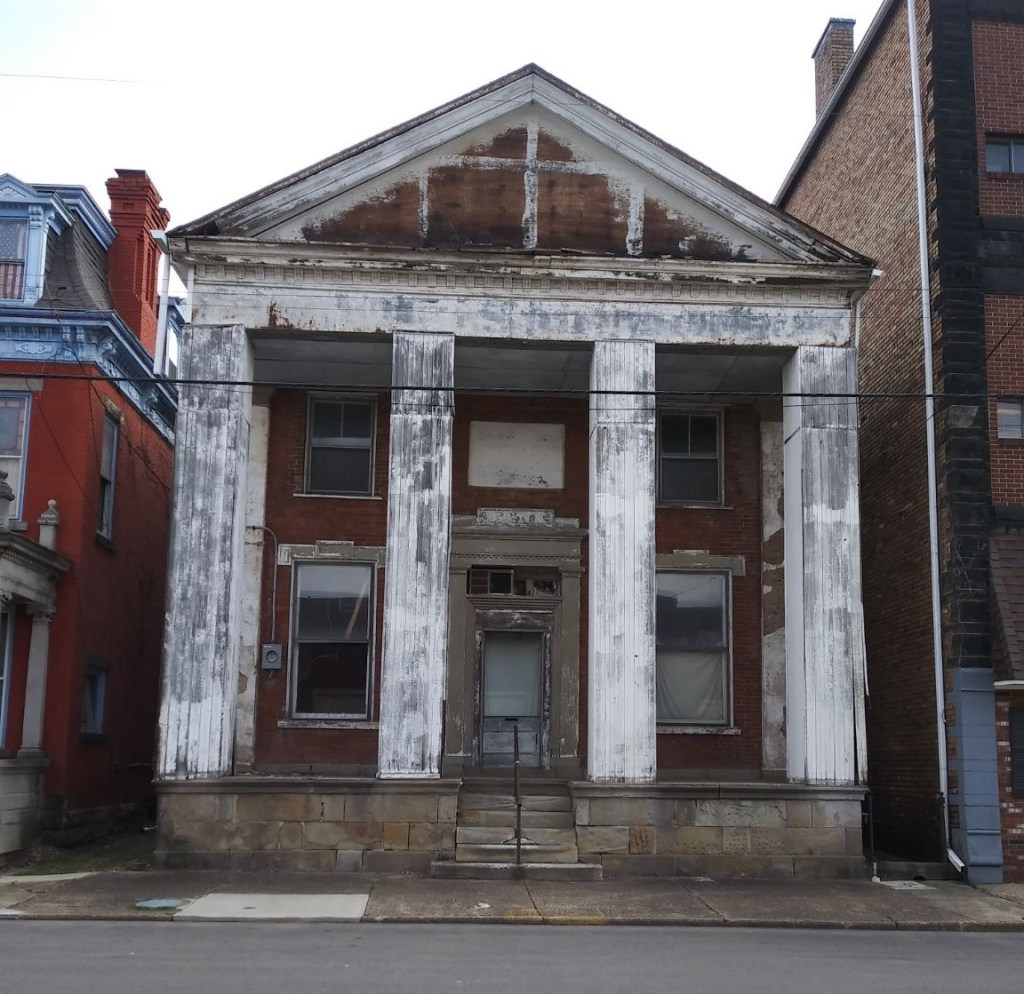
My Aunt Alice Hamilton took me to Betts’s, a bar in downtown Wellsburg, West Virginia, during the summer of 1967, after my sophomore year at West Liberty State College. Up until then, I had no idea that the large, ancient building with its imposing columns and massive stone porch and steps at 808 Main Street even housed a business, let alone an intimate bar.
If you ever watched the TV show Cheers, you will have an idea of the ambience of the small bar. The Cheers bar was much larger than Betts’s, but like Cheers, Betts’s had its regulars who had their places, almost reserved seats, at the bar each evening. Bob Stoetzer, the postmaster, sat on the last barstool on the north end of the bar. Betts sat on a wooden stool behind the bar on the south end. Pearl Baker, the librarian, sat three stools down from the south end of the bar. Eleanor Bickerstaff sat on the second stool from the south end while chain-smoking, laughing, and telling stories in her gravelly voice.
One night Eleanor had us all in stitches telling us how, when she was young, she sometimes went out to Buffalo Creek to find a big turtle. She would pull it out of the water, stand on its back, whack off its head, and take it home. She then told us how she made turtle soup. Picturing this short, older woman (always dressed to “the nines”) with very stooped shoulders, a little thick now through the middle with short grey hair standing on a turtle cracked us up every time!
When Mayor Anthony Cipriani retired, he wrote a history of Wellsburg, which was published in 1991.
In the book, Tony recorded the history of the building during its life as a bank:

In 1832, a branch of the Northwestern Bank of Virginia was established in Wellsburg [at 808 Main Street].
In 1865, after the passage of the National Bank Act, the [bank] was reorganized as the First National Bank of Wellsburg.
In May 1871, by order of the stockholders, the First National Bank went into liquidation and was succeeded amicably and without intermission by the Wellsburg National Bank.
In 1924, construction was started on a new bank building on the southwest corner of Eighth and Charles Streets. Construction was completed March 6, 1925.
LEFT: The cover of Tony’s book. Incidentally, one of Tony’s sons, Chris Cipriani, appeared in numerous Playhouse productions from 1977-1982.

I can’t find any record of what happened to the abandoned bank building at 808 Main Street at the time the bank moved around the corner to Charles Street. I subscribed to a property record search, but that was a bust. It only showed that Harold “Babe” Tarr, Betts’s husband, bought the building in 1956. He planned to open a bar on the first floor, Harold’s Club, and to house his family (Babe, wife Betty or Betts, and daughters Diane and Patsy) in an apartment on the second floor.
Diane told me that at some point the second floor had housed a dance hall. Maybe there was a bar on the first floor at that time to quench the thirst of the dancers upstairs? Diane knew for sure that her cousin, Jimmy Tarr, gave tap dancing lessons on the second floor in 1936. She also knew that when her dad bought the building in 1956, Babe renovated the bar and that he and some friends transformed the upstairs dance hall into an apartment with soaring ceilings and “flimsy” walls—living room, bedrooms, kitchen, and bath for the family of four.
Betts always told us that the bank’s safe was still in the room behind the back bar where there was storage, a sink for housekeeping, and the restrooms. The safe had been paneled over, but Betts assured us it was there, and that it had been used for coal storage when the Tarr family moved in. [NOTE: Diane told me that sometime in the early 1980s, Diane’s partner Tom, and Patsy’s husband Dave, took down the paneling hoping to find something exciting in the safe. They found coal. They replaced the paneling, and that was that.]
The actual name of the new bar in town was Harold’s Club, named for the owner, Harold “Babe” Tarr. Outside, near the front door, there was a discreet, burnished, bronze sign proclaiming, “Harold’s Club,” but everyone called it Babe’s. By the time of my induction into the club in 1967, Babe’s wife, Betts, was running the bar, and it soon became known as Betts’s.

Aunt Alice introduced me to Betts, the former Elizabeth Hudspeth, proprietor, bartender, janitor, and “chief cook and bottle washer.” From then on, I counted Betts as one of my dearest friends.
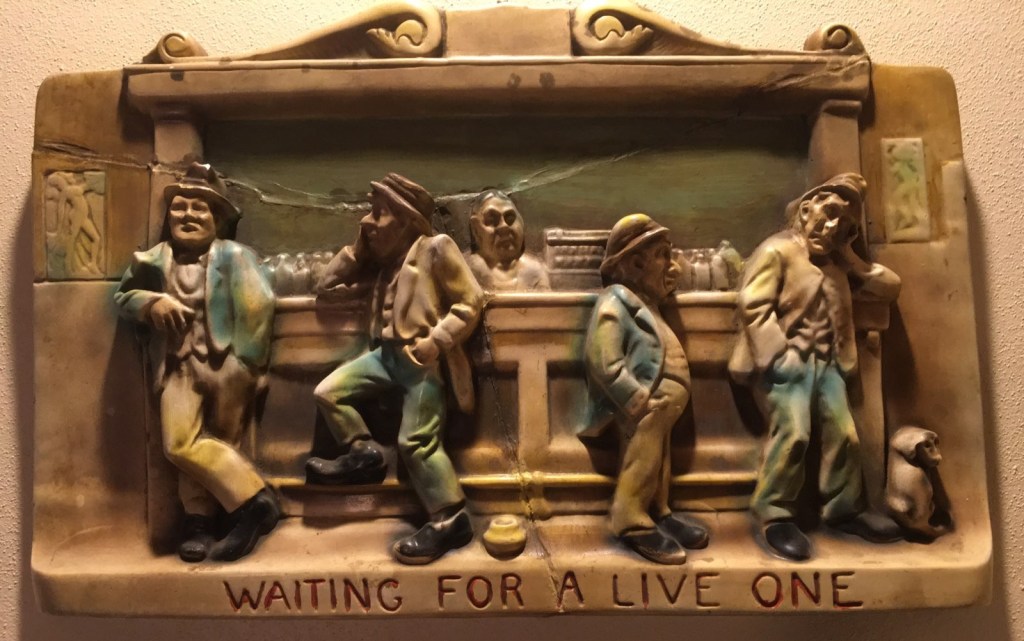
When I said earlier that the bar was intimate, I meant little. The size of the building masked the size of the interior, but the sturdy walls were at least one foot thick and possibly 14” or more. It was/is a very solid building. The bar had just six tables, three on either side of the large, front door. To the right of the door upon entering was a jukebox. Across the room, there were 8 high, comfy, padded bar stools with backs and footrests at the long, lovely bar, 14’ to 16’ running parallel with the Ohio River and Main Street. The back bar had a big mirror, and when people noticed the terra cotta sign over the mirror, they always got a laugh.
Babe opened the bar on the first floor in 1956, and Betts took care of the children and the house upstairs. Since all establishments with liquor licenses had to serve food, Betts also cooked for the family and the bar. The regular bar menu was pickled eggs in a big jar, dill pickles, and Slim Jim sausages. Betts also made a large pot of soup on weekdays for the lunch crowd. Bean soup and chili were favorites.
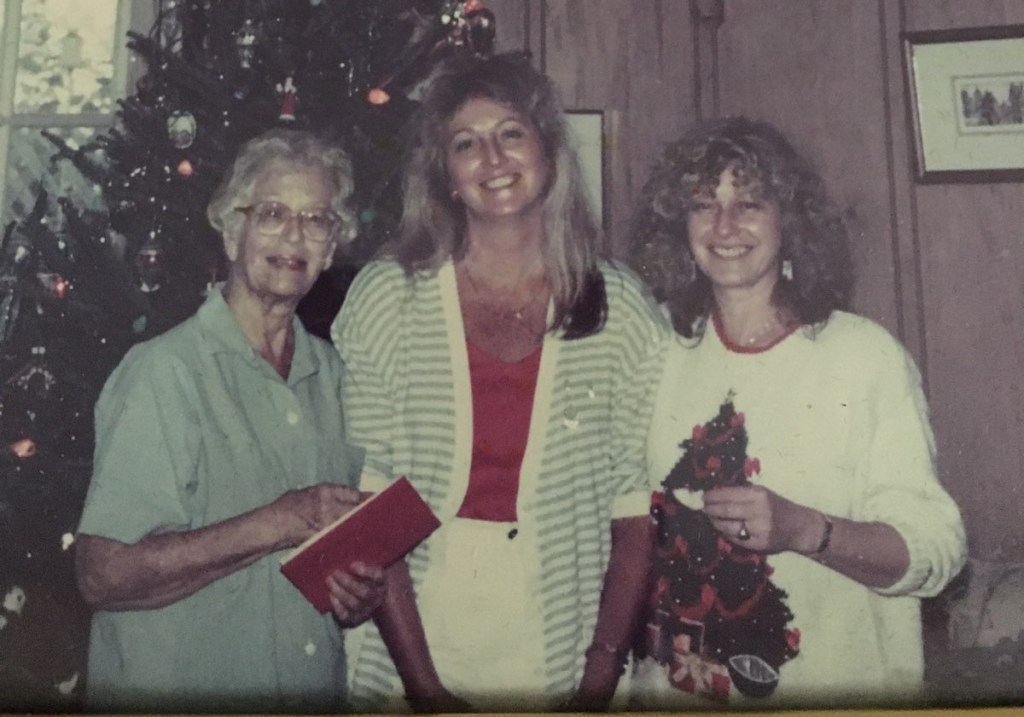
Betts went downstairs to the club most Friday and Saturday nights in those early days to chat with the regulars, most all of them friends. Diane said, “Even though my parents were both just downstairs, Mom hired a babysitter for us until I was old enough to watch Patsy.”
Diane also told this amazing story. “My dad could drink beer all night, but he couldn’t hold his liquor. One evening when Mom was out of town, Dad closed the bar, walked over to the pool hall, had a few drinks, and got into a poker game. Wibby (Wilber) Chamberlain was like Wellsburg’s benevolent godfather. He owned the pool hall, and he also ran all of the illegal gambling in Brooke County. Anyway, liquored-up, Babe proceeded to lose the bar or the mortgage of the bar, our home (!) in this poker game.
“When Mom learned what had happened the next day, she walked over to the pool hall. She and Wibby came to an agreement wherein Wib loaned Mom $10,000 to reclaim the mortgage that Dad had lost! Over the next X-number of years, Mom walked around the corner to the pool hall every Friday afternoon, often with her big, black, Labrador retriever, Sam. She eventually paid back the entire amount.”
[NOTE: Most evenings, Betts brought Sam to work with her. He had a favorite place behind the bar to lie, and Betts was often stepping over him to pull a beer or wash glasses. Sam was pretty imposing, and I imagine that he gave Betts some feeling of safety when she was alone in the bar. He often went back upstairs on his own when the bar became crowded.
Pearl Baker, the town’s librarian, lived a few houses north of Betts’s. (Pearl was a regular and often prevailed on a young man at the bar to walk her home after she’d had a few drinks.) One time, Pearl baked a ham and set it out on her front porch ledge to cool. Sam must have gotten a whiff of that ham, and before Betts could stop him, he had stolen the ham and run off with it. He eventually returned home, mouth dripping with ham grease, and probably full of the entire ham as it was never found!]

OUT OF SIGHT, NOT OUT OF MIND
Several of Wib’s slot machines were discreetly placed in Harold’s Club. Behind the right end of the bar was a door. Through that door was a little landing and then the stairway up to the second-floor apartment. (There was also an external staircase on the outside of the building on the right side as you face the building.) Directly inside that door to the left was a niche with three or four slot machines. There was a pull-down cover (a piece of painted plywood with a handle) that would hide the machines when the state liquor inspectors came to check up on things.
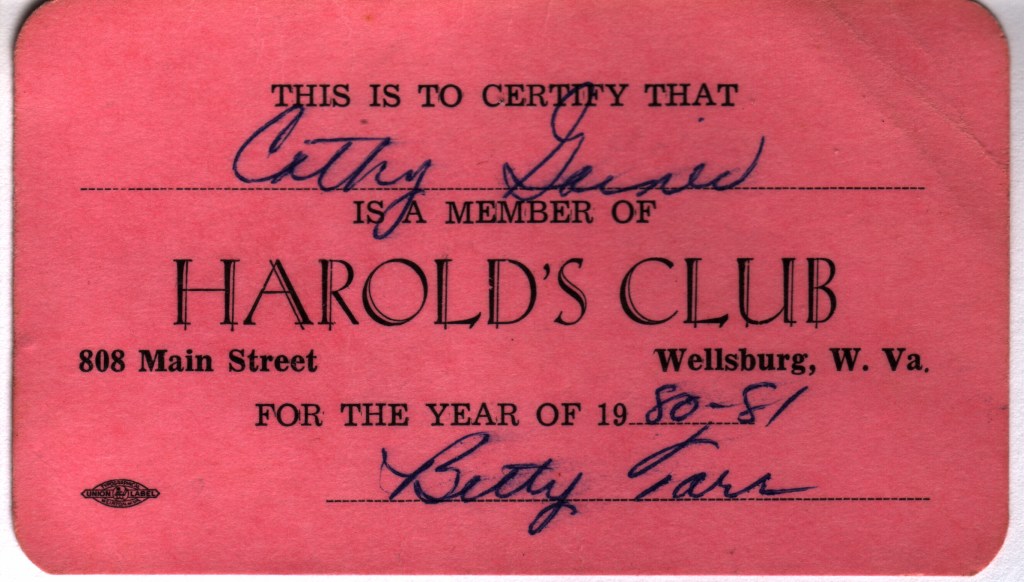
And what were those things? First, all bars in West Virginia at the time had to be private clubs, so Betts had to maintain a membership book with the names and addresses of all the “club” members. It cost $1 to join, and membership was by Betts’s invitation only (or by Babe’s invitation early on). The inspectors would ask to see the membership log.
The private clubs had to serve food, so the inspectors wanted to know about the menu. Betts’s standard line was, “Well, the kitchen is now closed, but the weenies are in the safe behind the back bar.” Since the “kitchen” wasn’t on the bar floorplan, the liquor inspectors were not allowed access to that area.
Finally, the inspectors would do a quick, little look around for evidence of illegal gambling. These inspections always went smoothly because Betts would always get a call about 10 minutes in advance of the inspector’s visit. I don’t know who made the call, but I imagine it was someone in law enforcement getting a little protection money, or maybe it was Wibby or one of his guys, protecting his machines. Anyway, Betts had plenty of time to pull the cover down over the machines. This was just a precaution, because that area of the first floor wasn’t on the ground plan of the bar either, meaning the inspectors couldn’t legally go through the door that led to the upstairs apartment where the machines were located.
THE HISTORY CONTINUES
In 1971 or 1972, Babe started losing weight like crazy, and he became quite ill. Betts called Diane, now a nurse, who came home and got her dad to the hospital where he was diagnosed with a gastric ulcer. During his sickness and long recovery, Betts took over the bar. When Babe did recover, he decided that he didn’t want to go back to the bar business. He had learned welding in the U. S. Navy, and had liked it, so he went to welding school, took a job, and loved working outside. Meanwhile, Betts was happy running the bar, changing the hours of operation and not opening until 6:00 p.m. She became the official owner in 1973, after she and Babe divorced.
OUR GO-TO PLACE
A year or two before Bill Harper and I married in 1972, I introduced him to Betts’s, and we went there often—affordable and friendly, a winning combination. In a previous post (Part 14), I told how the Harpers met the Cootes (Bill and Rich were inducted into the Elks Club on the same evening, and the Harpers introduced Rich and Betsy Coote to Betts’s that evening in 1976). Shortly after that meeting, the DeBords (Charles and Beverly) joined our group, and the six of us spent many fun evenings at Betts’s.
In those days before cell phones, we didn’t carry our cameras when we went out for an evening. Consequently, we have no photos of the interior of our favorite little bar. I hope you’ll eventually get a mental picture of Betts’s from the stories to be told.
Also, in 1972, Bill and I and John Hennen started the Brooke Hills Playhouse. Eventually, Betts’s became the official “corporate office” of the Brooke Hills Playhouse. During the summers, casts and crews would descend on Betts’s after the performance to cool off in the A.C. with cold brews. Betts made all of us feel welcome, and she often encouraged her regular patrons to buy the Playhouse table a pitcher or two of beer. We might rehash the evening’s performance, tell old Playhouse stories, or even play table games like Fictionary or Pictionary. Cathy Gaines, one of the Playhouse staffers in 1980, loved Betts’s, and she still has her membership card!
THE END OF AN ERA
Major changes started coming to our wonderful relationship with Betts’s in 1979. It wasn’t long after the conclusion of the Playhouse season on August 12, that Richard and Betsy Coote moved away. Rich had been the GM at the Westvaco bag plant in Wellsburg (still operating on Commerce St. but now owned by a different company), but he was promoted to regional manager for the company, and the Cootes moved to New Orleans. Tragedy struck on September 9, 1979 when Charlie DeBord was killed in an auto accident. His wife, Beverly, pregnant at the time of Charie’s death, shortly thereafter moved to Charleston, W. Va. to be near her family.
The Playhouse gang and many of our teacher friends continued to gather at Betts’s, but more changes were coming. Bill and I divorced at the end of the 1981 Playhouse season, and our son Andrew was born about the same time. Bill moved back to his home in Chester, W.Va., and I “inherited” the Playhouse and custody of Andrew.
For all intents and purposes, my days at Betts’s were over. I was teaching, helping with the scenery for the high school musicals directed by Norma Stone with musical direction by Rick Taylor, sponsoring several extra-curricular activities, directing shows at two local colleges, and being a single mother, while figuring out how we would keep the Playhouse going. When the summer of 1982 came around, some of the Playhouse casts and crews would head for Betts’s after the show, but I had to get home to relieve my mom and dad, who were wonderful. They would pick up Andrews after dinner at the barn night after night and take him to my home to put him to sleep in his own bed. I had little or no time for Betts’s, but I would give Betts a call every so often, just to stay in touch with a dear friend.
In 1985, Betts retired and closed the bar. In the fall of 1987, her many friends and family members had a big, going-away party for Betts at the American Legion Hall in Wellsburg, and she moved to Hope Sound, Florida to be close to her daughter Patsy. She also spent time in Boston and Florida with her daughter Diane.
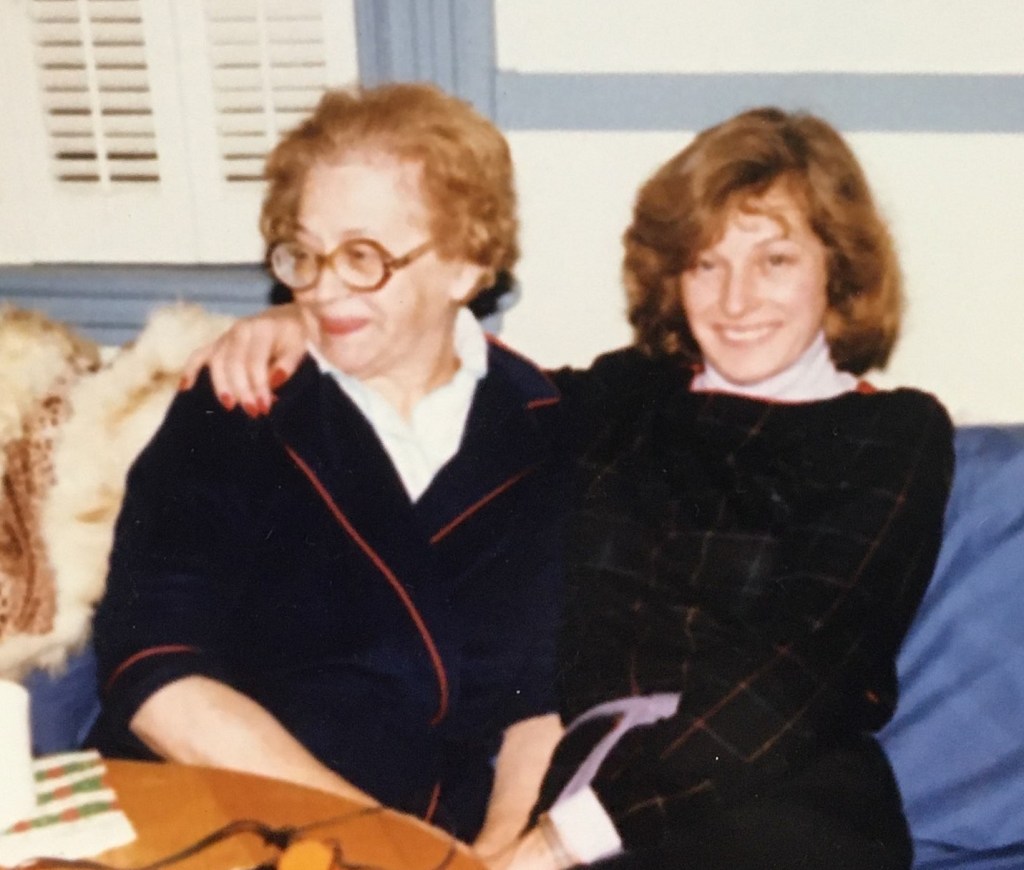
In 1987, Babe moved back into the apartment at 808 Main, and he lived there until he died following a heart attack in 2001 while watching the planes hit the twin towers on 9/11. Diane was able to get the last flight out of Boston to fly to Pittsburgh. She was the only civilian on the flight, but she is a veteran having served in the U.S. Navy. Her sister and brother-in-law quickly drove up from Florida. “I think watching the planes crash into the World Trade Center Towers was too much for the WW II vet to believe,” said Diane. “Dad passed away several days later. I consider him another victim of 9/11.” Babe was 88 when he died.
THE HISTORY CONCLUDES
I learned from the property records that the building had one owner from 1997 to 2003 and another for just 3 months in 2018. I can’t find anything about the present owner although it might be the same person who owned it from 1997 to 2003. That’s pretty spotty record-keeping. It has never reopened as a business, but perhaps one of the owners lived or lives upstairs. Today, it is still an imposing building, but it looks sadly bedraggled. Fortunately, some great stories live on.
THE STORIES BEGIN!
OOPS!
We often made Betts tell this story. One day Betts cooked a big pot of chili for the lunch crowd. It was boiling hot, but Babe hadn’t come upstairs to the apartment yet to carry the pot down to the club. Since she had time on her hands, Betts decided to clean the cage of her little parakeet, Budgie. Betts opened the cage door, and out flew Budgie, loving all that space in the big rooms to stretch his wings. The next thing Betts knew, Budgie had somehow taken a nosedive into the chili! Betts rushed to the stove, but of course, it was too late. Betts said she started to cry and then she started to think, “I don’t have time to make another pot of chili!”
She grabbed the ladle and fished poor, dead Budgie from the chili pot, headed for the bathroom, and flushed the little bird into oblivion. In short order, Babe came upstairs, grabbed the pot from the stove, and took it down to his hungry lunch bunch. Betts said it was twenty-some years before she told the story, but after two years she breathed easier as she never heard of any of their customers getting sick or dying from chili-boiled parakeet.
MEMBERSHIP REVOKED!
Bob Stoetzer, the Wellsburg Postmaster, stopped into Betts’s on a regular basis and always sat at the end of the bar, about seven barstools from where Betts would sit on a stool on the opposite side of the bar. One evening, a couple came to the door. Betts went to see who had arrived. It was someone who used to frequent the bar when Betts’s husband Babe ran the place and his date.
Betts let the couple in, and they sat on stools at the bar where the guy talked to Betts for a minute or so. The woman didn’t say a word to any of us, just gulped down a screwdriver that she definitely didn’t need. Apparently, Betts’s was not their first stop of the evening. Before long the woman made her way to the restroom, which was around Bob’s end of the bar, through a small archway, and in a back room.
A bunch of us were at a table holding an earth-shattering conversation or maybe playing a game as we often did. Bob had a direct view through the archway into the back room. After a while, Bob looked down the bar to Betts and announced in a complete deadpan voice, “Betts, you have a lady in distress down here.”
Betts went to see what the problem was. About three minutes later, Betts called for the woman’s date and shortly thereafter the couple struggled out into the main room, passed by us, and left.
When Betts returned to her stool, she told us what happened. “When I got back there, there she was on the floor. She must have fallen off the commode, and thankfully, she hadn’t locked the door. She was half in the restroom (more like a closet with a toilet and sink) and half out. After I got her up and leaning against the door jamb, I took a look at her. She’d been wearing a wig, and the thing was now on sideways with the part running ear to ear. Hair covered her face down to her chin. I screwed the wig back into place. Her panties were down around her ankles, so I pulled them up. Her skirt hem was tucked into her belt, so I pulled that down. Then I called for her date to come back to the restroom, get his date, leave the club, and never come back again.”
We never tired of that one!
THE BEAUTY OF LIVING IN A SMALL TOWN
Bob Stoetzer figured into another story. Bob was on his regular stool when I entered one evening.
“Hey, Bob,” I said, “I want to commend you and the U.S. Postal Service. You’re doing a great job.”
Bob didn’t seem to be too impressed, but I continued, “I got a letter today addressed to Shari Murphy, 1714 Marianna St., Wellsburg, WV, where I lived with my parents until I went away to college. After that, I moved away for a year, then I got married. I’m now Shari Harper. I live at 600 Commerce St., but I still got the letter!”
Bob ordered another beer, turned on his stool to look at me and said, “That’s nothing. We once delivered a letter addressed to “the one-legged man on Bethany Pike.”
Okay, that story trumped mine.
ANYTHING GOES!
Another time, our crazy friend Charlie DeBord got into a game of strip poker with one of the female associates from his law firm—right there in the bar! Betts finally went upstairs to her apartment and brought down some blankets to cover them up before someone’s underwear came off.
Probably the funniest part of this story occurred when people entered the bar. Customers would come in, scan the room to see where they might sit, and see the woman and Charlie sitting like Native Americans, each wrapped in a blanket and bare-footed.
Someone already seated would say, “They’re playing strip poker,” and go back to his drink. The newcomer would maybe say, “Oh,” or just nod, go on to the bar and order a drink. People were playing strip poker in a public place, for Pete’s sake, and everyone acted like it was the norm, which it wasn’t at all. But it was Betts’s, where people were either your friends or friends you didn’t yet know, and friends accepted each other—no matter what. Believe me, it was a beautiful thing.
A MODERN PROMETHEUS
Sometime in the mid-1980s, there would only be a few of us left after 11:00 p.m., but we were all having fun, so Betts would go upstairs to bed, and we would party on. She gave our great friend Rick Taylor the key to the front door, and he would lock up as we left. [NOTE: Rick and his wife Teresa joined the Playhouse group in 1977. Their stories are in Part 15-B of this Memoir.]
One night Betts had gone upstairs earlier than usual, and Betts gave Rick a key to lock up when we were ready to go home. Around midnight, Rick announced “Last Call,” so he and Teresa could leave at 12:30 a.m. Rick went in the back to start turning out lights, and our gang downed the remainder of our beers and put on coats. Unfortunately, a couple of steelworkers who were also regulars, led by Bill Fonner, who was a fun guy, wanted to stay. Rick stuck to his guns and said, “Everyone out,” and everyone left.
A few nights later, our gang was back at Betts’s when Bill Fonner returned. He had brought a chain, long enough to go from Betts’s stool, the entire length of the bar, and around the corner into the backroom where the restrooms were. Bill took the chain into the back room then joined his buddies at a table.
Later that evening, Betts again left Rick in charge. When Rick went behind the bar and assumed Betts’s stool, Bill brought out the chain. Then he pulled two locks from his pocket. We all watched and laughed as Bill, a big guy, locked one end of the chain around Rick’s waist, locked the other end to the bar rail, and went back and sat down. Rick dragged that chain up and down the bar and slung it back and forth so as not to trip on it for several hours—while drinking beer himself! No one wanted to leave. The show behind the bar was too good! Bill chained Rick to the bar several times over the years. Rick was always a good sport, and the story has been repeated hundreds of times.
TWO EXAMPLES OF “ALMOST-TOO-WEIRD-FOR-WORDS”
ONE. One evening the three couples, DeBords, Cootes, and Harpers were sitting at the table by the fireplace under the TV. (There would have been no central heating when the building was constructed as a bank, and there was a matching fireplace at the other end of the room.) I had my back to the bar, and for some reason, I put my arms up over my head to stretch.
A guy named Buggo, who bartended at the Drover’s Inn where Playhouse patrons could partake of our dinner-theatre arrangement, was sitting on a high barstool behind me. We had known him for years. When I stretched, he grabbed my wrist, put my thumb in his mouth, and bit down at the first joint! Hard! I was bent over the back of my chair, and I was trying to pull my thumb away, but he had a good grip on my wrist. AND he kept biting down even harder. I couldn’t move. I really was in pain, and the tears started rolling. I started yelling something like, “Stop it! What are you doing? You’re hurting me! STOP! STOP!”
My friends at the table originally thought I was kidding around, but I kept yelling and gasping and crying, and he wouldn’t let go. Richard Coote was sitting across the table from me, and he realized, I wasn’t joking. He sprang up, charged around the table, and pulled back his fist, yelling something. Buggo seemed to know he was about to get a fist in the face, and he finally let go! Betts, who was behind the bar really didn’t know what was happening as Buggo’s back was blocking her view.
I was free, but I was crying and couldn’t talk. I also couldn’t believe that my thumb was intact. As Richard checked on me, Buggo took off with Richard yelling, “Don’t ever come back!”
Someone explained to Betts what had happened. It was almost too weird to believe, but my throbbing, swelling, and teeth-marked thumb was proof of what had just happened. I’m pretty sure that Buggo never showed his face in Betts’s again. It wasn’t long after that that the Drover’s had a new bartender. Still a very strange incident.
TWO. One slow evening, Betts had “gone home” (home being just upstairs) leaving Bill and me and Rick and Teresa Taylor in the bar with the door locked. Rick and Bill were talking sports at the south end of the bar, so Teresa and I moved to the north end to talk. There was a knock at the door, and Rick went to see who was there.
Two guys that Rick, Teresa, and I taught school with (and that Rick was good friends with) were at the door. Rick let them in, locking the door behind them. They weren’t really regulars, but they had been to Betts’s before, so no big deal.
It wasn’t long before we realized they had been drinking somewhere long before they showed up at Betts’s. Rick served them each a beer. They declared they only wanted one before going home. One guy stayed with Rick and Bill to talk sports.
The other guy, for whatever reason, decided to bother Teresa and me. We really didn’t want to talk to a drunk, and we suggested he join the guys at the other end of the bar. He didn’t get the hint and hung around. Then, out of nowhere, he grabbed Teresa from behind and started pulling her over the back of the tall barstool which was tipping over. Who knows what he was thinking?
This all happened lightning fast. I don’t know what was said exactly, but Teresa yelled something like, “What the hell?” Anchoring her hands on the bar, she quickly swiveled the seat, turned and jumped from the stool, and came up yelling with fists swinging! The guy had been in an accident a few years before and had lost the sight in one eye. His hands immediately went to his face to protect himself, his eye in particular.
Teresa is the oldest of eight children, six of whom were brothers. She had been fighting with guys all her life and didn’t hesitate to get in a few good licks. She was backing the guy up when Rick saw Teresa swinging. He flew out from behind the bar yelling for the two drunks to get out and never come back.
They sobered up pretty quickly, but Rick was really pissed (rightly so), and he wasn’t having any of their attempts at apologies. They quickly left, and we were left wondering where that crazy “hug” had come from!
WE’RE ALL IN THIS TOGETHER
Our dear friend and Playhouse compatriot, Norma Stone tells the following, her favorite story. “Betts’s was the place to be on Friday nights during football season. The place would be packed, the tables full, and often three-deep at the bar. The regulars would be there early, and our group claimed the good seats. Those who had attended the high school football game would come in later.
“One evening our group had put two tables together on the jukebox end of the bar, and we were packed around our tables. In front of the fireplace, on the north end of the room, were Sue and Gary Griffith, good friends of ours, also.
“I’m not sure what exactly caused this to happen, but Sue fell sideways off her chair and onto the floor! Some at our table saw Sue go down, and within a millisecond, some crazy signal flashed across our table, and our entire table fell sideways off their chairs, in solidarity with Sue, I suppose! It’s a wonder no one was hurt! Nothing was said, but we were so tuned into each other, that down we all went down.
“Sue’s husband helped her up, and we all got up and got on with our conversation and drinking. Maybe you had to be there, but honestly, it was a thing of beauty!”
FLIPPED SO FAST
HE WONDERED WHERE THE CEILING WENT!
On a random Monday in the fall of 1978, some of our gang were at Betts’s watching Monday Night Football and solving world problems. At some point, Rich Coote started telling us that years ago he had seen an episode of Davy Crockett or Daniel Boone on TV where there was a leg wrestling contest. Sometime later, he had read something about women being better than men when it came to leg wrestling. It had something to do with women having a lower center of gravity, and on a whim, he had challenged his wife Betsy to a match, best of three, in their living room.
They lay down on the carpet, right hip to right hip. On the count of “One,” they raised their right legs, then lowered them. The same thing on the count of “Two.” On “Three,” they raised their legs, interlocked them, and Betsy flipped Rich tail over head in less than a second! They did it again. Boom! Rich again went flying! There was no need for Round Three!
A guy at the bar who knew Betsy, let’s call him “Walt,” had been listening to the conversation, and he said he didn’t believe the theory was true. Maybe Richard just didn’t have the technique or some such thing. Anyway, after a little smack talk, it was decided that Walt and Betsy (who wasn’t even at the bar that night) should duke it out—leg wrestling-wise.
On Friday, our regular group, Harpers, Cootes, and DeBords, went out to dinner and a movie and then stopped at Betts’s. Eventually, Walt arrived with the after-Brooke-High-School-football gang, and the match was on! Betsy disappeared into the back room.
A few minutes later, our group “singing” started the Rocky Balboa Theme Song. “Da, da, daaaaa. Da, da, daaaa…” Charlie appointed himself referee, and he announced, “Ladieeeees and Gentlemen, welcome to the Betts’s Bar Brawl. Let me introduce tonight’s contenders. First, the woman who put her husband Richard in his place and is looking to do the same to Walt, Betsy the Bomber.”
Betsy entered. She had changed into shorts, tee shirt, and a snazzy, full-length, hooded bathrobe like the ones fighters wear on their way to the boxing ring, that Bev had given to Charlie one Christmas.
Betsy did some boxer moves around the bar, ditched the robe, and hit the floor in front of the jukebox by the door, the only open space in the room.
Next, Charlie pointed to the bar, “And now the challenger, Walt the Wobegone. Walt, take your place beside your worst nightmare.” Betsy and Walt were nearly the same height with Betsy having a slight advantage. Betsy also had very long legs. You can see where this is going, can’t you?
Walt, confidently and happily, left his barstool and lay down hip-to-hip with Betsy, heads at the opposite end of each other. Everyone left their chairs and stools and circled around the two people on the barroom floor.
Charlie chattered on, “This match between Betsy the Bomber and Walt the Woebegone consists of three rounds. To win, you must win two rounds. Betsy, if you win, you have to buy Walt a pitcher of beer. Walt, if you win, you will have to apologize on bended knee to Betsy, ask her forgiveness, and vow to never denigrate women in any way again for the entire rest of your life. I will count to three.
“When I say, ‘One,’ raise your adjacent legs and point your feet skyward then lower them to the floor. Repeat this action when I say, ‘Two.’ When I say, ‘Three,’ raise and engage your legs and try to flip your opponent over, using only your raised leg. Ready?”
Charlie counted. Legs were raised. On Charlie’s, “Three,” Betsy flipped Walt so fast, he wondered where the ceiling went! The spectators went wild. Oh, my gosh, the laughing and the ribbing Walt endured. He declared Betsy’s victory a “fluke” as he crawled back into place for the next round! The opponents took their places again. Again, Charlie counted, and again Betsy sent Walt butt over hairstyle. The match was over. Charlie raised Betsy’s hand in victory. Betsy was so embarrassed, and she felt bad for Walt, who got up off the floor and left. People returned to their places and started drinking and chatting again, and the leg-wrestling incident entered the storied lore of Betts’s wonderful bar.
A DIRTY, ROTTEN SCOUNDREL
There was a guy whose name I’ve forgotten who would sometimes bring his guitar into Betts’s, and we would all join him in song. Sadly, that guy didn’t come to Betts’s very often. Teresa Taylor had majored in classical guitar at West Liberty, and we eventually convinced her to bring her guitar to the bar. We sang and drank and harmonized and carried on and had some great times. Teresa was very protective of her guitar, and she wouldn’t bring it out if the weather was too wet or too cold. Also, it was a bit of a pain for her to drag around, which we all understood, but we loved when she would bring it.
Someone finally had the great idea of starting a Guitar Fund, a jar on the back of the bar where people could contribute their change or some folding money. We needed about $250, I think, and with Betts gently mentioning it, the fund took off. No kidding. I don’t know if people really liked the singing or just thought it was funny and worth a contribution, but the fund was building.
One evening, the bar was packed. People were sitting two on a bar stool or chair or standing. Another good time was enjoyed. After a few hours, the bar slowly started to clear out, when someone noticed that the Guitar Fund jar wasn’t in its usual place. It had been there earlier, and several donations had been made. Now, it was gone!
Betts was pretty sure she knew who the thief was, a guy who only came in a couple of times a year, but of course, there was no proof, so we just let it go. We didn’t start the fund again and settled for singing when Teresa was able to bring her guitar. Betts never saw the guy again.
TIME TO GET BACK TO BUSINESS
There are so many stories from Betts’s, but it’s time to get back to the Playhouse history. Our beloved friend, Betty Hahn Tarr, Betts, died in 1993 at the age of 73.

EPILOGUE
This post received numerous positive replies. Erich Zuern wrote to me to relate two of his memories from Betts’s. I think it’s appropriate that his memories be included, and if you have any memories you’d like to share, send them to me at smcoote@gmail.com. If you are hesitant to write out your memories, email me, and we’ll arrange for a time to chat. I’ll do the writing for you.
Erich Zuern, Playhouse Designer/Tech Director for three seasons wrote: My story is kind of Betts’ adjacent. After a full season of fun and hard work, well-oiled with heavy glass pitchers of cold beer at Betts’s, I returned to Elizabethtown and our favorite college bar. After hefting those big glass pitchers all summer, the first cheap plastic pitcher I picked up nearly went right over my shoulder. Much beer was spilled, and much ribbing ensued.
I also recall driving to Betts’s with John Barto one evening after a show. John was a high school student at the time, who played Pseudolus in our production of A Funny Thing Happened on the Way to the Forum. John was, of course, underage but for some reason I never gave it a thought. When we stepped into the bar, he got uncharacteristically very shy, and when the Playhouse gang saw him at the door, that adventure ended very quickly.
I gave him a ride home. Of course, his dad being a minister just added to the scandal of it all. I am sure John knew he would not be allowed to stay. With a few (ahem) decades of hindsight, it seems likely to me that John had heard all the stories about Betts’s and was dying to see it for himself, despite knowing it would be off-limits. Mission accomplished, I would say.
By the way, I am completely jealous of Cathy Gaines’ membership card! I am quite certain I never had one as it would be a treasured keepsake—one of a very few tangible reminders of those ephemeral summers along the Ohio River!
[NOTE: Read more about Erich and his summers at the Playhouse in Part 18, the next installment of this memoir.]

 Life Without Lesson Plans
I loved this. What a great place it was. Such a good time we had
LikeLike
Lots of laughs and many problems solved!
LikeLike
Pearl Baker was my mother in law from 1972 until her passing in 1989. I married her daughter Jayne, and her son Tom was not only my brother inlaw but also my best friend since our days at WVU. All of us spent many fun evenings at Bett’s, and your article sure brought back many good memories. Thank you, Scott Stambaugh
LikeLike