
by Shari Murphy Coote and Friends
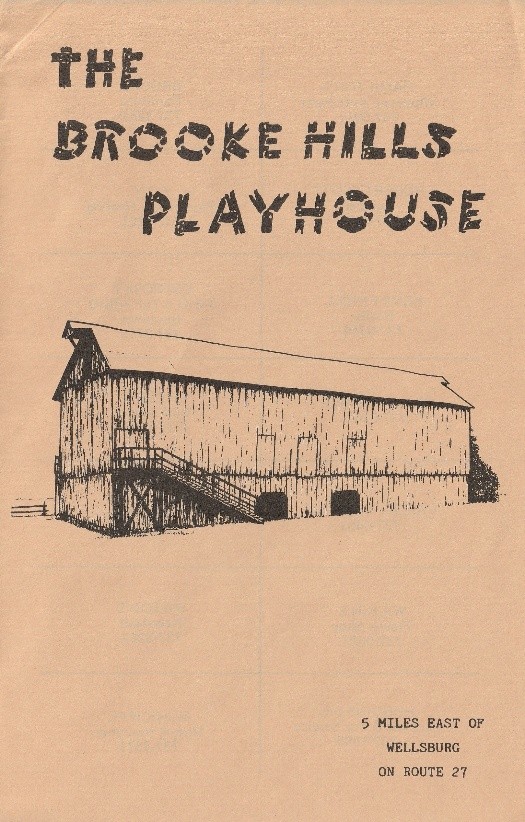
KICKING OFF THE SEASON AT THE MUSEUM
and BROOKE HIGH SCHOOL
This year we started the season in March with a Murder Mystery Party in the museum. I suppose this was cheating, but I couldn’t write a mystery. I’d buy one of those Murder Party kits, hand out the character descriptions, and our actors would have a rehearsal, asking each other questions, trying to find the murderer. At the party, the audience members received a copy of the “Police Report.” They circulated throughout the room, asked the characters questions and usually took notes, followed up on leads, asked more questions, and eventually wrote down who they thought the murderer was. I think we served light refreshments and beverages.
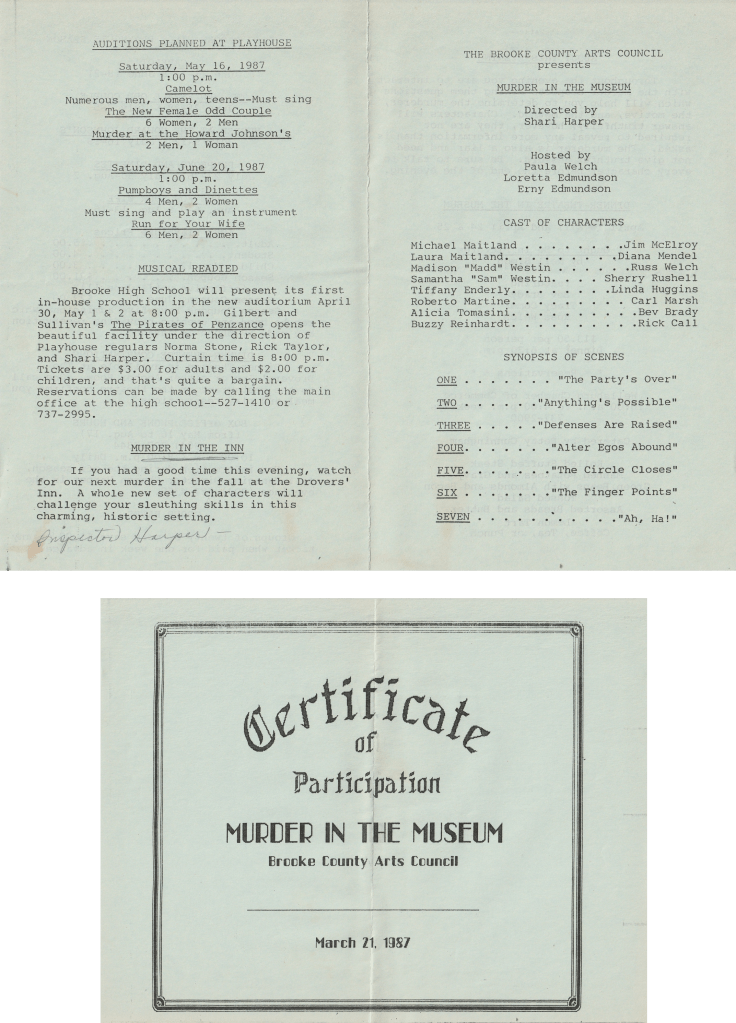
Everyone at the party received a Certificate of Participation, and those who solved the case received a Super Sleuth Certificate and some complimentary Playhouse tickets! We did these parties at the Museum, once at the Playhouse, up and down the valley for organizations, and several times in private homes for people who hired our troupe for the evening. We didn’t make a fortune, but every dollar came in handy! Besides, these Murder Parties had no royalty, scenery, costume, or property costs, and the cast got to eat and drink as well as the participants!
This was the spring when the auditorium at Brooke High opened. Norma Stone (director), Rick Taylor (musical director), and I (designer/tech director) had been putting on shows with the high school kids for a number of years (somewhere around 1977) on the small stage at Follansbee Middle School or the huge stage/basketball court (cross my heart and hope to die!) at Wellsburg Middle School for years, and both were horribly inconvenient. We were cramped at Follansbee (and there was no way to enter the stage on stage right, ugh!), and in Wellsburg, we had to move the scenery onstage for rehearsals and off stage afterward because the next day’s gym classes were held on the stage/ball court. Both situations were taxing and exhausting.
But finally in April 1987, the auditorium at Brooke High was nearly ready to be used. We rehearsed using the work lights, because the stage lighting control board hadn’t arrived, so there was no way to bring the stage lights up and down. The county’s Director of Maintenance was aware of the situation, and he knew when our play, The Pirates of Penzance, was scheduled to open. Unfortunately, he didn’t seem to care.
I called the lighting company and learned that the board had been sitting in Bellaire, Ohio, about 20 miles away, waiting several days for delivery to be arranged. While Norma held rehearsal, Rick and I drove to Bellaire and picked up the light board. We “borrowed” a table from one of the cafeterias and set up the board in the light booth. We borrowed a ladder from the janitor and focused the stage lights. I showed the two kids who were going to run lights for the operetta how to run the board, took them through the lighting cues which were marked in a script for them to follow, and we were ready for the first of two tech rehearsals the following day. Whew! That had been too close for comfort!
Of course, the Director of Maintenance was not the least bit happy with us, and Rick and I received stern reprimands stating we were close to insubordinate. Quite honestly, we would have done it again, if it was needed, to get the show on.
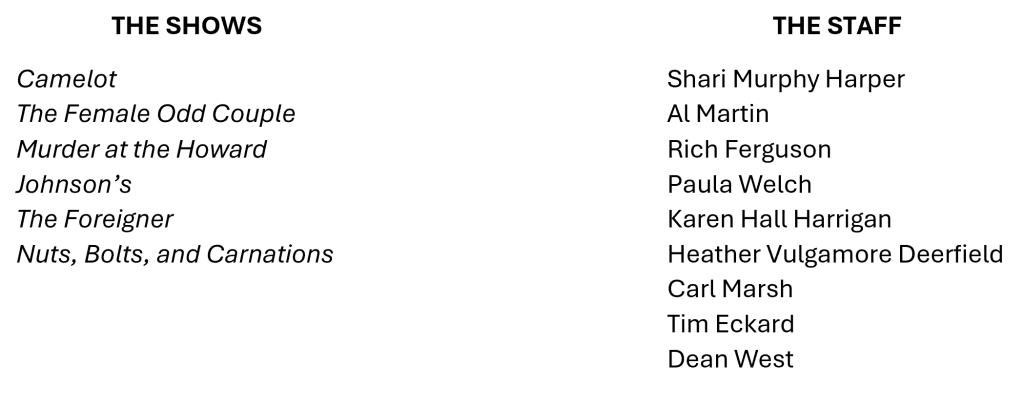
1987 was the season we finally wised up and scheduled a five-show season with each show running two weeks. We had one less set to build and paint, one less batch of props to buy, gather, or build, and one less wardrobe of costumes to buy, gather, or build, also. This was easier on the crew and saved us quite a bit of money.
Several of our audience faithful commented that they loved the 5-show schedule. They hated having to miss a show that only ran one week because they had lots going on or were out of town. With every show running two weekends, most loyal season coupon holders never missed another show!
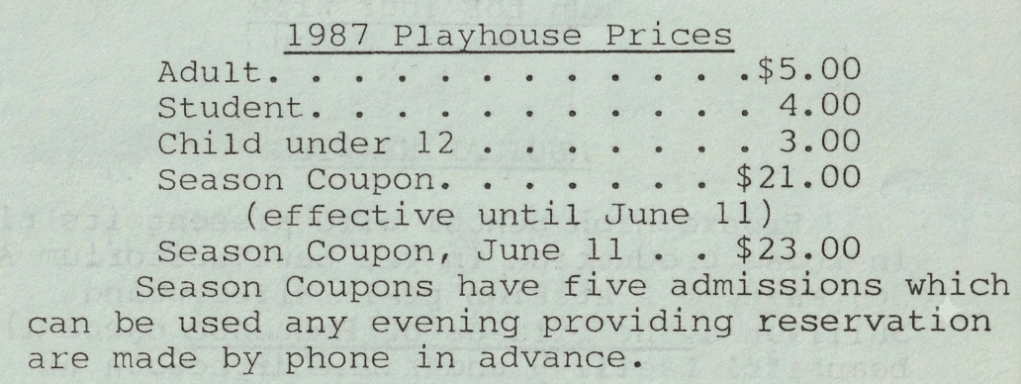
It’s hard to believe we could meet all of our production expenses, the staff salaries (our college kids, no adults were paid), and publicity costs with ticket prices, program ads, and a few donations, but we did.
The staff was compact, but they were wonderful. Heather, Carl, and Tim were back for their second season. Even though Al Martin’s second wife Betty stopped joining us for the summer after the 1985 season, Al continued to come and direct at least one show and build and paint scenery worthy of a Broadway stage. He was always an inspiration and a great teacher for our young college staffs. Karen had been hanging out and volunteering at the Playhouse since 1980 when she was cast in Oklahoma! Her first summer on the staff was in 1985, and she became our designer and tech director in 1986. Richard had been with us since our 1972 opening season, as had I, so this was a very seasoned and competent crew. Richard had a full-time job at West Liberty, and he was in several shows each season until 1982, when he also started directing a show each summer.
I have no recollection of why we didn’t do a second musical this season. Maybe that was part of the 5-show experiment, but we quickly put a small-cast musical back in the schedule for 1988.
BEGINNING WITH A BANG
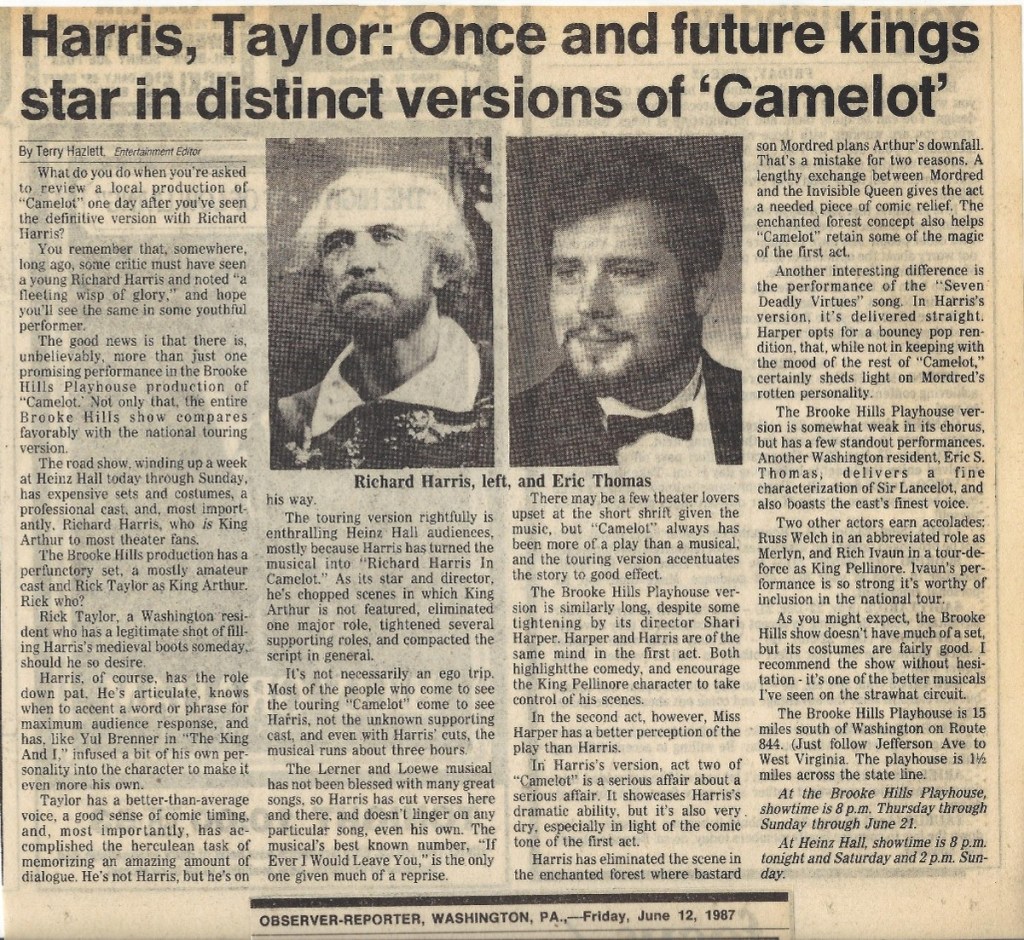
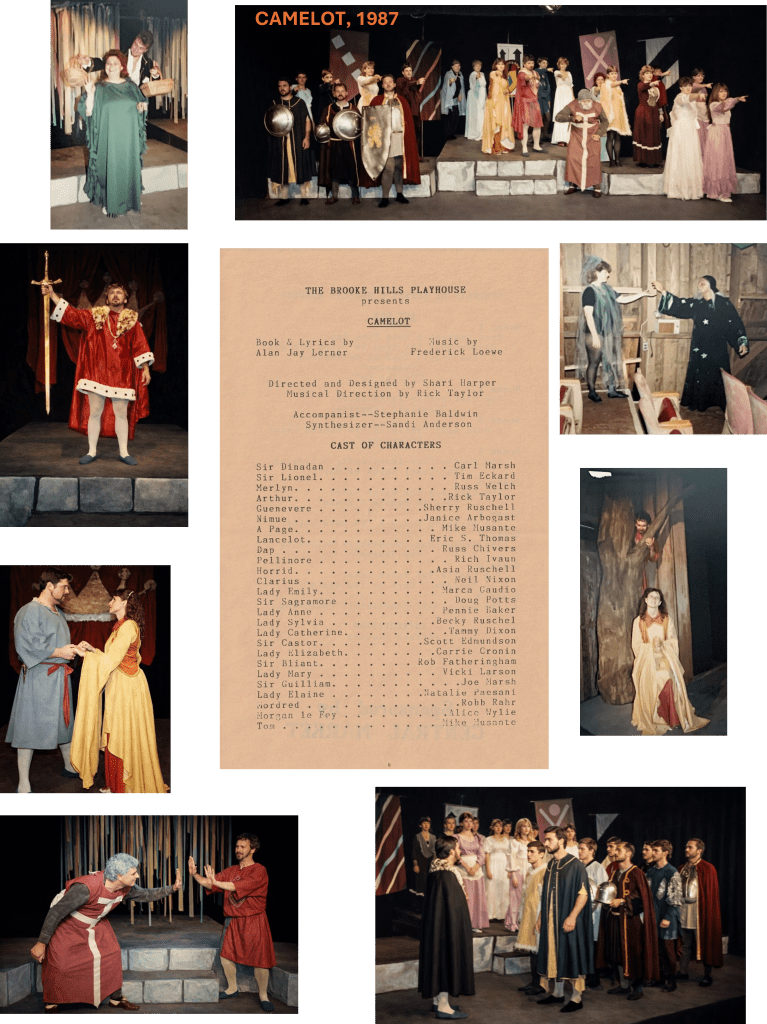
Who knew that bringing a medieval court to a stage in an old barn would be so popular, but we hit the jackpot when we opened the 1987 season with Camelot. We had sell-outs night after night. [NOTE FROM SHARI: It was so tempting to write “knight after knight,” but I didn’t succumb!] It was exhilarating! BUT the very best thing was the review we received from the critic at the Washington Observer, a guy who also reviewed the big stage shows in Pittsburgh. His review was so wonderful that it is the only review I kept (even had it laminated!) over the decades. Since I’ve started this memoir, people have shared their scrapbook photos, press releases, and reviews with me, but I kept the Camelot review from the day it was published. And it was a shocker! You can see why for yourself.
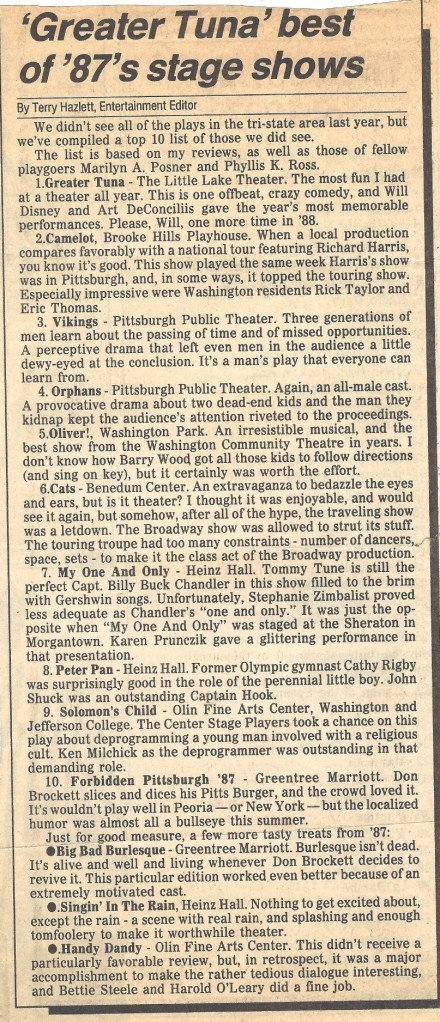
At the end of the season, the same reviewer published a list of the 13 best shows he’d seen in 1987, not just the summer seasons around the area, but all year. Our Camelot was #2! Holy smoke! It’s a good thing the list was published at the end of the year. My big head could hardly fit through the wide doors of the Playhouse!
Camelot was followed by The Female Odd Couple (Broadway debut 1985) which, like the show it was based upon, The Odd Couple (Broadway debut 1965), was equally funny. Actually, The Female Odd Couple may actually be funnier than the original. On one of the New York City trips sponsored by the Playhouse, we had seen the female version on Broadway with Sally Struthers (prissy) and Rita Moreno (slob). Everyone on the trip thought we should do the show at the Playhouse as soon as the rights were released, and we did. Bev Brady played the prissy character, and Sherry Ruschell played the slob. Jane Daugherty, Alice Wylie, Tammy Dixon, and Heather Vulgamore Deerfield played the card players, and Charlie Calabrese and Carl Marsh played the hysterically funny Hispanic brothers who attempt to date the two leads. It was a wonderful cast, and the production did gangbuster business on the heels of the super popular Camelot. Sadly, we’ve found no photos from the production.
Murder at the Howard Johnson’s, our third offering for the season, was described as “a light-hearted suspense comedy that centers on a love triangle,” as opposed to an out-and-out murder mystery. First, a wife and her lover attempt to murder her husband. In the next scene, the wife and husband plot to kill the lover, and finally, the husband and lover decide to murder the wife. Each attempt is funnier than the one before. Ineptness can produce a lot of hilarity.
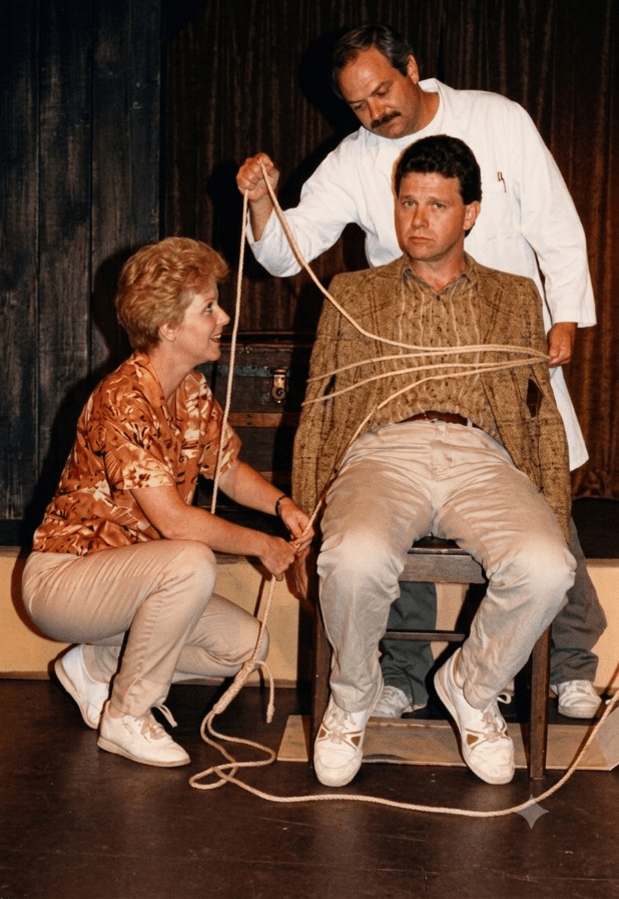
Murder at the Howard Johnson’s, 1987
Karen Hall, one of our “can-do-anything staffers,” was the tech director for the summer, but she also directed The Foreigner, a comedy about a shy guy named Charlie who just wants to be left alone at the fishing lodge where he’s staying with a friend. He pretends to be unable to speak or understand English or any other reasonable foreign language. Of course, because others at the lodge think he can’t understand anything, Charlie becomes privy to all sorts of secrets, and things get crazy. The show has been produced by high school, college, amateur, and professional theatres all over the country. I can honestly say that our production had the audience holding their sides and gasping for breath while laughing!
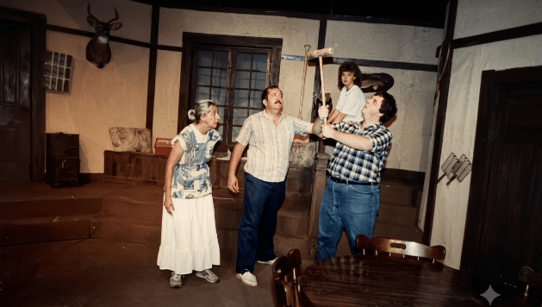
Russ Chivers, pictured above, had a very vivid memory of the show. “At some place in the show,” said Russ, “my character had to disappear through a trapdoor. Heather Vulgamore was the stage manager. She would climb down under the floor from backstage to trip the trapdoor. One night, I wasn’t standing in exactly the right place, and I just missed falling on Heather instead of the mattress!”
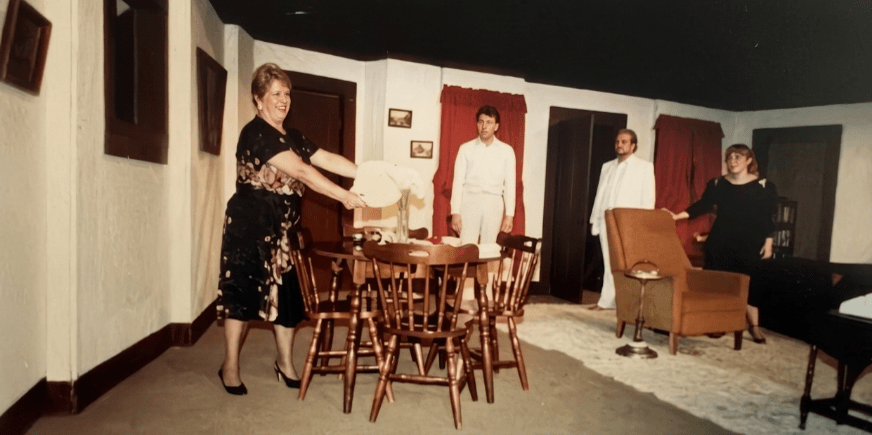
The final show, Nuts, Bolts, and Carnations, was a cute little comedy about the repercussions that resulted when a wife sends her husband, an auto mechanic, a bouquet of flowers at his garage. Although funny, it wasn’t the strongest way to end a season.
Matz Malone of the Steubenville Herald Star reviewed the show. After praising each actor in the cast (those in the photo and Heather Vulgamore Deerfield), he wrote, “Director Richard Ferguson has taken a mediocre vehicle, at best, and has come up with an entertaining and pleasant production. The cast of local thespians is talented and has fun with the material, which tends to offer area theatergoers yet another entertaining evening at the barn theatre.”
NEIL NIXON REMEMBERS
“In 1987, I was so down. My beloved mother was sick, and everything was hard. Then out of the blue, Paula Welch, a dear friend, suggested that I audition at the Brooke Hills Playhouse. Paula knew I could sing, and she reminded me that she always laughed at my jokes. Then her husband Russ chimed in and said I should give it a try.
“Sometime in June, the Playhouse held auditions. I went out to the barn and watched what was going on. Paula and Russ were both there, and Paula came up to me and said something like, ‘Just get up there and sing and read.’
“I turned in my audition sheet, and my name was called. I was used to being in front of people, so I wasn’t very nervous. I just did what director Shari Harper told me to read (with a few other people), and then I sang for musical director Rick Taylor.
“That evening, the Playhouse called to tell me that I’d be playing a character named Clarius in Camelot. Basically, I was in the chorus, but I did escort the elderly, comic but very loyal, Sir Pellinore. It was a great experience, great music, great cast, and Shari reminded me that we got a great review from the critic at the paper in Washington, Pennsylvania.
“I was hooked. The next summer I auditioned again. This time I was cast as a bumbling Indian, a Native American, called Chief Hihawaya. (There’s a joke there. Say it slowly.) It was a much larger part, and I’d never heard of the show, so I was a little skeptical. My second thoughts in that week between auditions and the beginning of music rehearsals were dispelled when I read the hilarious script. Rehearsals began, and the music was lively and clever and very funny. Every member of the cast was crazy and talented. Rehearsals were a blast!
“In truth, the Playhouse saved me. Life was difficult at this time. My mother was still sick, but I got a small break from worry in that old barn. The Playhouse gave me purpose and strength. I got back into a good mindset, and I found a new love—acting and singing at Brooke Hills. From then on church and the Playhouse sustained me. I will be forever grateful.
“My big number in Sgt. Fenshaw was a great comic song called ‘Would I Lie to You?’ The unsung answer was ‘Of course!’ It was so much fun! One night, when I made a big gesture, the head of my tomahawk flew off and up into the rafters. It got caught on something and never came down! One of the girls in my tribe laughed so hard that she wet her pants and had to leave the stage!
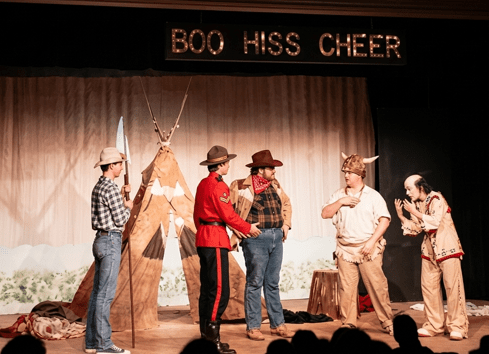
in Sgt. Fenshaw of the Mounties, 1988
“Over the years, I was in numerous Playhouse productions—Sgt. Fenshaw of the Mounties, The Return of Sgt. Fenshaw, Oliver, The Sound of Music, The Music Man, My Fair Lady, and others.
“In 1991, I played Captain Von Trapp with Emily Vulgamore as Maria in The Sound of Music. At the end of the show, during the reprise of ‘Climb Every Mountain,’ I was supposed to put the smallest Von Trapp daughter up on my shoulders and carry her up a ramp and offstage. I couldn’t do it. I just didn’t have the strength. Fortunately, the understanding director changed it so I could hold her little hand as we walked together up the ramp and off to cross the Alps. It’s little things like that which make Brooke Hills so special for me.
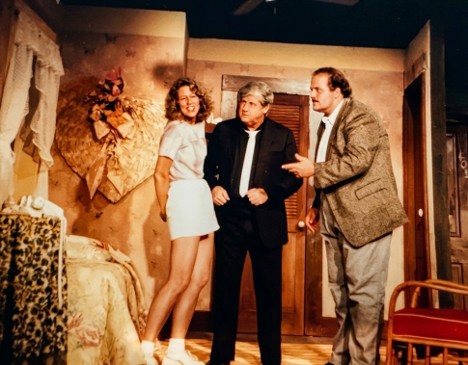
“Over the years, I was in numerous Playhouse productions—Sgt. Fenshaw of the Mounties, The Return of Sgt. Fenshaw, Oliver, The Sound of Music, The Music Man, Bottoms Up!, and others. My Fair Lady, in 1993, was my final show.
“In 2021, the Playhouse celebrated its 50th anniversary season. Part of the celebration included a musical review. Heather Vulgamore Deerfield and Emily Vulgamore Hores put the show together with help from many of their Playhouse friends. They told the Playhouse story with memories and songs from each of the five decades. I was so grateful to be asked to participate. I sang ‘Edelweiss’ and messed up a little, but the audience was very kind. Maybe they didn’t notice. Maybe it didn’t matter.
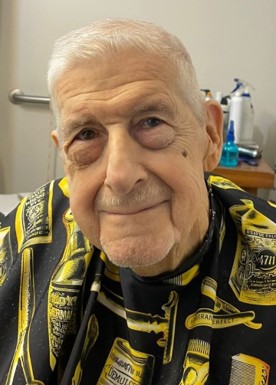
“I turned 91 last December (2023). Shari, thank you for asking me to share my Playhouse memories. May today’s Playhouse folks keep up this wonderful, caring ministry for years to come. To all those who serve today and throughout the Playhouse’s history, I love you.”
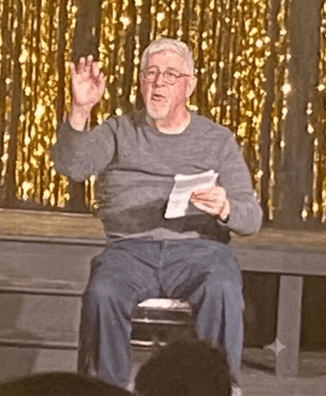
Neil H. Nixon Obituary
Neil Herman Nixon, 93 years old. He was born December 23, 1932, to the late Lenora Nixon (Treiber) and William E. Nixon of Wellsburg, WV. Neil passed away peacefully at Golden Oaks in Follansbee, WV on May 14, 2026.
He served in the Army during the Korean War in France. He taught music and art, was a guidance counselor, and a school administrator. After retiring from education, he worked for Brooke County Probation Office, Victims Assistance Program, was a longtime lay minister for the Community of Christ, was involved with Brooke Hills Playhouse musicals and plays, and also played a Johnny Apple Seed character who visited schools and fairs, spreading seeds and gospel.
He was preceded in death by the love of his life, Carol Jean (Dickson) Nixon, and his brother Charles Nixon. He leaves behind three children: Teri Foster (Doug), Steve Nixon (Jill), David Nixon (Melanie), five grandchildren, three great-grandchildren, and two nephews.
A private family memorial service will take place in the future.
ALFRED de JAAGER REMEMBERS
Al de Jaager grew up in Ridgewood, New Jersey, one of New York City’s bedroom communities. Only about 20 miles from the city, Ridgewood had train lines running through the community. Al said, “I attended grades 1-12 there, and my musical outlet at the high school was as the organist in the school orchestra. I was also a singer in my church choir. Our home was often filled with music, both popular and classical. My father was gifted with an extraordinary musical ear.
“My first exposure to theater was when my parents took me to NYC to see Victor Borge’s one-man show. We were in the front row, and it was hilarious. My high school put on plays. I don’t remember being overly impressed. Of course, I didn’t know that one day I would be involved in the theatre.”
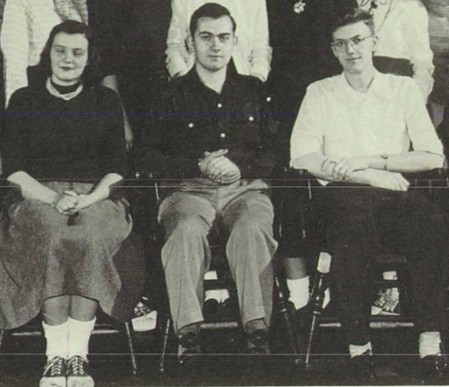
Following high school graduation, Al attended the Oberlin College Conservatory of Music in Oberlin, Ohio. “It was quite an eye-opening experience,” said Al. “There were many international students, and many different religions were represented. It was there that I met my first atheist. We became good friends. I also began to realize that my hometown was racist. Oberlin was, for 1953, a very open community. A number of couples of interracial marriages resided there.
“After graduation from Oberlin with a BMus in pipe organ performance, I joined the Army. Getting a job without having served in the military was difficult. Employers were hesitant to hire you because, if you were drafted, they had to rehire you upon your release from the military.
“My first day in the Army was quite interesting. I went through an enlistment center close to home with a group of men. We were put on a bus to Fort Dix, New Jersey. There was a heavy snowstorm that day, so it was slow going for the bus. I think it was between 9:00 and 10:00 p.m. when we arrived. Everything was dark! The electricity was out. They had to feed us, so we were ushered into a dark mess hall where we could see cooks working by candlelight. Dinner was a fried egg sandwich—perhaps enriched by a bit of eggshell or a drop of candle wax.
“Then we were marched to a ‘dorm’ to sleep. Remember: no electric=no heat. The next morning, we were marched to the mess hall for breakfast and then back. Because there was no electricity, they could not issue us uniforms, and therefore, they could not put us to work. We could look out the window and see soldiers clearing the snowy streets using short, collapsible entrenching tools!
“A couple more days of back and forth, and then ELECTRICITY. We were issued all our clothing, boots, etc., and then taken for our shots, many shots. Finally, we were assigned to companies for Basic Training.
“Basic Training was an 8-week lesson on how to put up with harassment. Fortunately, the nation was at peace. I’m sure it could have been much rougher. After graduating, we were given a two-week leave, and following that, most were to return for their next 8 weeks of training.
“I was fortunate. My test scores had me marked HAP (high aptitude), so I was to report to the First Training Regiment Chapel at Fort Dix to begin work as a Chaplain’s Assistant. I’ll skip ahead several weeks to when I was appointed director of the Regimental Chorus AND the Regimental Band. I’ll just say that this had me working seven days a week. The two groups alternated rehearsals. One rehearsed on Monday, Wednesday, and Friday afternoons, while the other rehearsed on Tuesday, Thursday, and Saturday mornings. The band often ended up with the Tuesday, Thursday, Saturday schedule as we played for the graduation ceremonies for other companies in our regiment.
“While I was in the Army, a friend suggested we go to New York City one day and see a couple of shows. We saw Beyond the Fringe and A Funny Thing Happened on the Way to the Forum. I loved them both!
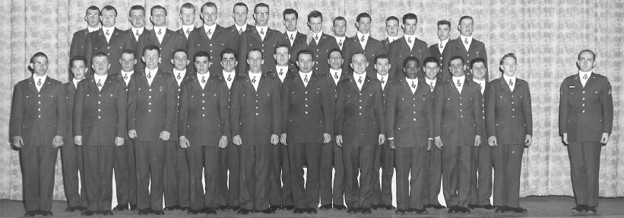
“There’s lots more that could, or shouldn’t, be said about my time in the Army, but I’ll just mention this one thing. My chorus (pictured above) was chosen to perform on the Kate Smith Show, so conducting all of those auditions was worth it. We went into NYC for the taping.” [NOTE FROM SHARI: Kate Smith, a big woman with an even bigger voice, was a huge recording star, radio star, and then TV star with her own variety show. For 50 years, from 1926 to 1976, she was one of the most popular entertainers in America. Her biggest song hits were ‘God Bless America’ and ‘When the Moon Comes over the Mountain’ During WW II, she raised more money for the war effort than any other performer. Being on the Kate Smith Show was a very big deal!]
“After the Army,” continued Al, “I was employed as Minister of Music at the First Presbyterian Church of Winchester, Virginia. The work schedule was overwhelming: organist for all services, director of five graded choirs and an adult choir, and a couple of Mr. Music appearances each week at 4- and 5-year-old classes in the church’s weekday kindergarten program. I also taught the organ students for the Shenandoah Conservatory of Music, which had just relocated to Winchester.
“I was busy, but I knew I had to learn more. I was impressed by the faculty recital by a new piano professor at Shenandoah. Talking with her, I learned that she had just completed her Master of Music degree at West Virginia University. Morgantown was not too far from Winchester, so I looked into it. I took a leave of absence for part of the summer and went to M’town.
“At the entry test, there were five of us: four young ladies who had just graduated from college and me, who had been out of college for 5½ years. I was the only one with no deficiency courses to take. Thank you, Oberlin. Then I met with the head of graduate studies to plan my courses. There were none that applied to my degree in the first term. But not all was lost.
“There was a visiting professor, I believe his name was Frank Kirby. His book on early keyboard music had just been published, and it was nice to study with someone who had everything at the tip of the tongue. The next summer, I studied with Hugh Ross, director of the New York School Cantorum. What a brain he was!
“I had a three-year assistantship, so, finishing the Master of Music in church music the first year, I decided not to return to the church in Winchester, but to work on a Ph.D. in Music Theory. Also, I had become organist-choirmaster at Wesley Methodist Church, sometimes referred to as the University Church in Morgantown.
“The pay was two-thirds that of the Winchester church, but I only played one service and conducted one choir. And what a wonderful choir it was!
“While attending WVU, I had occasion to befriend the sister of a friend of a friend. Talking with the young lady and her brother, they asked what I would be doing the next year, 1966. I told them I was going to be teaching at West Liberty State College, my first full-time teaching position. They asked if I knew Stanley Harrison, one of the school’s drama teachers. I did not. They said that I had to meet him. More about Stanley shortly.
“I don’t know what I was expecting when I started at West Liberty. At my audition/interview, the only member of the music faculty was the department chair. I knew one of the others from a class at WVU. I did not get to hear a choir or meet any students.
“Because there was a concert organist scheduled that evening, I could not play my audition on the college instrument, but rather on an electronic instrument in the President’s home. I was taken to College Hall to look in. There was a woman seated at the console, a light on in one of the pipe chambers, and the sound of someone, the organist, attempting to get a pipe in tune. OMG! A smart person would have gotten in his car, never to return.
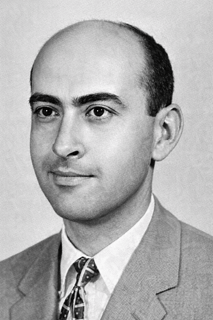
“Things got better, but not all at once. You can’t blame students if they have had poor instruction. But I eventually got past that.
“The first attempt at a choir tour was a disaster. A WVU friend had become choir director at Glenville State College and suggested we do exchange concerts. I presented the idea to Dr. Wolf, Department Chairman. His response was, ‘We can do that.’ That meant that the choir and band could go.
“There’s no use digging up bad memories or telling horrible tales of someone no longer with us. I’ll just say that the concert was fine, but it would be a couple of years before we could tour again.
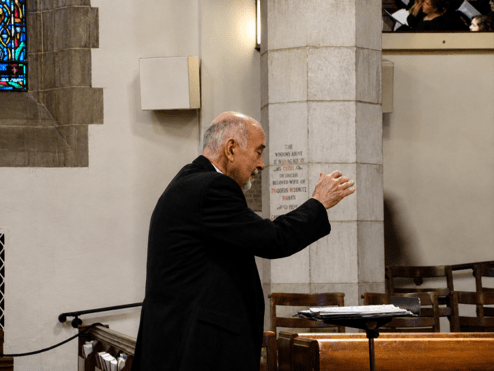
“Our first major tour was to EXPO Seattle. We traveled by train, leaving from Pittsburgh and changing in Chicago on the way out. We performed well, but the EXPO had just recently opened, and attendance had yet to catch on.
“Later, I established Spring Tour during the 10-day period following commencement. The first few days would include concerts at high schools, an occasional middle school, and churches close enough that we could return to home base. Some of the final destinations were: Chicago, Asheville, North Carolina, Washington, D.C., NYC, and Baltimore. Other enjoyable stops on the way included: Winchester, Virginia and Shepherdstown, West Virginia, along with a few other places.
“In my first few days at West Liberty, I did meet Stanley Harrison, and we quickly became friends. My first year at West Liberty was also the first year the Hall of Fine Arts was open. West Side Story was to be the first musical in the new theater. It was scheduled for late in the second semester. Bob Kreis, Conductor of the Wheeling Symphony and an acquaintance of mine from Oberlin days, was to be the music director.
“Stanley had been doing that for a few years, hiring members of the Wheeling Symphony Orchestra to play in the pit for musicals. West Side Story required a large pit orchestra at quite an expense. An actor from NYC was hired to play the part of Tony, and that meant more money. I was asked to do some vocal coaching with Tony. I also helped a bit with the chorus numbers. This was quite a breakthrough, as the Theater Department had little use for the Music Department after a bad experience with some students playing in the pit for previous shows.
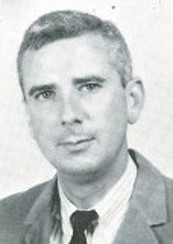
“The next year, the musical was Irma la Douce. Again, a NYC actress was hired to play Irma. Again, I was asked to do much-needed vocal coaching. I think Irma may have been hired for her dance skills.
“The following year, the musical was The Sound of Music. I think this may have been Bob’s last year with West Liberty. He wanted to do everything himself. From then on, I was music director for most of the college’s musicals. Money became less plentiful, and I was able to incorporate music students and faculty into the pit orchestras. I believe I was involved with a total of 29 shows.
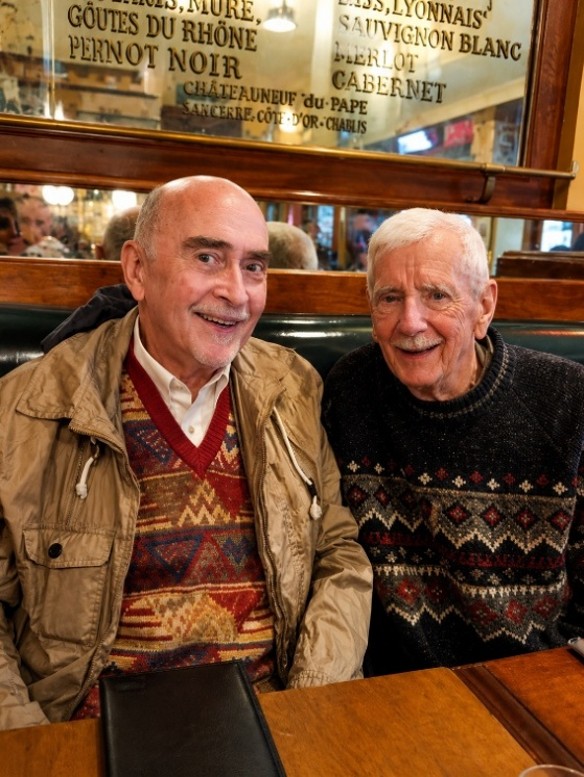
“As I mentioned earlier, Stanley and I became friends rather quickly. He and Bob Kreis had become friends through working together, but I think the expense of hiring Bob and the union musicians began to take a toll.
“After Stanley left West Liberty for NYC, I continued with a very good relationship with John Reilly, who took Stanley’s place as head of the theatre. When John was on sabbatical, I worked with Fran Schoolcraft, the drama teacher at Wheeling Park High School, who was directing in his place. Working with Fran was my choice as I had enjoyed working with her on three musicals at Wheeling Park. Later, there was another director who was filling in during a sabbatical, and the show was Working. He seemed very inexperienced and quickly became known for the words, ‘I lied.’ That meant he was going to change something.
“I also worked with Terry Allen. Sweeney Todd should have been my favorite, but technical issues made every performance a nightmare. I always enjoyed Man of La Mancha, but, honestly, I enjoyed the finished product of every show. Perhaps there was one exception, which I don’t need to name.
Back in 1972, Stanley asked me to recommend an accompanist for the opening show, You’re a Good Man, Charlie Brown, of the soon-to-be Brooke Hills Playhouse. I had no qualms recommending Mary Catherine Brehm (now Alodi) as we had worked together on many shows. I remember that she often brought Kristen, her daughter, with her to rehearsals.
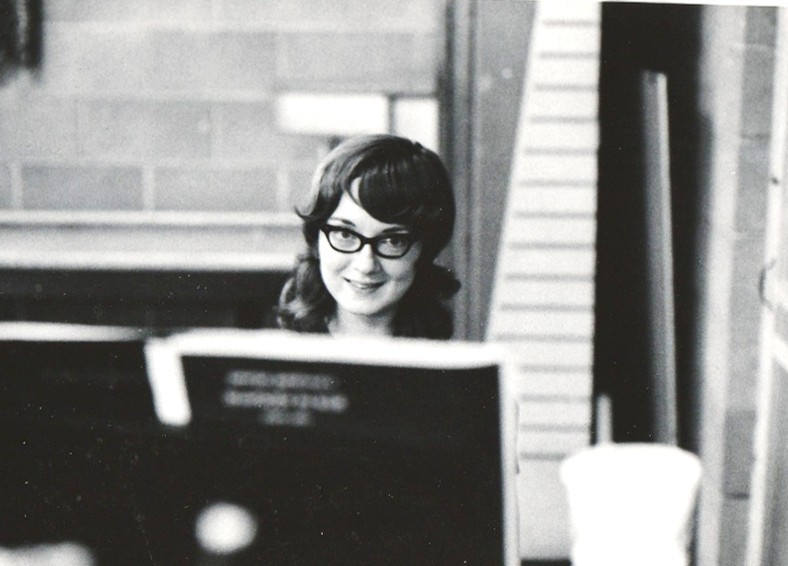
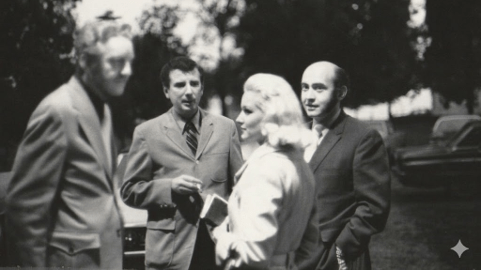
“I have no memory of who invited me to be the musical director of Oklahoma! in 1980 at Brooke Hills. I am sure it was a West Liberty connection, as I had been pretty successful with the college’s musicals by that time. I do remember going to the Playhouse, looking around, and thinking, ‘This is going to be interesting.’
“I had a two-piano version of the Oklahoma! score. The questions became: where can we put two pianos, and where do we get a second piano? I had worked with Bruce Ensinger many times before. He loves to accompany and continues to do that in his retirement. Julie Peteschel as second piano was a find. Good fingers, great attitude, hard-working. They were great together. I don’t remember where the second piano came from!
Holding auditions at the barn was a great experience and completely different than auditions at West Liberty. At West Lib, I already knew most of the people. At the Playhouse, I hardly knew anyone. The age differences were also interesting. I did not like being required to use someone because of their position. Using a non-singer in a role that requires solo singing made no sense to me, and during every performance, I just hoped the person would get through that number.
“So, auditions were interesting. If a person brought no prepared selection, I often asked them to sing something like ‘Happy Birthday.’ One boy said he didn’t know that. Next, I asked for ‘My Country, ‘Tis of Thee,’ but he didn’t know that either. Then someone let me know that it had to do with religious beliefs. ‘OK,’ I thought. ‘Maybe he can sing some scales on a neutral syllable.’ He had a nice young bass voice. He was in. “Once the cast was selected, they were very open and willing to do whatever I suggested. It was great fun watching them come together. Everyone was proud of the final product, including the audiences.”
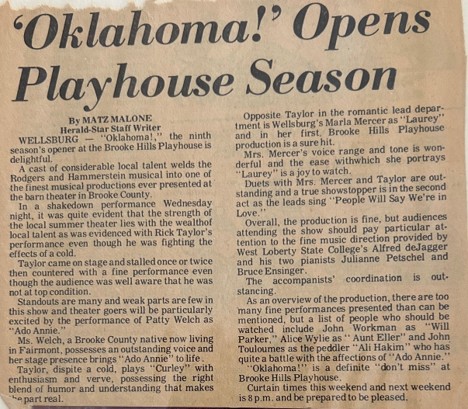
Working at Brooke Hills was a good experience for me. I really enjoyed the people. It was amazing to see how much could be achieved with very little. What the crew could create on that stage was impressive.”
[NOTE FROM SHARI: Over the decades, many of Al’s students appeared on the Playhouse stage, and we reaped the benefit of the musical training they received from Al. Although there were too many to name, the talents of Al’s students made a significant contribution to the Playhouse’s success.]
“In 2014, after 48 years at West Liberty, I retired. I think I could have done two more years, but Southeast Asia was calling. I retired at the end of the academic year in May. I had packed up, sold off, or given away all of my worldly goods and was in Cambodia in early June.
“When I started at West Liberty, things in the academic world were in a state of flux. I think the list of jobs I saw on the bulletin board at WVU included about 23 positions. Not all were faculty. A school like West Liberty State College, now West Liberty University, was just used as a stepping stone. In my first three years, I was offered two other positions, one in Ohio and one in Missouri. Either would have paid more, but neither really was quite right for me.
“Besides, I felt I was doing some good at WL. These students had so much to learn.”
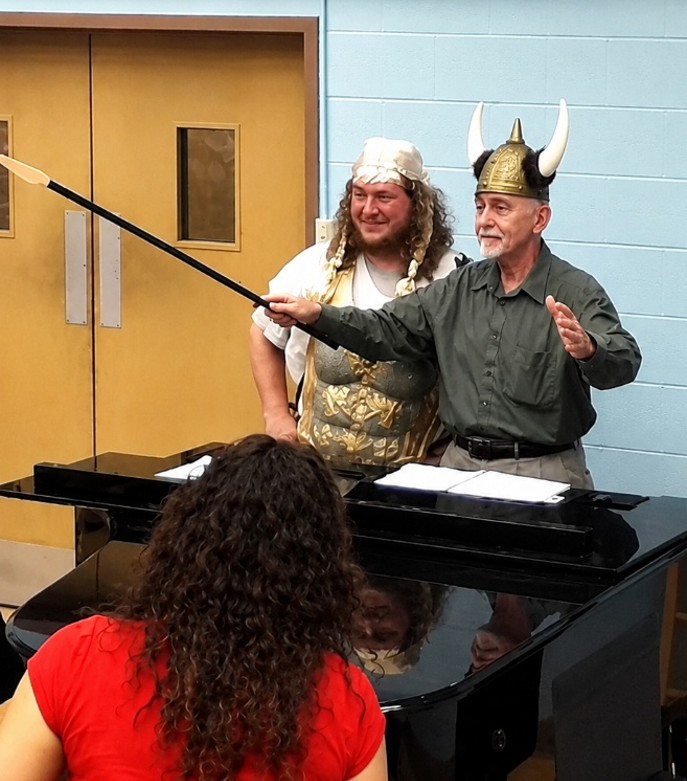
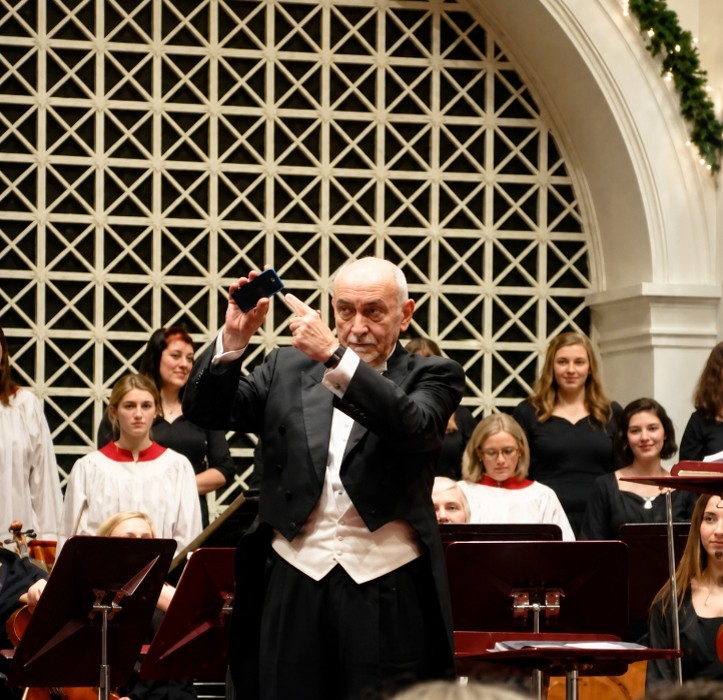
enjoying a lighter moment during a concert
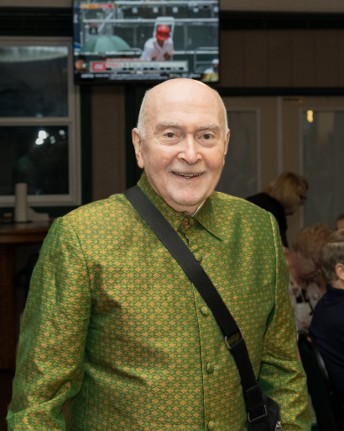
DEAN WEST REMEMBERS
“Shari, do you remember the first job you gave me when I arrived at the Playhouse for my year as an official member of the staff?” asked Dean. This is how our chat to catch up with each other after a lapse of 40 years began.
Of course, I had no idea.
“You sent me up on the roof of the barn with Greg Myers to fix the corrugated steel roofing. Some pieces had been pulled loose and slipped down, and some had been blown up and folded over. We put them back into place and screwed them down.”
I sat in stunned silence for a moment. I must have been crazy! It was 1986, and Dean had just graduated from high school. Greg was an ironworker who often worked on the construction of tall buildings, and he was an adult! I didn’t have the courage to ask Dean if he had told his parents what I’d ask him to do. I didn’t want to know!
“I think I threw my clothes and stuff for the summer in one of the travel trailers, my new home, and you sent me up on the roof. We didn’t even have the theater seats uncovered!
I had known Dean for years. He was in my class for the gifted, and then I had him in 7th grade language arts. By 1986, he had been volunteering at the Playhouse for two summers. His little brother Keith was in Snoopy! in 1984 and Fiddler on the Roof in 1985. Keith was too young to drive, so Dean would drive him to and from rehearsals and performances.
“One day in early 1984, I was sitting on one of the pews in the lobby waiting for Keith. Karen Hall had been spattering flats which she had lying out in the yard. She was cover in paint splotches from head to foot, and she asked me to help her carry in the flats. Technically, that was my first job at the barn, but not as a staff member, as a volunteer.”
Over the years, we were so fortunate to have great, young staff members, hard-working, dedicated, fun-loving, but serious about putting on a good show. Some of our staffers just wanted to act, but that would never happen. Everyone worked tech—building, painting, gathering or making props and costumes, hanging and focusing lights, occasionally stage-managing or serving on the running crews, whatever needed to be done. Any staffer could audition, and many were cast, but when they weren’t in rehearsal, they still had to work. They had very little free time, and I never could figure out when they learned their lines. Only rarely did I see any of them with a script! Dean had no desire to be on stage. He worked strictly on the tech side, and he was good at it. He was a natural with tools, and honestly, some of the kids arrived for the summer not knowing which end of a hammer to hold, the difference between a flathead and a Phillips screwdriver, or how to use a tape measure! They learned. Dean had been in the Service and Maintenance track in the vocational department at Brooke High School, where he worked with his mind and his hands for the two years before his Playhouse summer. He had great carpentry skills, how to wire an outlet or a lamp, and maybe how to replace the guts in a toilet tank! Sadly, since he was never on stage, we have no photos of Dean from his summer at the barn. [NOTE from SHARI: After his Playhouse summer, Dean attended Jefferson Technical College and graduated with an associate degree in Metallurgy and Metallography. Dean told me, “Both my high school track and my college degree have served me well during my whole career.” When he started his first job in the real world, not a Playhouse summer, he went to work for Wheeling-Pittsburgh Steel as a millwright and didn’t have to serve an apprenticeship. More about the scope of Dean’s career later.]
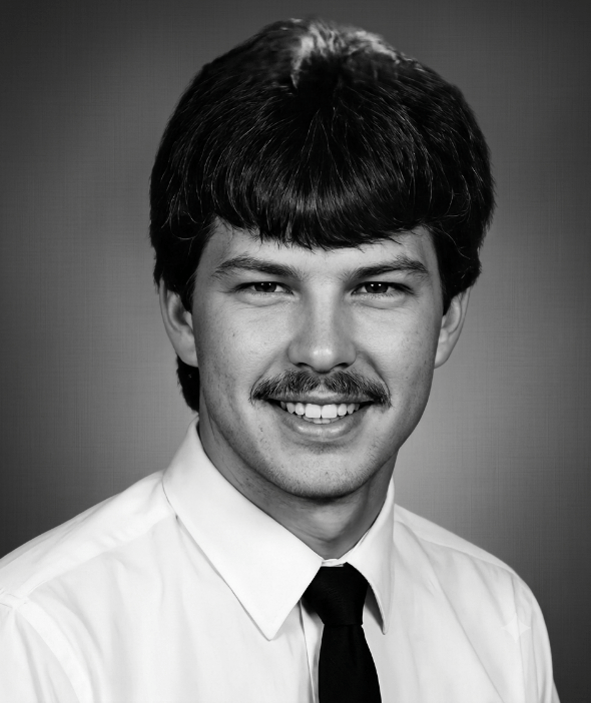
“Actually,” Dean said, “I did try out for a show once. My friend Carl Marsh was auditioning for H.M.S. Pinafore. He had auditioned before. I didn’t know what I was doing or anything about the show. The director asked me to sing something, but I didn’t know it, and he quickly said, “No, you won’t do.” And that was the end of that. Carl got a part!
“We worked long hours,” said Dean, “but we had fun, too. We had great cast parties. Carl, one of my best friends to this day, was also on the staff. Carl wrecked my Toyota Celica that summer. He had borrowed it to attend a funeral, and he got t-boned. He told Shari he was afraid to return to the barn and tell me what had happened. I was just happy he wasn’t hurt.”
“We also learned some things that were very practical. During one strike night, Carl was securing a piece of scenery by toenailing the rail at the base of a flat, and the wood split. Shari called me over to where Carl was nailing. ‘Here’s a nifty little trick,’ she said. ‘before you nail near the bottom of a board, turn the nail upside down and give it a few hits with your hammer on the tip, so it’s dull. For some reason, with that dull tip, the nail doesn’t split the board.’ Very handy!
“Another one of my early memories was spending time talking to Al Martin and seeing his sign which read, ‘We fix flats,’ nailed to the barn above the arch to the lobby on the pool-side of the barn. Sometimes I’d tell people, ‘I help fix flats.’ Not flat tires, stage flats.
“Al always stopped work at 5:00 p.m. and fixed himself a Manhattan. We were talking during cocktail time once during the run of Murder at the Howard Johnson’s. Al had directed it.
“Al said he always removed any swearing in the shows he directed. He felt it wasn’t necessary, but out of all the shows he’d directed over the years, he couldn’t get around the swear word in Ho Jo’s.
“In the show, which took place in a hotel room, Russ Welch’s character ended up outside on a ledge. When he finally re-entered through the window, he had a big white splotch on his jacket’s shoulder, and he announced, ‘A pigeon shit on me!’ Big laugh every night.
“Another memory was during Camelot. Rick Taylor was playing King Arthur, and near the end of one scene, he was one stage alone and had to hold up this long, heavy sword with one hand. I was running lights. Every night I could see him looking at me out in the light booth, saying with his eyes, ‘Turn off the darn lights!’
“Heather Vulgamore was on the staff, and she had claimed a storage shed the guys in the Brooke High Vocational Department had made. [NOTE from SHARI: When the well-built and nicely painted shed was offered for sale, I offered $750 for it. After a few weeks, one of my fellow teachers got someone to bring the heavy shed out to the park and place it on treated 4”x4”s behind the barn for prop storage, which we always needed more of. Haha on me. Heather claimed the shed for her living space and moved in a bed, table, lamp, clothes rack, and I don’t know what else before it ever stored one prop! Of course, all of her furnishings were claimed from the other prop storage areas.] The other guys on the staff and I loved to bang on the side of the shed and listen to Heather shriek!”
As I mentioned earlier, following Dean’s summer at the Playhouse, he started school at Jeff Tech and then went to work for Wheeling-Pitt. In the late 1980s, Wheeling-Pitt went on strike for a long time, and Dean left for a job at National Steel in Granite City, Indiana.
I love this part of Dean’s story. While Dean was at Jeff Tech, he met Theresa Sullivan from Jewitt-Scio, Ohio, and he asked her out. For their first date, he took Theresa to the Drover’s Inn for dinner and a show at the Playhouse! Now, that was a great first date! They married on May 28, 1990.
Dean and Theresa have three grown children: twin girls and a boy. Deana is a designer for the works for the Creegan Company in Weirton; Aerika is a social worker in Tulsa; and Evan works in research and development for Zeeco, a Tulsa-based company serving the gas and oil industry. Dean and Theresa have 5 grandchildren, all girls.
After some steel companies merged, Dean eventually left the steel industry, and in 2008, he went to work for Markwest, a small oil and gas company in Allegheny and Washington Counties in southwest Pennsylvania. At Markwest, he maintained the equipment that processed the raw natural gas and made it usable to consumers. When Markwest was taken over by the huge Marathon Oil with its thousands of employees, Dean looked around for something
else. In 2019, he joined Cherokee Measurement & Control in Tulsa, Oklahoma. “We have 36 employees. I’m the head of the Service Division and have four guys under me, so we’re 14% of the company! Basically, we maintain the equipment that measures the flow of gas through a company’s pipelines.”
Today, Theresa and Dean have a lovely home in Tulsa, and Dean’s mother Sally lives with them. When we talked, I asked Dean to say, “Hi,” to his mom. I think I should have asked him to tell her, “Thank you for sharing Dean and Keith with the Playhouse for so many summers!”
WINDING DOWN THE SEASON
During the last two weeks of the season, the crew ran the evening show, cleaned out storage areas, started packing up the tool room, and built a set for a show we planned to do in the museum in the spring of 1988.
The curtain came down on the 1987 season on the evening of Sunday, August 16. Of course, we didn’t have a curtain, but we had had a good season with a great crew.
After the final performance of Nuts, Bolts, and Carnations, we struck the set and stored the flats and the door and window units in the hall outside the kitchen on the barn’s first floor. The stage lights were taken down and stored with all the cables under the seating platforms at the back of the house. By now, we had purchased an electric piano, and I think that was taken to Brooke High for use and winter storage. The light board, hand tools, and expensive hinges and hardware were packed into my car to be stored at my house. Our two big saws, a radial arm saw and a table saw, gifts from the senior Harpers for Bill and my wedding back in 1972 (dissolved by divorce in 1981), were securely chained to one of the big upright barn posts near the kitchen.
On Monday, the crew secured the barn’s upstairs windows and doors with 2”X4”s and metal pipes. The Heather Shed was locked up along with the shower under the ramp and the outdoor entrance to the dressing room. The pews and cable spools that were always in the lobby were moved to the kitchen. The staff packed their belongings and headed home or back to college.
Shortly after school started in September, our group started reading scripts to prepare us for choosing the 1988 season.


